
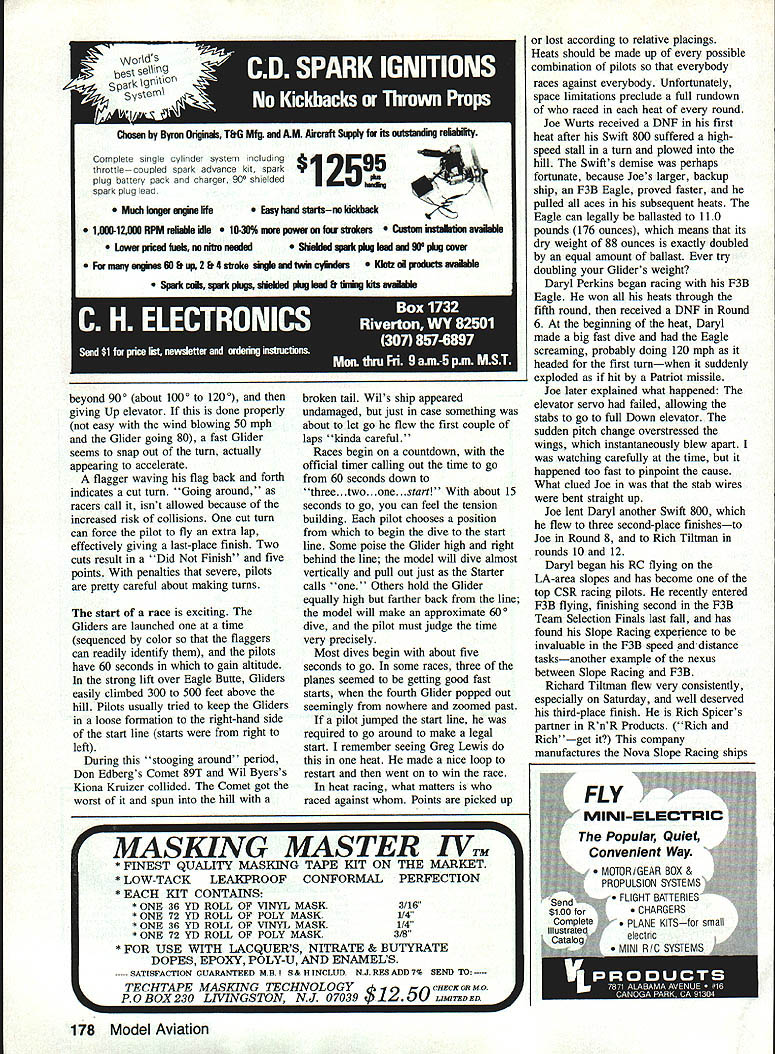
Mid-Columbia Slope Races
Overview
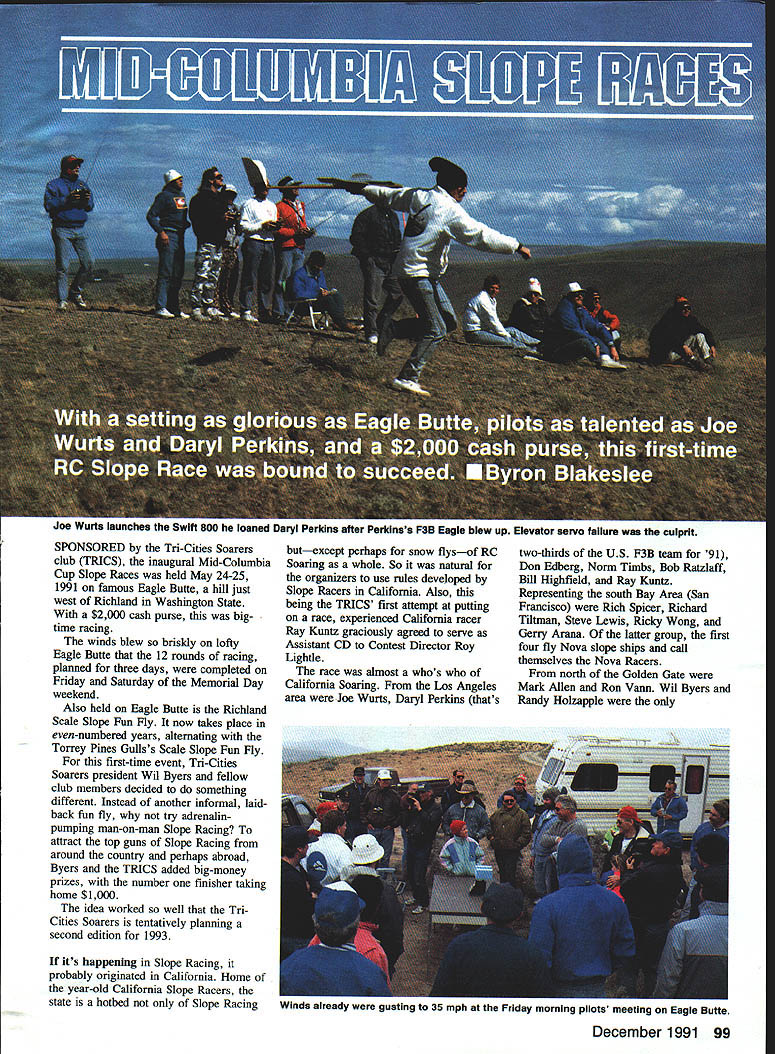
Sponsored by the Tri‑Cities Soarers (club TRICS), the inaugural Mid‑Columbia Cup Slope Races were held May 24–25, 1991, on Eagle Butte, a hill just west of Richland, Washington. With a $2,000 cash purse (first prize $1,000), the event attracted top slope racers. Twelve rounds of racing were planned over three days, but brisk winds allowed completion on Friday and Saturday of the Memorial Day weekend.
Also held at Eagle Butte is the Richland Scale Slope Fun Fly, now scheduled in even‑numbered years and alternating with the Torrey Pines Gulls' Scale Slope Fun Fly.
Tri‑Cities Soarers president Wil Byers and club members chose man‑on‑man slope racing (heat racing) to attract top competitors. Because the club was new to running such a race, experienced California racer Ray Kuntz served as Assistant Contest Director to Contest Director Roy Lightle, and the organizers adopted rules developed by the California Slope Racers.
Competitors
The entry list included many top American and international pilots:
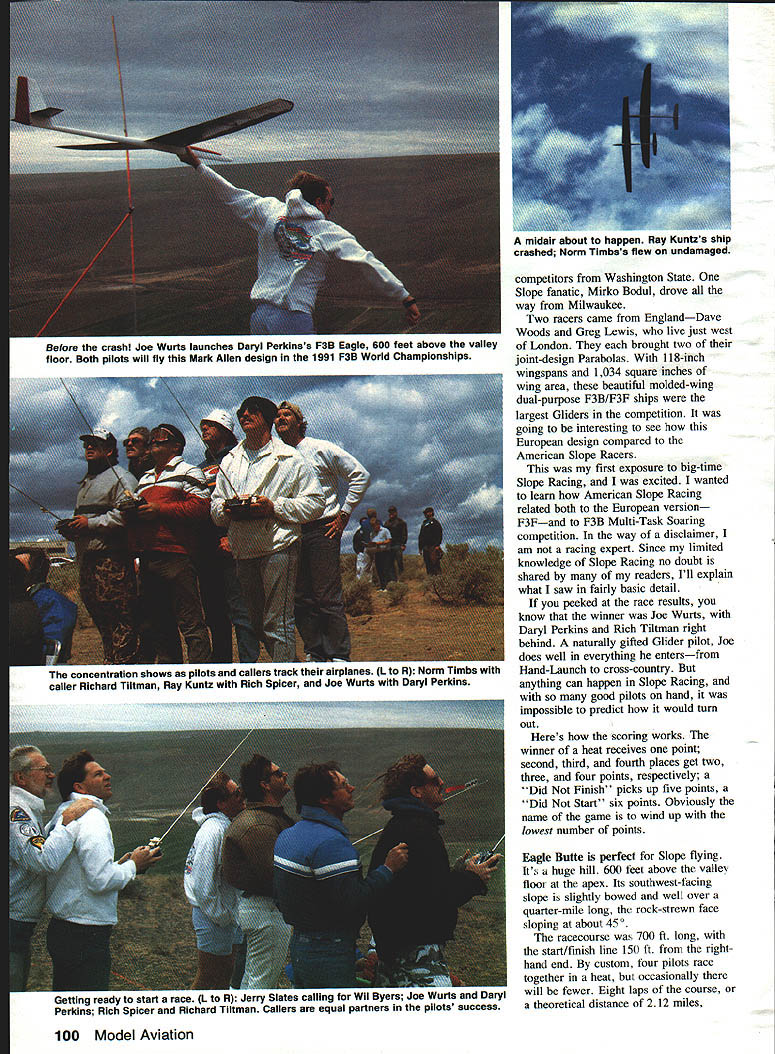
- From the Los Angeles area: Joe Wurts, Daryl Perkins, Don Edberg, Norm Timbs, Bob Ratzlaff, Bill Highfield, Ray Kuntz.
- South Bay / San Francisco area: Rich Spicer, Richard (Rich) Tiltman, Steve Lewis, Ricky Wong, Gerry Arana (the first four fly Nova slope ships and call themselves the Nova Racers).
- From north of the Golden Gate: Mark Allen, Ron Vann.
- Local Tri‑Cities entries: Wil Byers, Randy Holzapple.
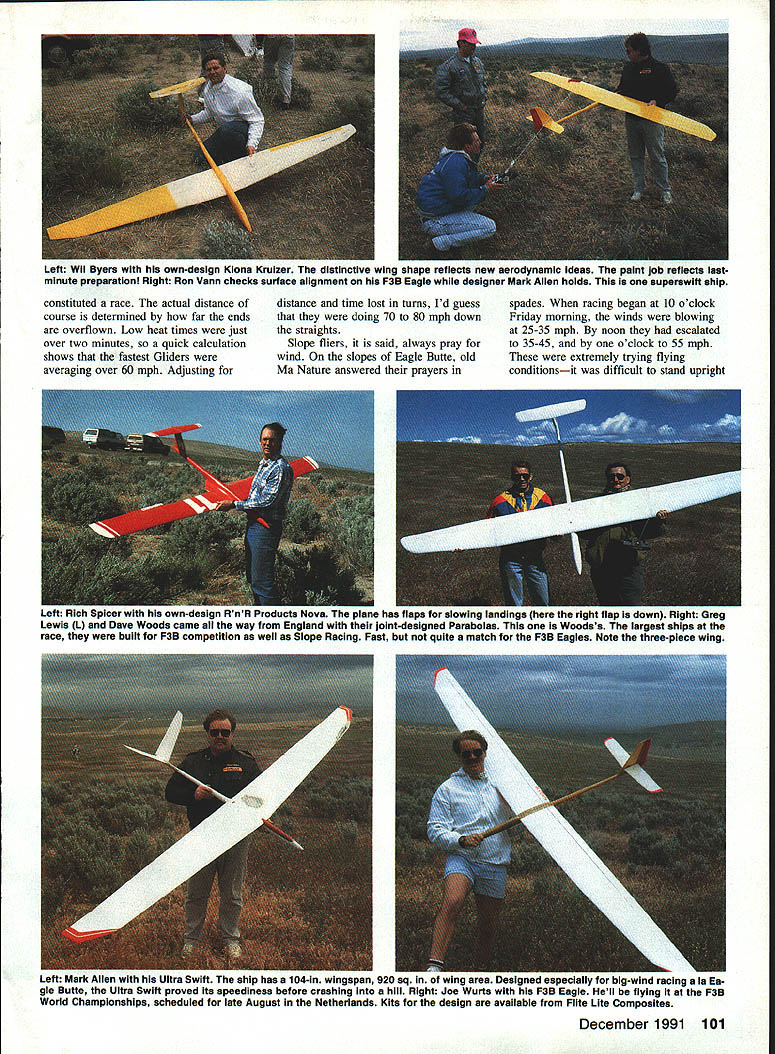
- International: Dave Woods and Greg Lewis (England), who brought two joint‑design Parabolas (118‑inch wingspan, 1,034 sq in wing area).
The Europeans brought large, molded‑wing dual‑purpose F3B/F3F ships, providing a comparison with American slope racers' equipment.
Scoring
- 1 point — first place in a heat
- 2 points — second place
- 3 points — third place
- 4 points — fourth place
- 5 points — "Did Finish" (DNF)
- 6 points — "Did Start" (DNS)
Lowest total points wins.
Course and Conditions
Eagle Butte is about 600 feet above the valley floor, with a southwest‑facing slope slightly bowed and more than a quarter‑mile long, the rock‑strewn face sloping roughly 45°.
- Racecourse length: 700 ft.
- Start/finish line: 150 ft. from the right‑hand end.
- Heat format: four pilots per heat (occasionally fewer).
- Race distance: eight laps of the course (theoretical total about 2.12 miles, counting the back-and-forth).
Wind conditions:
- Friday: 25–35 mph in the morning, 35–45 by noon, and up to ~55 mph by 1:00 pm — extremely trying conditions.
- Saturday: generally 20–25 mph, sometimes 30 mph — ideal for racing.
Low heat times were just over two minutes; fastest gliders averaged over 60 mph, and adjusting for turns suggested 70–80 mph down the straights.
Equipment and Ballast
Pilots ballasted gliders heavily in strong winds. FAI rules limit glider gross weight to 5.0 kg (11.023 lb) or 24.52 oz per sq ft of lifting surface (total wing and stabilizer area), whichever comes first.
- Example: a minimum area to reach 11.0 lb gross weight is about 1,035 sq in.
- Many successful F3B Eagles had ~940 sq in wing area + 100 sq in stabilizer area; these proved fast at Eagle Butte.
- Smaller ships were disadvantaged in winds above ~30 mph: although meeting the weight-per-area limit, their gross weight was lower (7–10 lb), and in this type of racing, weight functions like horsepower.
- Heavily ballasted gliders make landings hazardous; impacts often break components.
Race Procedures and Roles
- Pilots stand shoulder to shoulder just behind the start/finish line.
- Four flaggers (one per color) are stationed at each end of the course; the end is defined by two poles at right angles to the course (one at the edge of the hill, the other 20 ft back).
- Before each heat, each plane is assigned a color and shown to flaggers so they can identify it.
- Each pilot has a helper called a caller. The caller launches the glider, stands behind the pilot during the heat, and alerts the pilot to turns and other tactical actions. Pilots credit callers as equal partners in success.
Start procedure:
- Gliders are launched one at a time, sequenced by color. Pilots have 60 seconds to gain altitude; in strong lift gliders climbed 300–500 ft above the hill.
- Pilots usually keep gliders in a loose formation to the right of the start line.
- Countdown from 60 seconds to "three…two…one…start!" creates tension. Pilots choose dive profiles to cross the start line at or just after the start; jumping the line requires going around for a legal start.
Turning Technique and Penalties
- By the rules, turns must always be made away from the hill: right turn on the left end, left turn on the right end.
- A typical turn involves rolling and snapping the model through a 180° turn while watching for traffic. Advanced technique can include rolling beyond 90° (about 100°–120°) and then easing elevator to snap out quickly; done correctly this can appear to accelerate the glider.
- A flagger waving a flag indicates a cut turn. "Going around" (skipping the prescribed turn direction) is not allowed due to collision risk.
- Penalties:
- One cut turn can force a pilot to fly an extra lap (effectively a last place).
- Two cuts result in a "Did Not Finish" (5 points).
Notable Flights and Crashes
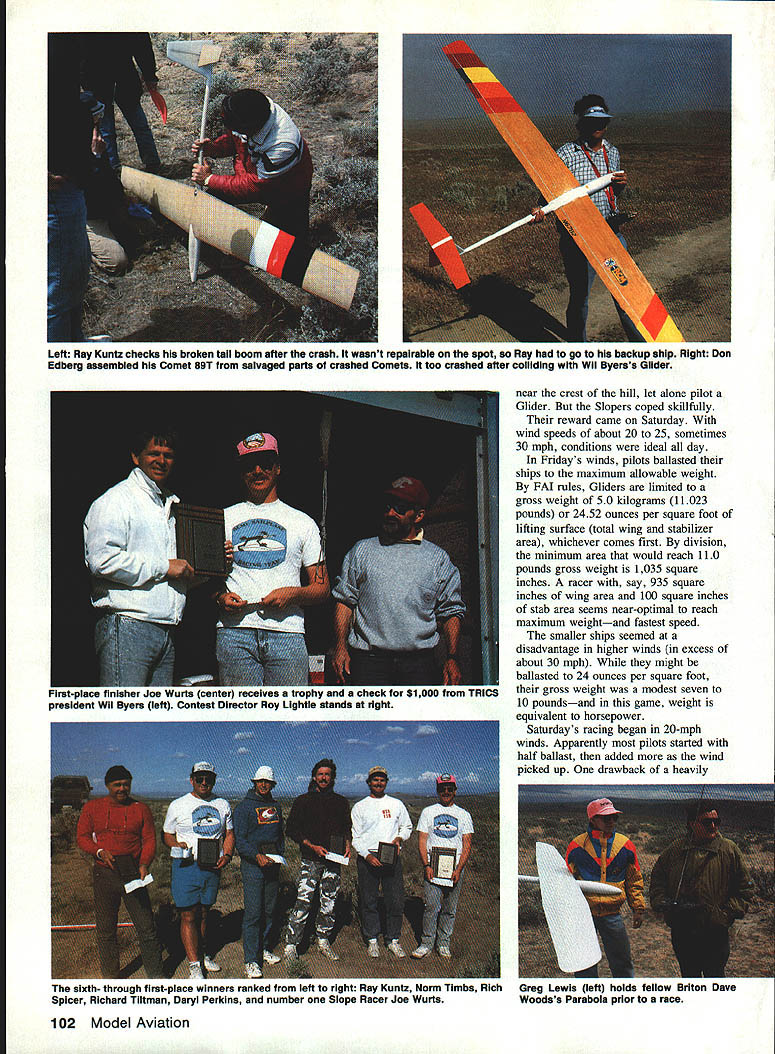
- Midair collisions did occur. Ray Kuntz's ship crashed in one incident; Norm Timbs' ship caused a midair but flew undamaged.
- During pre‑start "stooging around," Don Edberg's Comet 89T and Wil Byers' Kiona Kruizer collided. The Comet broke its tail and struck the hill; Wil Byers' ship appeared undamaged.
- Joe Wurts suffered a DNF in his first heat when his Swift 800 experienced a high‑speed stall in a turn and impacted the hill. His backup F3B Eagle proved faster for the rest of the contest.
- Daryl Perkins had a catastrophic structural failure in Round 6: after a very fast dive the stabilizer elevator servo failed, allowing full down elevator and overstressing the wings until they blew apart. Joe Wurts lent Daryl a Swift 800 for later heats.
- The Parabolas from England were very fast and robust fans of heat racing despite the risk of loss; they were competitive but not quite as fast as the F3B Eagles at Eagle Butte.
Results and Highlights
- Winner: Joe Wurts.
- Runner‑up: Daryl Perkins.
- Third place: Richard (Rich) Tiltman.
- Joe Wurts dominated after switching to his F3B Eagle; Daryl Perkins won most of his early heats before his structural failure and later finished strongly using borrowed equipment.
- Richard Tiltman flew consistently, especially on Saturday, earning a well‑deserved third place.
- Rich Spicer impressed with smooth flying and controlled turns; his Nova tended to fall behind Eagles on the straights but made up ground in the turns.
F3F vs Heat Racing
- Heat racing (four planes simultaneously) is more exciting for spectators and pilots, but it increases the risk of collisions and lost planes.
- Europeans favored timed F3F racing (individual runs on a 100‑m course) to reduce collisions; F3F was moving toward becoming an official FAI World Championship event.
- At Eagle Butte, two factors reduced collisions: a longer than average 700‑ft course that spread planes out, and very strong lift that kept models buoyant. Still, heat racing appeals to daring pilots (mostly Americans), while F3F appeals to more conservative fliers (mostly Europeans).
The Final Heat
The final heat featured Rich Spicer, Joe Wurts, Ricky Wong, and Norm Timbs. Joe needed a third‑place finish or better to secure the contest win. Instead of flying conservatively, Joe engaged in an aggressive duel with Rich Spicer. They were neck and neck for several laps and touched a couple of times in the straights. Rich cut a turn while pushing hard and paid the price. Afterward Joe commented he was glad Rich was such a smooth flier and hadn't flinched when the planes made contact.
Transcribed from original scans by AI. Minor OCR errors may remain.

