
John C. Ballard
Midget Mustang
To be competitive in Goodyear requires more than just a good airplane. Here are the total system details used by the 1975-1976 Nationals winner.
During the late Summer and Fall of 1974, Goodyear racing passed through an important milestone. Prior to that date, competitors spent the majority of their effort with liner and piston fitting on the Rossi, or trying to squeeze an additional 1,000 rpm from the dependable Super Tigre. The 1974 Nationals saw the first racing competitors with tuned exhaust extensions. Some "horns" were short in length and large in diameter, while others were long and slender. For the most part, their actual performance boost was limited to terrifying the competition with noise and visual adornment. The eventual first place winner was, in fact, running "open stack."
During our long trip home, John Kilsdonk and I decided we should investigate using the so-called "horn." We evaluated several different megaphones. These included the standard Rossi model, along with several others that were fabricated based on technical data available for small 2-cycle engines used on motorcycles and go-karts. Obviously, we were favorably impressed with the power gain.
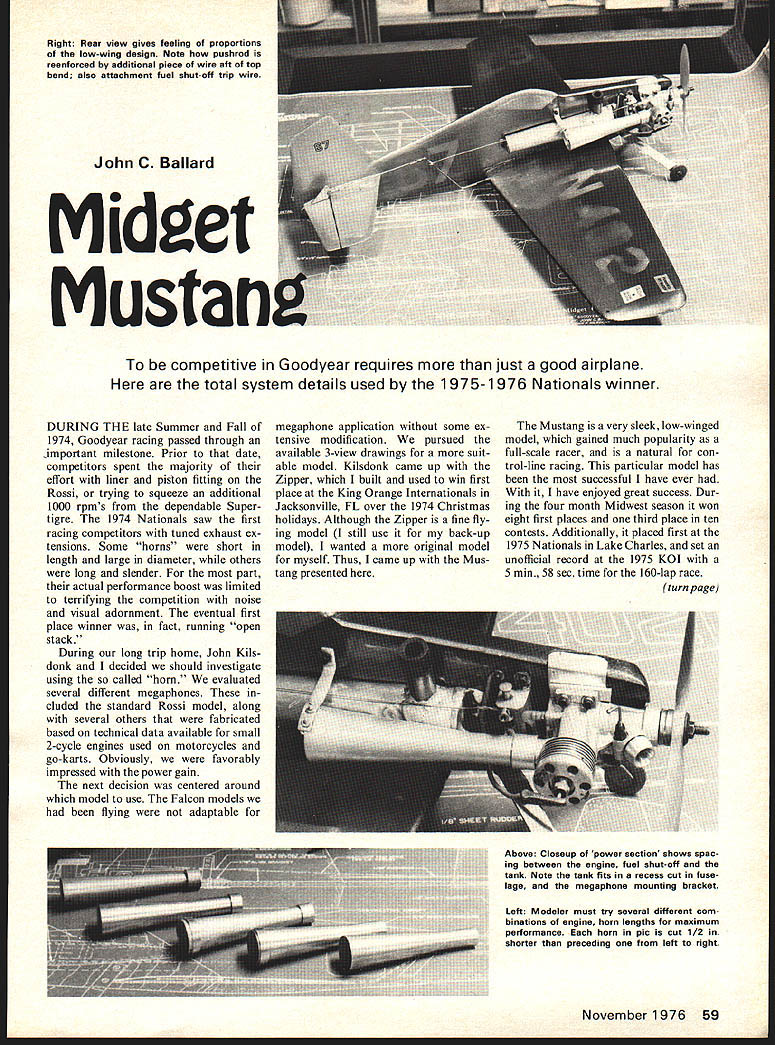
The next decision was centered around which model to use. The Falcon models we had been flying were not adaptable for megaphone application without some extensive modification. We pursued the available 3-view drawings for a more suitable model. Kilsdonk came up with the Zipper, which I built and used to win first place at the King Orange Internationals in Jacksonville, FL over the 1974 Christmas holidays. Although the Zipper is a fine flying model (I still use it for my back-up model), I wanted a more original model for myself. Thus, I came up with the Mustang presented here.
The Mustang is a very sleek, low-winged model, which gained much popularity as a full-scale racer, and is a natural for control-line racing. This particular model has been the most successful I have ever had. With it, I have enjoyed great success. During the four month Midwest season it won eight first places and one third place in ten contests. Additionally, it placed first at the 1975 Nationals in Lake Charles, and set an unofficial record at the 1975 KOKI with a 5 min., 58 sec. time for the 160-lap race.
Purpose of article: acquaint control-line Goodyear enthusiast with the excellent performing model, engine shut-off, propeller, megaphone and fuel tank systems required to produce competitive results.
CONSTRUCTION
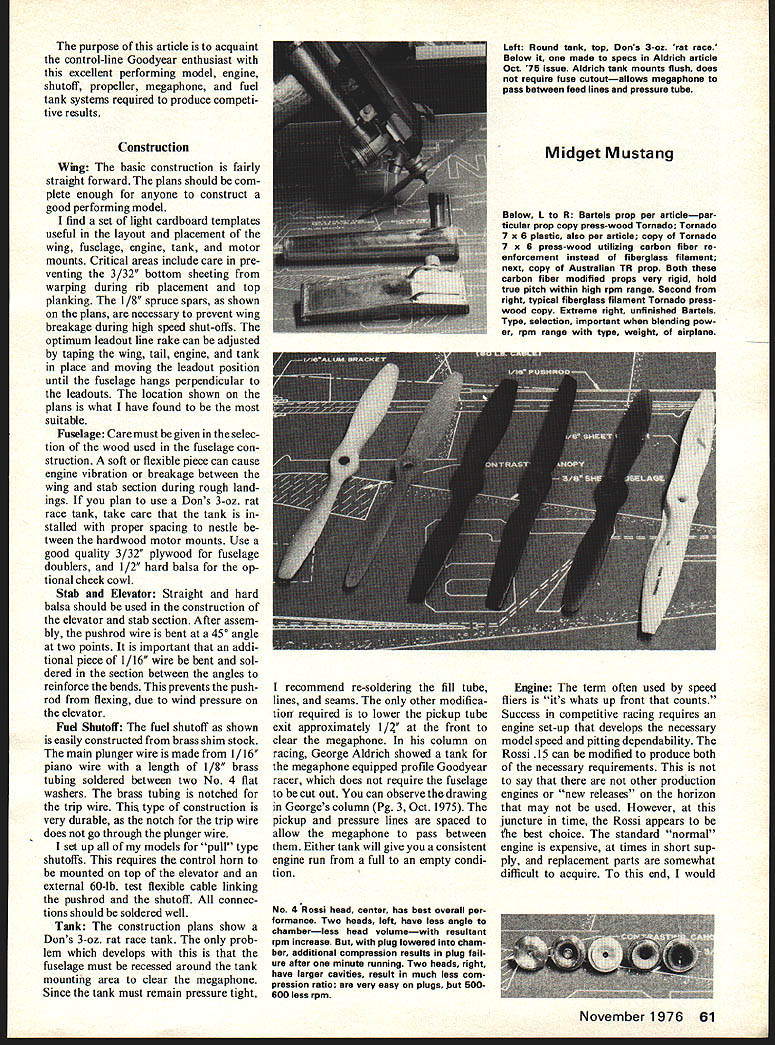
Wing: Basic construction is fairly straightforward. The plans should be complete enough so anyone can construct a good performing model. I find a set of light cardboard templates useful for layout placement of the wing, fuselage, engine, tank and motor mounts. Critical areas include care in preventing 3/32" bottom sheeting from warping during rib placement. Top planking and 1/8" spruce spars shown on the plans are necessary to prevent wing breakage during high-speed shut-offs. Optimum leadout line rake can be adjusted by taping the wing, tail, engine and tank in place and moving the leadout position until the fuselage hangs perpendicular. The leadouts location shown on the plans is what I have found suitable.
Fuselage
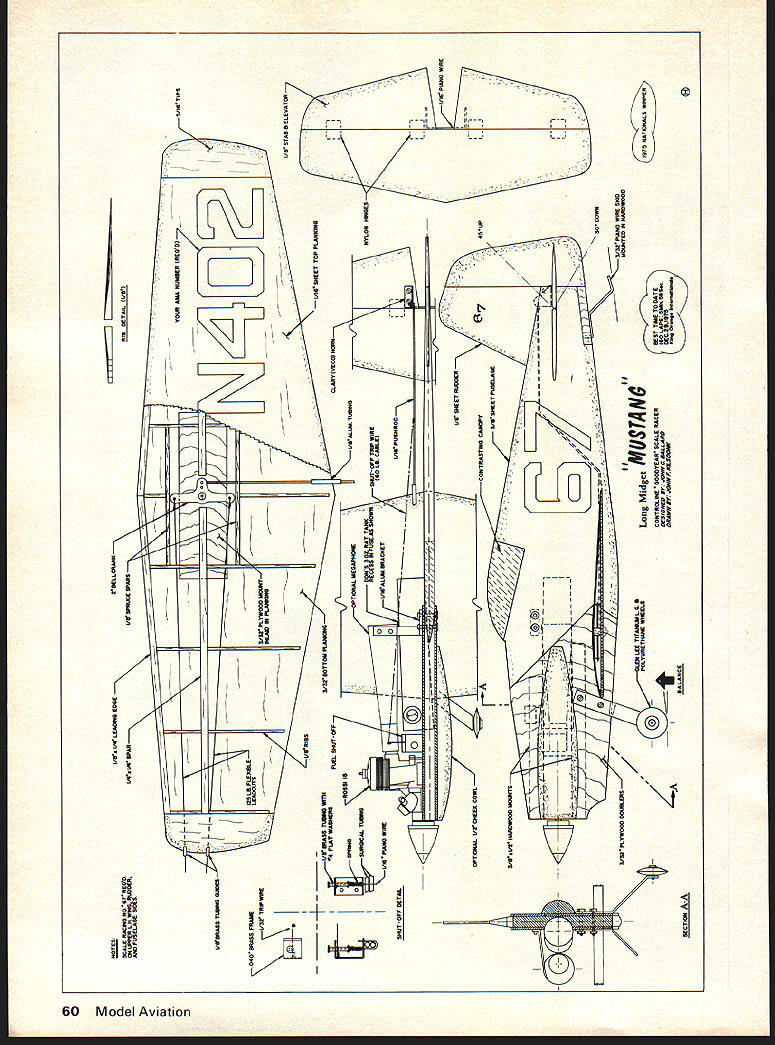
Care must be given to selection of the wood used in fuselage construction. A soft, flexible piece can cause engine vibration and breakage between the wing and stab section during rough landings. Plan on using Don's 3-oz rat-race tank; take care that the tank is installed with proper spacing, nestled between hardwood motor mounts. Use good quality 3/32" plywood fuselage doublers; 1/2" hard balsa cheek cowl is optional.
Stab / Elevator
Straight hard balsa should be used in construction of the elevator.
Long Midget "MUSTANG"
Control-line team scale racer Signed John C. Ballard Drawn by Jon Kilsdonk
Fuel Shutoff
The fuel shutoff as shown is easily constructed from brass shim stock. The main plunger wire is made from 1/16" piano wire with a length of 1/8" brass tubing soldered between two No. 4 flat washers. The brass tubing is notched for the trip wire. This type of construction is very durable, as the notch for the trip wire does not go through the plunger wire.
I set up all of my models for "pull" type shutoffs. This requires the control horn to be mounted on top of the elevator and an external 60-lb. test flexible cable linking the pushrod and the shutoff. All connections should be soldered well.
Tank
The construction plans show a Don's 3-oz. rat race tank. The only problem which develops with this is that the fuselage must be recessed around the tank mounting area to clear the megaphone. Since the tank must remain pressure tight, I recommend re-soldering the fill tube, lines, and seams. The only other modification required is to lower the pickup tube exit approximately 1/2" at the front to clear the megaphone. In his column on the racing, George Aldrich showed a tank for the megaphone equipped profile Goodyear racer, which does not require the fuselage to be cut out. You can observe the drawing in George's column (Pg. 3, Oct. 1975). The pickup and pressure lines are spaced to allow the megaphone to pass between them. Either tank will give you a consistent engine run from a full to an empty condition.
Engine
The term often used by speed fliers is "it's what's up front that counts." Success in competitive racing requires an engine set-up that develops the necessary model speed and pitting dependability. The Rossi .15 can be modified to produce both of the necessary requirements. This is not to say that there are not other production engines or "new releases" on the horizon that may not be used. However, at this juncture in time, the Rossi appears to be the best choice. The standard "normal" engine is expensive, at times in short supply, and replacement parts are somewhat difficult to acquire. To this end, I would
Midget Mustang
recommend that an individual purchase a "re-worked" engine from a competent re-work specialist. There are two in my area that I am familiar with: Mr. Doc Anderson of Anderson Aero Units, 4804 Janet, Sylvania, OH 43560; and Mr. George Aldrich of Aldrich Products, 1317 St., Marie, Mission, TX 78572. You may, of course, want to modify your own engine, but a miscalculation or slip can be very costly.
Engine Re-work:
Modification in several areas of the Rossi will produce a slight performance gain in each. The accumulative result will be a 2000-3000 rpm gain, yet retaining the necessary dependability.
Shaft Timing and Bearings:
It is important that the crankshaft spin freely when assembled in the case with a prop drawn tightly against the thrust washer. Most of the crankshafts received show one at 40° ABC, and close about 55° ATC, or 195° total duration. Opening the closing side to 62° ATC for a total of 202° duration will improve performance. You can go further, but the needle valve adjustment becomes extremely critical, and frequent crankshaft breakage may result.
Piston and Liner:
The single most important factor in producing a "strong" Rossi is the piston and liner fit. The liner must be measured for roundness and taper, and should taper approximately .005 until the last 1/8" before top dead center. I hone the liner round and then bake the piston at 450°F for 3 to 4 hours. Usually, after the piston has cooled to ambient temperature, it will have grown enough to require a hand lapping fit to the liner. Ideally, the piston should drop free to bottom dead center from 1/8" below top dead center. If you plan to utilize the power boost of the megaphone, the exhaust timing of the liner must be modified prior to final lap fitting. A standard timed "normal" has about 143° of exhaust timing. To optimize the megaphone, the exhaust must be filed to approximately 155°-158° duration. To utilize a full length tuned pipe, Rossi modifies the "pipe timed" liners to approximately 162°-168°.
Head Configuration:
Rossi produces several different head designs and each is numbered. I use the Rossi #4 drilled and tapped for a standard glow plug. I have tried numerous designs, but in my high humidity Midwest area, this design is as good as any. The only glow plug that I have found that will withstand severe racing conditions and high nitro is the "Glo-Bee," manufactured by Fusite Division of Emerson Electric Company.
Megaphone:
The standard Rossi megaphone and adapter can be used as a starting point. Cut the adapter that comes with it to 5/8" long and flare the inside diameter slightly. Slide the megaphone back and forth on the adapter while operating the engine with a prop that produces approximately 21,000/22,000 rpm's full bore. A rpm gain of 1500/2000 should indicate the approximate ideal length of the megaphone. This length is usually about 4 5/8" to 4 3/4" from the front of the adapter to the rear of the "horn." A 1/16" half-soft aluminum bracket must be made to hold the megaphone securely to the model. John Kilsdonk has made some tapered aluminum bands which slip over the megaphone and lock at the very base of it. These help prevent the "horn" from cracking at the point of attachment.
One final note for those of you
Construction
Wing:
Basic construction is fairly straightforward. Plans should be complete enough that anyone can construct a good performing model. I find a set of light cardboard templates useful for layout placement—wing, fuselage, engine, tank, motor mounts. Critical areas include care in preventing 3/32" bottom sheeting warping during rib placement. Top planking and 1/8" spruce spars shown on the plans are necessary to prevent wing breakage during high speed shut-offs. Optimum leadout line rake can be adjusted by taping wing, tail, engine and tank in place and moving the leadout position until the fuselage hangs perpendicular. Leadouts location shown on the plans is what I have found suitable.
Fuselage:
Care must be given to selection of wood used in fuselage construction. Soft, flexible pieces can cause engine vibration and breakage between wing/stab section during rough landings. Plan use Don's 3-oz rat race tank. Take care tank is installed with proper spacing to nestle between hardwood motor mounts. Use good quality 3/32" plywood fuselage doublers; 1/2" hard balsa optional cheek cowl.
Stab/Elevator:
Straight hard balsa should be used in construction of the elevator. You might want to produce your own megaphone. A thinner wall of .012/.022 on the "horn" creates more resonance and consequently yields slightly higher performance.
Propeller
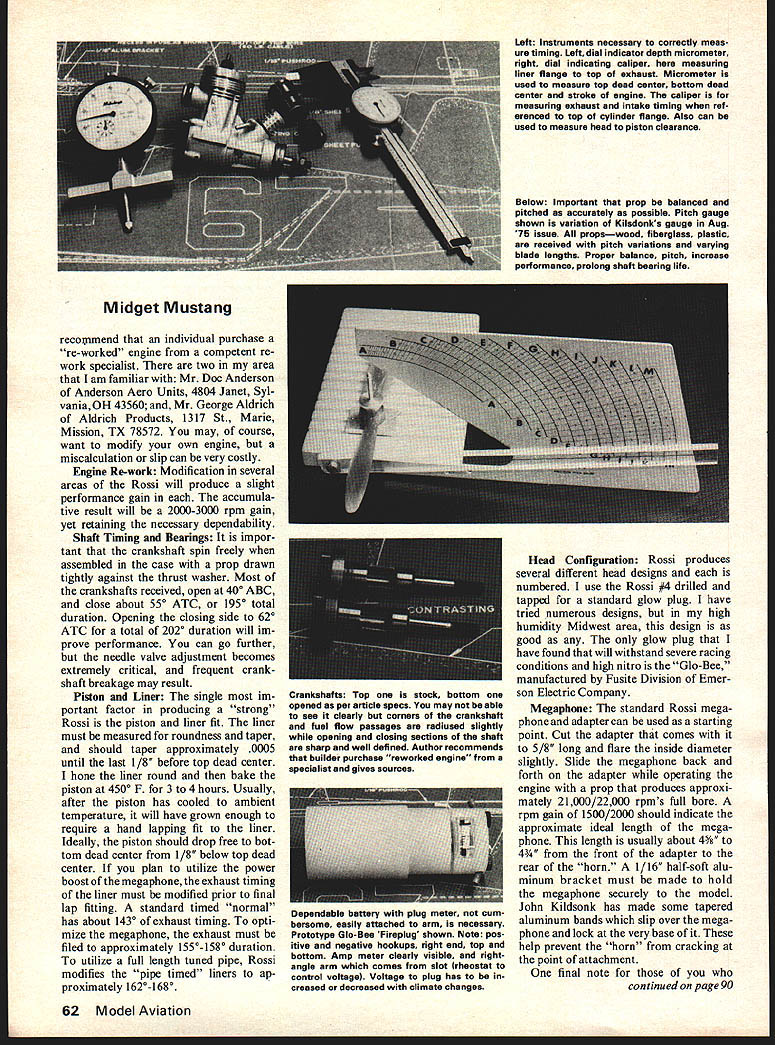
Selection and proper sizing of the propeller can make or break a Rossi. The two brands I have worked with are the Bartels 7x6, and the Kelly 7x6. Bartels are difficult to acquire, but this is not so with the Kelly. Aldon Kelly produces six different types of 7x6 propellers in either fiberglass or carbon fiber. His address is Kelly Products, Inc., P.O. Box 38, Western Springs, IL 60558. The prop I use measures 6 3/4 x 5 1/2. Different engines or atmosphere conditions may require some modification. Be sure to carefully balance your prop prior to mounting the engine.
Re-Starting During Pit Stops
The problem of consistent re-starts during racing conditions is often caused by a faulty or weak battery. We have had some difficulty finding a dependable battery with "plugmeter" which could easily be attached to the arm and was not cumbersome. Re-starts during cold or rainy meets were often difficult. We had no way of increasing or reducing the voltage to the glow plug which changes with the climate. The Fusite Division of Emerson Electric Company has produced a compact 2-volt battery pack that contains a rheostat to match voltage to the glow plug requirements, and includes a built-in "plugmeter." The unit is small and packed in a polypropylene case.
Racing is a team event. One man cannot do it alone. I would like to thank my pit man, Gary Fenstres, for his hard work and thorough preparedness which has enabled the system presented here to be a consistent winner.
If you have any questions or comments, my address is: 10102 Kimblewick Drive, Louisville, KY 40223. Good luck, and good racing.
Transcribed from original scans by AI. Minor OCR errors may remain.

