
Midland RC Modelers’ Success Story
Background
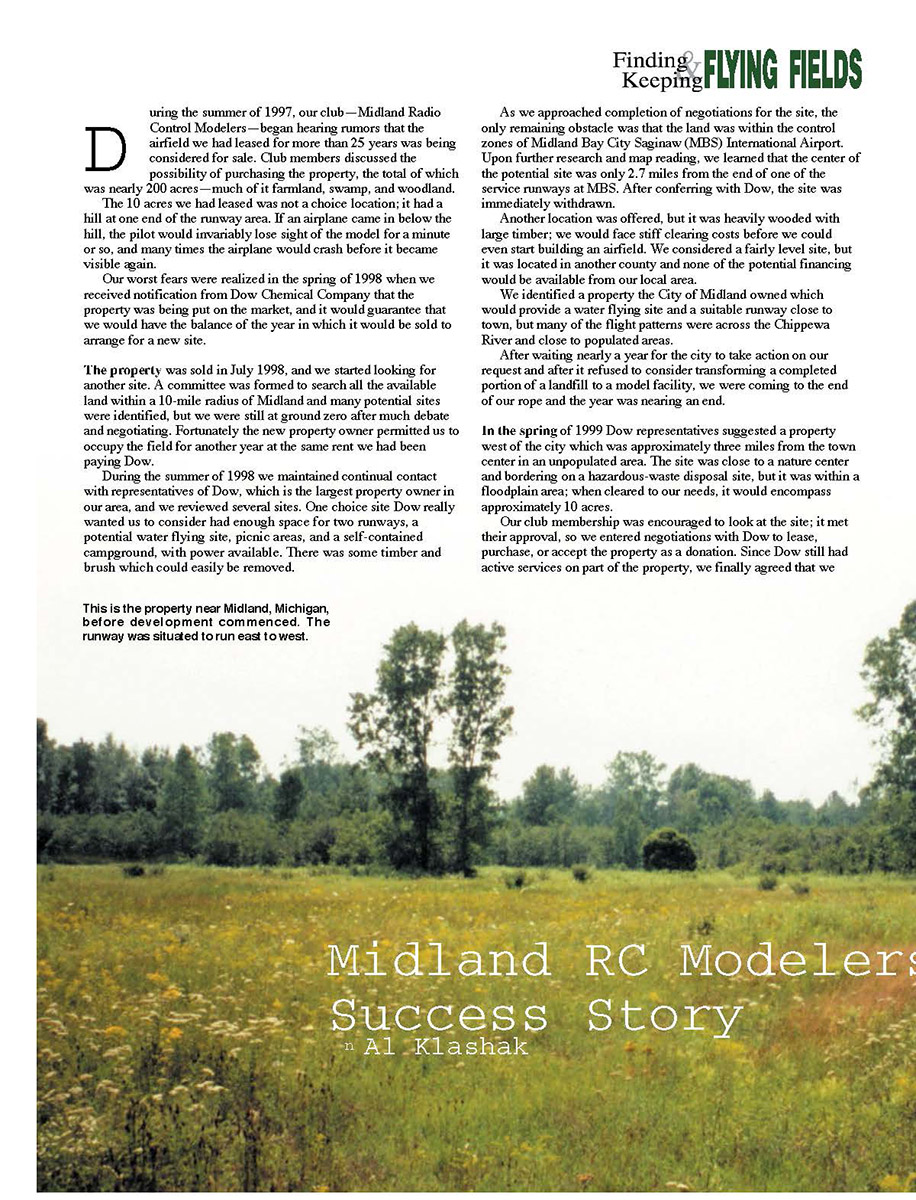
During the summer of 1997, our club—Midland Radio Control Modelers—began hearing rumors that the airfield we had leased for more than 25 years was being considered for sale. Club members discussed the possibility of purchasing the property, which totaled nearly 200 acres—much of it farmland, swamp, and woodland. The 10 acres we had leased was not a choice location; it had a hill at one end of the runway area. If an airplane came in below the hill, the pilot would invariably lose sight of the model for a minute or so, and many times the airplane would crash before it became visible again.
Our worst fears were realized in the spring of 1998 when we received notification from Dow Chemical Company that the property was being put on the market. We were guaranteed the balance of the year in which it would be sold to arrange for a new site.
The property was sold in July 1998, and we began looking for another site. A committee was formed to search all available land within a 10-mile radius of Midland. Many potential sites were identified, but after much debate and negotiating we were still at ground zero. Fortunately, the new property owner permitted us to occupy the field for another year at the same rent we had been paying Dow.
Site search and obstacles
During the summer of 1998 we maintained continual contact with representatives of Dow, the largest property owner in our area, and we reviewed several sites. One choice site Dow wanted us to consider had enough space for two runways, a potential water-flying site, picnic areas, and a self-contained campground with power available. There was some timber and brush that could easily be removed.
As we approached completion of negotiations for that site, the only remaining obstacle was that the land was within the control zones of Midland–Bay City–Saginaw (MBS) International Airport. Upon further research and map reading, we learned that the center of the potential site was only 2.7 miles from the end of one of the service runways at MBS. After conferring with Dow, the site was immediately withdrawn.
Another location offered was heavily wooded with large timber; we would have faced stiff clearing costs before we could even start building an airfield. We considered a fairly level site in another county, but none of the potential financing would have been available from our local area.
We identified a property the City of Midland owned which would have provided a water-flying site and a suitable runway close to town, but many of the flight patterns would have been across the Chippewa River and close to populated areas. After waiting nearly a year for the city to take action on our request—and after it refused to consider transforming a completed portion of a landfill into a model facility—we were coming to the end of our rope and the year was nearing an end.
Securing the new field
In the spring of 1999 Dow representatives suggested a property west of the city approximately three miles from the town center in an unpopulated area. The site was close to a nature center and bordered on a hazardous-waste disposal site, but it was within a floodplain area. When cleared to our needs, it would encompass approximately 10 acres.
Our club membership inspected the site and approved it, so we entered negotiations with Dow to lease, purchase, or accept the property as a donation. Since Dow still had active services on part of the property, we finally agreed that we could obtain the land on an open-ended lease for $500 per year.
On August 12, 1999, we had an airfield, but much remained to be done so that the property would be usable in 2000. Prior to completing the lease, we negotiated with the new owner of our previous field to lease directly from him for an additional year, which covered our needs through 1999 into 2000.
Reincorporation and nonprofit status
Knowing we could not afford significant development expenses, the officers and board decided to reincorporate and seek Internal Revenue Service approval of 501(c)(3) not-for-profit status. That would allow us to approach Dow and several local foundations for grants to assist with field development.
We received final approval of 501(c)(3) status on April 2, 1999, based on our extensive educational programs conducted in the community and with local educational institutions.
Development and funding
Dow agreed to help develop the new field and hired a contractor to handle leveling and grading. Sweat equity by club members was vital to removing trees, brush, and stumps from the areas we would use for runways and parking. Brush was ground into chips with a chipper furnished by Dave Schmelzer, owner of a rental-equipment company.
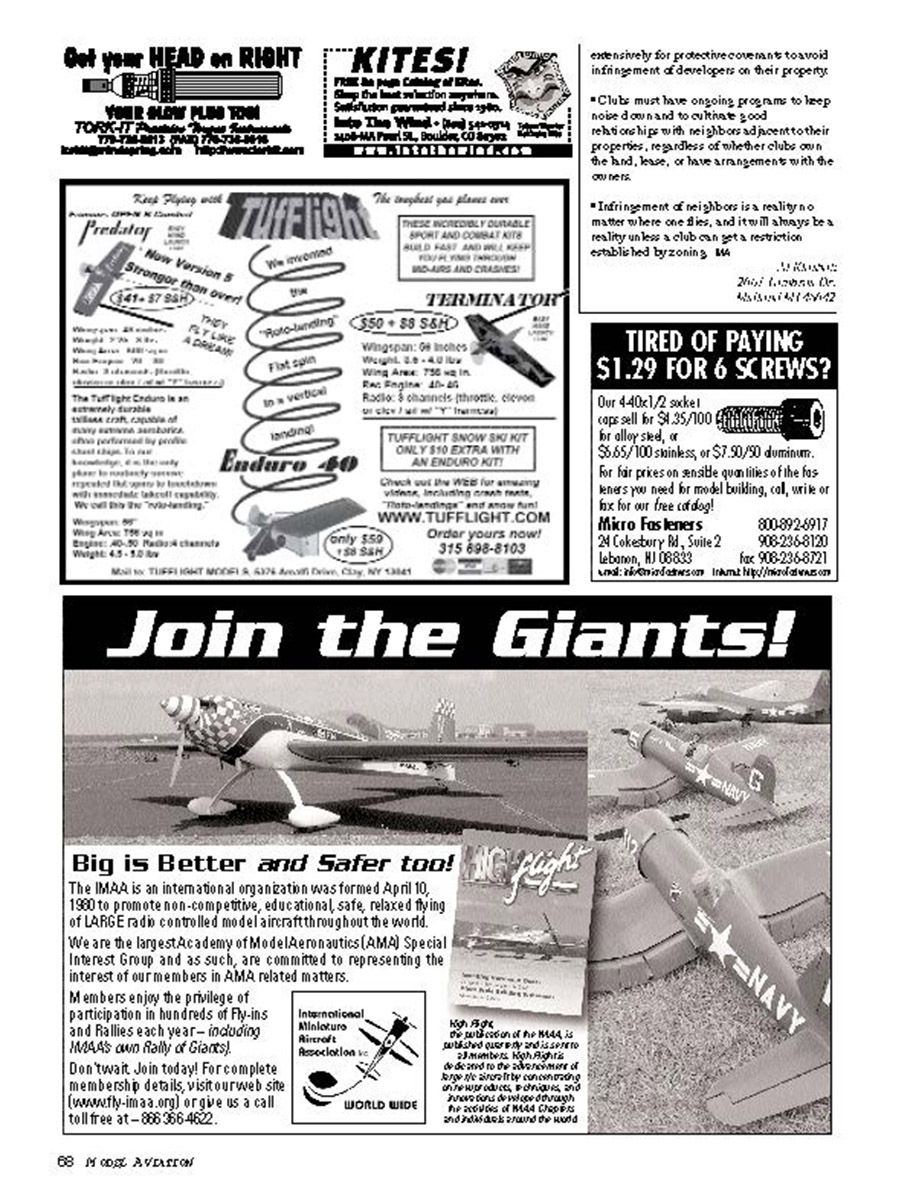
After laying out east–west and north–south runways, we discovered space for eight self-contained camper parking spaces and a generous area for parking for air shows and other activities. Club members worked steadily through October removing firewood, and the contractor leveled the site and prepared it for seeding and fertilizing. Through negotiations with a lawn and garden contractor—Servinski Sod Service—we obtained seed and fertilizer at near cost.
For a low price, the owner of Allied Ready Mix Company agreed to grade, furnish, and spread crushed concrete aggregate cement on the roadways and parking areas for access to the runway area.
During negotiations with Dow, we were advised to approach local foundations and businesses for additional fundraising. Dow asked what we thought we needed, and after we provided a minimum figure, Dow agreed to extend funding in increments as work was completed, in addition to the funds the club had available.
Dow's generous offer and the club members' sweat equity allowed us to complete safety fencing, seeding, and additional fertilizing, and to have a friendly electrician and Consumers Power Company supply electrical service to the field.
We did not have underground water or sewage services on the property, so we purchased two Porta-Johns and members furnished water in special containers for events.
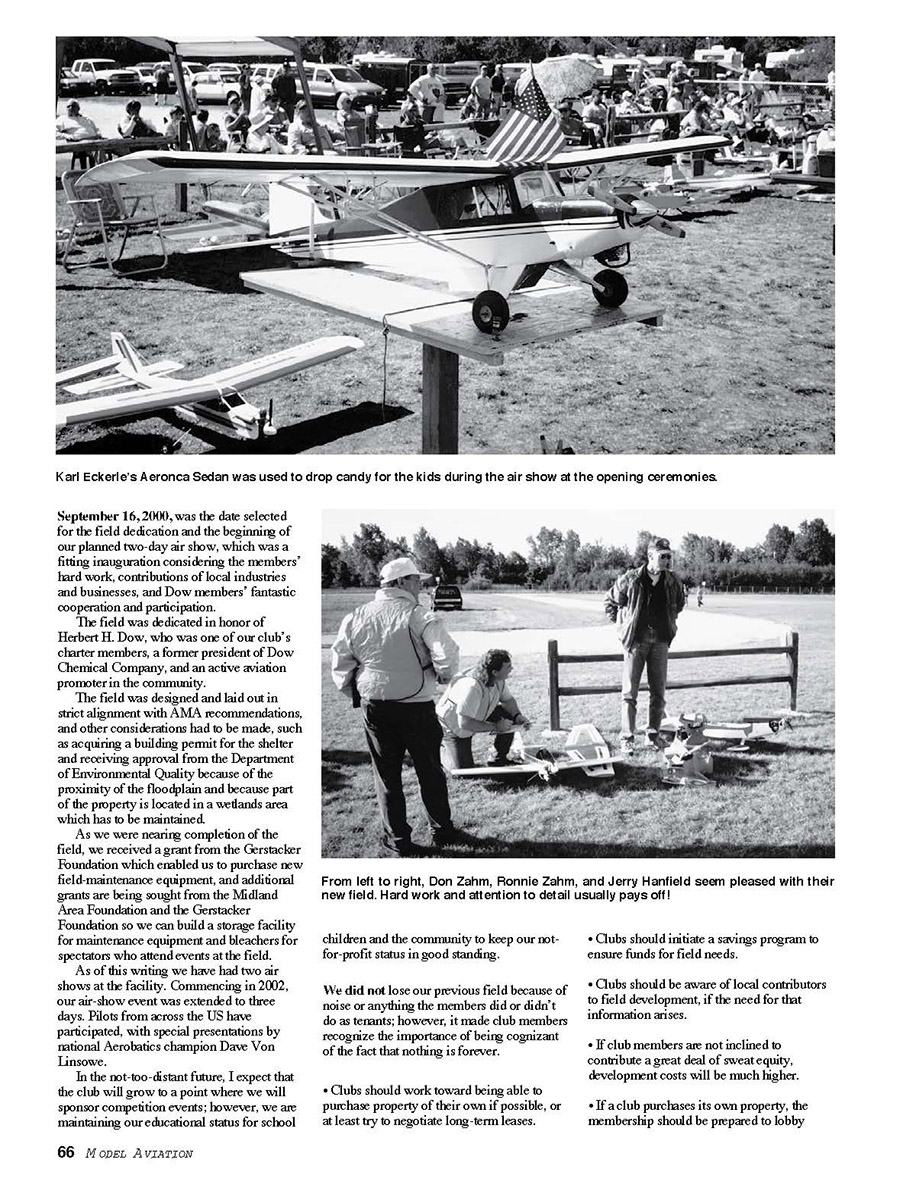
Since the club had arranged to rent the old field for another year, that permitted us time to get the new grass runway well established and to install a new 35-by-350-foot blacktop runway before the field opened in September 2000. Dave Schmelzer arranged to have a shelter and impound constructed at minimal cost to the club—roughly $1,800.
Dedication and compliance
September 16, 2000, was selected for the field dedication and the start of our planned two-day air show, a fitting inauguration considering the members' hard work, contributions from local industries and businesses, and Dow members' cooperation and participation.
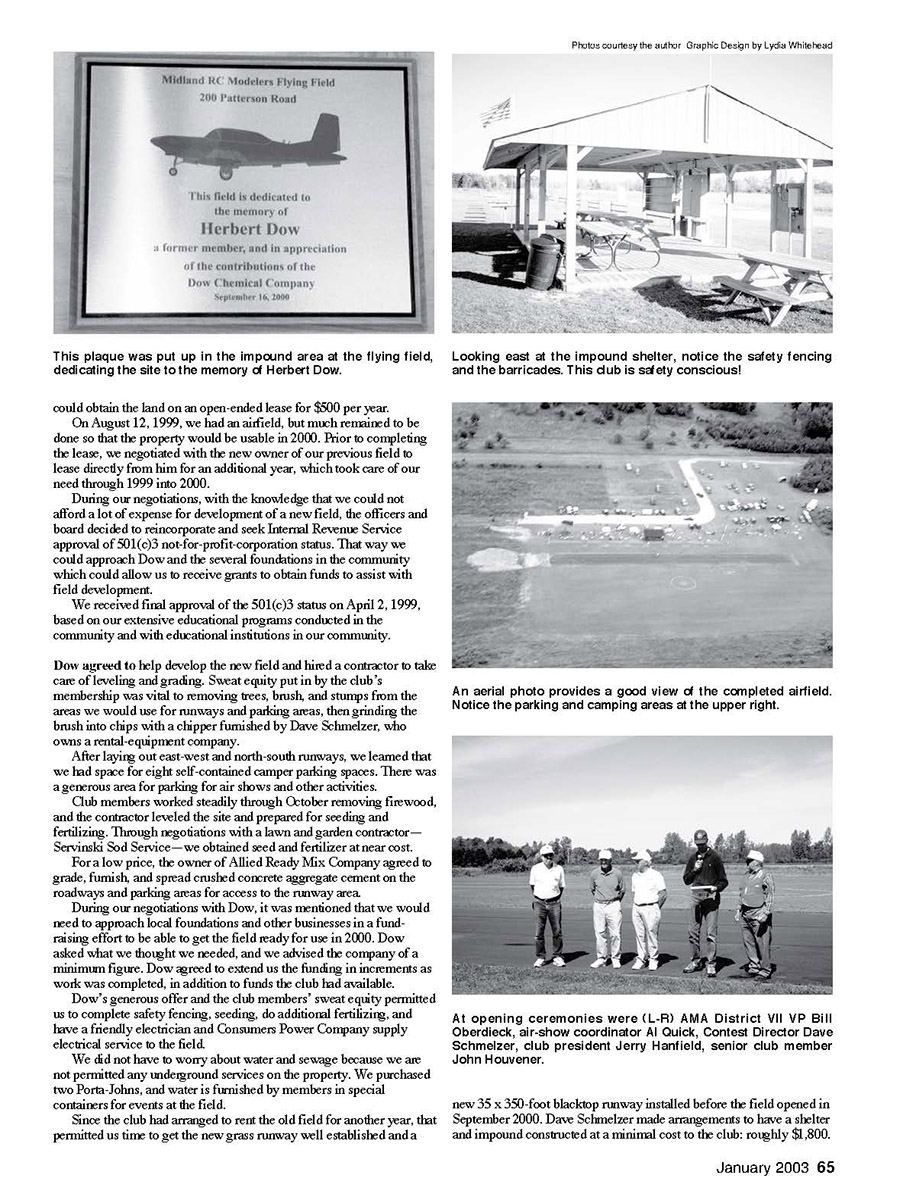
The field was dedicated in honor of Herbert H. Dow, one of our club's charter members, a former president of Dow Chemical Company, and an active aviation promoter in the community.
The field was designed and laid out in strict alignment with AMA recommendations. Other considerations included acquiring a building permit for the shelter and receiving approval from the Department of Environmental Quality because of the proximity to the floodplain and because part of the property is located in a wetlands area that must be maintained.
Grants, events, and the future
As we neared completion of the field, we received a grant from the Gerstacker Foundation, which enabled us to purchase new field-maintenance equipment. Additional grants are being sought from the Midland Area Foundation and the Gerstacker Foundation to build a storage facility for maintenance equipment and bleachers for spectators.
As of this writing we have had two air shows at the facility. Beginning in 2002, our air-show event was extended to three days. Pilots from across the U.S. have participated, with special presentations by national aerobatics champion Dave Von Linsowe.
In the not-too-distant future, I expect the club will grow to a point where we will sponsor competition events; however, we are maintaining our educational status for school children and the community to keep our not-for-profit status in good standing.
We did not lose our previous field because of noise or anything the members did or did not do as tenants; however, the experience made club members recognize the importance of being cognizant of the fact that nothing is forever.
Lessons learned
- Clubs should work toward being able to purchase property of their own if possible, or at least try to negotiate long-term leases.
- Clubs should initiate a savings program to ensure funds for field needs.
- Clubs should be aware of local contributors to field development, if the need for that information arises.
- If club members are not inclined to contribute a great deal of sweat equity, development costs will be much higher.
- If a club purchases its own property, the membership should be prepared to lobby extensively for protective covenants to avoid infringement by developers on their property.
- Clubs must have ongoing programs to keep noise down and to cultivate good relationships with neighbors and adjacent properties, regardless of whether clubs own the land, lease, or have arrangements with the owners.
- Infringement of neighbors is a reality no matter where one flies, and it will always be a reality unless a club can get a restriction established by zoning or other legal means.
Author
Al Klashak 2641 Theodore Dr. Midland, MI 48642
Transcribed from original scans by AI. Minor OCR errors may remain.

