
Midwest Slope
Dave Sanders
Introduction
"YOU'RE GOING WHERE?" "Kansas, man." "There's no slopes in Kansas. It's flat as a pool table, Dave!" "They say there's slopes ... and wind. I gotta see for myself, dude."
Your preconceived geographic notions about Kansas are true for a large portion of its wide-open real estate, but in the north-central portion there are some landforms that represent a slope soarer's paradise: strong, steady prairie winds and excellent slope sites. I was going to attend the fifth annual Midwest Slope Challenge, sponsored by the Lincoln (NE) Area Soaring Society (LASS), on the weekend of May 16–17, and enjoy a refreshing cultural awakening.
After getting an hour or so outside of Kansas City and well into the three-and-a-half-hour drive west on I-70 to the small town of Lucas (near the Lake Wilson venue), there were very nice slopes every few miles and epic slopes about every 20 miles. By the time we pulled in at the Lucas Country Inn, it was nightfall; but my knowledgeable guides, Jim Frickey and Traci Wagner, had me primed for a great experience. The little inn's lobby was already packed with airplanes and pilots—some were hangar flying, some were sleeping off the night's 100% corn-fed beef cuisine from Linda's Cafe, and others were busily readying airplanes for the next day's festivities. The arrival-day bull sessions lasted well into the wee hours.
Saturday: Wind and Racing
Saturday got off to a slow start with barely a hint of wind, but Midwesterners were not deterred. Hand-launch models filled the skies, Jerry Slates set up a hi-start for larger Thermal Duration models, and Jim Frickey ran a winch for larger Unlimited and Scale models. By noon the wind began to turn on and sparkles of white appeared across the lake from the southeast, giving ideal direction for the event's primary slope.
Event director Paul Wright and race CD Alden Shipp quickly readied the race matrix, held a pilots' meeting, and put the LASS crew to work setting pylons and staking out the pit area. The operation was smooth and effective—very organized—and racing began in earnest by 1 p.m.
Classes and Racing Format
Four airframe classes were run:
- Stock Sig Ninja (One Design)
- 60-inch class
- Unlimited
- Stock Sig Samurai (One Design)
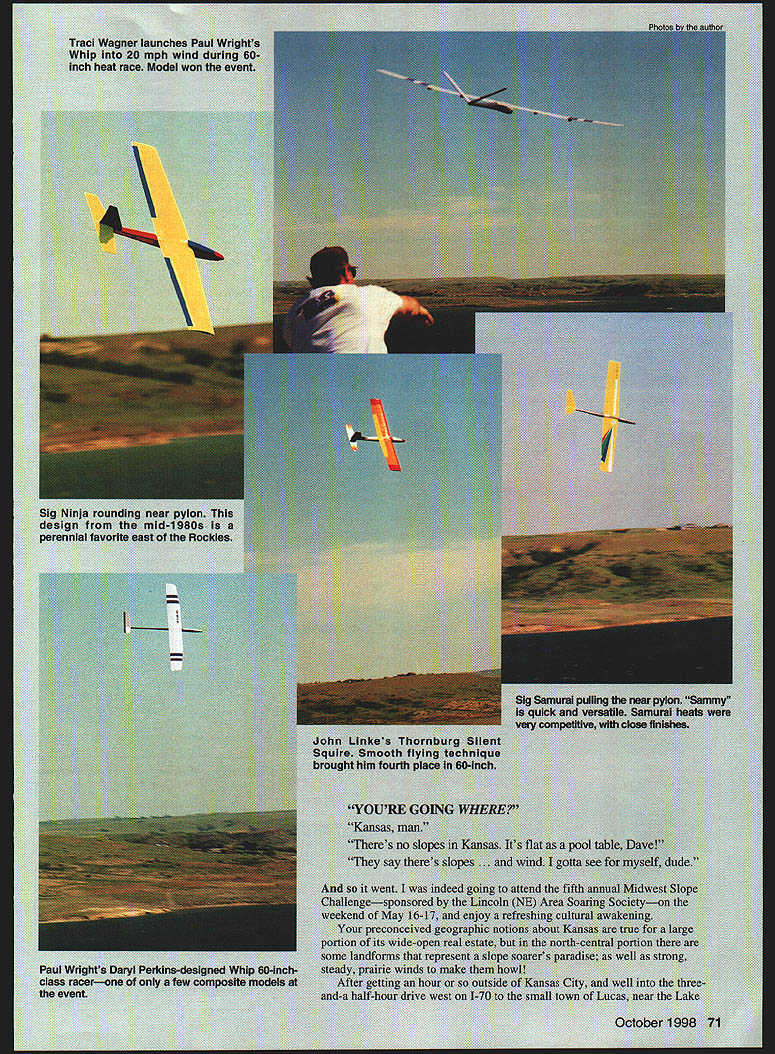
The Ninja and Samurai classes are one-design events, aimed at pitting pilots of all skill levels against each other in more-or-less equal airframes. Both Sig designs are products of Midwest design talent, notably Mike Pratt. For the previous four years Sig had sponsored the event, but they were unable to do so this year.
#### Ninja (Stock Sig Ninja)
- Field: 18 entrants
- Format: Five rounds each in heats of two to four airplanes; top four advanced to a final round to decide places.
- Conditions: Wind started at about 20 mph and increased; pilots added ballast to handle the speed.
- Results:
- Paul Wright
- Tom Wild
- Wayne Henning
#### 60-inch Class
- Field: 10 entries
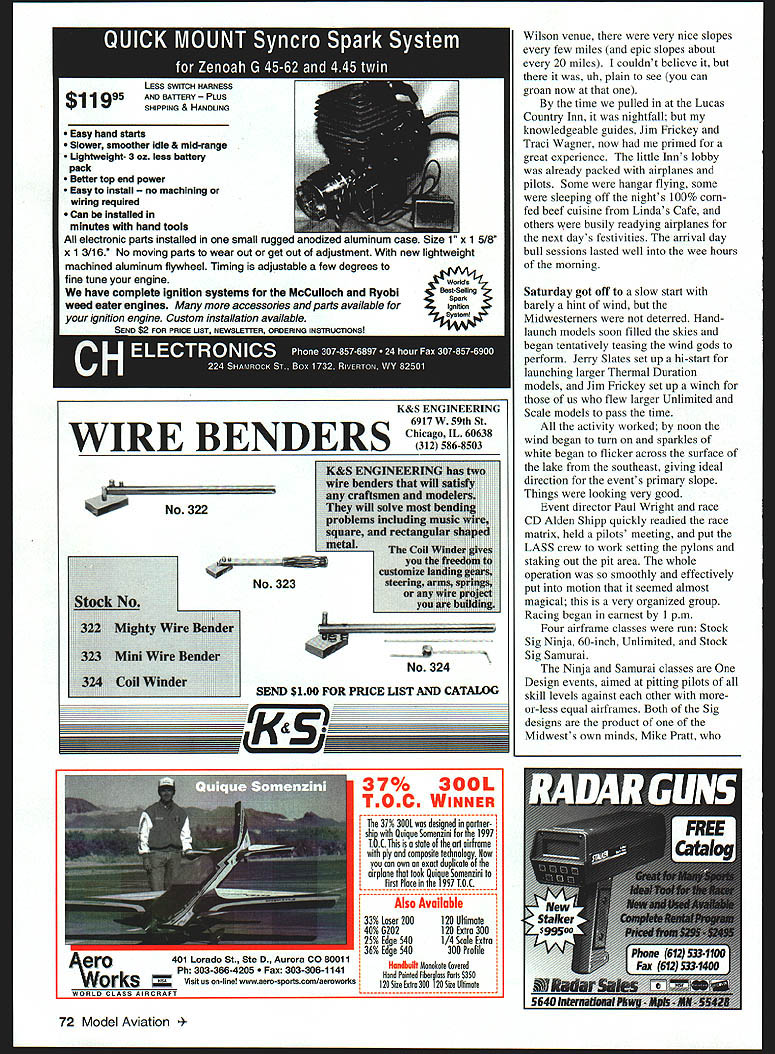
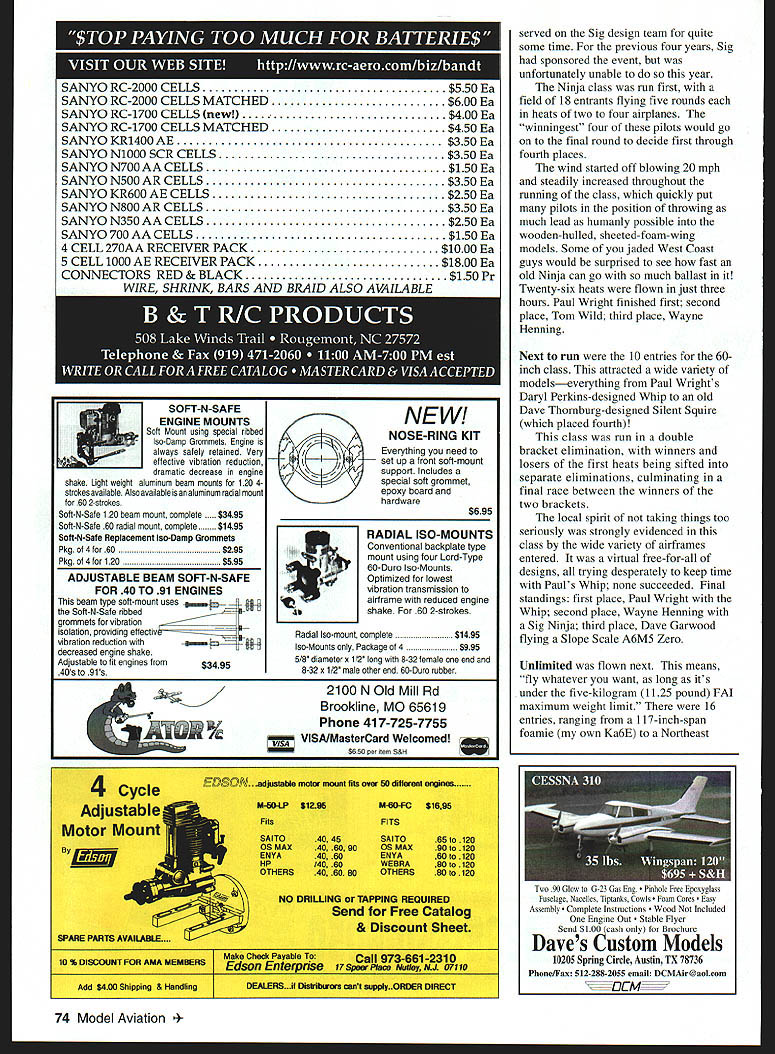
- Models: Wide variety, from Paul Wright's Daryl Perkins–designed Whip to an older Dave Thornburg Silent Squire.
- Format: Double-bracket elimination (winners and losers brackets), culminating in a final between the two bracket winners.
- Results:
- Paul Wright (Whip)
- Wayne Henning (Sig Ninja)
- Dave Garwood (Slope Scale AGMS Zero)
#### Unlimited
- Definition: Fly whatever you want, as long as it's under the five-kilogram (11.25-pound) FAI maximum weight limit.
- Field: 16 entries, ranging from a 17-inch-span foamie to a Ka6E-type ship to larger scale sailplanes.
- Conditions: Flown in the strongest air of the day—about 30 mph gusting to 35.
- Format: Double-elimination bracket, same as the 60-inch class.
- Results:
- Paul Wright (Whip)
- Ken Hawkins (NSP Starbarrow)
- George Voss (Sig Samurai)
- Wayne Henning (Samurai)
#### Samurai (Stock Sig Samurai)
- Field: 12 entries
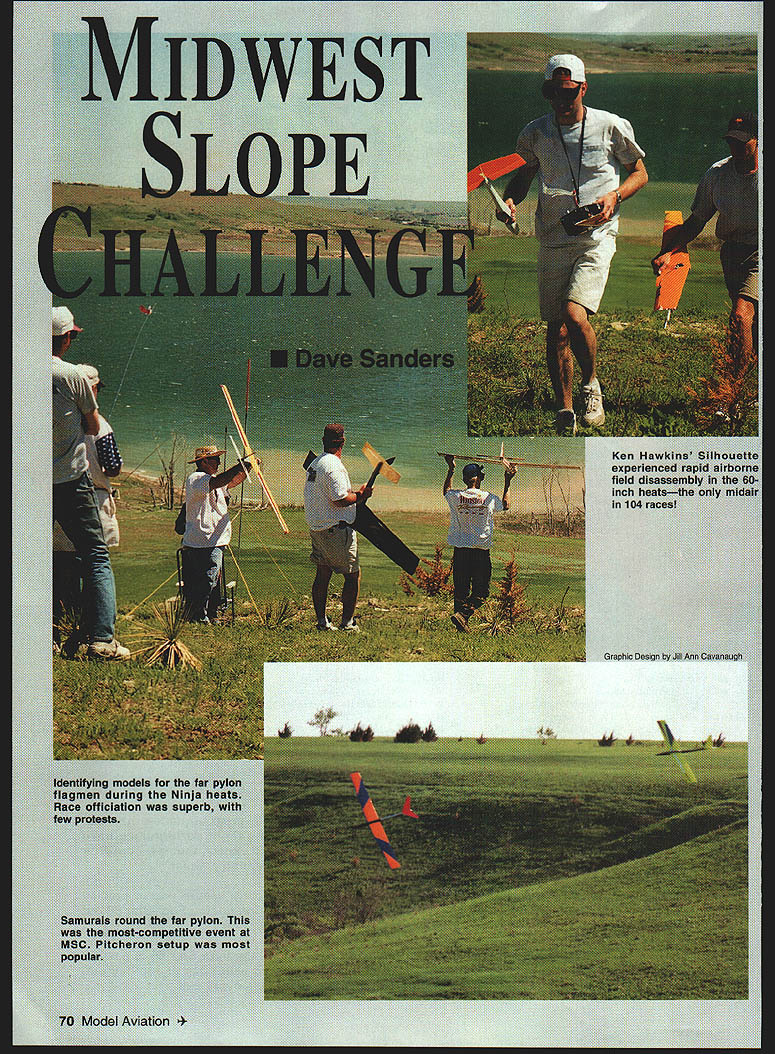
- Notes: The Samurai was the most competitive class. The Sig Samurai can be built "wingeron" (wing rotation for roll, conventional elevator on V-tail) or "pitcheron" (wing movement mixed to control both roll and pitch). Locals favored the pitcheron setup for its simplicity.
- Format: Double-elimination rounds with very close finishes.
- Final: Steve Rohman vs. Paul Wright featured an exciting finish decided by mere inches.
- Results:
- Paul Wright
- Steve Rohman
- Wayne Henning
- Daryl Huelsman
Paul Wright was the standout pilot, winning multiple classes with his Whip.
Saturday Evening
Saturday evening featured an all-you-can-eat prime rib banquet and awards ceremony at the K-18 Cafe on the north side of Lucas. Speakers included Dave Garwood, George Voss, and the author, discussing the day's events and possible new formats for next year's meet (foamies and new one-design racers were topics of interest). A raffle followed, with prizes from Critter Bits, Dave's Aircraft Works, and Soaring Central.
Sunday: Fun-Fly
Sunday was designated a fun-fly day. The strong air from earlier in the weekend dropped to 15–20 mph with light thermal activity. Handlaunch models filled the skies; Jerry Slates again set up the hi-start and Jim Frickey ran the winch. Activities were relaxed and social, with pilots exploring nearby slopes and enjoying the flying.
Alden Shipp, Dave Garwood, Joe Chovan, and I toured other local hot spots—slopes with exceptionally clean lift bands where you could do aerobatics within arm’s length of your model and inches from the ground. The scenery and flying were a spiritual experience for many.
Venue: Lake Wilson
The entire Lake Wilson venue is slope wonderland. The reservoir occupies a natural valley and was created by a dam built in the 1960s by the Army Corps of Engineers, which still administers the area. Ken Wade, the resident ranger, was helpful in arranging site use and noted that RC soaring pilots are particularly welcome; the club has a record of environmentally sensitive use.
Amenities:
- Comfortable camping facilities around the lake
- Heated showers
- Playgrounds for kids
- Water supply for campers and RVs
- Well-maintained park grounds kept tidy by Corps staff
Organizers and Acknowledgments
The LASS event staff did an outstanding job. Key organizers:
- Paul Wright (Event Director)
- Alden Shipp (Race CD)
- Jim Baker
- Mike Green
These volunteers bent over backwards to ensure comfort and smooth running of the event. The staff ran 104 races in four classes over about six-and-a-half hours.
Conclusion
This was a fantastic event: great slopes, terrific air, friendly people, and reasonable costs for food and lodging. For anyone skeptical about Kansas slope soaring, Lake Wilson and the surrounding hills are worth the trip. As Dorothy might have said, "There's no place like home"—and for slopers, this area comes pretty close.
Contact for 1999 MWSC
Lincoln Area Soaring Society c/o Paul Wright 1745 140th, Garland NE 68306-9232 Tel.: (402) 796-2175 E-mail: PaulW@lsco.com
Transcribed from original scans by AI. Minor OCR errors may remain.

