
Midwest Slope Challenge
Dave Garwood
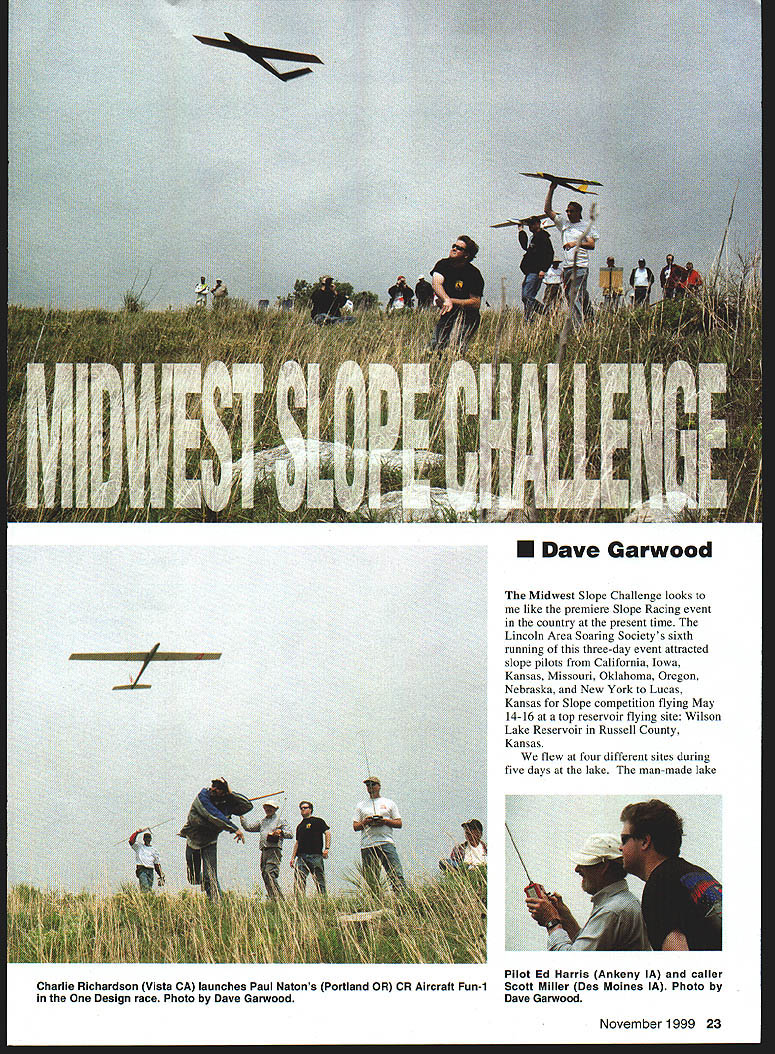
The Midwest Slope Challenge looked to me like the premier slope-racing event in the country at the present time. The Lincoln Area Soaring Society's sixth running of this three-day event attracted slope pilots from California, Iowa, Kansas, Missouri, Oklahoma, Oregon, Nebraska, and New York to Lucas, Kansas. Flying took place May 14–16 at a top reservoir flying site: Wilson Lake Reservoir in Russell County, Kansas.
We flew at four different sites during five days at the lake. The man-made reservoir has 100 miles of shoreline surrounded by nearly treeless rolling hills. The ridge has a grass landing strip and is also used by hang gliders. The landlord, the U.S. Army Corps of Engineers, is receptive to RC soaring events in addition to its water-conservation and flood-control responsibilities. The main uses of the reservoir are recreation — swimming, fishing, boating, camping, hunting, and windsurfing. Two hundred species of birds and 47 species of mammals have been seen at the lake. Site director Ken Wade told us the Corps is happy to support recreation and sporting events consistent with good land- and water-resource conservation practices.
Racing began in 20–25 mph southerly winds Friday and continued throughout Saturday. Lighter southeast winds on other days made it possible to fly Thursday, Sunday, and Monday, giving pilots time to make a leisurely trip to the event.
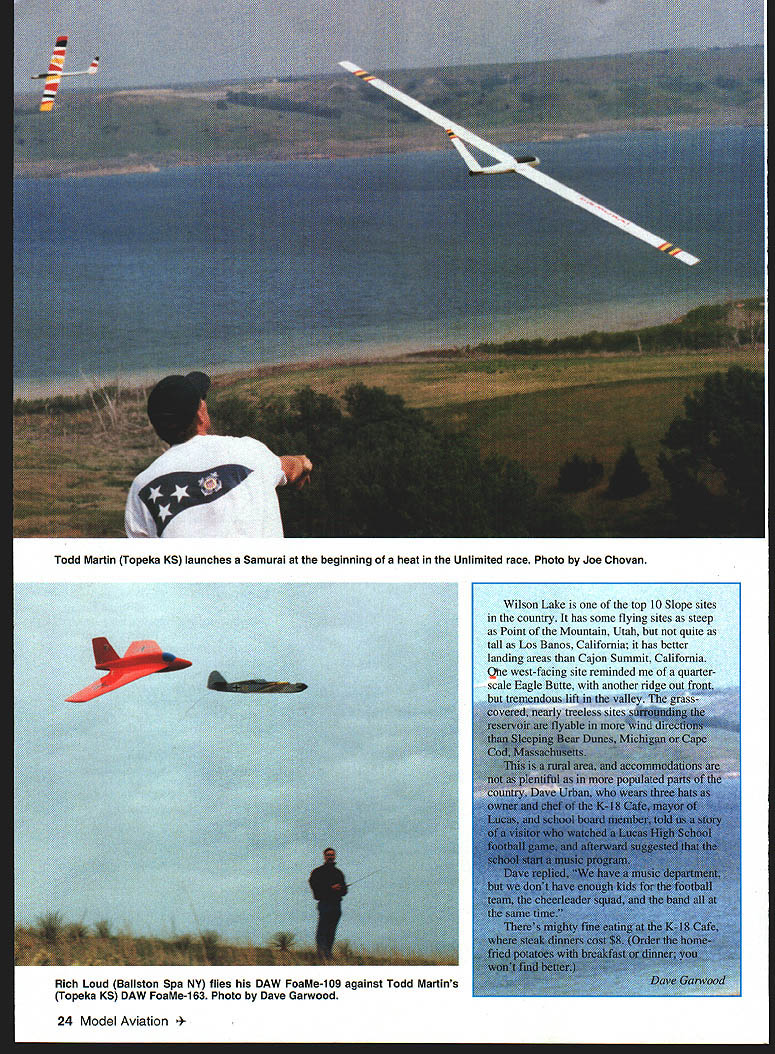
Wilson Lake is one of the top 10 slope sites in the country. It has some flying sites as steep as Point of the Mountain, Utah (though not quite as tall as Los Banos, California) and better landing areas than Cajon Summit, California. One west-facing site reminded me of a quarter-scale Eagle Butte, with another ridge out front and tremendous lift in the valley. The grass-covered, nearly treeless sites surrounding the reservoir are flyable in more wind directions than many other sites such as Sleeping Bear Dunes, Michigan or Cape Cod, Massachusetts.
Accommodations in this rural area are limited. Dave Urban, who wears three hats as owner and chef of the K-18 Cafe, mayor of Lucas, and school board member, told us a story about a visitor who watched a Lucas High School football game and afterward suggested the school start a music program. Dave replied, "We have a music department, but we don't have enough kids for the football team, the cheerleader squad, and the band all at the same time." There's mighty fine eating at the K-18 Cafe — steak dinners cost about $8. Order the home-fried potatoes with breakfast or dinner; you won't find better.
Foamie Enduro Race
The Foamie Enduro is something new, much like roller-derby airplane racing. Starting with a mass launch, competitors fly bounceable EPP (expanded polypropylene) foam airplanes around 14-foot poles at each end of the course. It's a good introduction to sailplane racing — you don't have to worry much about hurting the airplane. To score, pilots must make a figure-8 around both poles, staying below the tops of the poles. Pilots are allowed to pick up a downed airplane and relaunch if necessary. Four five-minute heats were flown. Twenty-six competitors, in groups of 13, faced steady 20–25 mph winds, which made it tough to keep airplanes low enough to make a scoring pass. The high-intensity event generated lots of whoops and hollers from pilots, callers, and spectators. Paul Wright of Lincoln, NE won flying a Zagi Razor. Rich Loud of Ballston Spa, NY finished second flying a DAW FoaMe-109; it was Rich's first sailplane race.
Ninja Race
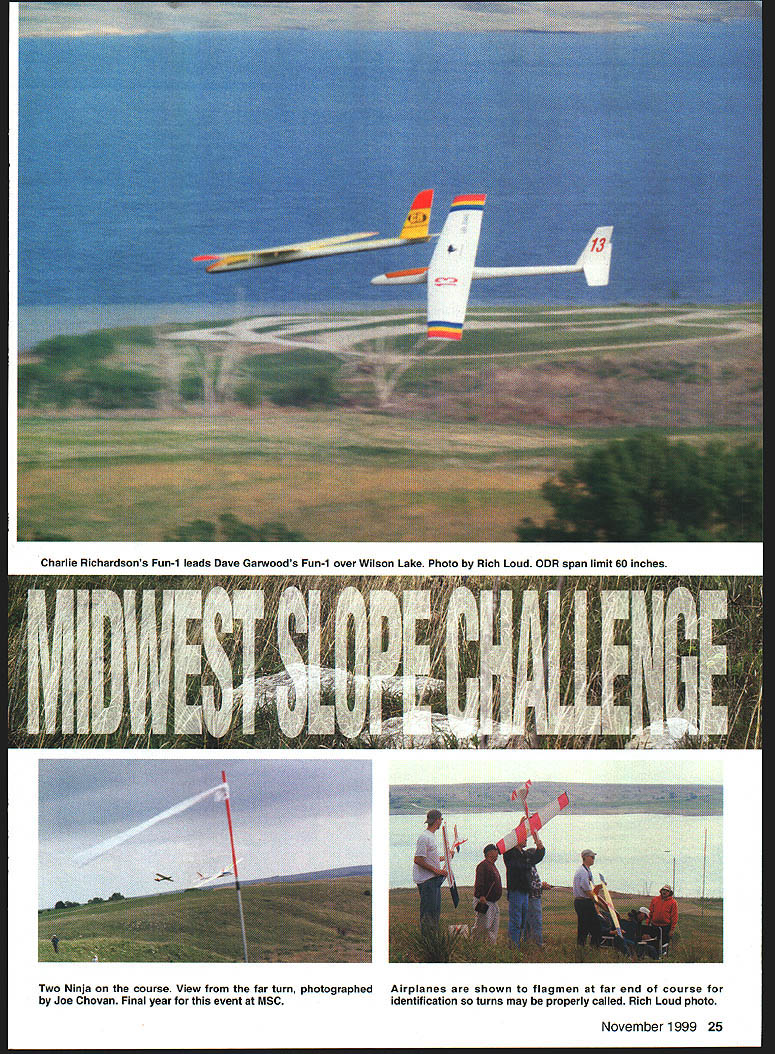
Ninja races have run since the beginning of the MWSC series, capitalizing on the low cost and fine performance of the Sig Ninja, considered the sportsman entry-level class. Airplanes are prepped with strengthened fuselages, ballast systems, and colorful paint schemes. The event was flown in four-airplane heats with double-elimination scoring, flying eight laps over a 90-yard course. The Ninja race was won by Lende Troiani of Warrensburg, MO, a first-time competitor. Second place went to Wayne Henning of Omaha, NE. This was the last year for Ninja racing at the MWSC, as the class has been eclipsed by the rise of the 60-inch ODR (One-Design Race) class.
One-Design Race (60-inch ODR)
Seeking lower-cost competitive racing sailplanes, Paul Naton of the Torrey Pines Gulls published a specification for a One-Design sailplane. Span is limited to 60 inches; exotic building materials are prohibited; elevator-to-flap mixing is not allowed. It is intended as an open specification so scratch-builders and kit manufacturers can design to it. Leading the pack is Charlie Richardson's Fun-1. CR Aircraft sells a kit with a presheeted wing and fiberglass fuselage for a reasonable price (about $79.95). LASS club members tested the design last year and were delighted with the Fun-1's performance. Four New York Slope Dogs brought Fun-1s from the Northeast to compete against West Coast- and Midwest-built ODR airplanes. The airplane handles impeccably, flies very well in light lift, and handles high winds with the addition of ballast. For this MWSC event, no other ODR airplane was flown. Charlie Richardson (Vista, CA) took first place in the class, with Paul Naton (Portland, OR) second.
Unlimited Race
The Unlimited class allowed anything up to the AMA and FAI weight and wing-loading limits. We saw a few dedicated racing airplanes, and many people flew their 60-inch racing airplanes; the Sig Samurai was the most numerous single design. This was the closest race, with the tightest turns and airplanes often turning neck-and-neck for the entire heat. The slightest mistake on any of the 10 laps could put you out of the running. Each two-airplane heat was run three times, with two of three finishes determining the heat winner. This method gives pilots a chance to overcome early mistakes, speeds operation of the race, and eliminates the hazard of many landings and launches during the race. Paul Naton flew a CR Renegade to first place, and Paul Wright (Lincoln, NE) took second with a DP Whip.
When two days of racing were over, the implacable LASS crew had staged 136 heats in four races during two days. These guys are good!
COMPETITION RESULTS
Foamie Enduro Race
- Paul Wright — Zagi Razor — Lincoln, NE
- Rich Loud — DAW FoaMe-109 — Ballston Spa, NY
- Wayne Henning — Bowman Ruffneck — Omaha, NE
- Steve Dworsky — DAW FoaMe-163 — Lincoln, NE
Ninja Race
- Lende Troiani — Sig Ninja — Warrensburg, MO
- Wayne Henning — Sig Ninja — Omaha, NE
- Todd Martin — Sig Ninja — Wichita, KS
- Jim Porter — Sig Ninja — Bettendorf, IA
60-inch One-Design Race
- Charlie Richardson — CR Fun-1 — Vista, CA
- Paul Naton — CR Fun-1 — Portland, OR
- Joe Chovan — CR Fun-1 — Syracuse, NY
- Paul Wright — CR Fun-1 — Lincoln, NE
Unlimited Race
- Paul Naton — CR Renegade — Portland, OR
- Paul Wright — DP Whip — Lincoln, NE
- Charlie Richardson — CR Fun-1 — Vista, CA
- Wayne Henning — Sig Samurai — Omaha, NE
The Wilson Lake racers represent a geographic cross-section of America; note that each of the class winners was from a different state. Wayne Henning (Omaha, NE) and Paul Wright (Lincoln, NE) were consistent fliers throughout the event, both placing in the top four in three events.
It's notable that Charlie Richardson and Paul Naton came from the West Coast to fly in Kansas. Charlie runs CR High Performance Aircraft and has more sailplane designs currently in production than anyone I know. Paul Naton has been the Torrey Pines Gulls race coordinator, is the star and producer of the Endless Lift videos, and has completed a 10,000-mile sailplane flying tour of the U.S., documented in his first video.
Some competitors displayed startled looks and long faces when they were called up to fly against pilots with 15 or more years of experience. Racing against Charlie or Paul is like going up against an expert in a current-events quiz: scary but enlightening, and you're richer for the experience. Both men were generous with their help and advice, more interested in promoting slope racing than in winning prizes.
The Future
The sixth MWSC may be a pivotal year for the series. Paul Wright has been the honcho for this event and an extremely tough competitor — last year he swept all four racing events. Lincoln Area Soaring Society member Steve Rohman quipped, "We let Paul win as long as he runs the event." This year some guys didn't get the word. Paul will soon be moving to England, and future events will be the responsibility of other club members. With the demise of slope racing in the West (the California Slope Racers did not post a race schedule this year) and the fickle winds in the East (the May St. Lawrence River race was called off for lack of wind), it looks like the best slope racing in the country will be done on Central Time.
Best of luck and success to the Lincoln Area Soaring Society in continuing the Midwest Slope Challenge.
Dave Garwood 5 Birch Ln. Scotia, NY 12302
Transcribed from original scans by AI. Minor OCR errors may remain.

