
Milestones in RC
Text and drawings by Paul Plecan
NOWADAYS, the average RC enthusiast accepts most of the reliability, light weight and model maneuverability without question. Forty years ago, it was a different story. We will attempt to briefly cover the major advances in the state of the art, leaning toward model aircraft rather than electronics or complex gadgetry.
While the very early pioneers like Ross Hull and Clinton DeSoto developed basic electronic circuitry and lightweight energy‑efficient actuators (both magnetic and rubber powered), most readers will relate more readily to what happened at the various Nationals. While the designs are presented in rough chronological order, some were flown years prior to publication, so bear that in mind.
Early pioneers and the 1937 Nationals
Without much fanfare, a radio control event was included in the 1937 Nationals in Detroit. Six models were entered, half of which got airborne. Of the three, two promptly crashed after takeoff. Chet Lanzo flew his model well enough to stand out among the others and thus took home two trophies and a brand new engine. While the tuning of the RC gear was quite critical, Chet was able to make numerous successful flights. At a time when 5 or 6 pounds was the usual weight of the airborne system, Chet pared it down to 28 ounces. His model had a simple crutch‑type fuselage, a span of 9 feet and was powered by a Baby Cyclone engine.
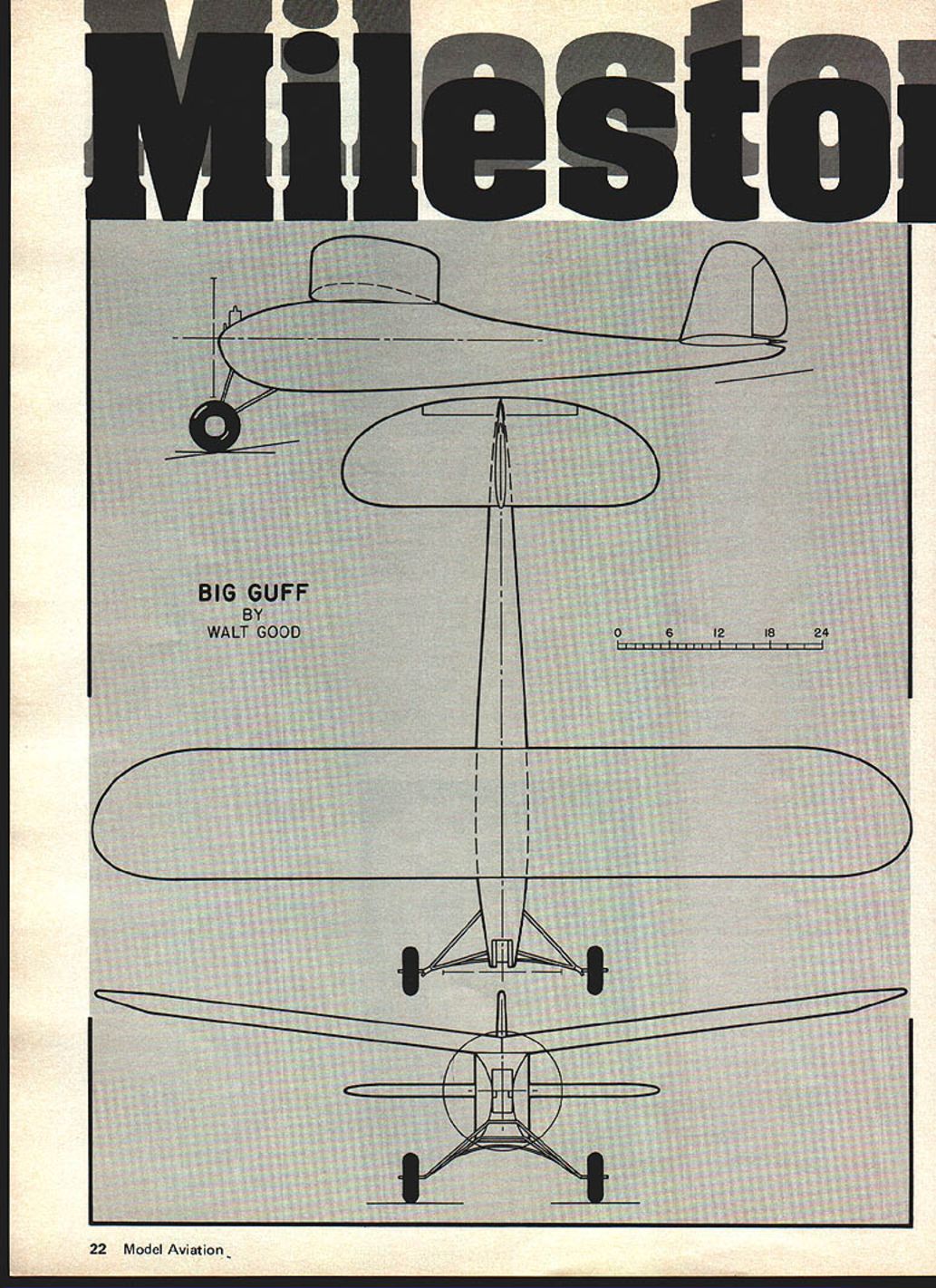
Big Guff
By Walt Good
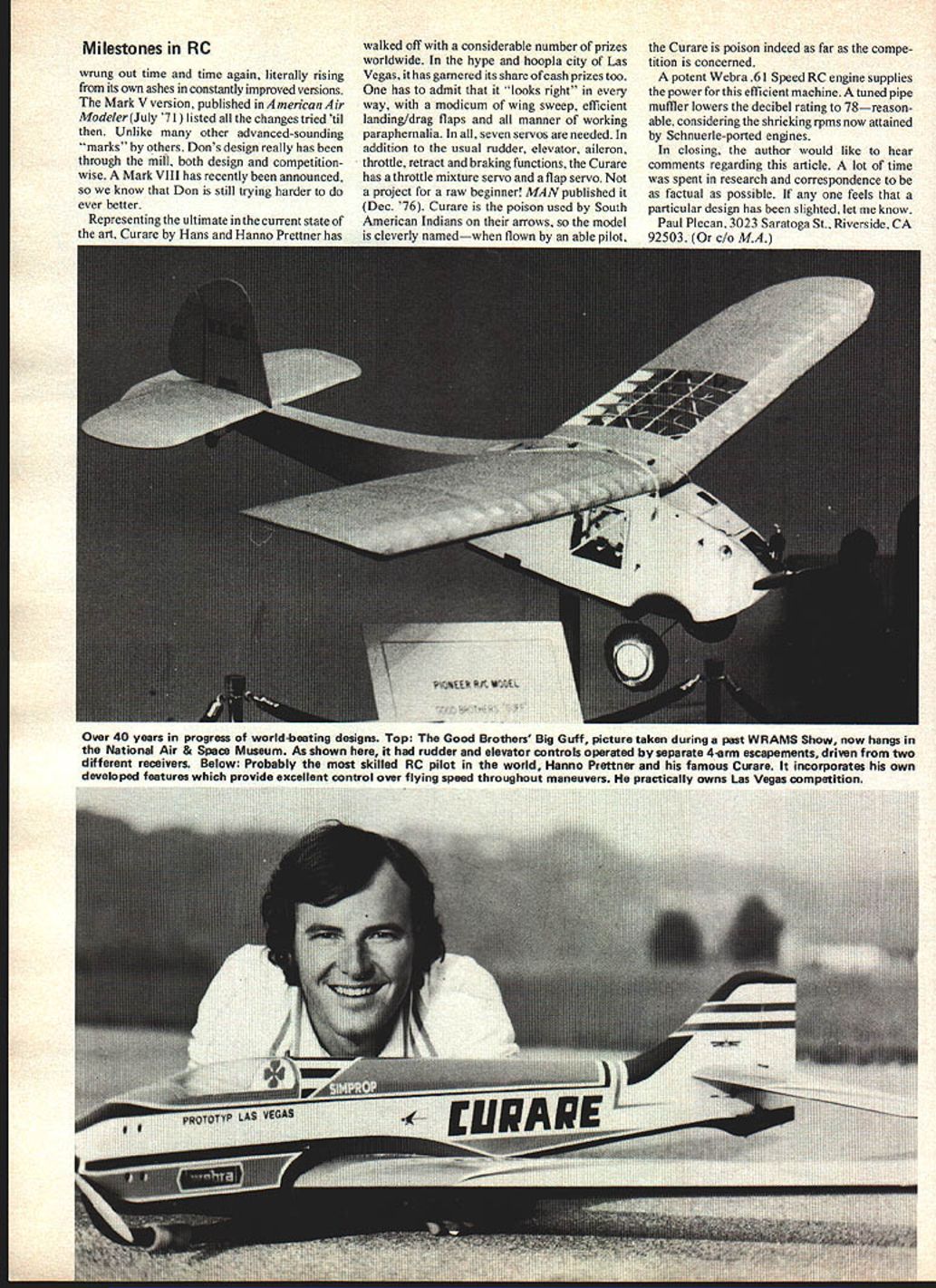
Big Guff was flown by Walt Good at the 1938 Nats. An 8‑foot design, loosely based on the old free‑flight KG concept and borrowing from Walt’s free‑flight Guff design, this model featured generous dihedral, which helped restore stable flight if control was lost. The huge 6‑in. M&M airwheels cushioned landing impact. While Big Guff won on rudder only, the model had an escapement elevator and two receivers, so was capable of pitch control. In 1939 Walt was aided by his brother Bill, then a licensed radio amateur; together they stayed ahead of the competition, winning the RC events in 1940 and 1947. (Big Guff appeared in Air Trails, Oct./Nov./Dec., 1940 issues.)
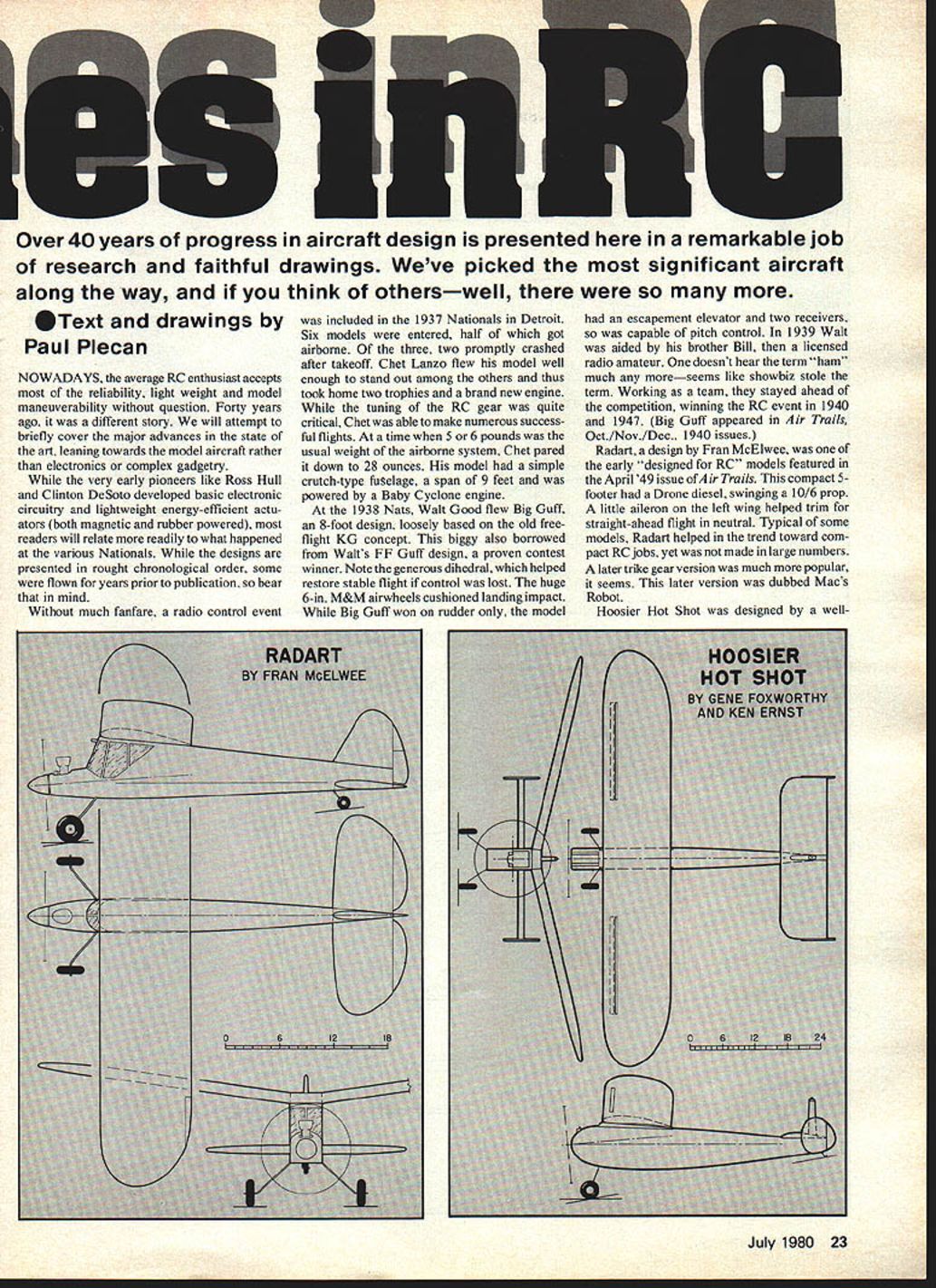
Radart
By Fran McElwee
Radart was one of the early “designed for RC” models, featured in the April 1949 issue of Air Trails. This compact 5‑footer was powered by a Drone diesel swinging a 10/6 prop. A small aileron on the left wing helped trim for straight‑ahead flight in neutral. Typical of some designs, Radart helped in the trend toward compact RC jobs, yet was not made in large numbers. A later trike‑gear version proved more popular and was dubbed Mac’s Robot.
Hoosier Hot Shot
By Ken Ernst (flown by Gene Foxworthy)
Hoosier Hot Shot was designed by well‑known modeler Ken Ernst and flown by Gene Foxworthy; a construction article appeared in Air Trails, May 1950. The Hot Shot used a Dennymite with a 14/8 prop, with ample dihedral, large wing slots and twin rudders. Earlier free‑flight models were prone to a corkscrew, ground‑fatal result: once banked sharply under power they began an ever‑steepening vicious circle. Hot Shot, however, could circle tightly with little altitude loss—slotted wings probably helped achieve this.
Foxworthy told Bill Winter he once tested the wing slot action by covering the slots with tape. Under power the model refused to climb, sped across Indianapolis Airport chest‑high and struck the fence at the far end. Bill also recalled seeing very high, far‑out flights and long, accurate approaches along the runway: “I have seen him, in windy weather no one else would fly, low motor, two‑speed ignition, holding ship nose‑high in front of him, about 25–50 feet away, letting swerve drift 90 degrees right, coming back hang up front him again going left, etc.”
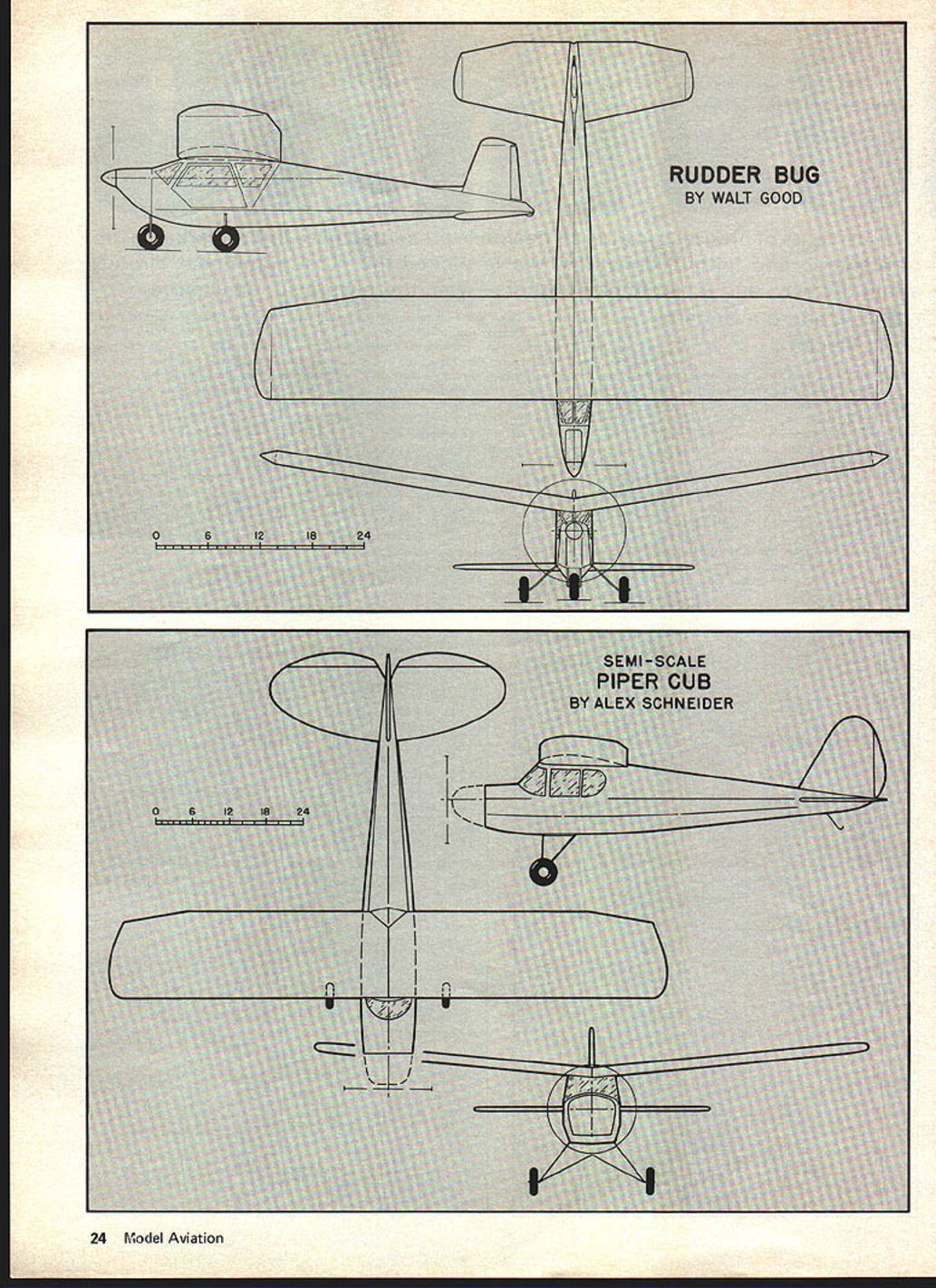
Rudder Bug
By Walt Good
Walt Good’s Rudder Bug featured lots of dihedral and came at a time when interest in RC was growing rapidly. The 6‑foot span model, powered by a DeLong .29 and later a Forster .29, was sturdy and performed well. The airborne RC gear weighed about a pound and provided rudder control—neutral, right, left. The Rudder Bug appeared in the May/June 1949 issues of Model Airplane News. A 5‑foot version was kitted by Berkeley; thousands sold. Don Clark of the DCRC club scaled down the original Bug. Walt took first at the 1949 Nats and several subsequent Nats. Rudder Bugs outnumbered other designs by a large margin.
Semi‑scale Piper Cub
By Alex Schneider
Alex Schneider developed a Piper Cub semi‑scale job that he could do inside and outside loops with, and had success with inverted flight. The Cub originated with a Capital kit, had a 7'6" span and was powered by an Anderson Spitfire two‑speed ignition engine. Although glow was popular at the time, Alex preferred the lighter model possible with fuel‑efficient spark ignition. Early versions weighed about 7 pounds, later around 9 pounds. With a 12.5 inch chord and a NACA 6412 airfoil, weight was no problem.
Anecdote by Bob Beckmann: Two days before the 1952 Nats he and Alex test‑flew the rebuilt Cub. Alex brought the Cub directly overhead and pushed it into a vertical dive. After an abrupt pullout about 20 feet over their heads, Alex asked if the dive had been the required 100 feet. Bob said that if Alex did it that way for the judges, it wouldn't matter how long it was—they would sure know it was vertical. Alex won at the Nats in 1952, 1954 and 1955.
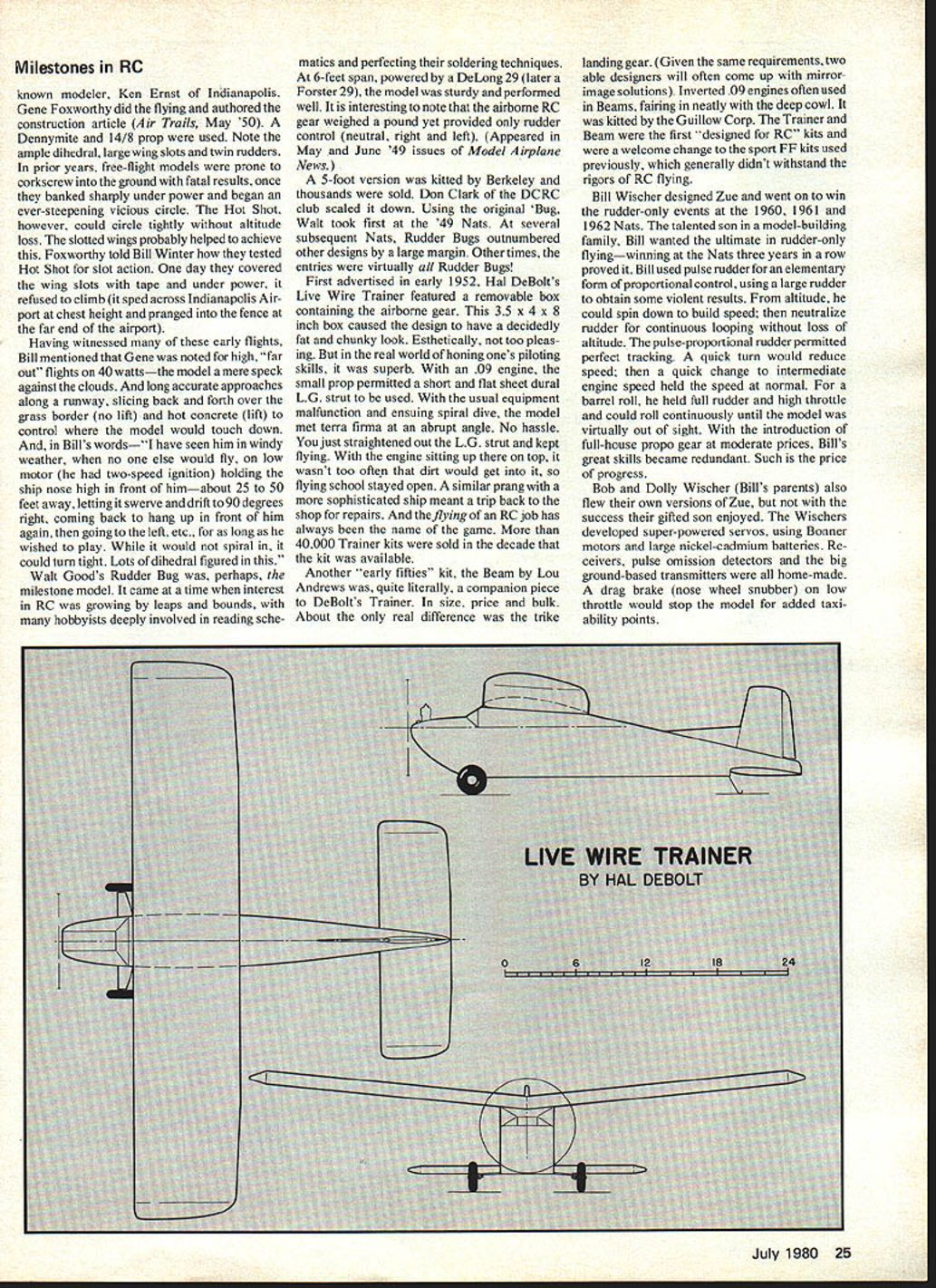
Live Wire Trainer and Beam
By Hal DeBolt and Lou Andrews
First advertised in early 1952, Hal DeBolt's Live Wire Trainer featured a removable box containing the gear. This 3.5 x 4 x 8 inch box gave the design a flat, chunky look, but it was superb for honing piloting skills. With an .09 engine and small prop, the short, flat landing gear strut broke cleanly in hard crashes, allowing quick repair and return to flying. About 40,000 Trainer kits were sold during the decade it was available.
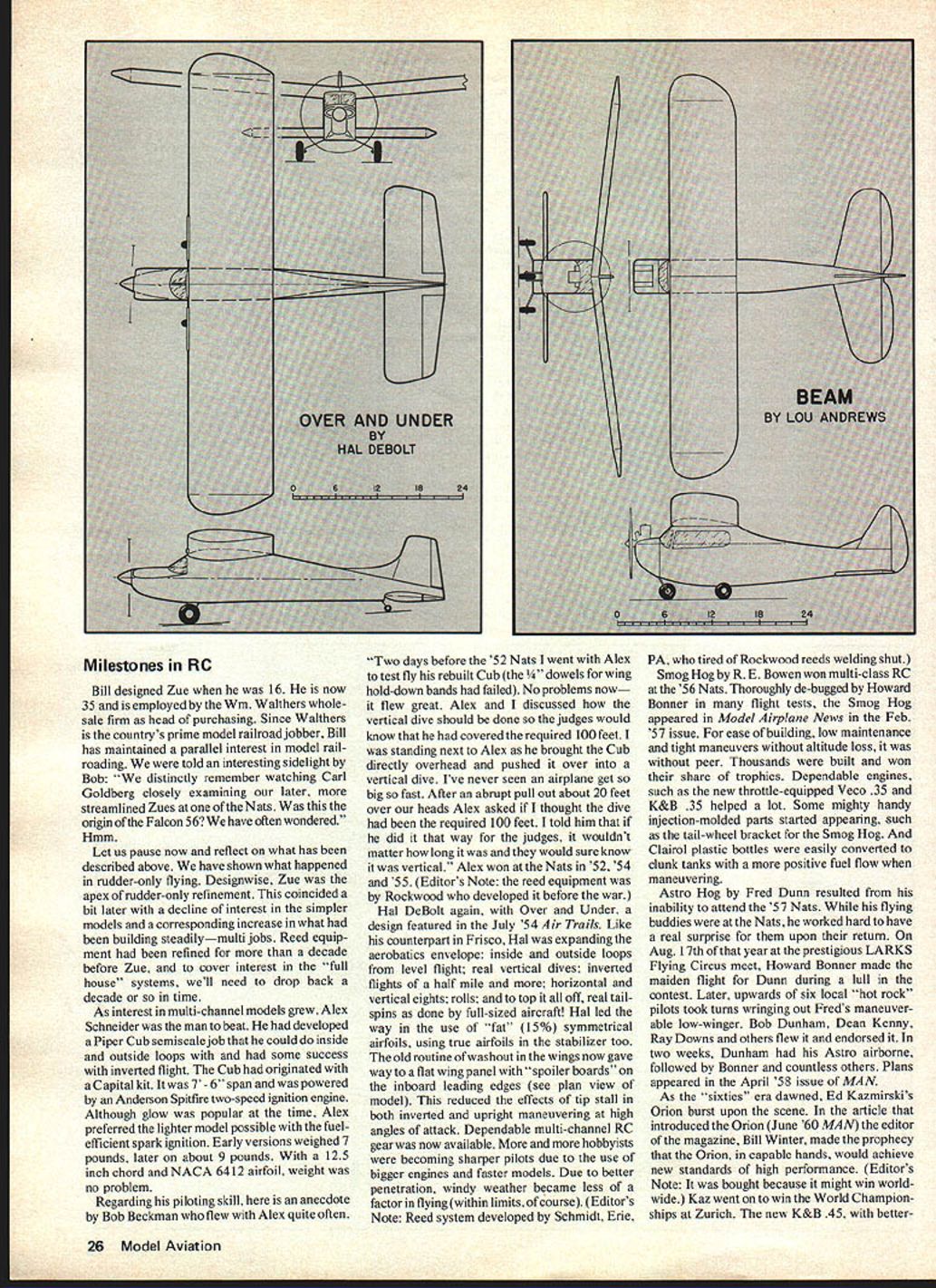
The Beam by Lou Andrews, kitted by the Guillow Corp., was a companion piece to DeBolt's Trainer in size, price and bulk. The main difference was trike landing gear and the use of inverted .09 engines often faired neatly with a deep cowl. The Trainer and Beam were among the first "designed for RC" kits and were a welcome change from free‑flight kits, which generally didn't withstand the rigors of RC flying.
Zue
By Bill Wischer
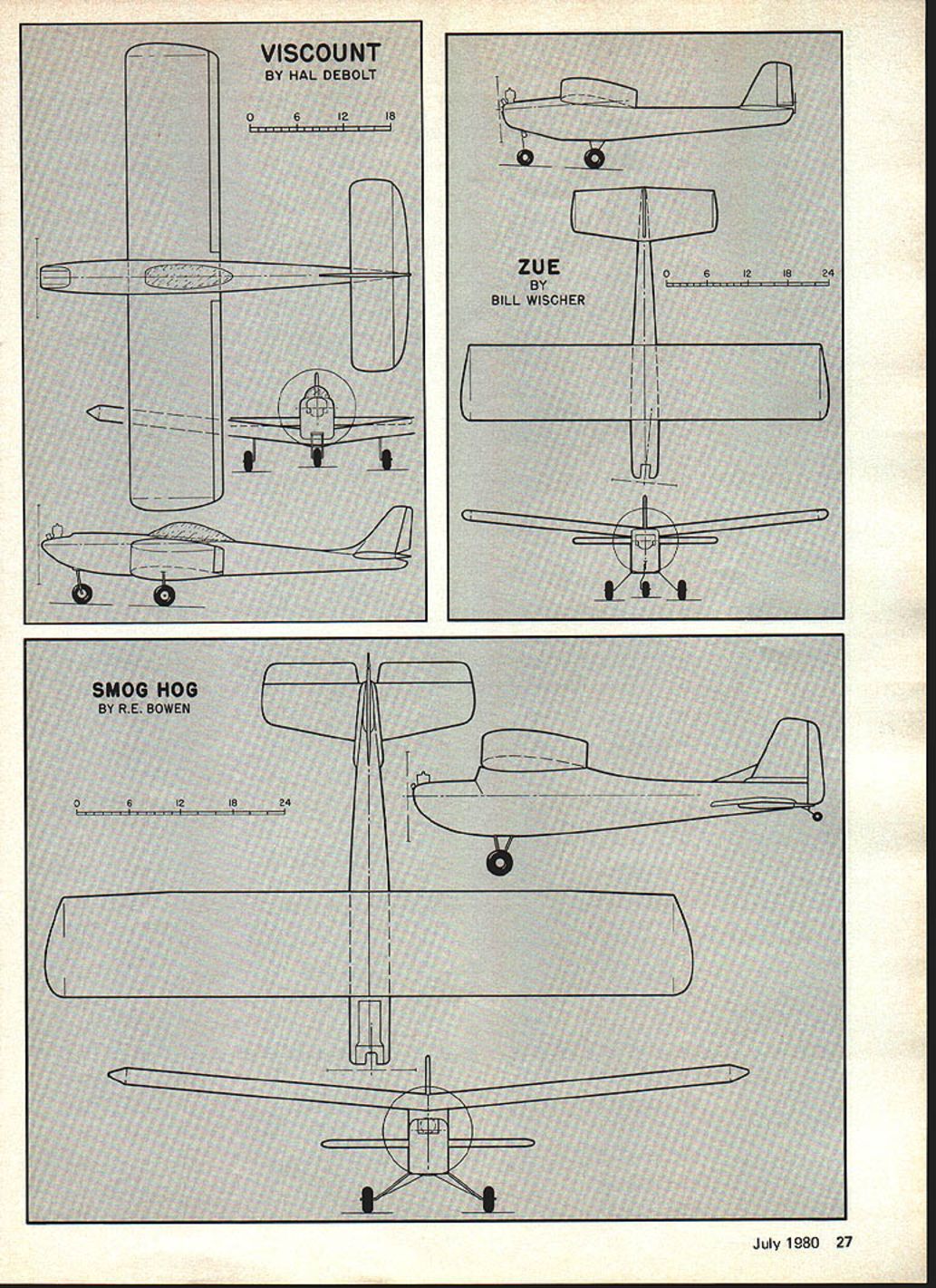
Bill Wischer designed Zue and won rudder‑only events at the Nats in 1960, 1961 and 1962. Bill used pulse rudder for an elementary form of proportional control, employing a large rudder to obtain dramatic results. From altitude, he could spin down to build speed, neutralize the rudder for continuous looping without loss of altitude, and use pulse‑proportional rudder for perfect tracking. A quick turn would reduce speed; a quick change to intermediate engine speed held speed at normal. For a barrel roll he held full rudder and high throttle and could roll continuously until the model was virtually out of sight. With the introduction of full‑house proportional gear at moderate prices, Bill's specialized skills became less unique.
Bob and Dolly Wischer (Bill's parents) also flew their own versions of Zue, though not with the success their son enjoyed. They developed super‑powered servos using Bonner motors and large nickel‑cadmium batteries. Their receivers, pulse omission detectors and large ground transmitters were home‑made. A drag brake (nose wheel snubber) on low throttle would stop the model for added taxi‑ability points.
Bill designed Zue when he was 16. He later worked as head of purchasing for Wm. Walthers, maintaining a parallel interest in model railroading. Bob noted they once saw Carl Goldberg examining their more streamlined Zues at a Nats—perhaps the origin of the Falcon 56.
Over and Under
By Hal DeBolt
Hal DeBolt's Over and Under (featured in the July 1954 Air Trails) expanded the aerobatics envelope: inside and outside loops from level flight, real vertical dives, inverted spins, long horizontal and vertical eights, rolls, and full‑sized tailspins. Hal led the way in the use of "flat" (15%) symmetrical airfoils, using true airfoils in the stabilizer as well. The old routine of washout in the wings gave way to a flat wing panel with "spoiler boards" on the inboard leading edges to reduce tip‑stall effects both inverted and upright at high angles of attack. Dependable multi‑channel RC gear was becoming available, and bigger engines with faster models made hobbyists sharper pilots and reduced the impact of windy weather.
Smog Hog
By R. E. Brown
Smog Hog, by R. E. Brown, won multi‑class RC at the 1956 Nats. Thoroughly de‑bugged by Howard Bonner, Smog Hog appeared in Model Airplane News in February 1957. For ease of building, low maintenance and tight maneuvers without altitude loss, it was without peer. Thousands were built and it won numerous trophies. Dependable throttle‑equipped engines such as the Veco .35 and K&B .35 helped a lot. Injection‑molded parts, like the Smog Hog tail‑wheel bracket, became common, and common household items (Clairol plastic bottles) were often converted to clunk tanks for positive fuel flow during maneuvers.
Astro Hog
By Fred Dunn
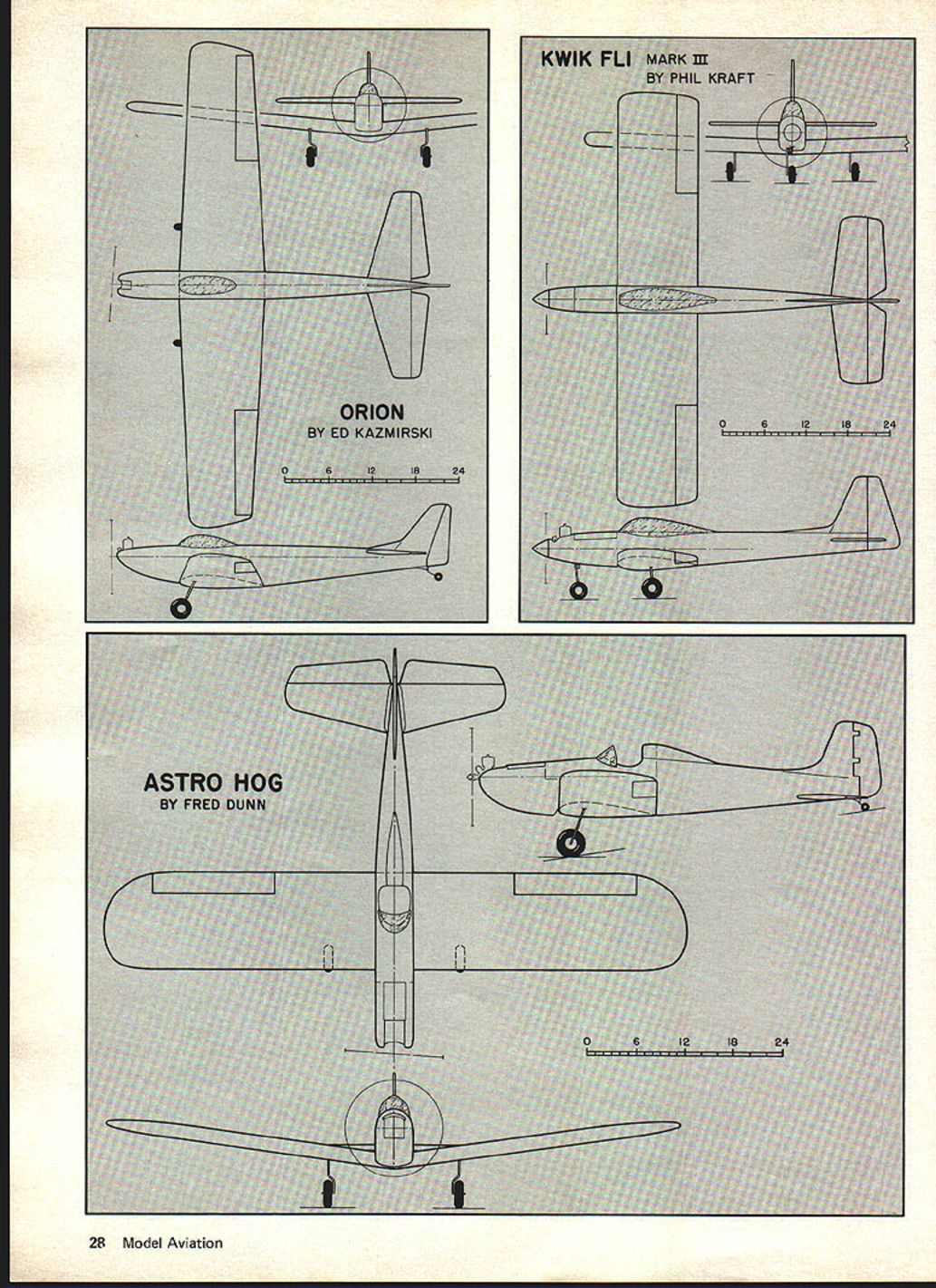
Astro Hog resulted from Fred Dunn's inability to attend the 1957 Nats; while his friends were at the Nats he worked to have a surprise ready for their return. On August 17 of that year at the LARKS Flying Circus meet, Howard Bonner made the maiden flight during a lull in the contest. Local hot‑rock pilots like Bonner, Bob Dunham, Dean Kenny and Ray Downs flew and endorsed it. Plans appeared in the April 1958 issue of Model Airplane News.
Oriole
By Ed Kazmirski
As the 1960s dawned, Ed Kazmirski's Oriole burst upon the scene. In the June 1960 MAN article introducing the Oriole, editor Bill Winter prophesied that in capable hands the Oriole would achieve new standards of high performance. Kazmirski went on to win the World Championships at Zurich. The new K&B .45 engine contributed to improved performance.
Viscount
By Hal DeBolt
Hal DeBolt's Viscount was introduced as a kit in 1962 (designed in 1960). It popularized a new idea of ultra‑simple ailerons—strip ailerons—using flexible cable within a curved metal tube to improve upon the bellcrank systems then in use. Inspired by full‑scale strip ailerons used on a Goodyear racer, Hal found strip ailerons lighter and providing greater torsional rigidity, reducing susceptibility to flutter. The Viscount was also one of the earliest designs featuring practical retracts; while Hal's particular retract system did not catch on commercially, it pointed the way for others.
Kwik Fli Mark III
By Phil Kraft
Conceived in 1963 and developed over a four‑year period, the Kwik Fli Mark III won the 1967 Nats for Phil Kraft. Developed in conjunction with Kraft proportional gear, the Kwik Fli series emphasized simplicity to achieve maximum flying with minimal construction effort. Plans for Kwik Fli III were published in MAN (Feb. 1968) and it was kitted by several firms. Phil Kraft became a top contender nationally and internationally.
Phoenix V
By Don Lowe
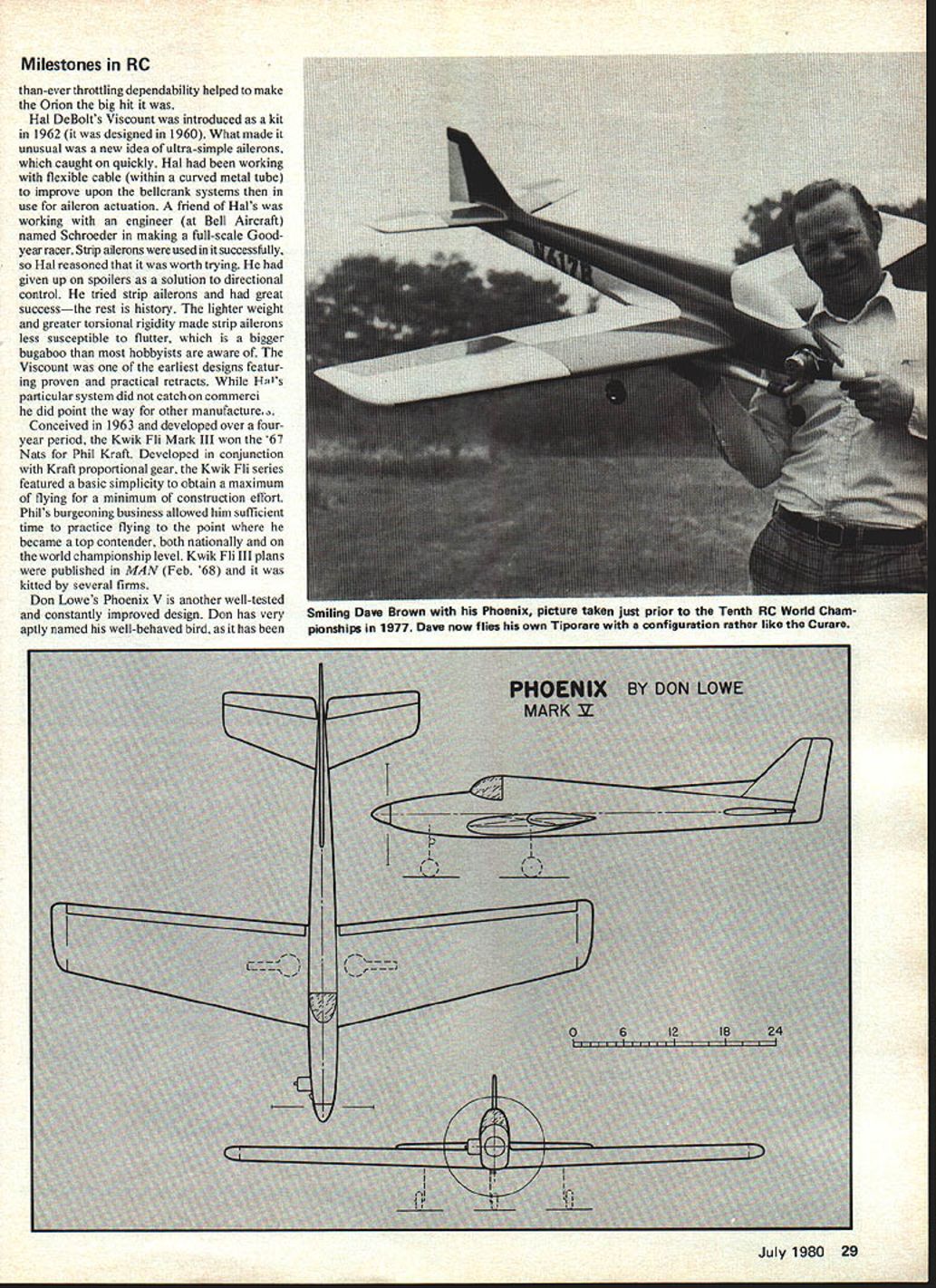
Don Lowe's Phoenix series has been well tested and constantly improved. Aptly named, the Phoenix has been wrung out time and time again, rising from its own ashes in continually improved versions. The Mark V (published in American Air Modeler, July 1971) listed many prior changes, and a Mark VIII was later announced, showing Don's continued pursuit of better performance.
Curare
By Hans & Hanno Prettner
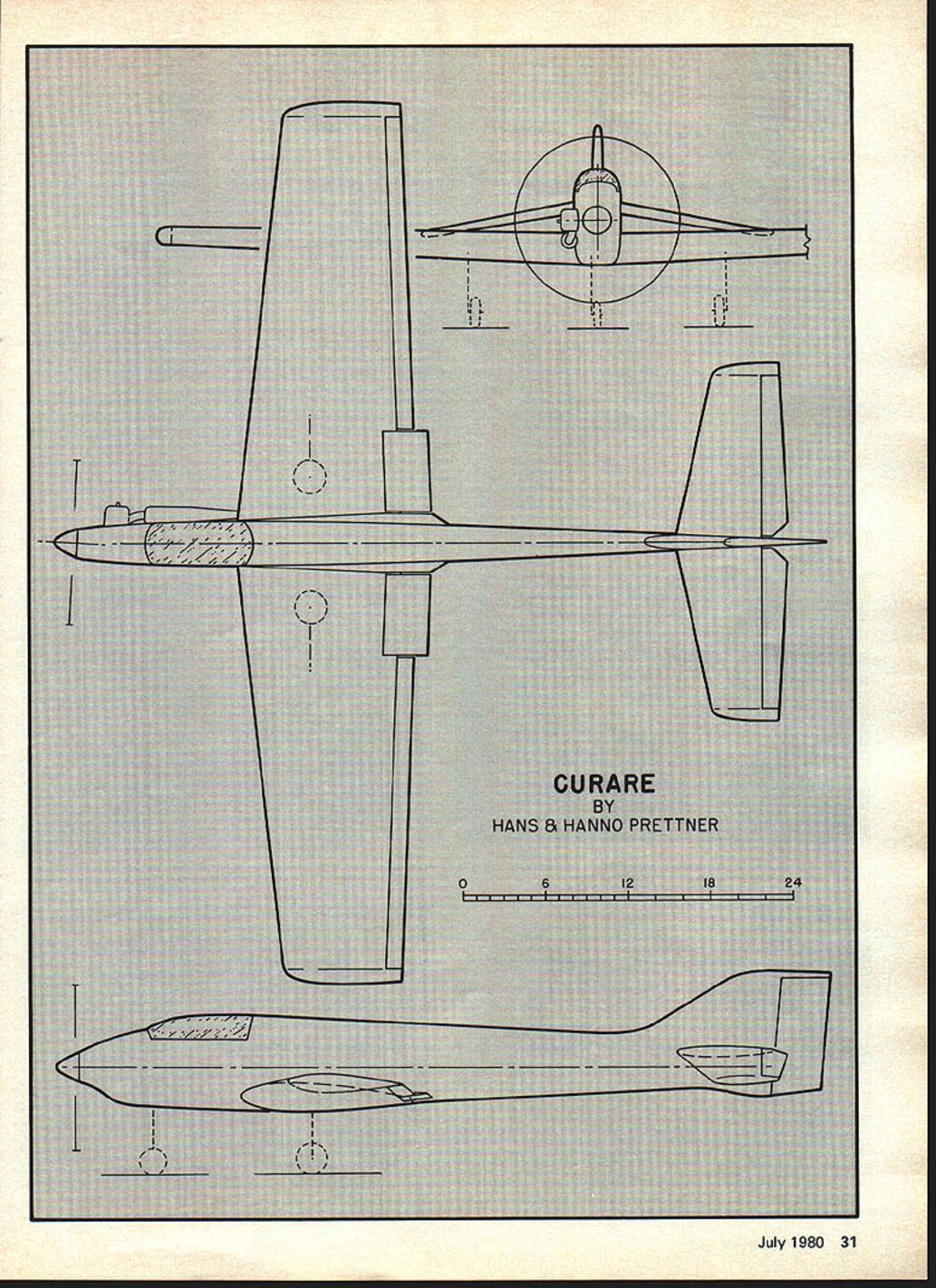
Representing the ultimate in the current state of the art, Curare by Hans and Hanno Prettner has won numerous prizes worldwide. It “looks right” with modest wing sweep, efficient landing/drag flaps and many refinements. Curare requires seven servos: rudder, elevator, aileron, throttle, retract, throttle mixture and flaps—so it is not a project for beginners. Model Airplane News published Curare in December 1976. A potent Webra .61 Speed RC engine supplies power; a tuned pipe muffler lowers the decibel rating to about 78, reasonable for the high rpm of Schnuerle‑ported engines. Curare (named for South American poison) is indeed “poison” to the competition in skilled hands.
In closing, the author would like to hear comments regarding this article. A lot of time was spent in research and correspondence to be as factual as possible. If anyone feels that a particular design has been slighted, let me know.
Paul Plecan 3023 Saratoga St., Riverside, CA 92503 (Or c/o M.A.)
Transcribed from original scans by AI. Minor OCR errors may remain.

