
Milwaukee Model Aero Club
By Jim Noonan
Introduction
We continue our glimpse of what modeling in America was like in the teens of 1900. World War I brought changes that broke up the group. Part 2 of 2.
It was only logical that my interest in this pioneering club and my newly acquired knowledge of club members' building methods and model designs led me to build replicas of their models. Most were fine fliers despite being built of basswood, pine, spruce, and a lot of bamboo. It was the rubber they were forced to use that really told the tale. Their best time by a twin pusher (132 sec.) was easily beaten on November 1, 1970, with a 181-sec. flight that had no help from thermals. That was real testimony to the superiority of good Pirelli. The model climbed very high among the RC planes on the field—to the surprise of the RC guys who would not believe we had carved the pine props ourselves.
Club models and exhibitions
The club built scale models, but no flight results are known. The models were exhibited each year at the public library with much view to attracting new club members. The idea of indoor flying had not yet occurred to anyone (true indoor flying began in Chicago in about 1919). Evidence of a primordial form of indoor flying is a model of 8-inch span with floats of folded note paper, varnished, which would take off from a meat platter filled with water. It was a novelty for club meetings and useful to impress company at home.
Thermals were unknown both to model fliers and aviators. When flights became longer it was assumed the reason was a better glide. None of the surviving club members could remember a model ever being carried out of sight upward in a thermal. Of course models were lost, but not in the sky!
History of the club
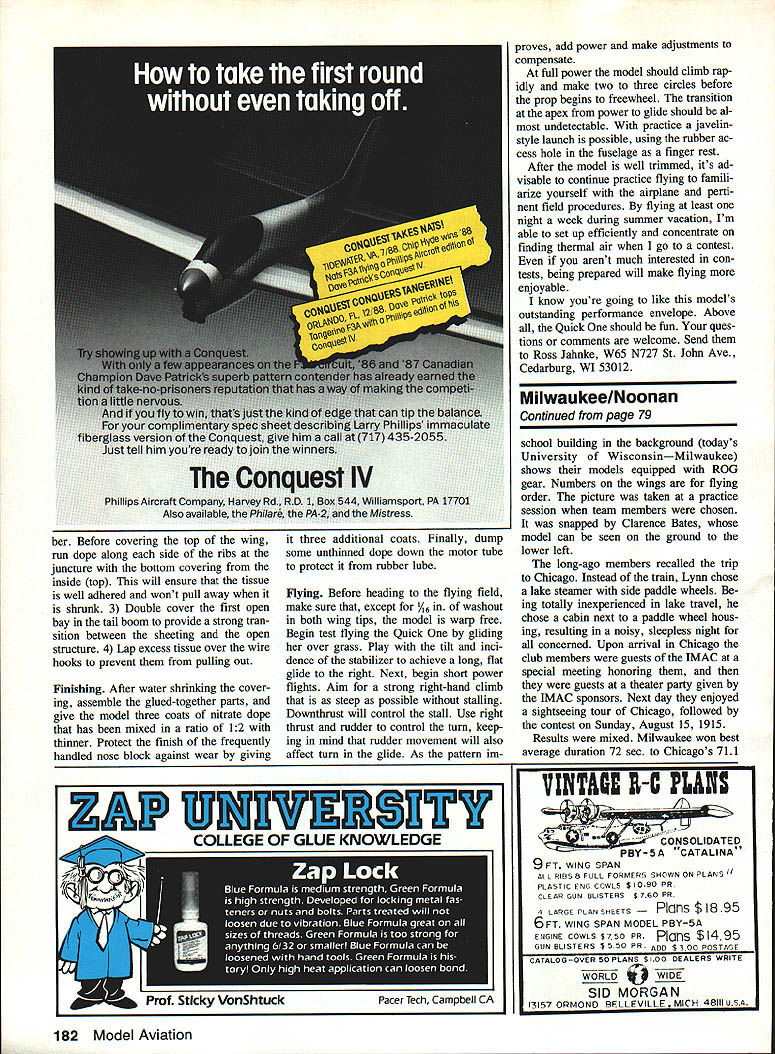
Ken Sedgwick built a twin pusher in 1914 and was trying to fly it in the driveway next to his home when Ervin Eiring stopped to observe. He invited Ken to attend a club meeting that evening at the home of the club leader, Lynn Davies. Ken and Ervin were in high school; Lynn was already in college. Ken was shown models that then were the state of the art, with paper-thin basswood props and superb wings covered with goldbeater's skin. Ken learned quickly and proved to be very original in model designing. Thus he and Ervin became building buddies.
The club held regular formal business meetings and kept minutes. Club activities were written up for and published by the Milwaukee Journal as well as the national Aerial Age Weekly. The governing body for model aviation at the time was the Aero Science Club of New York, the AMA of its day, to which the Milwaukee Model Aero Club (MMAC) became affiliated.
In early 1915 the Aero Club of America announced the National Model Competition for various types of flying models. The ACA Nationals were to be held each year for three years. The club with the highest point score was awarded the Villard Trophy. Here's how it worked: on the day a club held a meet the stated type model flights were witnessed by two adults, the results sent to the Aero Club of New York, and the modeler made three flights, the results being averaged. Finally, individual club member averages were totaled for a club average, and this translated into competition points.
Aerial Age and Flying magazines promoted the contest and, later, published the results.
1915 results and intercity meet
The Milwaukee Model Aero Club entered and sent the following results, August 30, 1915:
- Lynn Davies: 1,100 ft.
- Gilbert Counsell: 492 ft.
- Ervin Eiring: 438 ft.
- Ken Sedgwick: 601 ft.
The club average was 672 ft., earning fourth place. This was the only year the Milwaukee club entered.
Chicago's Illinois Model Aero Club entered all events each year (1915, 1916, and 1919) and won the Villard Trophy. It reposes today in Don Lockwood's attic along with many other IMAA trophies and mementos.
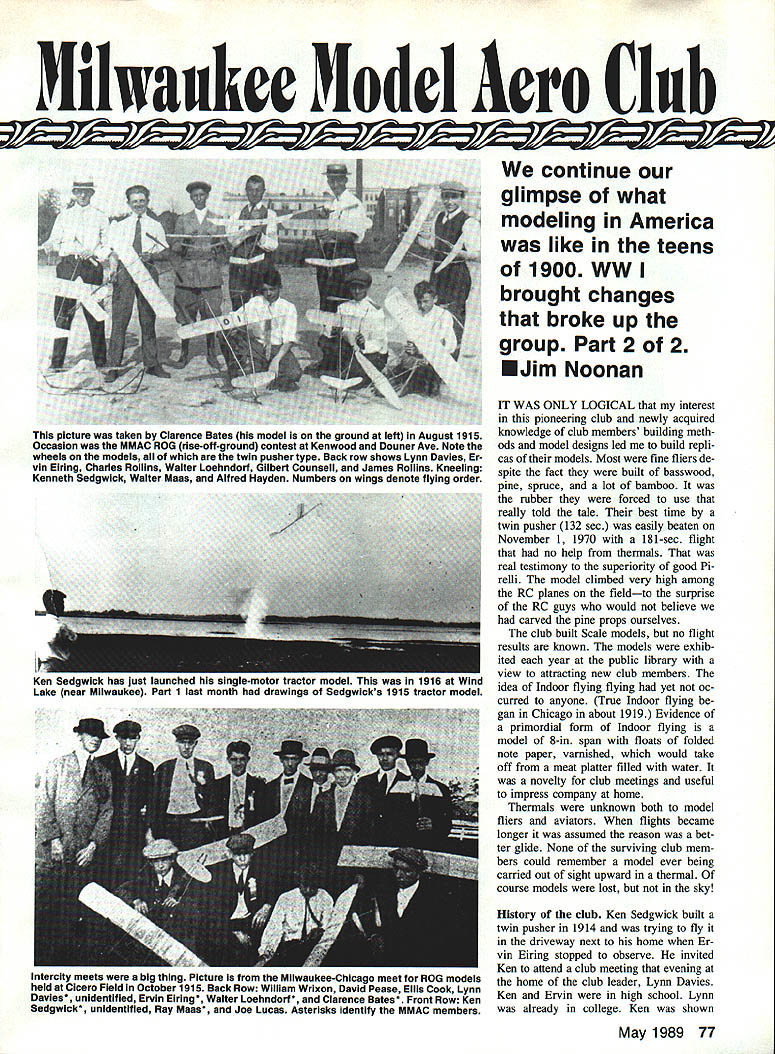
The prime event of 1915 was the first intercity meet between the Milwaukee and Chicago clubs. Each club selected a team with backup members and chose rise-off-ground (ROG) duration and distance as the events. A photo of the MMAC with the school building in the background (today's University of Wisconsin—Milwaukee) shows their models equipped with ROG gear. Numbers on the wings indicated flying order. The picture was taken at a practice session when team members were chosen. It was snapped by Clarence Bates, whose model can be seen on the ground to the lower left.
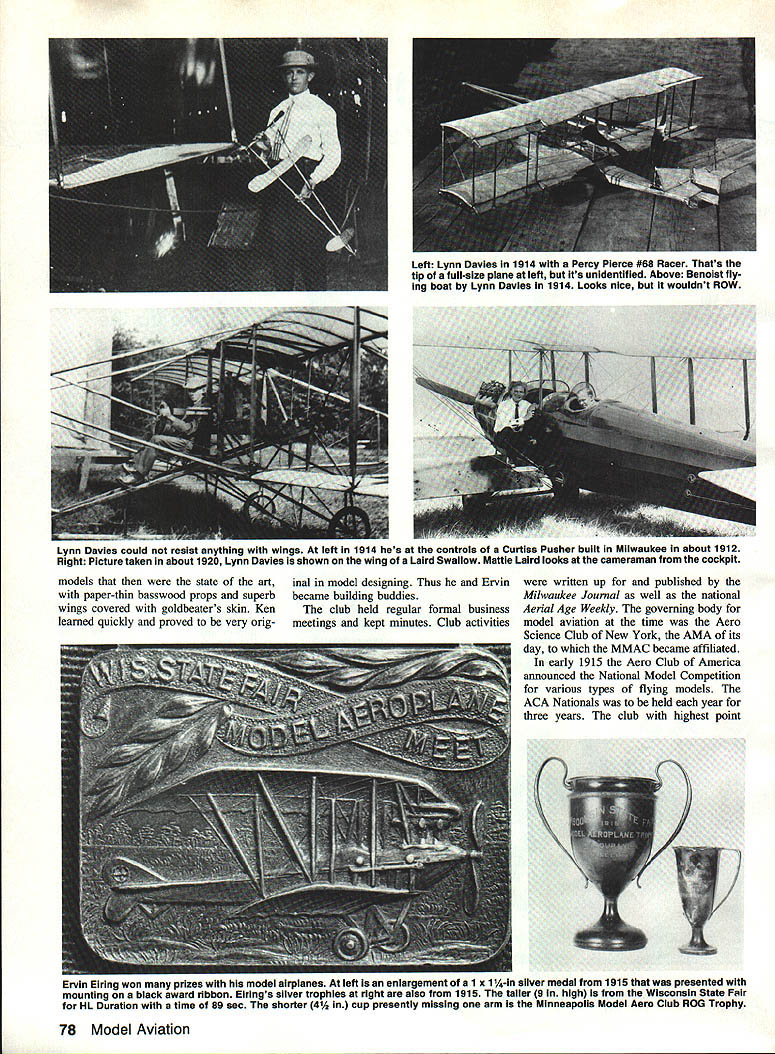
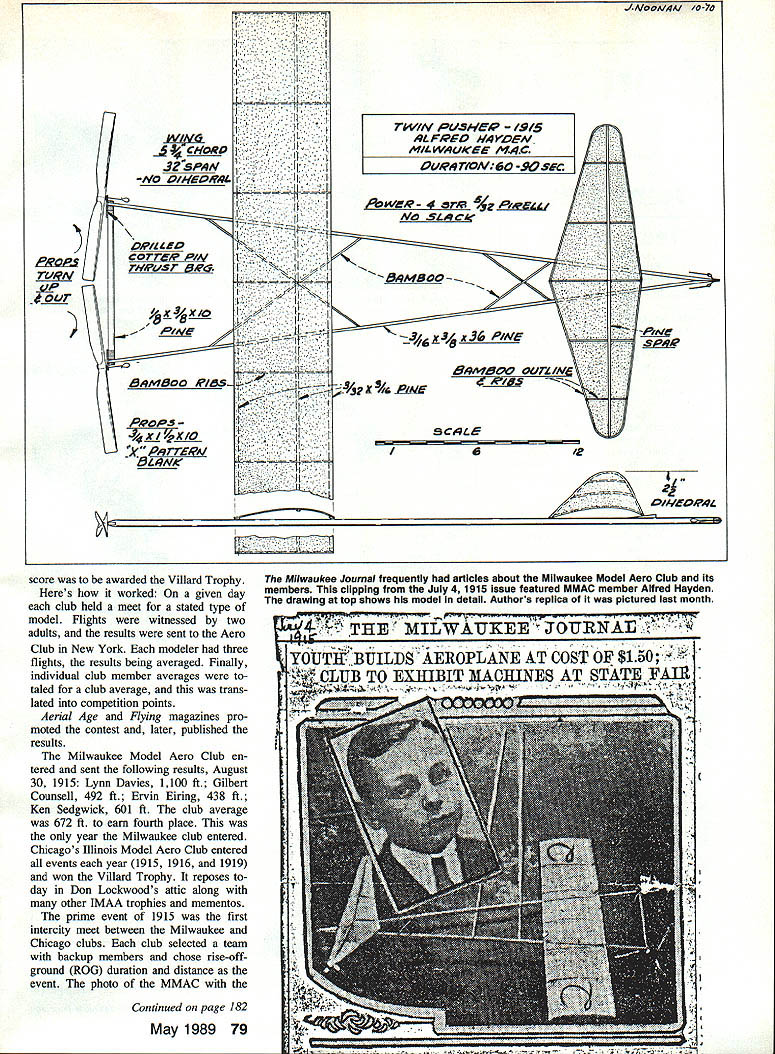
The long-ago members recalled the trip to Chicago. Instead of the train, Lynn chose a lake steamer with side paddle wheels. Being totally inexperienced in lake travel, he chose a cabin next to a paddle-wheel housing, resulting in a noisy, sleepless night for all concerned. Upon arrival in Chicago the club members were guests of the IMAC at a special meeting honoring them, and then they were guests at a theater party given by the IMAC sponsors. The next day they enjoyed a sightseeing tour of Chicago, followed by the contest on Sunday, August 15, 1915.
Results were very close. Milwaukee won best average duration, 72 sec., to Chicago's 71.1 sec. Chicago won distance, 747.3 ft. to Milwaukee's 691.4 ft. Combined points gave the meet to the IMAC, 198.7 to Milwaukee's 193.5. The clubs were quite evenly matched, and the contest resulted in lifelong friendships.
Milwaukee learned about "cans" at that meet. These were short lengths of tubing made from tin cans to keep the rubber in place next to the motor stick. MMAC members improved on the idea by making cans of bent bamboo rings. (By my time we made them of piano wire.)
Club innovations and events
The Milwaukee club also indulged in some fun events. Ken Sedgwick fitted a tiny camera to his model. It snapped good pictures in flight using a firecracker fuse to release a rubber band which tripped the shutter. The same device also released parachutes, and this came to be an event at their contests.
1916–1919 and decline
The year 1916 began with a club report reviewing the events of 1915 and plans to enter the National Meet (but they failed to do so). Flying began on June 16. However, the club's field was then found to be too small; models overflowed it repeatedly and were lost. Much activity continued, new officers were elected, and more plans were made to enter the Nationals (which again failed to materialize). Lynn left to attend Armour Institute in Chicago for graduate study not available in Milwaukee.
The club continued without him for another year, but lacking Lynn's guidance, no club reports were published. Meanwhile, Lynn was invited to join the IMAC and competed with their team in the 1916 National Contest.
By 1917 other members were leaving; the war had begun. Ken Sedgwick left to get an engineering degree at Armour. In general the grand time was over; members experienced more and more demands on their time. Ken thought that the last club activity occurred in 1919.
Known members (19 members as of 1915)
- Clarence Bates
- Gilbert M. Counsell
- Milo C. Counsell
- Lynn Davies
- Thomas Dunlop
- Ervin Eiring
- Alfred Hayden
- Walter Loehndorf
- Ray Maas
- Charles Rollins
- James Rollins
- Ken Sedgwick
- Ted Sedgwick
All are deceased.
Transcribed from original scans by AI. Minor OCR errors may remain.

