
Mini-electrics
One of the newest forms of electric-powered modeling is becoming established with Free Flighters. These diminutive electric motors, geared down and powered by tiny rechargeable nickel-cadmium (Ni-Cd) cells, are quiet, clean, very easy to use—and powerful. —Don Srull
Over the past several years the mini-electric motor has emerged as a popular power source for Free Flight scale and sport models. These small geared motors put out about 0.003 shaft horsepower, enough to fly models weighing two to three ounces with wing areas around 75–150 sq. in. The whole power package (motor, prop, batteries, switch, etc.) can weigh about an ounce. With a 30–60 second charge the power will sustain flights longer than one minute.
Early small electric systems (for example, the Mattel Super Star and VL Products’ Hytork system) were larger—about 2½ oz.—and delivered roughly 50% more power for bigger models (up to about 10 oz.). Today's mini-electrics are better suited to the popular 20–30 in. span sport and scale rubber-model sizes flown in local schoolyards and soccer fields.
Available systems
Exactly what are these power packs and where can you get them? Currently three companies market mini-electric power systems in the U.S.: Model Rectifier Corporation (MRC), VL Products, and Ferrell Enterprise (FE). All use small rectangular Mabuchi motors (about 3/8 × 3/4 in., ~12 g, three-pole, wound for 1–3 V, carbon brushes, bronze oilite bearings).
Battery packs have also shrunk: two 50–100 mAh Ni-Cd cells are common and the flight pack can weigh only 15–20 g. Good motors and compact cells at low prices make mini-electric models accessible.
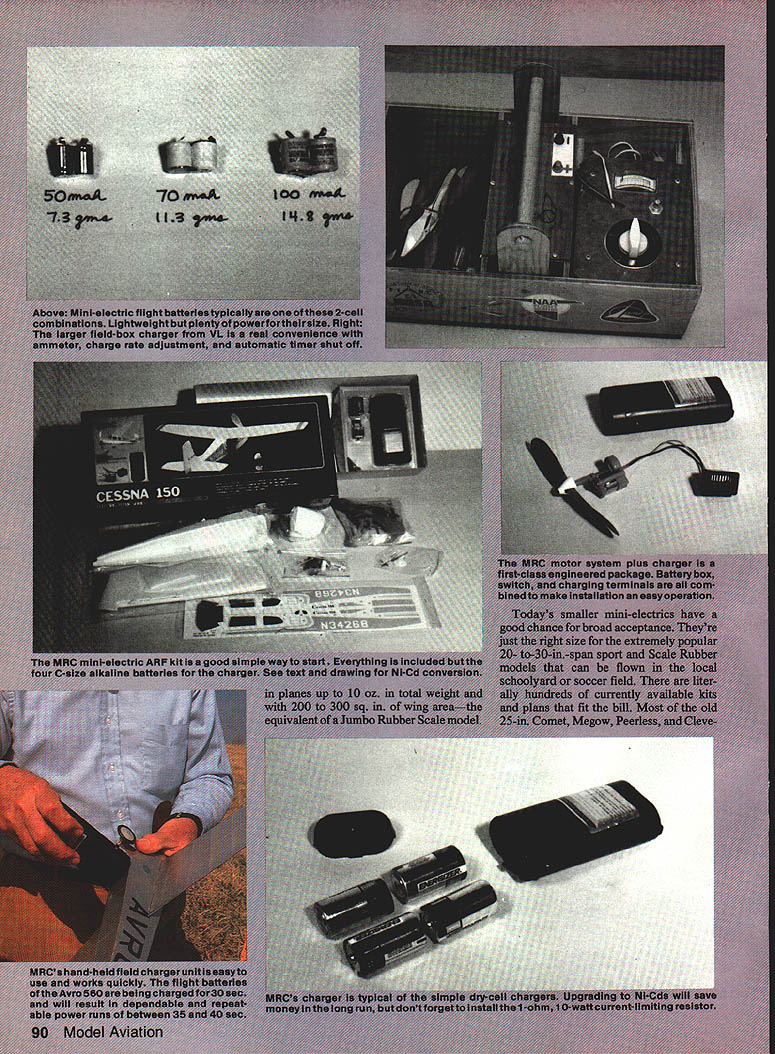
- MRC: Sells an all-foam, ready-to-fly 20 in. span semi-scale Cessna Cardinal with a complete power package (motor, prop, flight battery, switch, charger box). It uses a 6 in. Peck-Polymers prop and a two-cell 50 mAh flight battery. Add four C-size dry cells for the charger and you can be flying quickly. The package is an economical way to start (~$30 total). MRC replacement motor packs (motor, batteries, props, gears, charger, etc.) are available for about $12. (Model Rectifier Corp., 2500 Woodbridge Ave., Edison, NJ 08817.)
- VL Products: The HY-70 uses a higher gear ratio (7:1 vs. 4.5:1 on some others) and originally had the 70 mAh pack clipped directly to the motor (no switch). To charge the battery is removed and attached to a charging clip. This simple arrangement limits installation flexibility, so VL introduced the HY-70AR, which uses wires so the battery can be inside the model. VL motors also include a prop freewheeling device that decouples the prop when power is exhausted, reducing glide drag and protecting the flight batteries.
- Ferrell Enterprise (FE): Sells several motor/battery combinations. The Model .007 (two-cell) is similar in performance to MRC and VL. FE uses a simple frame and a 4.5:1 gear reduction. It includes a 5½ in. nylon prop (Williams Brothers), a two-cell 70 mAh battery pack, and a mini on/off/slide switch. Total airborne weight is about 28 g (1 oz). (Ferrell Enterprise, 300 W. Lincoln #82, Orange, CA 92665.)
Standard two-cell 50–70 mAh flight packs are near-optimum for most mini-electric models. Table 1 (not included here) summarizes three mini-electric systems and some of their specifications.
Charging flight batteries
Charging between flights is often the newcomer’s trouble spot. A typical mini-electric flight draws about 2 A. For a 30–60 sec run that equates to roughly 1–2 ampere-minutes (2 A × 0.5 min = 1 ampere-minute; 2 A × 1 min = 2 ampere-minutes).
Converting mAh to ampere-minutes:
- 50 mAh = 0.050 Ah × 60 min = 3 ampere-minutes
- 70 mAh = 0.070 Ah × 60 min = 4.2 ampere-minutes
- 100 mAh = 0.100 Ah × 60 min = 6 ampere-minutes
Common field chargers:
- Simple dry-cell chargers (typical MRC package) use four C-size cells in series (~6 V) and supply about 2 A. Left on for 1 minute they provide ~2 ampere-minutes. These chargers are convenient and fast but have drawbacks (see below).
- FE offers a charger using three C-size dry cells supplying ~1–1.5 A (50–100 sec charge). FE also markets a “slow” charger using two D-size dry cells at a much lower rate; it takes longer but substantially reduces the risk of overcharging.
Practical charging notes:
- Fast-charge at high rates can warm cells; for small 50–70 mAh cells it’s safest to fast-charge to about 75% of full capacity and avoid extended high-rate charging.
- Slower charge rates are safer; halving the charge current doubles the charging time.
- With simple dry-battery chargers you can learn to judge charge times for your flight durations, but you must time charges accurately (use a watch with seconds).
Shortcomings of simple dry-battery chargers:
- Dry cells have limited capacity and will wear down, requiring replacement and leading to longer charge times as they age.
- They lack an ammeter or charge meter, so the exact amount of charge delivered is unknown.
Upgrading chargers
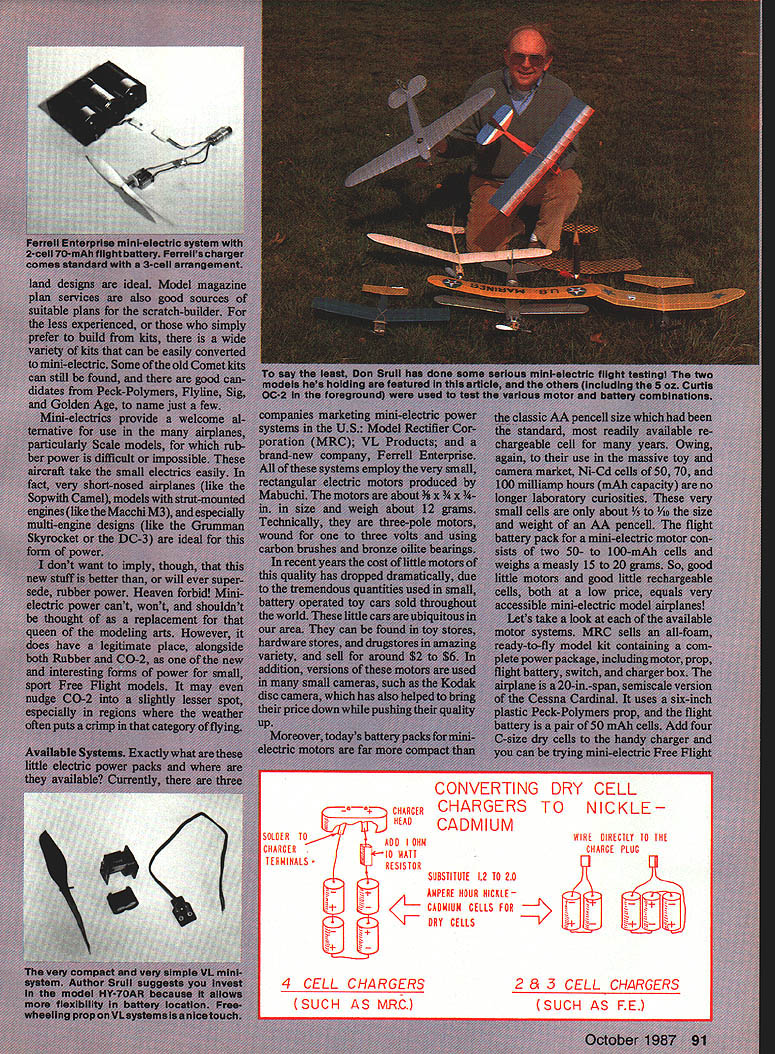
- For convenience and consistency, consider a more capable charger or converting your dry-cell charger to use rechargeable Ni-Cd sub-C or super-C cells (1.2–2.0 Ah). These packs provide more consistent charge current and are cost-effective over time compared with replacing many dry cells.
- If converting a 4-cell dry-cell charger to Ni-Cd, add a 1-ohm, 10-watt dropping resistor to limit charging current to about 2 A for small 50–70 mAh flight cells. Converting some FE chargers (two- or three-cell designs) may not require a dropping resistor; check current output.
- A good charger with an ammeter or charge timer greatly improves convenience and battery life.
Care and feeding of flight batteries
- Temperature is a good indicator of charge state: a slightly warm cell indicates a good charge; hot cells or a popping sound indicates overcharge and possible cell damage (cell venting). Damaged cells will not hold charge well and should be replaced.
- If a cell leaks or corrodes end caps, replace the pack immediately.
- With practice and careful timing, simple chargers work, but upgraded chargers and proper handling extend pack life and reliability.
Suitable models and installations
Models for mini-electrics should be built light—more like rubber-powered models than glow-engine designs.
Recommended targets:
- Wing area: 75–150 sq. in.
- Airframe weight (minus power system and prop): no more than 2 oz.
- Good target airframe weight: 1–1.5 oz.
If you have a rubber-powered model 20–30 in. span, remove its prop and rubber motor and weigh it—you'll often find it suitable for conversion to mini-electric.
Example designs:
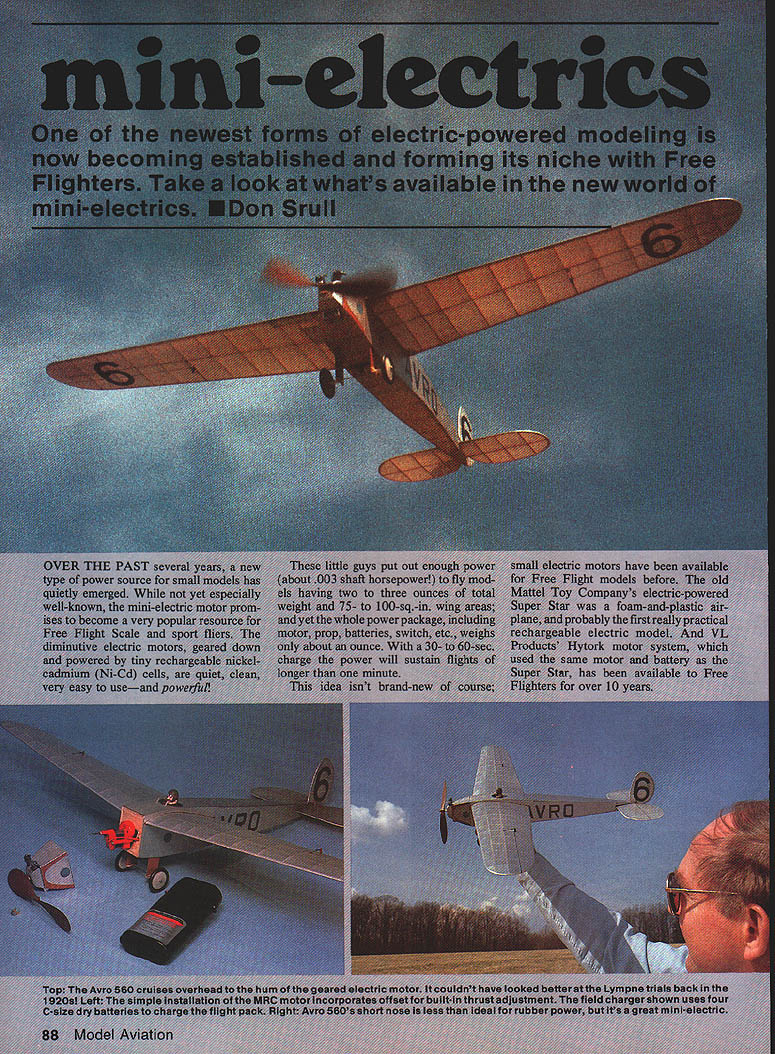
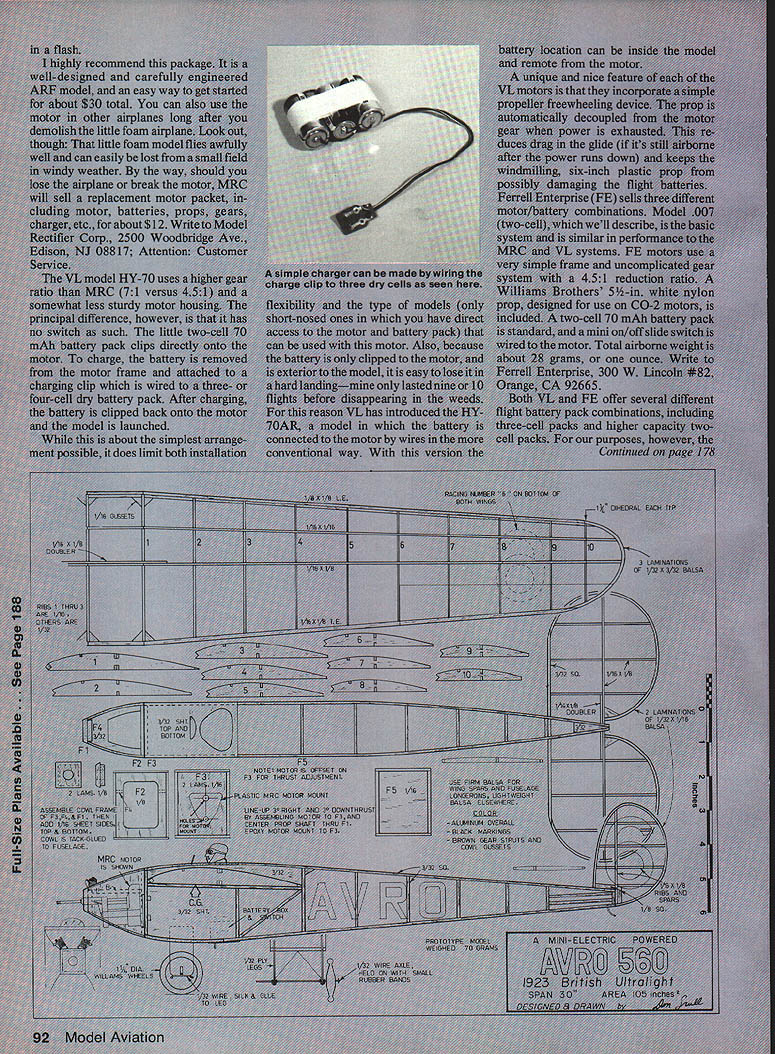
- Avro 560: 30 in. span, 105 sq. in. wing area, total weight 70 g (2.5 oz.), powered by the standard MRC system.
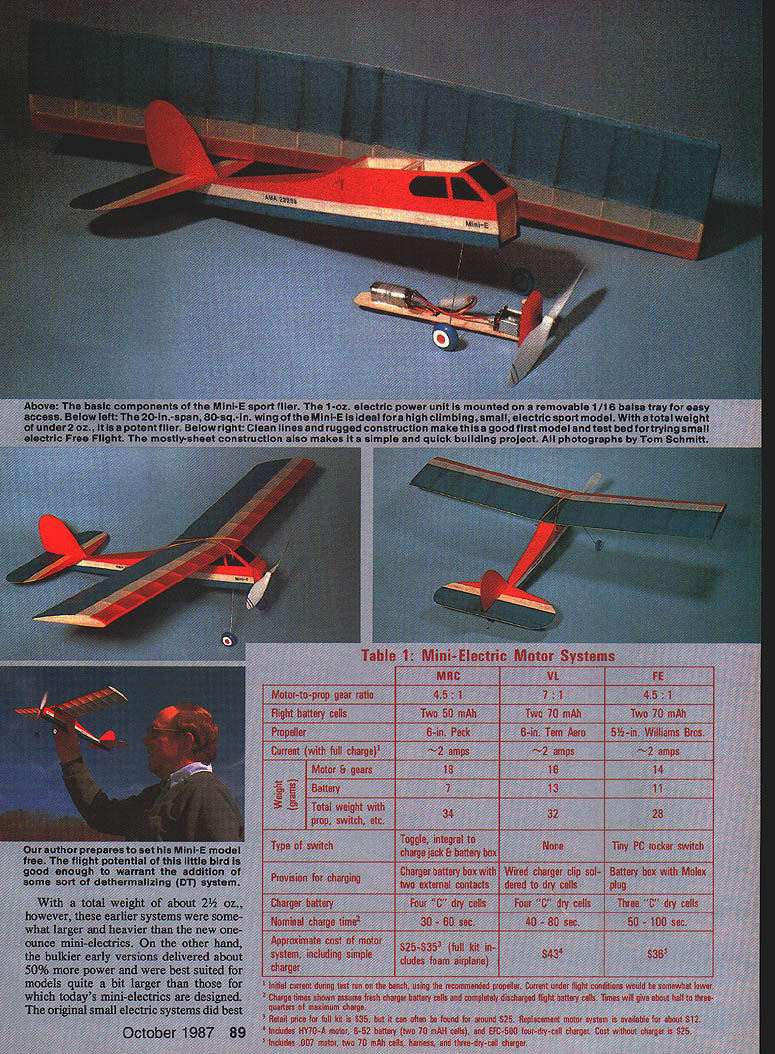
- Mini-E: ultralight sport model, 20 in. span, 80 sq. in. wing area, total weight 54 g (1.9 oz.), powered by the FE .007 two-cell system.
Both fly extremely well; the watchword is keep them light.
Conclusion
Mini-electrics are a fun, quiet, and accessible way to fly small free-flight models. If there is interest, further articles can cover do-it-yourself tricks: motor rewinding, alternative flight batteries, field chargers, charger enhancements, and supply sources. Meanwhile, get into this new fun thing—you'll get a charge out of it!
Transcribed from original scans by AI. Minor OCR errors may remain.

