
Minute Man: It's never too late to build your childhood dream plane.
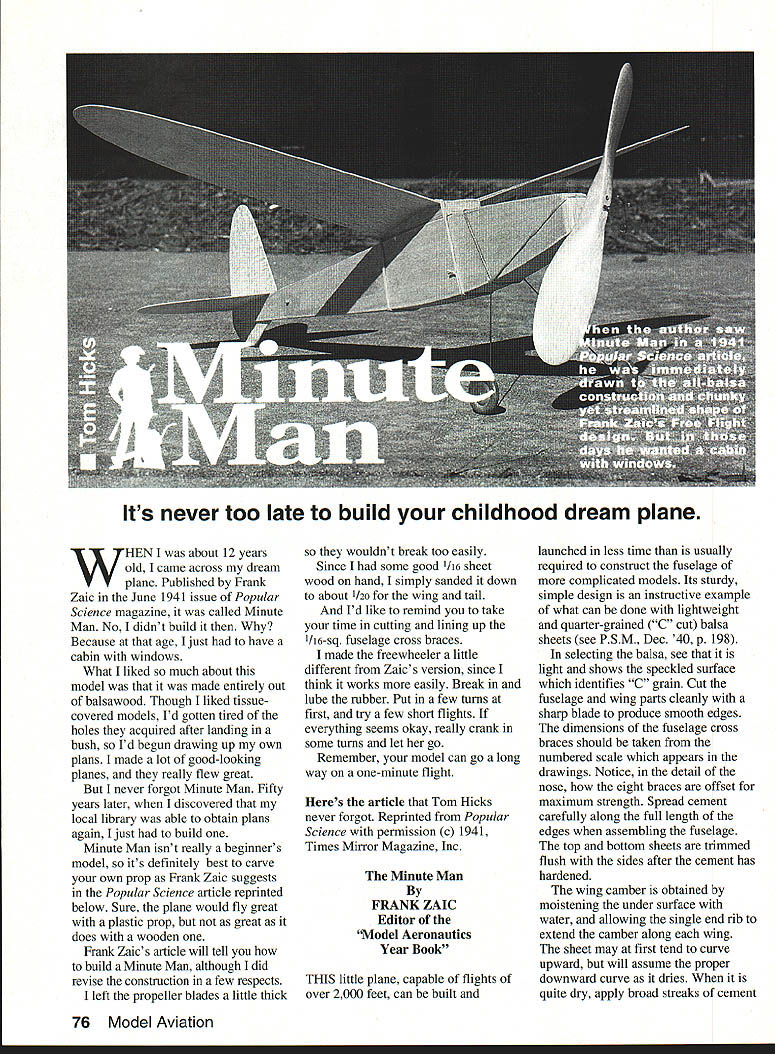
When I was about 12 years old, I came across my dream plane. Published by Frank Zaic in the June 1941 issue of Popular Science magazine, it was called Minute Man. No, I didn't build it then. Why? Because at that age, I just had to have a cabin with windows.
What I liked so much about this model was that it was made entirely out of balsa wood. Though I liked tissue-covered models, I'd gotten tired of the holes they acquired after landing in a bush, so I'd begun drawing up my own plans. I made a lot of good-looking planes, and they really flew great.
But I never forgot Minute Man. Fifty years later, when I discovered that my local library was able to obtain plans again, I just had to build one.
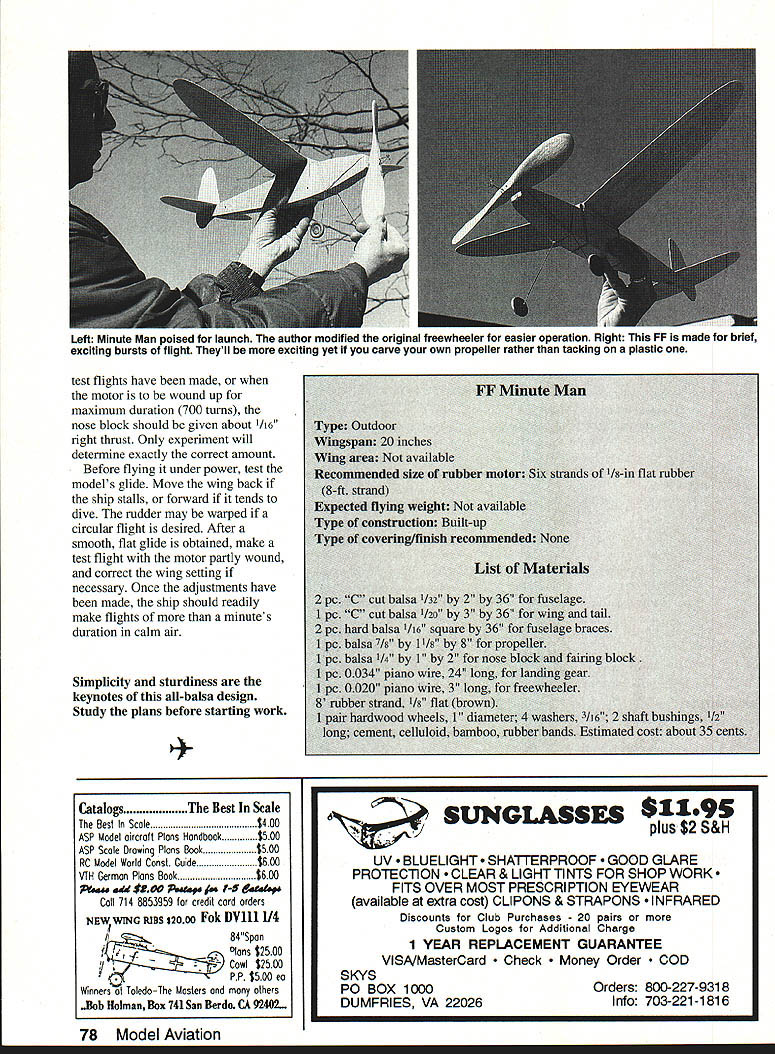
Minute Man isn't really a beginner's model, so it's definitely best to carve your own prop as Frank Zaic suggests in the Popular Science article reprinted below. Sure, the plane would fly great with a plastic prop, but not as great as it does with a wooden one.
Frank Zaic's article will tell you how to build a Minute Man, although I did revise the construction in a few respects. I left the propeller blades a little thick so they wouldn't break too easily.
Since I had some good 1/16" sheet wood on hand, I simply sanded it down to about 1/20" for the wing and tail.
And I'd like to remind you to take your time in cutting and lining up the 1/16" square fuselage cross braces.
I made the freewheeler a little different from Zaic's version, since I think it works more easily. Break in and lube the rubber. Put in a few turns at first, and try a few short flights. If everything seems okay, really crank in some turns and let her go.
Remember, your model can go a long way on a one-minute flight.
Here's the article that Tom Hicks never forgot. Reprinted from Popular Science with permission (c) 1941, Times Mirror Magazine, Inc.
The Minute Man
By FRANK ZAIC
Editor of "Model Aeronautics Year Book"
This little plane, capable of flights of over 2,000 feet, can be built and launched in less time than is usually required to construct the fuselage of more complicated models. Its sturdy, simple design is an instructive example of what can be done with lightweight and quarter-grained ("C" cut) balsa sheets (see P.S.M., Dec. '40, p. 198).
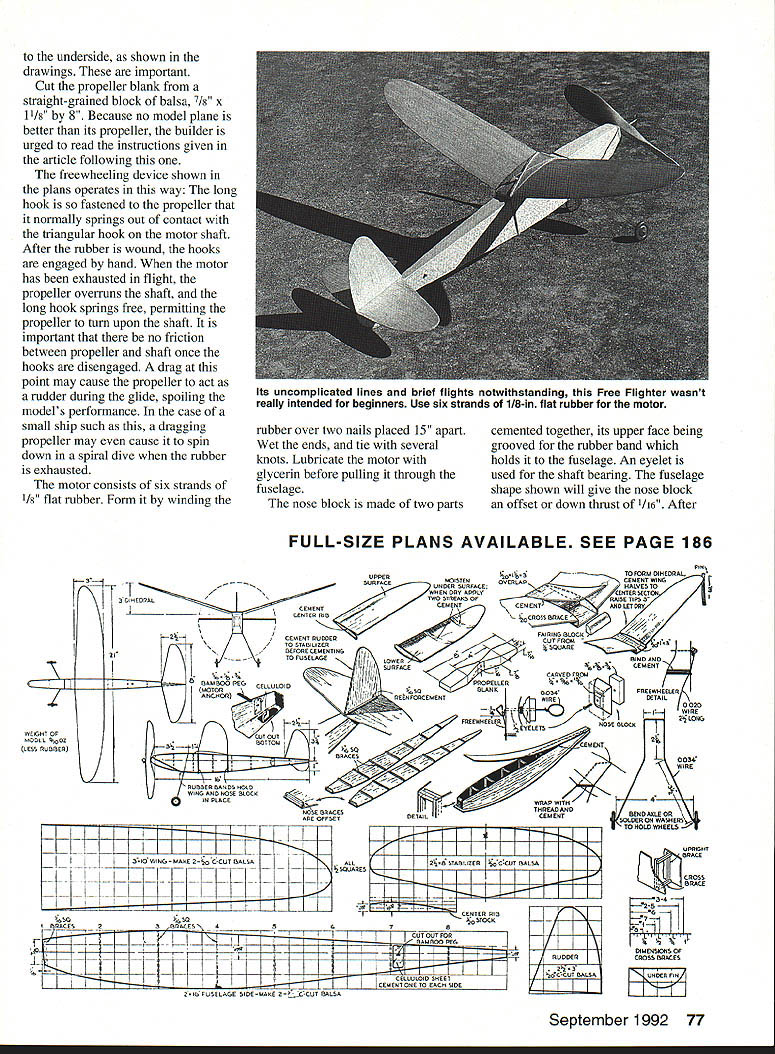
In selecting the balsa, see that it is light and shows the speckled surface which identifies "C" grain. Cut the fuselage and wing parts cleanly with a sharp blade to produce smooth edges. The dimensions of the fuselage cross braces should be taken from the numbered scale which appears in the drawings. Notice, in the detail of the nose, how the eight braces are offset for maximum strength. Spread cement carefully along the full length of the edges when assembling the fuselage. The top and bottom sheets are trimmed flush with the sides after the cement has hardened.
The wing camber is obtained by moistening the under surface with water, and allowing the single end rib to extend the camber along each wing sheet. The sheet may at first tend to curve upward, but will assume the proper downward curve as it dries. When it is quite dry, apply broad streaks of cement to the underside, as shown in the drawings. These are important.
Cut the propeller blank from a straight-grained block of balsa, 7/8" x 1-1/8" x 8". Because no model plane is better than its propeller, the builder is urged to read the instructions given in the article following this one.
The freewheeling device shown in the plans operates in this way: The long hook is so fastened to the propeller that it normally springs out of contact with the triangular hook on the motor shaft. After the rubber is wound, the hooks are engaged by hand. When the motor has been exhausted in flight, the propeller overruns the shaft, and the long hook springs free, permitting the propeller to turn upon the shaft. It is important that there be no friction between propeller and shaft once the hooks are disengaged. A drag at this point may cause the propeller to act as a rudder during the glide, spoiling the model's performance. In the case of a small ship such as this, a dragging propeller may even cause it to spin down in a spiral dive when the rubber is exhausted.
The motor consists of six strands of 1/8" flat rubber. Form it by winding the rubber over two nails placed 15" apart. Wet the ends, and tie with several knots. Lubricate the motor with glycerin before pulling it through the fuselage.
The nose block is made of two parts cemented together; its upper face being grooved for the rubber band which holds it to the fuselage. An eyelet is used for the shaft bearing. The fuselage shape shown will give the nose block an offset or down thrust of 1/16". When test flights have been made, or when the motor is to be wound up for maximum duration (700 turns), the nose block should be given about 1/16" right thrust. Only experiment will determine exactly the correct amount.
Before flying it under power, test the model's glide. Move the wing back if the ship stalls, or forward if it tends to dive. The rudder may be warped if a circular flight is desired. After a smooth, flat glide is obtained, make a test flight with the motor partly wound, and correct the wing setting if necessary. Once the adjustments have been made, the ship should readily make flights of more than a minute's duration in calm air.
Simplicity and sturdiness are the keynotes of this all-balsa design. Study the plans before starting work.
FF Minute Man
- Type: Outdoor
- Wingspan: 20 inches
- Wing area: Not available
- Recommended size of rubber motor: Six strands of 1/8-in flat rubber (8-ft. strand)
- Expected flying weight: Not available
- Type of construction: Built-up
- Type of covering/finish recommended: None
List of Materials
- 2 pcs. "C" cut balsa 1/32" x 2" x 36" for fuselage
- 1 pc. "C" cut balsa 1/16" x 3" x 36" for wing and tail
- 2 pcs. hard balsa 1/16" square x 36" for fuselage braces
- 1 pc. balsa 1/8" x 1-1/8" x 8" for propeller
- 1 pc. balsa 1/4" x 1" x 2" for nose block and fairing block
- 1 pc. 0.034" piano wire, 24" long, for landing gear
- 1 pc. 0.020" piano wire, 3" long, for freewheeler
- 8' rubber strand, 1/8" flat (brown)
- 1 pair hardwood wheels, 1" diameter
- 4 washers, 3/16"
- 2 shaft bushings, 1/2" long
- cement, celluloid, bamboo, rubber bands
Estimated cost: about 35 cents.
Transcribed from original scans by AI. Minor OCR errors may remain.

