
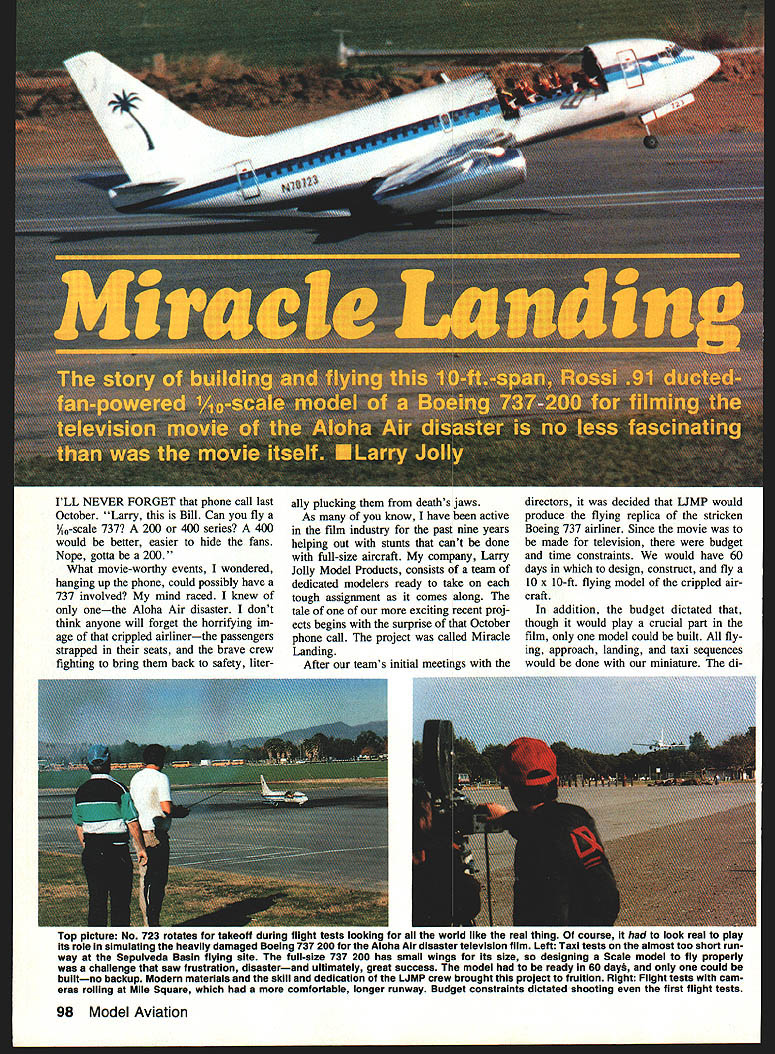
Miracle Landing
By Larry Jolly
The story of building and flying this 10-ft.-span, Rossi .91 ducted-fan–powered 1/10-scale model of a Boeing 737-200 for filming the television movie of the Aloha Air disaster is no less fascinating than the movie itself.
I'll never forget that phone call last October. "Larry, this is Bill. Can you fly a 1/10-scale 737? A 200 or 400 series? A 400 would be better, easier to hide the fans. Nope, gotta be 200."
What movie-worthy events, I wondered, could possibly have a 737 involved? My mind raced. I knew of only one—the Aloha Air disaster. I don't think anyone will forget the horrifying image of that crippled airliner—the passengers strapped in their seats and the brave crew fighting to bring them back to safety, literally plucking them from death's jaws.
As many of you know, I have been active in the film industry for the past nine years helping out with stunts that can't be done with full-size aircraft. My company, Larry Jolly Model Products (LJMP), consists of a team of dedicated modelers ready to take on each tough assignment as it comes along. The tale of one of our more exciting recent projects begins with the surprise of that October phone call. The project was called Miracle Landing.
The Assignment
After our initial meetings with the directors, it was decided that LJMP would produce the flying replica of the stricken Boeing 737. Since the movie was to be made for television, there were budget and time constraints. We would have 60 days to design, construct, and fly a 10-ft.-span flying model of the crippled aircraft.
The budget dictated that, though it would play a crucial part in the film, only one model could be built. All flying, approach, landing, and taxi sequences would be done with the miniature model. The director was finicky and a stickler for authenticity, so we couldn't fudge the damage to the aircraft. He reluctantly agreed to let us increase the size of the nacelles by 20 percent. The external detail had to hold up to the required tight shots. Finally, we had to produce a full crew and passenger complement for the interior shots.
On the plus side, the film company had a solid fiberglass 1/6-scale 737 that we could use as a plug for molding our own fiberglass parts. The plug was pretty close to scale and a big time-saver.
Team and Responsibilities
As with most of our projects, we delegated the work so all subassemblies would come together at the same time and we could meet our deadline.
- Engineering: Jim Jolly, Kent McKenna, Larry Jolly
- Molds and glass parts: Bart Frazee
- Nacelle plugs: Jim Jolly and Dennis Brandt
- Wing and stab foam cutting: Kent McKenna and Ken Williams
- Wings and stabs final assembly: Kent McKenna
- Fuselage: Larry Jolly (with team help)
The work was essentially done in our spare time; we were all holding down full-time day jobs during construction. The model was completed in five weeks of spare-time work.
Construction: Airframe and Wings
The fuselage, nacelles, and vertical stabilizer were laid up in epoxy fiberglass with S-glass reinforcement where necessary. The fuselage weighed 11 pounds bare, which is outstanding considering it is constructed in three sections and measures over 10 feet long and 16 inches in diameter. The S-glass was laid longitudinally and around the barrel-like formers. This reinforcement stiffened the fuselage and minimized "oil canning."
Kent cut the wings and stabs from 2-lb. white foam. We decided to construct the wing in one piece to make the model more solid and keep the weight down. Though it's a fairly good-sized craft, the 737 has a comparatively small wing.
Ducted-fan operation, filming, and wing loading were constantly on our minds. The wing cores were cut in five pieces. Each wing had a center panel and a tip and was mated to a center section that bolts to the fuselage. Initially the main center panel was tack-glued to the left and right center panels. We then added unidirectional fiberglass spar caps and sheeted the upper surface with 3/32-in. balsa.
From the bottom we added a 1/8-in. full-depth spar constructed from 1/4-in. end-grain balsa capped on both sides with 1/8-in. plywood, with unidirectional fiberglass between the balsa and plywood. This main wing spar doubled as the main landing gear support. The rest of the wing was constructed in standard foam-and-balsa format, always using unidirectional strips under the 3/32-in. balsa sheeting.
Powerplants, Nacelles, and Systems
While we were building the airframe, Steve Korney of Hurricane Fans was building our powerplants. It was decided we needed pulling power more than top speed. Steve suggested his six-bladed tractor fan unit, powered by Rossi .91s with Picco carbs.
The nacelles were designed with an internal firewall to accept the Hurricane fan unit. The bell mouth then slips into place and the nacelle halves are faired and glued. The nacelles were glassed and faired to shape, and a 1/8-in. plywood bulkhead was installed to accept the nacelle mount and landing-gear attachments. The nacelles were made just large enough to take the Hurricane units and are secured with screws.
The 737 model featured aileron, flap, throttle, retracts, rudder, and elevator functions. All control surfaces had their own servos for safety. For guidance we used my Futaba PCM 8-channel radio with 13 servos. Futaba servos were used throughout, with the exception of the throttle control, which was handled by one S-33 for each engine.
The landing gear was a major concern. Ultimately we chose Robart quarter-scale pneumatic units for the mains and a modified B&D manual unit for the nose gear. The Robart mains took an incredible amount of abuse without failing.
Interior, Fuel, and Finish
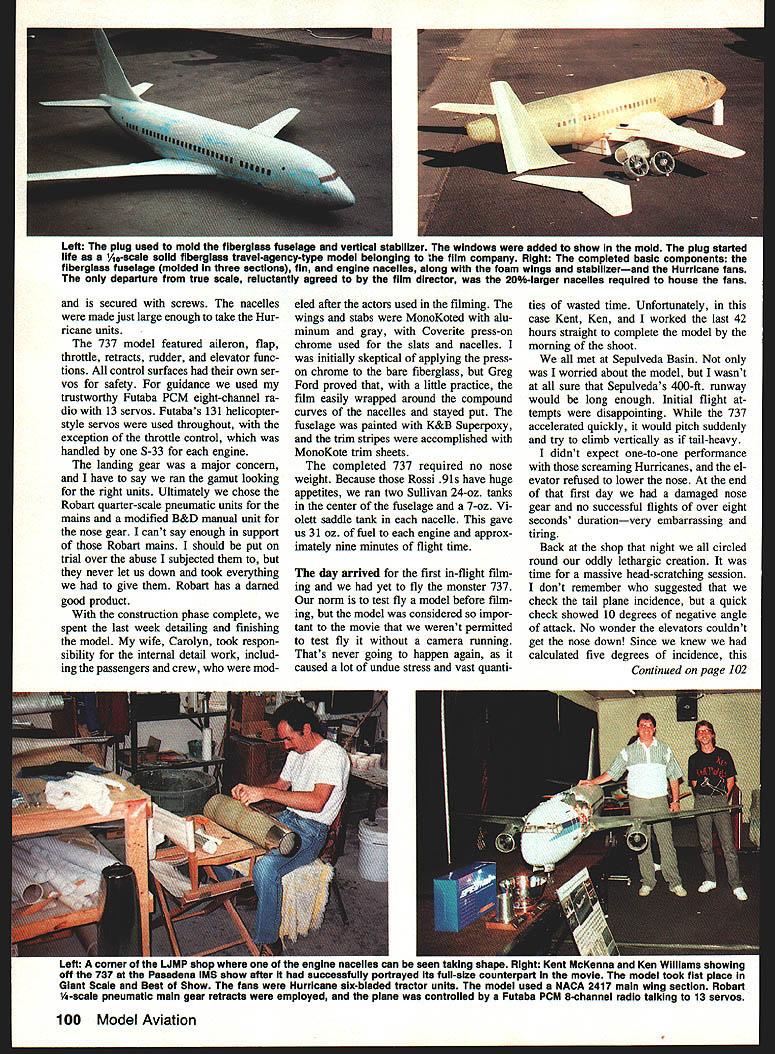
With the airframe essentially completed and the engines installed, we finished the interior. The passenger cabin was outfitted with molded seats and seat belts, and the pilots and passengers were constructed as mannequins for the tight interior shots. All interior detail had to be authentic and stand up to close scrutiny in the film.
My wife, Carolyn, took responsibility for the internal detail work, including the passengers and crew, who were modeled after the actors used in the filming. The wings and stabs were MonoKoted with aluminum and gray, with Coverite press-on chrome used for the slats and nacelles. I was initially skeptical of applying the press-on chrome to the bare fiberglass, but Greg Ford proved that with a little practice the film easily wrapped around the compound curves of the nacelles and stayed put. The fuselage was painted with K&B Superoxy, and the trim stripes were accomplished with MonoKote trim sheets.
Because Rossi .91s have large appetite, we ran two Sullivan 24-oz. tanks in the center of the fuselage and a 7-oz. saddle tank in each nacelle. This gave us 31 oz. of fuel to each engine and approximately nine minutes of flight time.
Flight Testing: Early Trials
Flight testing was conducted at Sepulveda Basin and Mile Square Park. The airplane flew well during checkout flights. Once the camera crew was ready and the shots planned, the airplane was taken to the film location and the flying sequences completed without incident. The model performed beautifully, and the production people were pleased with the realism we achieved.
The day arrived for the first in-flight filming and we had yet to test the monster 737. Our norm is to test fly a model before filming, but the model was considered so important to the movie that we weren't permitted to test fly it without a camera running. That caused a lot of undue stress and wasted time. In this case Kent, Ken, and I worked the last 42 hours straight to complete the model by the morning of the shoot.
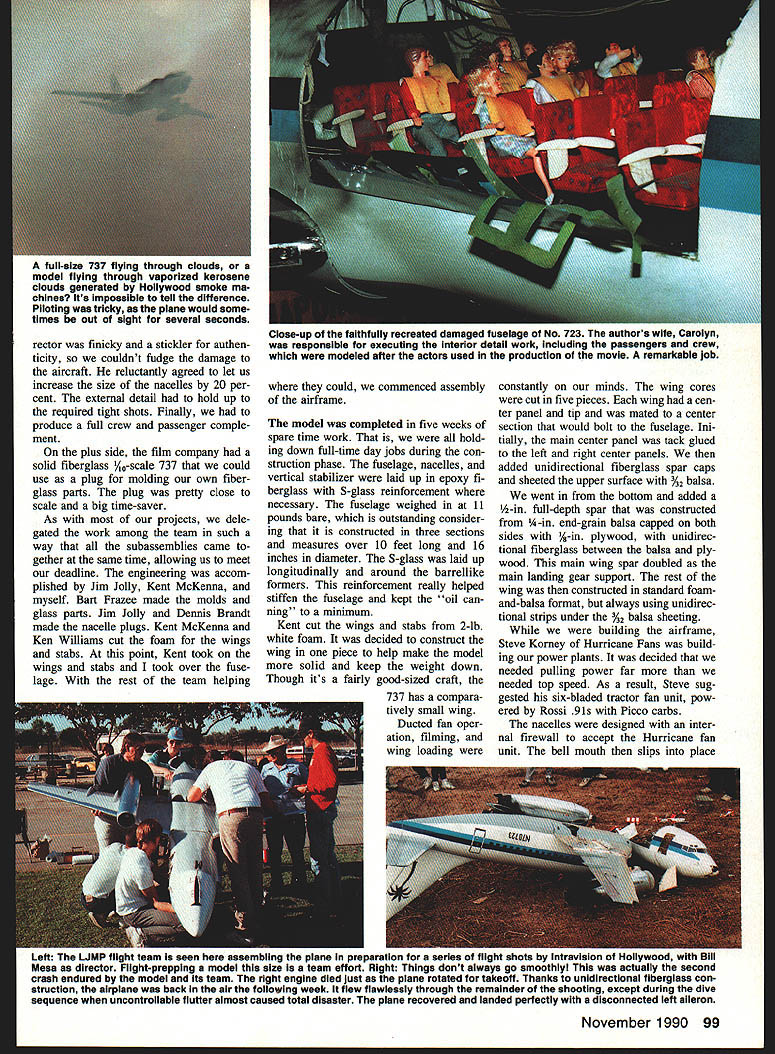
We all met at Sepulveda Basin. Not only was I worried about the model, but I wasn't sure Sepulveda's 400-ft. runway would be long enough. Initial flight attempts were disappointing. While the 737 accelerated quickly, it would pitch suddenly and try to climb vertically as if tail-heavy. The elevator refused to lower the nose. At the end of that first day we had a damaged nose gear and no successful flights over eight seconds' duration.
Troubleshooting and Fixes
Back at the shop we circled our oddly lethargic creation for a massive head-scratching session. A quick check showed 10 degrees of negative tailplane angle of attack. Since we had calculated five degrees of incidence, we had either miscalculated or mistraced the stabilizer datum-locating lines. Kent, Dennis, and I quickly reduced the stabilizer's angle of attack. We also arranged with the film company to fly the model privately over the weekend.
After a Sunday of test-running the fans, we were convinced power was not the problem; each side was developing over 14 lb. of static thrust. With that reassurance and the modifications and repairs complete, we raced to Mile Square to beat the setting sun.
A rapid assembly and preflight check showed all was ready. Kent and Steve fired the engines while I prepared to get the ship airborne. I eased the throttles forward and signaled for Randy to release the plane. The 737 accelerated and the nose lightened. After a ground roll of about 300 ft., I began to rotate for takeoff. The nose came up and suddenly the model was off and accelerating. Applying forward pressure, I watched as the 737 followed my command and went to level flight.
With a loud cheer from those assembled, we were off. The 737 flew surprisingly well and was impressively responsive—so well that no trims were required.
Incident, Repair, and Radio Issue
On the third trip around the field I reduced power and commenced a landing approach. The model suddenly veered left and showed symptoms of being in fail-safe mode. Miraculously, the 737 straightened out on an adjacent runway and flew into the ground without a flare, making ground contact at a slight left-wing, nose-down attitude. The model was damaged again, but at least we had achieved controlled flight and knew she'd fly again.
Back at the shop we found a shattered left nose gear and scratches on the left wing; the fuselage looked sad from the wing forward. The total repair, including painting, took four of us less than 16 hours.
Futaba checked the radio and found a cracked receiver crystal. The crystal was changed and the rest of the system checked out. Though we can't be certain the system wasn't damaged in the crash, no further radio mysteries were encountered.
Filming with Special Effects
We were on! Sepulveda Basin was again the site for approach shots and simulated flight in and out of the clouds. Hollywood smoke machines (Dynajet-powered) vaporize kerosene into a thick white smoke, taking only a few seconds to put up a substantial smoke screen. The plan was to fly race-horse circuits while the special effects crew put up broken smoke to simulate clouds.
The 737 was behaving. It started, got aloft, and flew each time it was asked. I was getting comfortable with the model, despite the fact it virtually took the whole runway to take off and land. The cameramen were doing artsy things and Kent and I were getting a lot of 737 pilot and copilot time.
One thing made us jumpy: as it flew through the fake clouds the craft would go IFR (instrument flight rules) for five to eight seconds at a time. We strained to keep track of the 737 in the dense, fog-like conditions.
Then disaster. On one takeoff the model seemed a tad slower coming off the line. As it rotated the right fan died. The model hung in the air, nose high, right engine silent, left engine at full power—without enough rudder to hold it straight. The model rotated to a nose-down position and struck the ground, the fuselage severing in front of the wing as the left nacelle detached and miniature bodies were hurled through the air. It was uncanny and morbid. We were sick and almost ready to give up.
Like an FAA accident investigation team, we recovered every piece and converged on the shop. Repairs were possible and mainly cosmetic—the unidirectional fiberglass under the wing skins had paid off handsomely. Though the model had hit hard twice, the wing structure hadn't failed. We just needed to get the plane back to camera condition.
Mile Square: Final Sessions
For the next film session we went to Mile Square for landing and taxi shots. I was relieved because of the large landing area. During the last repairs we were desperate for time. My motivation being low, I opted for hardware-store Krylon rather than Supercoat. When Ken saw me spray-canning over the repaired area, he shook his head. I ad-libbed as he walked away, "Hey man, the epoxy's not holding up. Once you lower your standards to Krylon, the model will last forever."
My paradox proved true. This was the day our 737 was made to see. The most difficult shots—like flying over the edge of the runway three feet above the ground—came off without a hitch. Imagine all that foam, glass, and Krylon scooting along at 80+ mph over the same ground track time after time. Then there were the landings: the model had to touch down within a foot of a white dot on the runway with the camera zoomed in tight.
Mile Square wasn't closed; we were flying off an adjacent runway under tightly controlled conditions while sport flying continued on the active runway. Each of the 12 flights that day was picture perfect. Kent would right the flares, the plane would accelerate, lift off, and fly. Steve Korney tracked the 737 at over 80 mph gear-down and over 90 mph gear-up. We literally stopped traffic on nearby streets as drivers spotted what appeared to be a stricken airliner landing at Mile Square.
The last flight called for a diving sequence. Uncertain about letting the 737 accelerate too much, I had saved this maneuver for last. We fueled up and took off. The landing gear was raised and the nose gear doors closed. Aloft, the craft flew with the precision and stability of a large Pattern ship. After a few passes for the camera, we climbed to between 500 and 1,000 ft.
As the camera crews focused, I powered to half stick. The model dove for approximately nine seconds, attaining an incredibly high speed. As I started to pull out, she began fluttering violently. The stabs, rudder, and left wing were a blur and airframe failure seemed imminent. The camera crew stayed on the model—after all, the footage could be useful if the director changed his mind.
I pulled all power and held on to the elevator. The model slowly rounded out of the dive. The left aileron, obviously no longer connected to its servo, fluttered. I guided the craft through a 180° turn to the runway and pointed her homeward. The landing that followed was perfect. It was almost impossible to tell when flying stopped and wheels started rolling. As the ship rolled down the runway nose-high, the director yelled, "That's a wrap."
I had a hard time holding back tears as the ship slowed to a stop. We had endured and overcome bad times and accomplished what couldn't have been done any other way. Pushing the model back to the pits, Kent quipped, "You obviously had too much aileron control before, huh?"
Aftermath and Awards
Two weeks later the model was entered in the static competition at the International Miniature Show (IMS) in Pasadena. Kent spent the whole weekend explaining to interested spectators that we weren't twisted; the model was built for a movie. I don't think anyone can look at that torn fuselage and not think of the poor, desperate passengers and the crew fighting to get them down. After all that, a light finally shone on our 737: it was awarded First Place in Giant Scale and Best of Show at IMS Pasadena. We couldn't believe it.
I'm proud that model aviation played a part in bringing this heroic episode to the screen. I'm also proud of LJMP's team of dedicated modelers for sticking with this arduous project. They performed above and beyond what I would ever have asked of them. There were times when we had over 13 people working on the model. Though I haven't mentioned each of you individually, I want to express my gratitude for the part you played.
I hope you enjoyed the final product. After viewing Miracle Landing I reviewed the FAA accident report on the actual incident. The movie was very accurate—except for those pesky commercials.
Transcribed from original scans by AI. Minor OCR errors may remain.

