

Miracle in South Austin
By Bill Mol
The Aeromodelers of Austin flew at the same location for more than 15 years, and the Hill Country Radio Control Association, somewhat farther south, flew from the same field for ten years. Unfortunately, progress being what it is, the Aeromodelers lost their field to highway construction and were forced into a small, rather uphill site. On January 8, 1993 the Hill Country club was informed that the field they were leasing would be sold and they would have to evacuate. A request to lease month-to-month was denied. A search was initiated to find a new location. Neither club could afford to buy land, and the only other good location was north of town and unable to absorb 100 new members.
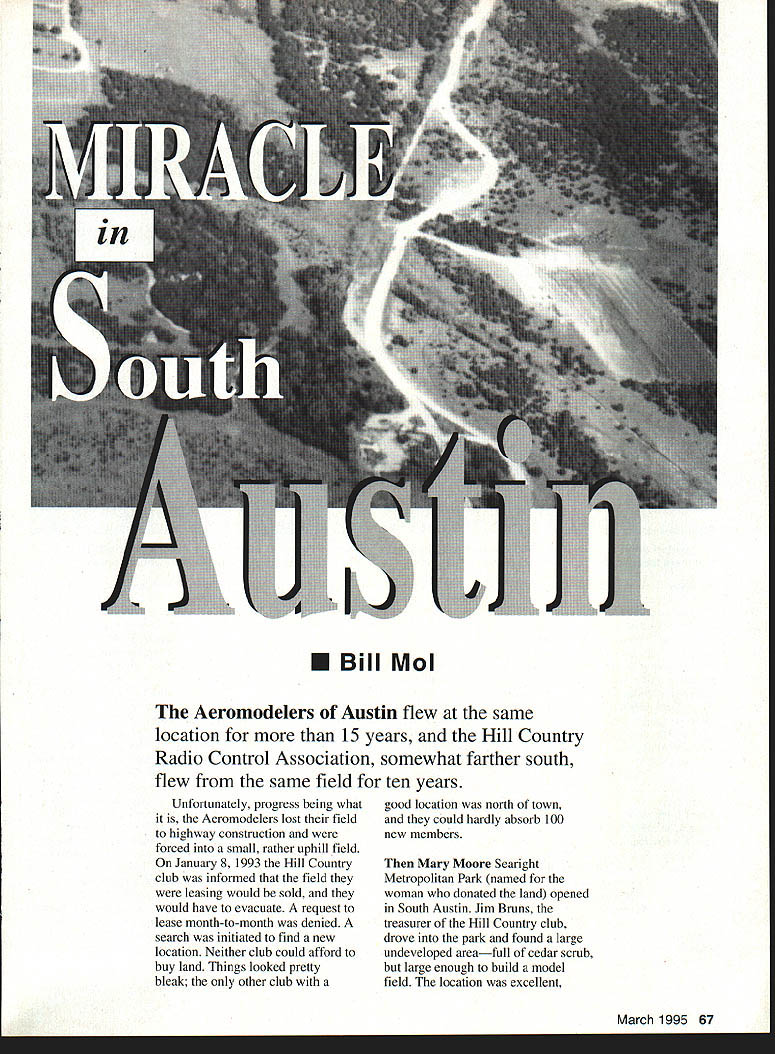
Then Mary Moore Searight Metropolitan Park (named for the woman who donated the land) opened in South Austin. Jim Bruns, treasurer of the Hill Country club, drove into the park and found a large undeveloped area—full of cedar scrub but large enough to build a model field. The location was excellent, but it would take a major effort to clear and level the land.
Jim called Ralph Declairmont, Hill Country president, and other club officers agreed the site had potential. Ralph contacted Larry McKinney, president of the Aeromodelers. After reviewing the field, the two clubs entered serious discussion. If the two South Austin clubs would merge, they might have enough manpower and money to build the field. The clubs agreed to join forces. The easy part was done; the challenge was getting city and county officials to allow a model field to be built in the park.
Gaining official approval
Larry McKinney and Ralph Declairmont knew how to approach the city council. Ralph invited park and environmental officials to the old Hill Country field and arranged flight demonstrations so officials could see and hear the impact of model flying. Videotapes provided by AMA Headquarters were also shown. Officials were favorably impressed and began letters of request to concerned agencies for formal approval. The combined clubs, now called Hill Country Aeromodelers of Austin, told officials the field would be built at no cost to the city or county.
Plans were drawn and sent to the Austin Parks and Recreation Department, with a copy to the mayor. Alternate sites were suggested, but none proved suitable. The Land and Facilities Committee voiced concern over possible noise; a flying demonstration for the full committee alleviated those concerns. Site security was another issue—the committee wanted assurance the field would be open to the public—which was resolved after discussion. The combined club treasury was about $7,000—just about enough to clear and level the field.
The miracle to get the field operational appeared in the form of club member Jim Vier. An experienced developer, Jim knew how to get things started and, through contacts with city officials, expedited the necessary paperwork. On May 7, 1993 plans were approved and the Aeromodelers were authorized to start clearing operations pending final lease approval.
Construction priorities
The club officers and board of directors set construction priorities, approved by the membership on May 17:
- Clear and level the field
- Security fencing and parking lot
- Operations building
- Safety fencing and field configuration
Clearing and initial work
In a few days heavy equipment, arranged by Jim Vier and provided by Capitol Excavation Company of Austin, appeared on the site. In two days the cedar scrub was gone. On May 26 a contract was let to plow, disc, till, and rake the field; that work was completed the first day in June. On June 10 the Austin City Council approved the request to use the park, contingent on the Hill Country Aeromodelers paying the improvement expenses. On July 9 the city council signed an agreement for use of the park land for five years, renewable for five years.
Because the park land was city-owned, the club was required to purchase an Austin small project permit (cost $225) and provide a detailed site plan. On October 22 the city approved the overall development plan and issued a building permit.
Donors, volunteer work, and amenities
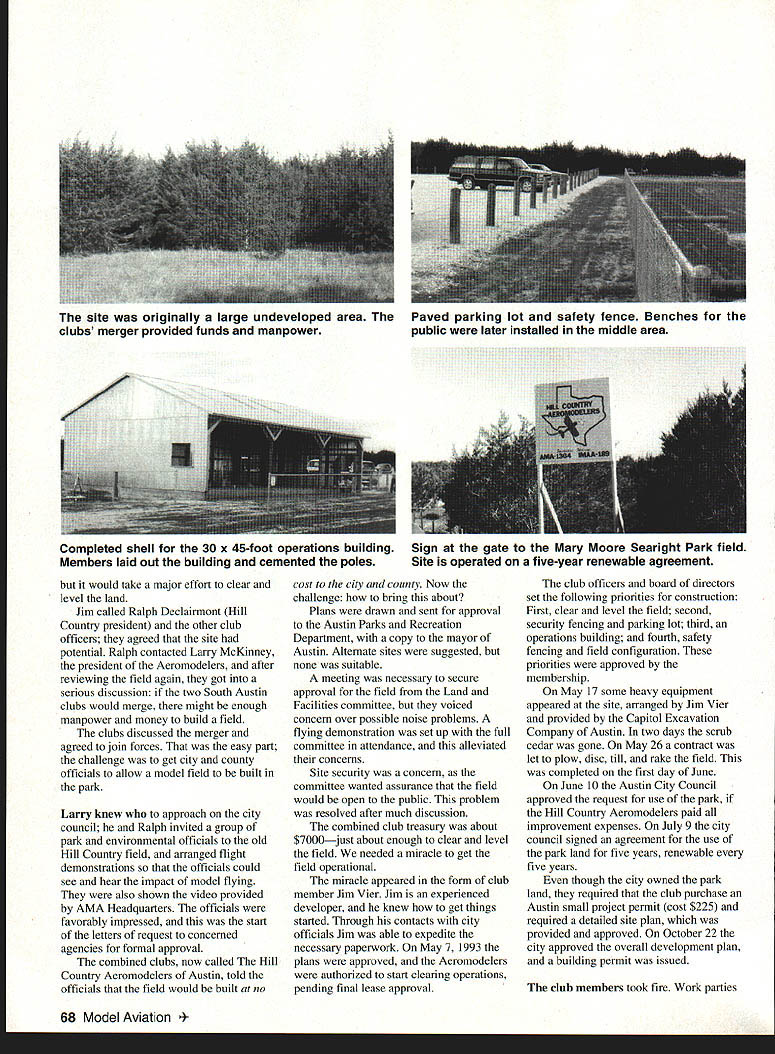
Club members took pride in the work and conducted many work parties. The merger provided the funds and manpower to make the site usable. Later installations included a paved parking lot, safety fence, and public benches. The shell of a 30 x 45-foot operations building was completed: members laid out the building, cemented poles, and erected the sign and gate for Mary Moore Searight Park field. Grass was purchased and sown.
Donations and contributions:
- Rick Schafer (Custom Model Products) procured donated fence posts.
- The Lower Colorado River Authority (LCRA) supplied cable.
- Pedernales Electric Company contributed to parking area construction.
- Bob Fricke produced Texas caliche from a local gravel company for the parking lot.
Next came the operations building. Jimmie McDaniel struck an excellent bargain with Furrow's Lumber Company for a precut pole-barn. Robert Courtney Jr. supervised the layout and cementing of poles. Jimmie, Robert, Ed Nichols, and others formed the slab; twenty-seven yards of concrete was ordered and, with Rick Schafer in charge, the floor was poured. Various construction activities continued through the winter, slowed somewhat by weather and holidays.
At that time the club consisted of 63 members. Many had failed to rejoin when the fields were lost and had found other places to fly, but as the new field took shape old and new members were added. Most everyone participated to the degree they could; older or less physically able members helped supervise, provided moral support, and often supplied refreshments.
The building rose, safety fences were installed, benches were built for the public, and a wind sock was donated by the treasurer, Jim Bruns, whose thoughtful wife bought it for him.
Field opening and public outreach
The field was made safe to fly from. Chief instructor pilot Monte Dove fired up a test model while members with mobile phones were stationed deep in the park and to the north toward the highway. Monte flew a number of runs in each direction to establish flying perimeters that would avoid interfering with tennis courts to the south and the road to the north.
At the March 8 club meeting the field was declared open. Flying began in earnest, and the formal opening (with the public invited) was scheduled for the weekend of April 9. The club arranged a model airplane static display at a large local mall on the weekend of March 26 and distributed flyers announcing the formal opening.
Local newspapers and TV stations were notified. Committees were formed for refreshments, sound, registration, transmitter impound, aircraft inspection, and field safety and operational control. On the Friday before the opening, the Austin American-Statesman published an excellent feature story on the club and the opening. Hundreds of spectators arrived, and despite high winds, they were treated to constant, occasionally spectacular flying.
Instructor pilots flew more than 100 buddy-cord demonstration flights with spectators who wanted to try. The demonstrations thrilled many children and adults and resulted in several immediate new memberships. The club grew to about 100 members and made money on food sales while gaining many friends.
Current status and future plans
The site operates under a five-year renewable agreement. The field is not yet complete; planned improvements include:
- Covered pilot preparation pits
- A permanent snack bar for club weekend cookouts and flying events
- Possibly a paved runway when the treasury allows
The club's goal is to have the finest flying field in Texas; they feel they are nearly there. The field is located in South Austin on Slaughter Lane, between I-35 and Manchaca.
Ralph Declairmont Hill Country Aeromodelers 2401 Toulouse Drive Austin, TX 78748
Transcribed from original scans by AI. Minor OCR errors may remain.

