
The Model Aircraft Project
In December 1941, the United States was thrown into the Second World War. As the nation geared up for total commitment, Secretary of the Navy Frank Knox asked Commissioner of Education John W. Studebaker if the nation's schoolchildren could build 500,000 scale model airplanes for the war effort. The models were needed for aircraft recognition-and-identification training. The Model Aircraft Project had been mobilized.
The following account, condensed from Scale Model Aircraft Construction Procedure by Robert W. Hambrook and Paul E. Garber, outlines the program's goals and requirements. Hambrook was Executive Secretary of the Model Aircraft Project committee; Garber was a lieutenant in the Navy's Bureau of Aeronautics (BuAer).
Purpose and scale
"The US needs scale model planes for winning the war! The models are to be used specifically for the training of pilots, military and civilian, airplane spotters, and thousands of others who are concerned with the recognition and identification of Allied and Axis aircraft."
At 35 feet away, these models, made to a scale of 1/72 (one inch equals 72 inches), appear the same size as the real airplane at approximately half a mile distance. A swift decision by those on the ground or in the air is necessary.
"The Project gives the youth of the US a definite responsibility in the war effort which should not be underestimated. The models will contribute directly to the National Defense. It is doubtful if any greater privilege has been accorded to the schools of this Nation than the one represented by this all-out war effort in the making of scale model aircraft."
"The scale model builder need know little about aeronautics, but should be able to read drawings, know materials, tools, etc. It is hoped, however, that everyone making scale models will not stop at that point, but will continue building flying models and become interested in aviation. It will indeed be disappointing if many hundreds of model airplane clubs are not formed as a result of this scale model activity."
Origins and design work
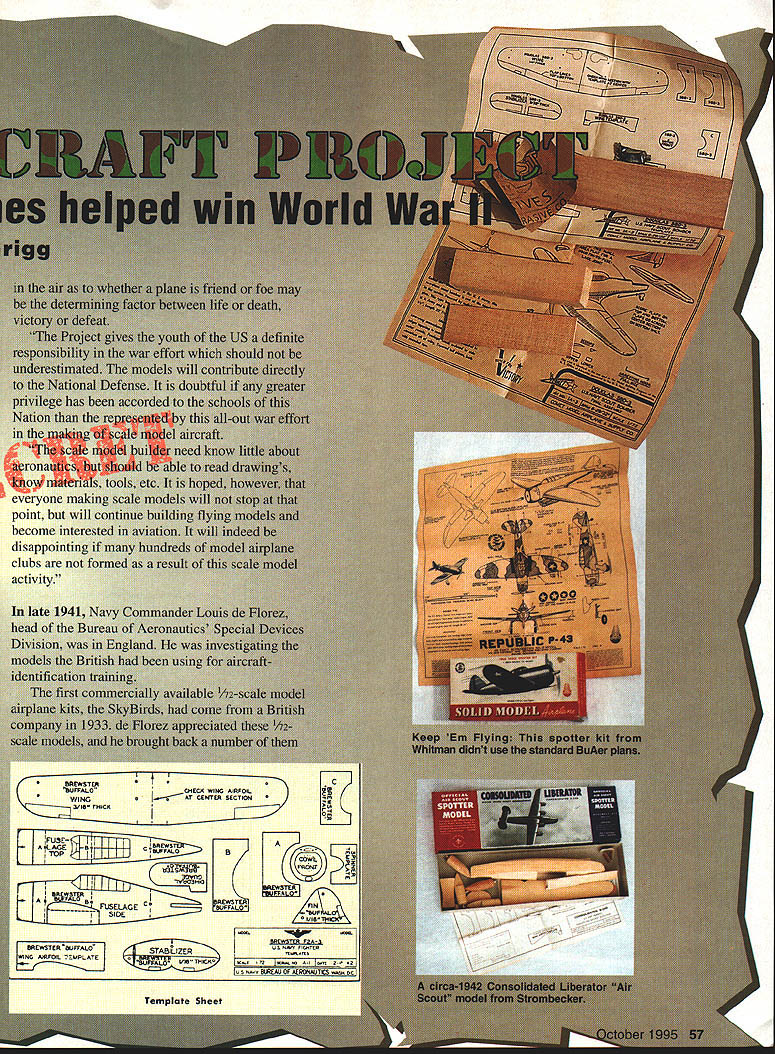
In late 1941, Navy Commander Louis de Florez, head of the Bureau of Aeronautics' Special Devices Division, was in England investigating the models the British had been using for aircraft-identification training. The first commercially available 1/72-scale model airplane kits, the Skybirds, had come from a British company in 1933. De Florez appreciated these 1/72-scale models and brought back a number of them. When he returned to the US on December 8, the Model Aircraft Project began to take shape.
It was determined that the airplanes for the program should be 1/72-scale solid models, constructed from soft wood. But before anyone could start building models, someone needed to start drawing plans.
On December 9, Bill Bishop, founder and general manager of Chicago's Comet Model Airplane & Supply Co., was summoned to Washington, D.C. Project head Robert Hambrook realized that Comet's drafting department had the capability to produce all of the plans for the Model Aircraft Project.
In the meeting, Bishop was given all the prevalent information the Navy had on Japanese aircraft. Bishop looked the material over and was surprised by what he saw.
"Every model builder in the US already knows everything in this 'SECRET' file you've handed me!" Bishop told the officer.
"We are aware of that," the officer replied. "We just do not want the enemy, and the American people, conscious of that fact!"
Bishop returned to Chicago. A concentrated effort resulted in model airplane plans that were ready to send out by February 16, 1942. Most of the plans were drawn from photos and three-views published in model (and full-scale) airplane magazines. The Navy assumed the costs of the plans and selected the aircraft that would be drawn.
Well-known modeler Carl Goldberg drew plans for the Zero; Robert Rider, head of the drafting department, drew the plans for the Spitfire and some of the other models. (Rider later became executive vice-president of Monogram Models.)
Schools, distribution, and construction
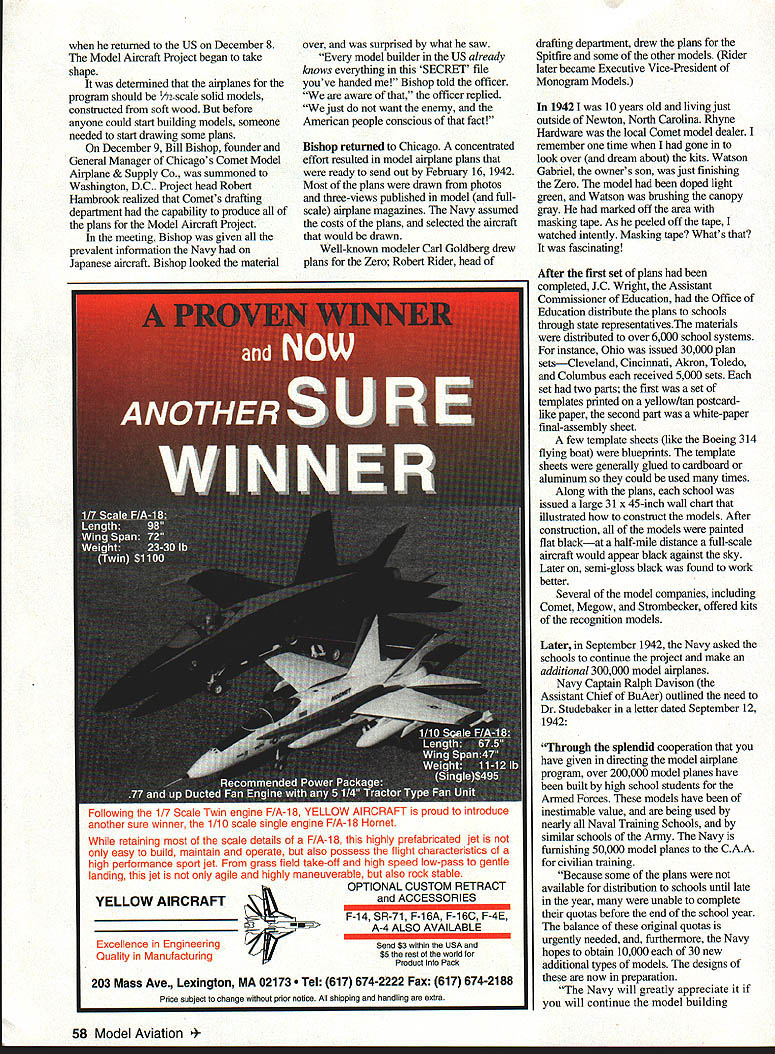
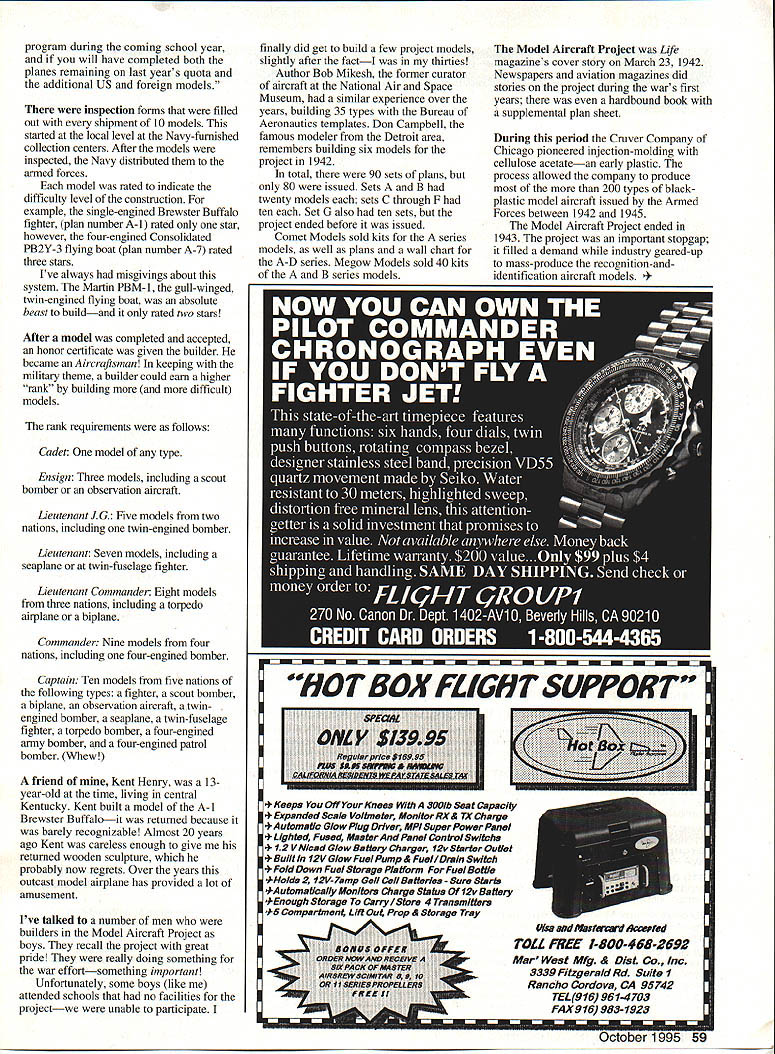
After the first set of plans had been completed, J. C. Wright, the Assistant Commissioner of Education, had the Office of Education distribute the plans to schools through state representatives. The materials were distributed to over 6,000 school systems. For instance, Ohio issued 30,000 plan sets—Cleveland, Cincinnati, Akron, Toledo, and Columbus each received 5,000 sets. Each set had two parts: the first was a set of templates printed on a yellow/tan postcard-like paper; the second part was a white-paper final-assembly sheet.
A few template sheets (like the Boeing 314 flying boat) were blueprints. The template sheets were generally glued to cardboard or aluminum so they could be used many times.
Along with the plans, each school was issued a large 31 x 45-inch wall chart that illustrated how to construct the models. After construction, all of the models were painted flat black—at a half-mile distance a full-scale aircraft would appear black against the sky. Later on, semi-gloss black was found to work better.
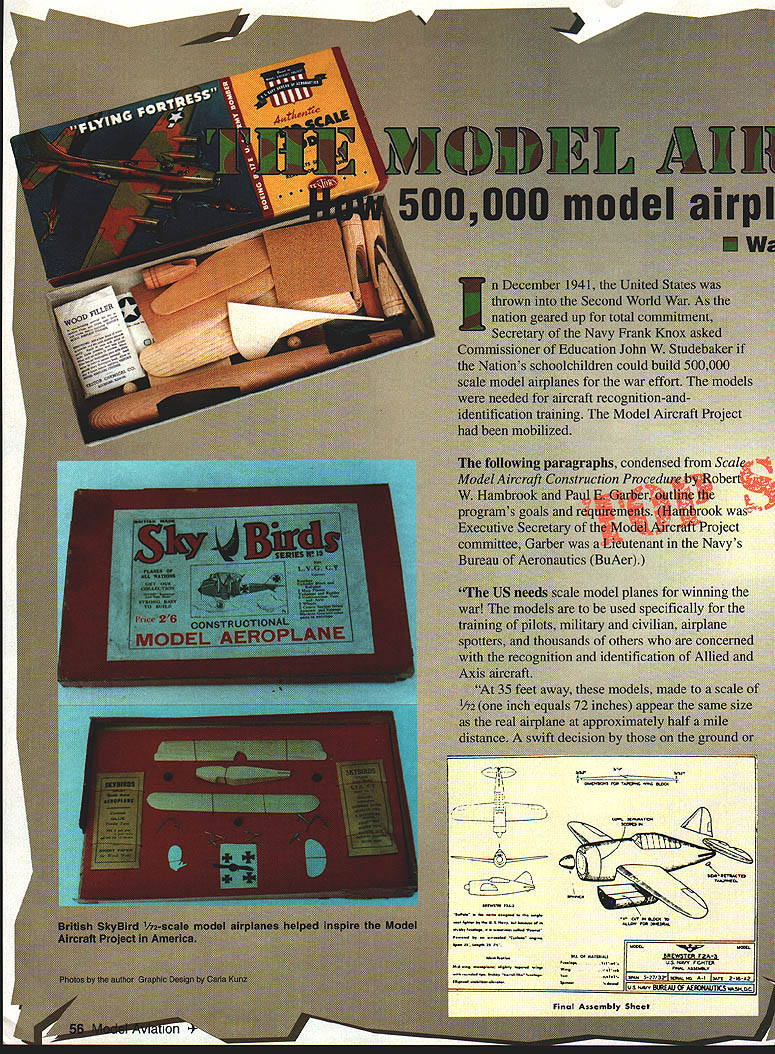
Several of the model companies, including Comet, Megow, and Strombecker, offered kits of the recognition models.
In September 1942 the Navy asked the schools to continue the project and make an additional 300,000 model airplanes. Navy Captain Ralph Davison (Assistant Chief of BuAer) outlined the need to Dr. Studebaker in a letter dated September 12, 1942:
"Through the splendid cooperation that you have given in directing the model airplane program, over 200,000 model planes have been built by high school students for the Armed Forces. These models have been of inestimable value, and are being used by nearly all Naval Training Schools, and by similar schools of the Army. The Navy is furnishing 50,000 model planes to the C.A.A. for civilian training."
"Because some of the plans were not available for distribution to schools until late in the year, many were unable to complete their quotas before the end of the school year. The balance of these original quotas is urgently needed, and, furthermore, the Navy hopes to obtain 10,000 each of 30 new additional types of models. The designs of these are now in preparation."
"The Navy will greatly appreciate it if you will continue the model building program."
There were inspection forms that were filled out with every shipment of 10 models. This started at the local level at the Navy-furnished collection centers. After the models were inspected, the Navy distributed them to the armed forces.
Each model was rated to indicate the difficulty level of the construction. For example, the single-engined Brewster Buffalo fighter (plan number A-1) rated only one star; however, the four-engined Consolidated PB2Y-3 flying boat (plan number A-7) rated three stars.
The author had misgivings about this system. The Martin PBM-1, the gull-winged, twin-engined flying boat, was an absolute beast to build—and it only rated two stars!
After a model was completed and accepted, an honor certificate was given the builder. He became an Aircraftsman. In keeping with the military theme, a builder could earn a higher "rank" by building more (and more difficult) models.
Rank requirements
- Cadet: One model of any type.
- Ensign: Three models, including a scout bomber or an observation aircraft.
- Lieutenant J.G.: Five models from two nations, including one twin-engined bomber.
- Lieutenant: Seven models, including a seaplane or a twin-fuselage fighter.
- Lieutenant Commander: Eight models from three nations, including a torpedo airplane or a biplane.
- Commander: Nine models from four nations, including one four-engined bomber.
- Captain: Ten models from five nations of the following types: a fighter, a scout bomber, a biplane, an observation aircraft, a twin-engined bomber, a seaplane, a twin-fuselage fighter, a torpedo bomber, a four-engined army bomber, and a four-engined patrol bomber.
Personal recollections and participation
In 1942 the author was 10 years old and living just outside Newton, North Carolina. Rhyne Hardware was the local Comet model dealer. The author remembered watching Watson Gabriel, the owner's son, finishing a Zero: the model had been doped light green and the canopy was being brushed gray. The masking tape was peeled off—masking tape was a fascination.
A friend, Kent Henry, was 13 at the time, living in central Kentucky. Kent built a model of the A-1 Brewster Buffalo—it was returned because it was barely recognizable. That modest model airplane later provided amusement for its owner and others.
Many men who were builders in the Model Aircraft Project as boys recall the project with great pride. They felt they were doing something important for the war effort. Unfortunately, some boys attended schools that had no facilities for the project and were unable to participate. The author eventually built a few project models in his thirties.
Author Bob Mikesh, the former curator of aircraft at the National Air and Space Museum, built 35 types with the Bureau of Aeronautics templates over the years. Don Campbell, a well-known modeler from the Detroit area, remembers building six models for the project in 1942.
Plans, kits, and industry
In total there were 90 sets of plans, but only 80 were issued. Sets A and B had twenty models each; sets C through F had ten each. Set G also had ten, but the project ended before it was issued.
Comet Models sold kits for the A series models, as well as plans and a wall chart for the A–D series. Megow Models sold 40 kits of the A and B series models.
The Model Aircraft Project was Life magazine's cover story on March 23, 1942. Newspapers and aviation magazines covered the project during the war's first years; there was even a hardbound book with a supplemental plan sheet.
During this period the Cruver Company of Chicago pioneered injection-molding with cellulose acetate—an early plastic. The process allowed the company to produce most of the more than 200 types of black-plastic model aircraft issued by the Armed Forces between 1942 and 1945.
Conclusion
The Model Aircraft Project ended in 1943. The project was an important stopgap; it filled a demand while industry geared up to mass-produce the recognition-and-identification aircraft models.
Transcribed from original scans by AI. Minor OCR errors may remain.

