
Model Barnstorming
Henry Jacob
Origins
CRUNCH! The No. 3 glider, piloted by Orville Wright, settled back to earth after a miraculous flight of 622½ feet. In one exhilarating demonstration over Kill Devil Hill near Kitty Hawk, North Carolina, the era of aviation was born.
Wilbur and Orville Wright's dramatic feat took place in October 1902, but it was not until World War I that airplanes first began to be put to practical use. In that war, both Allied and Central European strategists saw that aircraft could be exploited for reconnaissance purposes, and the aviators who flew these planes constituted a small elite.
At first, enemy pilots passing each other during reconnaissance missions often waved and saluted. That unprecedented camaraderie did not last long. When the first reconnaissance pilot fired a pistol at a passing enemy plane, the exemption from hostilities was shattered. Soon the skies erupted with the noise of rifles and machine guns mounted on aircraft—and air war became a reality.
Inventive pilots devised loops, rolls, and Immelmanns to escape pursuing enemy planes. These early "dog fights" were a riveting spectacle to soldiers and civilians watching the evasive maneuvers from the ground below.
After the war, many of these daring aces began demonstrating the exhilaration of flying and performing dangerous maneuvers in frail airplanes. These performers came to be known as barnstormers.
Barnstorming and the Public
Barnstormers helped develop both the performance and the image of the modern airplane. Alone or in groups, they flew all over the United States, setting down at county fairs and on lonely pastures near small towns to put on air shows. People gathered to see the flying machines, take rides, and meet the men who flew them.
Thrills such as wing-walking and parachute jumping triggered the same surge of adrenaline in barnstorming audiences that a tightrope walker provokes in a circus. There was a charged awareness of risk—the possibility of a crash—which added to the excitement.
Model Barnstorming
Now you can thrill everyone with a model barnstorming show. You can offer crowds some of the same excitement full-size barnstormers provided in aviation's infancy.
Giving your model the ability to perform utility functions greatly increases the fun of flying and adds new purpose to an old model. Dropping balsa wood bombs at ground targets from 30 ft., releasing parachuters, and towing a 50-ft.-long crepe paper party streamer are excellent starters.
Picture yourself performing the perfect takeoff. After climb-out, circle back over the field and release a long ribbon that trails behind the airplane, following it through a series of loops, rolls, and Immelmanns—tracing your maneuvers with the grace of an artist's brush. Do a tail slide and a stall turn; the taut streamer doubles back on itself, then stretches out again as the descending airplane follows.
Now position the aircraft upwind of the spectators and release the streamer. As it drifts down, the real show begins: diving, looping, rolling, and turning, the airplane chases the streamer to the ground. The spectacle of the airplane coming dangerously close to, or even colliding with, the falling streamer generates tension and makes an exciting show.
After towing the streamer, drop it completely, then make repeated passes at the slowly descending streamer. During a run, you might snag the drifting crepe paper on a wing for a victory pass—or, as has happened to many pilots, get caught by the towline, stall the engine, and make a dead-stick landing. Barnstorming stunts are thrilling but require practice and caution.
Performance Ideas
- Aerobatic maneuvers to use with streamers: loops, rolls, Immelmanns, tail slides, stall turns.
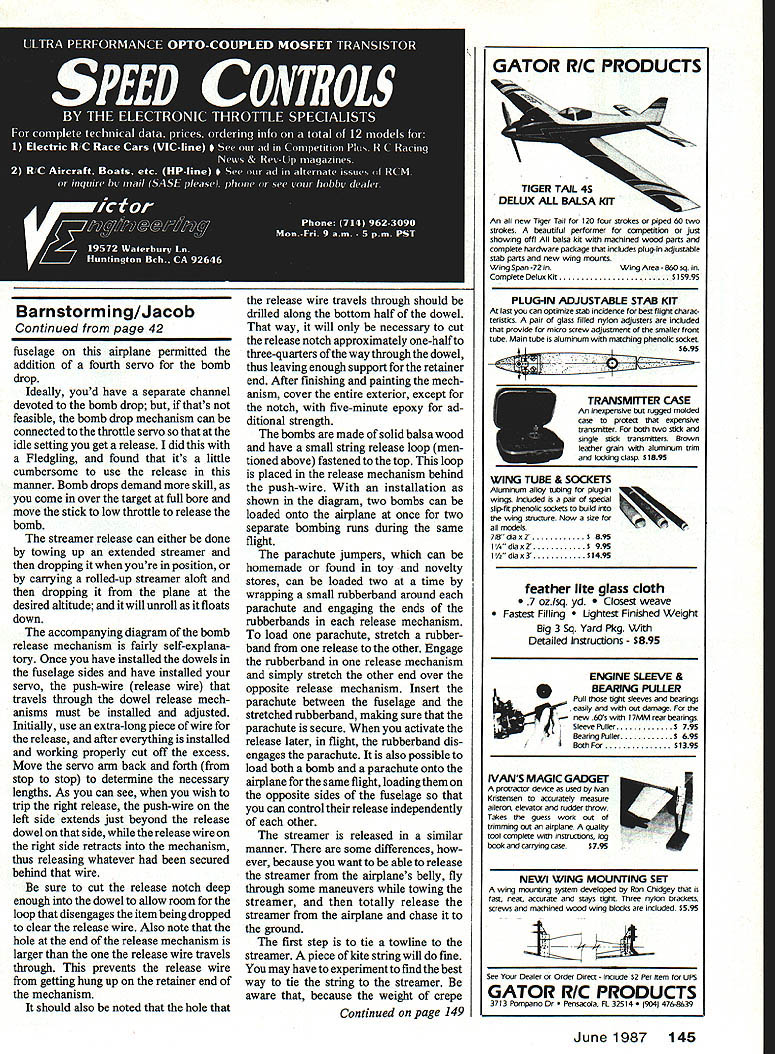
- Bomb drops: solid balsa wood bombs with a small string loop; attack targets marked on the ground for spectator thrill.
- Parachute jumps: small toy parachutists folded and held for release.
- Streamer tow and release: tow a long streamer for maneuvers, then release it to float down and chase it.
Release Mechanism Overview
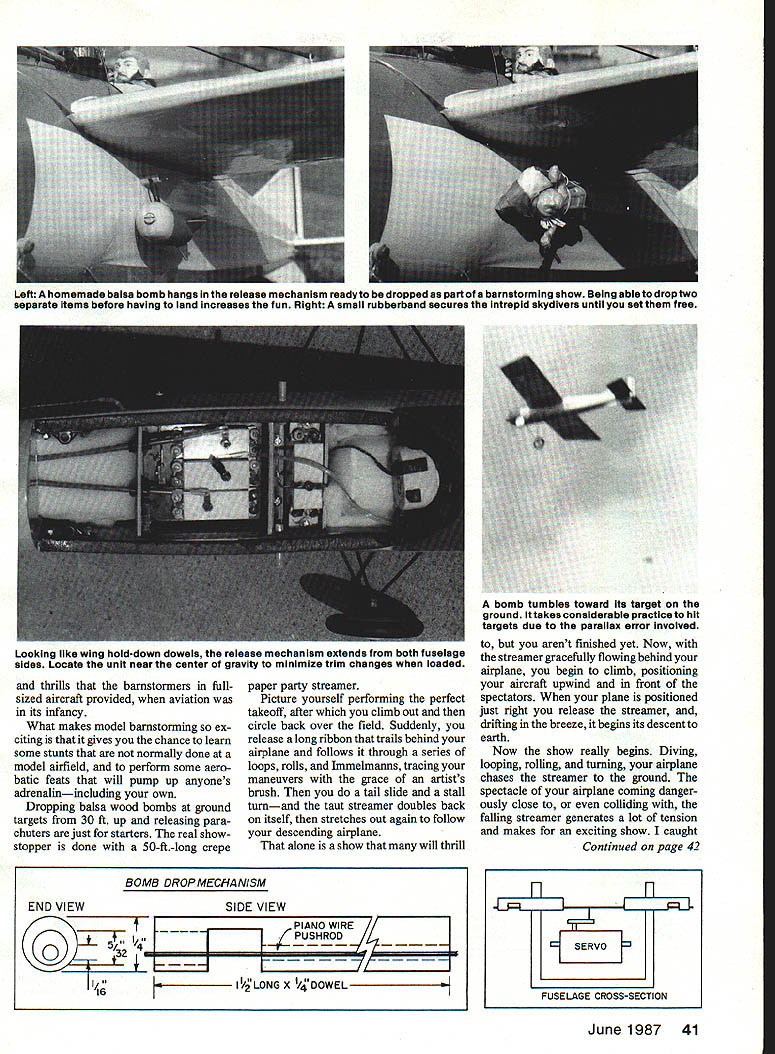
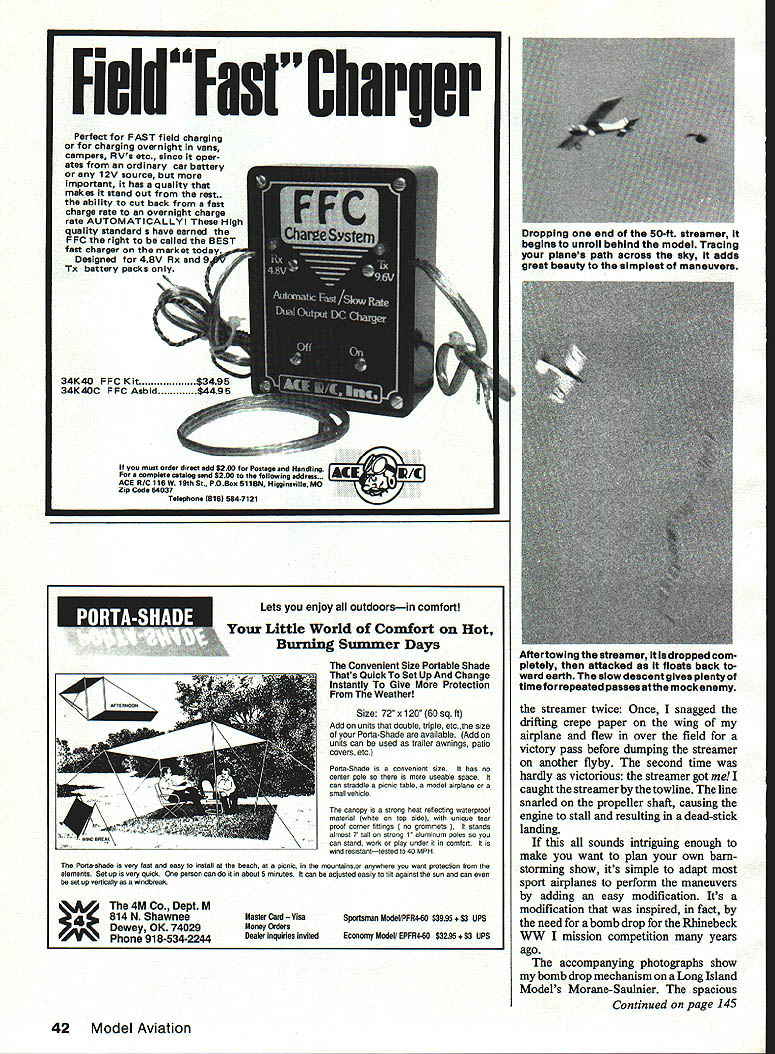
Looking like wing hold-down dowels, the release mechanism extends from both fuselage sides. Locate the unit near the airplane's center of gravity to minimize trim changes when loaded.
Key points for the mechanism:
- Install dowels in the fuselage sides and mount a servo to operate the push-wire (release wire).
- Use an extra-long piece of push-wire initially; adjust lengths by moving the servo arm from stop to stop, then trim excess once set.
- When tripping the right release, the push-wire on the left side extends just beyond the release dowel on that side, while the release wire on the right side retracts—releasing what had been secured behind that wire.
- Cut the release notch deep enough in the dowel so the disengaging loop clears the release wire cleanly.
- Drill the hole that the release wire travels through along the bottom half of the dowel. That way you only need to cut the release notch about one-half to three-quarters through the dowel, leaving enough support for the retainer end.
- Make the hole at the end of the release mechanism larger than the one the release wire travels through to prevent hang-ups on the retainer end.
- After finishing and painting the mechanism, cover the entire exterior (except the notch) with five-minute epoxy for additional strength.
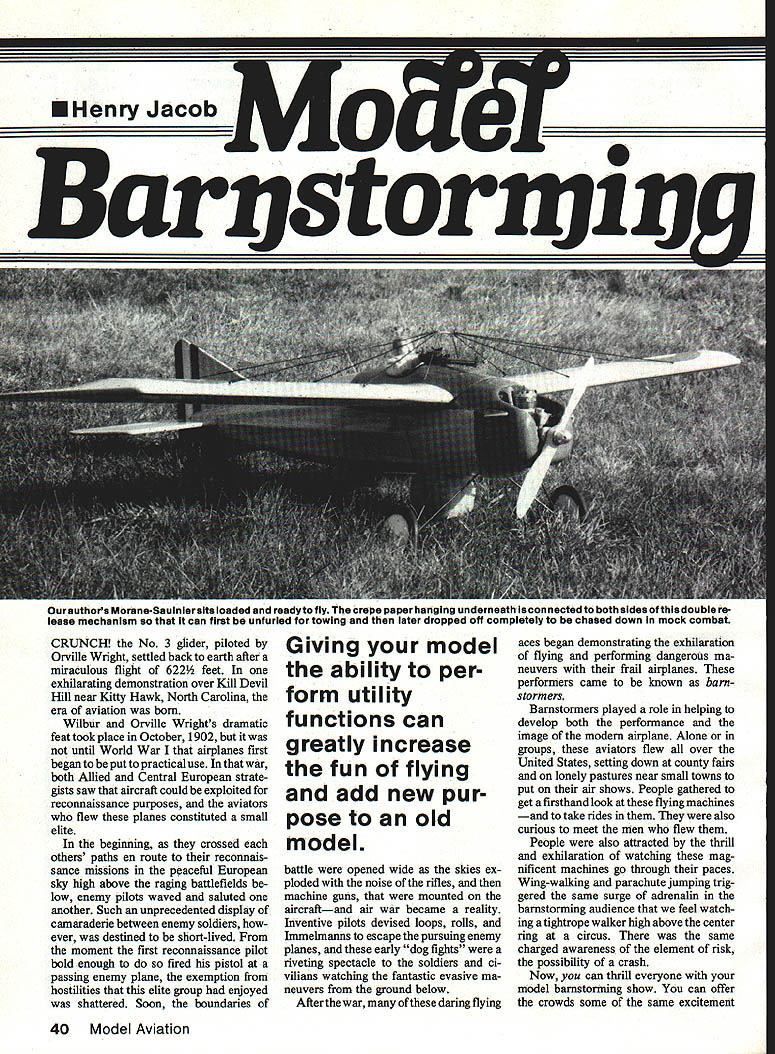
The accompanying photographs and diagram (not included here) show a bomb-drop mechanism installed on a Long Island Model's Morane-Saulnier. The spacious fuselage on that airplane permitted adding a fourth servo for the bomb drop.
Servo and Channel Options
- Ideally, use a separate radio channel devoted to the bomb or streamer release.
- If a separate channel is not feasible, the bomb-drop mechanism can be tied to the throttle servo so that the bomb is released at the idle throttle setting. This is workable but can be cumbersome: bomb drops demand skill—you typically approach the target at full throttle and move the stick to low throttle to trigger release.
Loading Bombs, Parachutists, and Streamers
Bombs:
- Make bombs from solid balsa wood.
- Fasten a small string release loop to the top of each bomb and place the loop in the release mechanism behind the push-wire.
- With a typical installation, two bombs can be loaded for two separate bombing runs in the same flight.
Parachutists:
- Parachutes can be homemade or purchased from toy/novelty stores.
- Load two at a time by wrapping a small rubber band around each parachute and engaging the rubber band ends in each release mechanism.
- To load one parachute between releases: stretch a rubber band from one release to the other, secure it in one release, stretch the other end over the opposite release, and insert the parachute between the fuselage and the stretched rubber band.
- When the release activates in flight, the rubber band disengages and frees the parachute.
- You can load both a bomb and a parachute on opposite sides of the fuselage and release them independently.
Streamer:
- Tie a towline (kite string works well) to the streamer. Double the end of lighter crepe paper over itself and tie the string around the doubled end to prevent ripping when unrolled.
- Make the streamer long enough so it clears your airplane by about three feet.
- Put a small loop on the end of the string and engage it in the release mechanism.
- Thread a rubber band through the center of the rolled-up streamer and roll the towline around it. Secure the streamer to the airplane belly by slipping one end of the rubber band over one release dowel and hooking the other end to the push-wire on the opposite dowel.
- One dowel holds the rubber band; the other dowel releases it. The dowel that holds the rubber band is also used to secure the towline—be careful not to tangle the towline in the rubber band.
- Secure any slack line between the rubber band and the fuselage.
- Hook each dowel the same way every time to avoid accidentally disconnecting the streamer when you intend only to set it up for towing.
Operating the System
- Test the release operation on the ground with the servo arm travel set to the needed lengths.
- When you want to tow the streamer, activate the release that frees the rubber band while the towline remains secured.
- When you want to drop or free the streamer for chasing, activate the release that disengages the towline.
- Practice bomb and parachute drops to learn how wind and altitude affect landing points; aim targets on the field for more spectator thrill.
Tips and Safety
- Barnstorming gives you the chance to learn stunts not normally done at a model airfield and to perform aerobatic feats that raise adrenaline—but always put safety first.
- Do not chase the streamer over spectators or follow it into the ground.
- Do not release streamers, bombs, or parachutes where they could cause harm or land outside permitted areas.
- When flying with other pilots, coordinate streamer passes—take turns and avoid tangling lines.
- Remember: bomb drops and parachute drops require skillful approaches; practice at safe altitudes and on appropriate fields.
Barnstorming can be a lot of fun for you and for spectators. With practice and care, you can recreate the spectacle and thrills that full-sized barnstormers provided when aviation was in its infancy. Happy barnstorming!
Transcribed from original scans by AI. Minor OCR errors may remain.

