
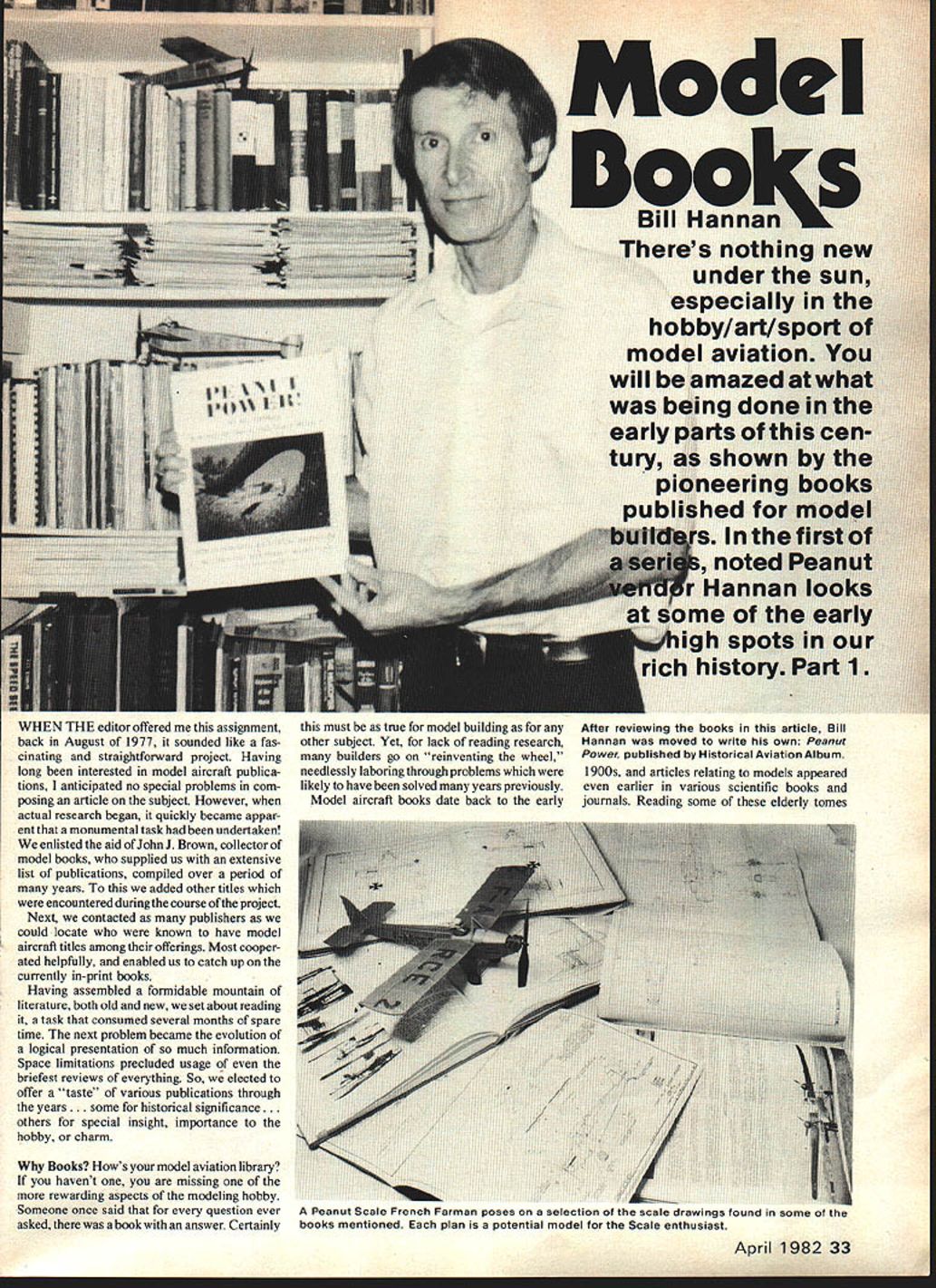
Model Books
Bill Hannan
When the editor offered me this assignment back in August of 1977, it sounded like a fascinating and straightforward project. Having long been interested in model-aircraft publications, I anticipated no special problems composing an article on the subject. However, once actual research began it quickly became apparent that a monumental task had been undertaken.
I enlisted the aid of John J. Brown, a collector of model books, who supplied an extensive list of publications compiled over many years. To this we added other titles encountered during the course of the project. Next, we contacted as many publishers as we could locate who were known to have model-aircraft titles among their offerings. Most cooperated helpfully and enabled us to catch up on currently in-print books.
Having assembled a formidable mountain of literature, both old and new, I set about reading — a task that consumed several months of spare time. The next problem became the evolution of a logical presentation of so much information. Space limitations precluded usage of even the briefest reviews of everything. So I elected to offer a "taste" of various publications through the years — some for historical significance, others for special insight, importance to the hobby, or charm.
Why Books?
How's your model aviation library? If you haven't one, you are missing one of the more rewarding aspects of the modeling hobby. Someone once said that for every question ever asked there was a book with an answer. Certainly this must be as true for model building as for any other subject. Yet, for lack of reading and research, many builders go on "reinventing the wheel," needlessly laboring through problems which were likely to have been solved many years previously.
Model-aircraft books date back to the early 1900s, and articles relating to models appeared even earlier in various scientific books and journals. Reading some of these elderly tomes provides a sort of time-machine insight into the thinking of fellow modelers long since forgotten — a window to the past, and a lucid reminder that very little has changed in model aviation. Virtually every "new" development is indeed "old hat," having appeared (at least in principle) long ago. A review of earlier works can sometimes yield fresh solutions to current problems.
Early works: Chanute, Pénaud, Johnson, Collins
The earliest book investigated in our survey was Progress in Flying Machines, written by Octave Chanute and printed in 1894. Chanute was an important Wright brothers' mentor and a heroic figure in the history of aviation who served for many years as a clearinghouse for aero information among enthusiasts. In his book Chanute attempted to catalog and classify the experimental efforts of every known flight pioneer the world over. He featured illustrations and data relating to all manner of miniature flying machines, which served to inspire generations of inventors.
For example, the achievements of French model builder Alphonse Pénaud are graphically documented. His "planophore" of 1871 was a rubber-powered model of 18-inch wingspan, capable of 11-second flights covering 131 feet. Weighing only slightly over 1/2 ounce, the machine seems to have been the first to feature the now-standard systems of longitudinal stability via incidence settings and lateral stability by dihedral. Chanute states clearly that the model was equipped with a vertical tail and in fact steered with it — a tail that does not appear in some later illustrations, and which many later modelers have omitted when flying reproductions.
Other models described included those designed by Lawrence Hargrave of Australia. Hargrave not only invented the box kite, but flew small craft powered by compressed-air engines as early as 1890.
Happily, the long out-of-print Chanute book has been reprinted by Lorenz & Herweg Publishers of Long Beach, CA, and we recommend it highly to students of aviation history.
The earliest exclusively model-aviation book we reviewed was The Theory and Practice of Model Aeroplaning, a 1910 publication by V. E. Johnson. This British classic presents a history of models, theories of operation, and practical design advice. Were you aware that a few internal-combustion "gas"-powered models had successfully flown by that time? A rather sophisticated example depicted in Johnson's book is a four-cylinder V-type engine complete with a clockwork shut-off device. Steam and compressed-air engines of the time were also well documented. Interestingly, electric motors had been tried and found wanting.
Meanwhile, in the United States, The Boys' Book of Model Aeroplanes was published in 1910, authored by Francis A. Collins. The volume sold well and was reprinted in 1911 and again in revised form in 1921. The Second Boys' Book of Model Aeroplanes appeared in 1911, in which Collins acknowledged the New York Model Aero Club and a number of individual contributors.
Somewhat confusingly, another Collins — A. Frederick (apparently unrelated) — authored The Boy's Book of Aeroplanes in 1919. This contained a brief history of aviation, plans for simple helicopters, a twin-pusher, a model Bleriot, Wright biplane, and Curtiss flying boat, plus instructions for making a compressed-air engine and even a hangar.
Harper, the interwar years, and the 1920s–1930s boom
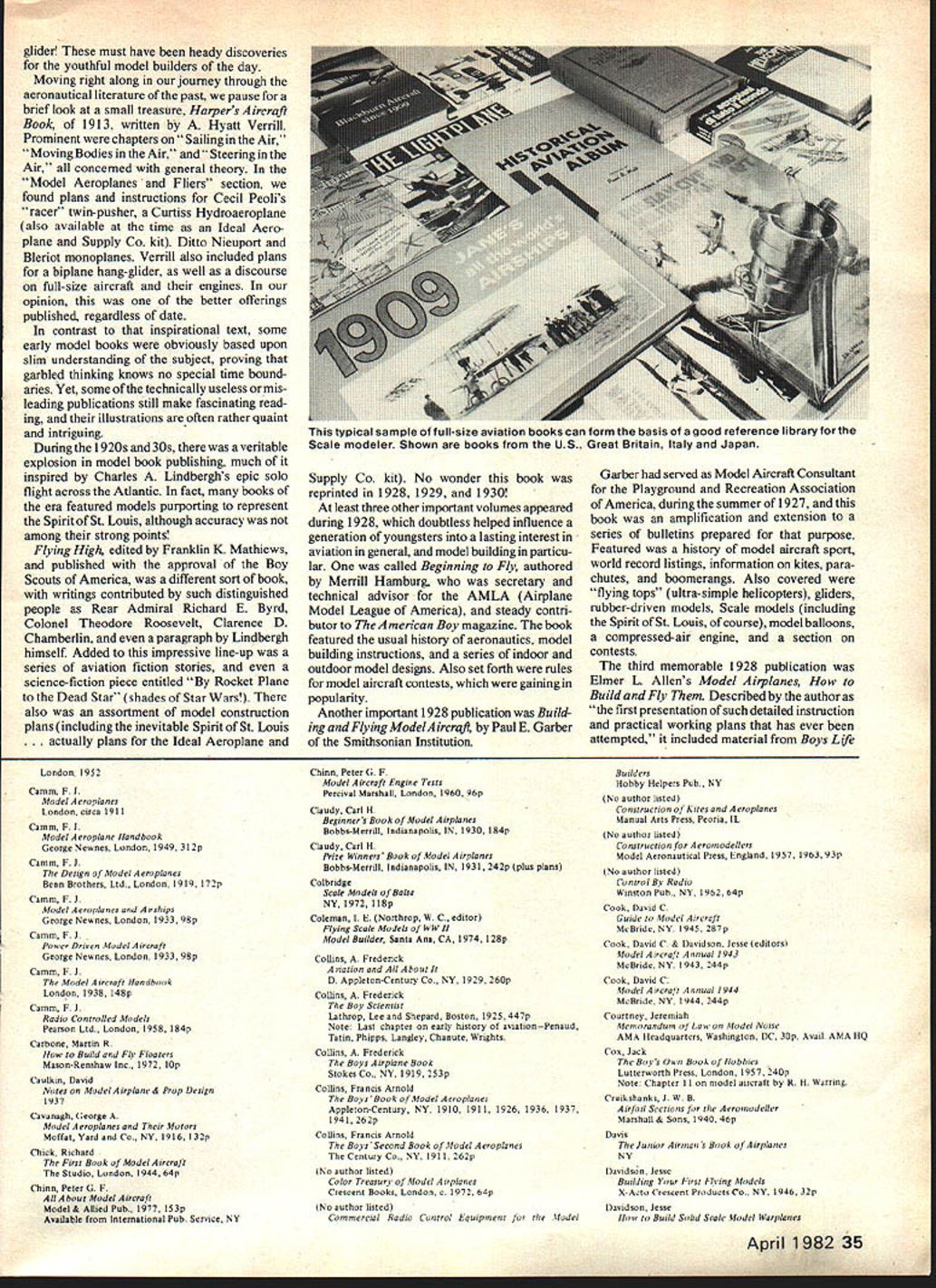
Harper's Aircraft Book (1913), by A. Hyatt Verrill, is a small treasure. Prominent chapters include "Sailing in the Air," "Moving Bodies in the Air," and "Steering in the Air," concerned with general theory. In the "Model Aeroplanes and Fliers" section are plans and instructions for Cecil Peoli's twin-pusher racer, a Curtiss hydroaeroplane (also available as an Ideal Aeroplane and Supply Co. kit), and Nieuport and Bleriot monoplanes. Verrill also included plans for a biplane hang-glider and a discourse on full-size aircraft and their engines. In our opinion, this is one of the better offerings published, regardless of date.
In contrast, some early model books were obviously based on a slim understanding of the subject; garbled thinking knows no special time boundaries. Nonetheless, technically useless or misleading publications often make fascinating reading, and their illustrations are often quaint and intriguing.
During the 1920s and 1930s there was a veritable explosion in model book publishing, much of it inspired by Charles A. Lindbergh's epic solo flight across the Atlantic. Many books of the era featured models purporting to represent the Spirit of St. Louis, although accuracy was not among their strong points.
Flying High, edited by Franklin K. Mathiews and published with the approval of the Boy Scouts of America, included contributions by Rear Admiral Richard E. Byrd, Colonel Theodore Roosevelt, Clarence D. Chamberlin, and even a paragraph by Lindbergh. The book mixed aviation fiction with practical model-construction plans (including a Spirit of St. Louis plan derived from the Ideal Aeroplane and Supply Co. kit). It was reprinted several times in the late 1920s.
Three other important 1928 volumes doubtless helped influence a generation of youngsters. Beginning to Fly, by Merrill Hamburg (secretary and technical advisor for the Airplane Model League of America), featured history, model-building instruction, indoor and outdoor designs, and rules for model contests. Building and Flying Model Aircraft, by Paul E. Garber of the Smithsonian Institution, amplified a series of bulletins and included history, world record listings, kites, parachutes, boomerangs, flying tops, gliders, rubber-driven models, scale models, model balloons, a compressed-air engine, and a section on contests. Elmer W. Allen's Model Airplanes, How to Build and Fly Them (1928) presented detailed instruction and practical working plans, including material drawn from Boys' Life and popular kits of the day.
The year 1930 saw Beginner's Book of Model Airplanes (They Fly!), by Carl H. Claudy, a charming, practical, and humorous approach that helped demystify the subject. Also in 1930, Aircraft Book for Boys by Dorothy Verrill (daughter of A. Hyatt Verrill) appeared, largely devoted to full-scale aviation but including a couple of model plans.
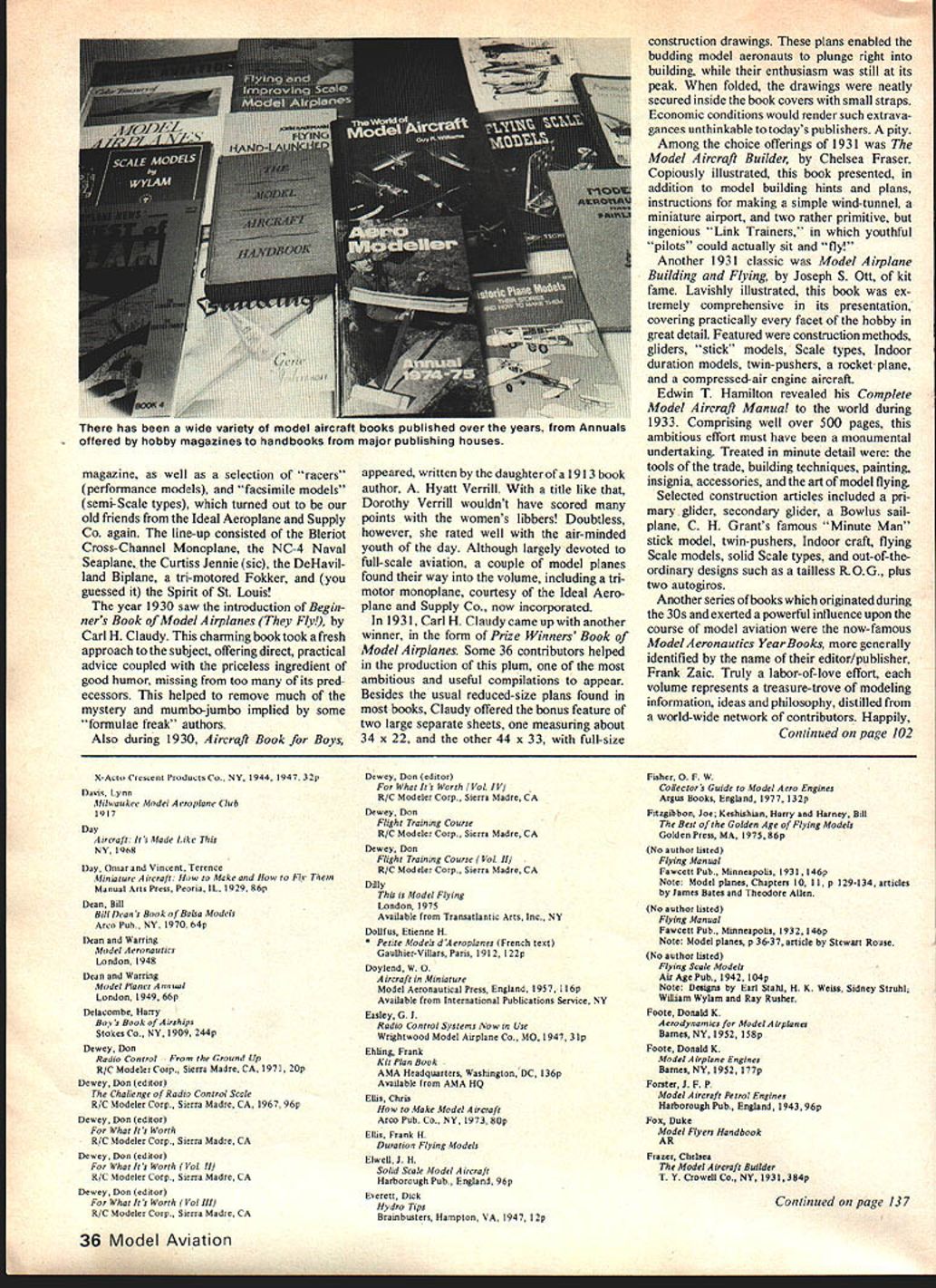
In 1931 Claudy produced Prize Winners' Book of Model Airplanes, a major compilation with contributions from some 36 authors. Notably, it included two large, separate full-size construction sheets (about 34 x 22 and 44 x 33 inches) folded and secured inside the covers — an extravagance rarely seen in later publishing. Other 1931 titles of interest include The Model Aircraft Builder by Chelsea Fraser (which contained instructions for a simple wind-tunnel, a miniature airport, and primitive "Link Trainers") and Model Airplane Building and Flying by Joseph S. Ott (lavishly illustrated and comprehensive in scope).
Edwin T. Hamilton's Complete Model Aircraft Manual (1933) ran to well over 500 pages and treated in minute detail tools, building techniques, painting, insignia, accessories, and the art of model flying. Construction articles included primary and secondary gliders, a Bowlus sailplane, C. H. Grant's "Minute Man" stick model, twin-pushers, indoor craft, flying scale models, solid scale types, and out-of-the-ordinary designs such as tailless R.O.G. models and autogiros.
Another influential series originating in the 1930s was the Model Aeronautics Year Books, edited/published by Frank Zaic. Each volume is a treasure trove of model information, ideas, and philosophy, distilled from a worldwide network of contributors. Some of these items have been reprinted and are still available.
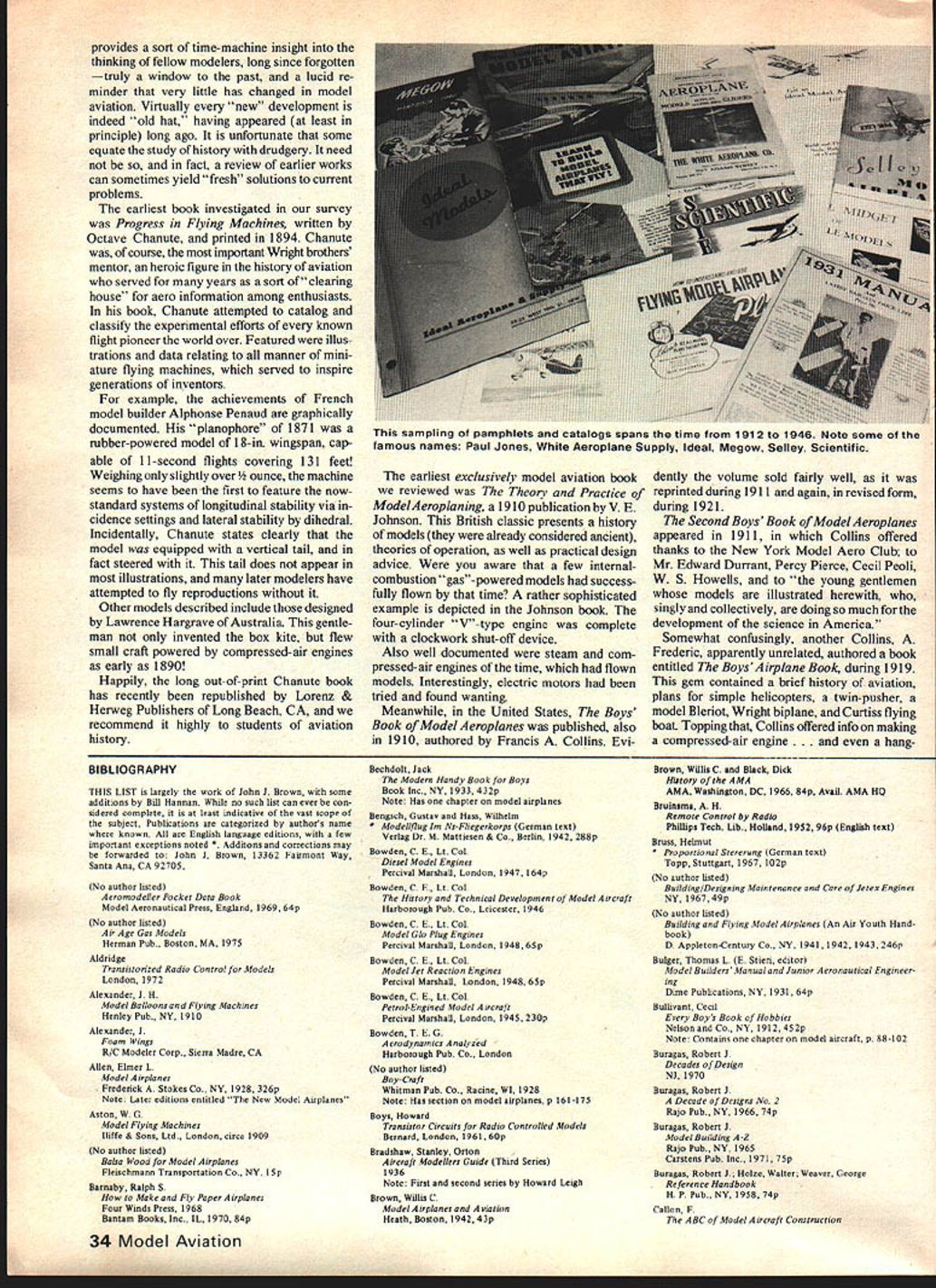
Besides books and magazines, pamphlets and booklets also offered exciting and useful model-building information. An example is Paul Jones' Step-by-Step Course in Model Aviation (1936), now a rare collectible.
1940s–1950s and later
Moving into the 1940s, model-aviation offerings continued. The Model Aircraft Handbook by William Winter (former editor of this magazine), published in 1941 and illustrated by Paul Plecan and H. A. Thomas, explained preparation of construction plans, use of materials and tools, design features, finishes, model engines, flying and adjusting, including free flight, control-line, and radio control. The book went through multiple editions and printings and was later extensively revised by Howard McEntee.
Two important volumes by Charles Hampson Grant appeared during the 1940s: Design for Flight and Model Airplane Design and Theory of Flight. While some of the theories presented provoked controversy in the modeling press, the books had a significant and lasting impact on model-aircraft design thinking.
Of the many informative and useful publications to appear during the 1950s, one noteworthy title is Model Aeronautics Made Painless by Raul J. Hoffman (1955). This remarkable compilation reduces virtually everything known about model aircraft, between one set of covers — both practical and mathematical explanations are given, making it equally useful to theory- and empirically-minded modelers.
(To be continued.)
Bibliography
- Cann, F. J. Model Aeroplanes. London, circa 1911.
- Cann, F. J. Model Aeroplane Handbook. George Newnes, London, 1949, 312 p.
- Cann, F. J. The Design of Model Aeroplanes. Benson Brothers, Ltd., London, 1919, 172 p.
- Cann, F. J. Model Aeroplanes and Airships. George Newnes, London, 1933, 98 p.
- Cann, F. J. The Model Aircraft Handbook. George Newnes, London, 1938, 148 p.
- Cann, F. J. Radio Controlled Models. Pearson Ltd., London, 1958, 184 p.
- Chinn, Peter G. F. Model Aircraft Engine Tests. Percival Marshall, London, 1960, 96 p.
- Claudy, Carl H. Beginner's Book of Model Airplanes. Bobbs-Merrill, Indianapolis, IN, 1930, 184 p.
- Claudy, Carl H. The Beginner's Book of Model Airplanes. Bobbs-Merrill, Indianapolis, IN, 1931, 242 p. (plus plans)
- Colebridge. Scale Models of Boats. NY, 1972, 118 p.
- Coleman, I. E. (Northrop, W. C., editor). Flying Scale Models of WWII. Model Builder, Santa Ana, CA, 1974, 128 p.
- Collins, A. Frederick. Aviation and All About It. D. Appleton-Century Co., NY, 1929, 260 p.
- Collins, A. Frederick. The Boy's Book of Aeroplanes. Stokes Co., NY, 1919, 353 p.
- Collins, Francis Arnold. The Boys' Book of Model Aeroplanes. The Century Co., NY, 1910; reprints 1911, 1926, 1936, 1937, 1941, 262 p.
- (No author listed). Color Treasury of Model Airplanes. Crescent Books, London, c. 1972, 64 p.
- (Commercial Radio Control) Equipment for the Model Builder. Hobby Helpers Pub., NY.
- (Construction of Models and Aeroplanes). Manual Arts Press, Peoria, IL.
- Conrad (no author listed). Manual for Model Aeroplanes. Model Aeronautical Press, England, 1957, 1960, 93 p.
- Cook, David C. Guide to Model Aircraft. McBride, NY, 1945, 287 p.
- Cook, David C. & Jenkins, Jesse (editors). Modelcraft Annual, 1949–1953. McBride, NY, 1949, 244 p.
- Cook, David C. Model Aircraft Annual 1944. McBride, NY, 1944, 244 p.
- Court, Ernest. Manual of Construction of Model Noise. AMA Headquarters, Washington, DC, 30 p.
- Cox, Jack. The Boy's Own Book of Hobbies. Lutterworth Press, London, 1957, 240 p.
- Cox, Jack. The Model Aircraft Manual. (Note: Chapter II on model aircraft by R. H. Warring.)
- Crickshaw, J. W. B. The Aeromodeller's Year Book. Marshall & Sons, 1940, 46 p.
- Davis. The Junior Airman's Book of Airplanes. NY.
- Davidson, Jesse. Building Your First Flying Model. A Modern Product Publications Co., NY, 1946, 32 p.
- Davidson, Jesse. How to Build Small Scale Model Warplanes. (Title entry incomplete in source.)
Transcribed from original scans by AI. Minor OCR errors may remain.

