
Model Design Using Spreadsheets
Ron Bozzonetti
It is not uncommon for something designed for one purpose to be used for another, as has happened with spreadsheet programs. While intended for accounting, the spreadsheet lends itself as a practical model aircraft design tool, replacing the hand-held calculator.
This article briefly describes my efforts in utilizing a spreadsheet program to perform calculations I require when designing model aircraft.
Advantages
- It's easy to learn.
- No special skills or knowledge are required.
- Results are instantaneously displayed.
- Changes to the data or format can be made easily.
- A file with all of the model's data can be stored for future reference.
- A hard copy can easily be made.
Files developed
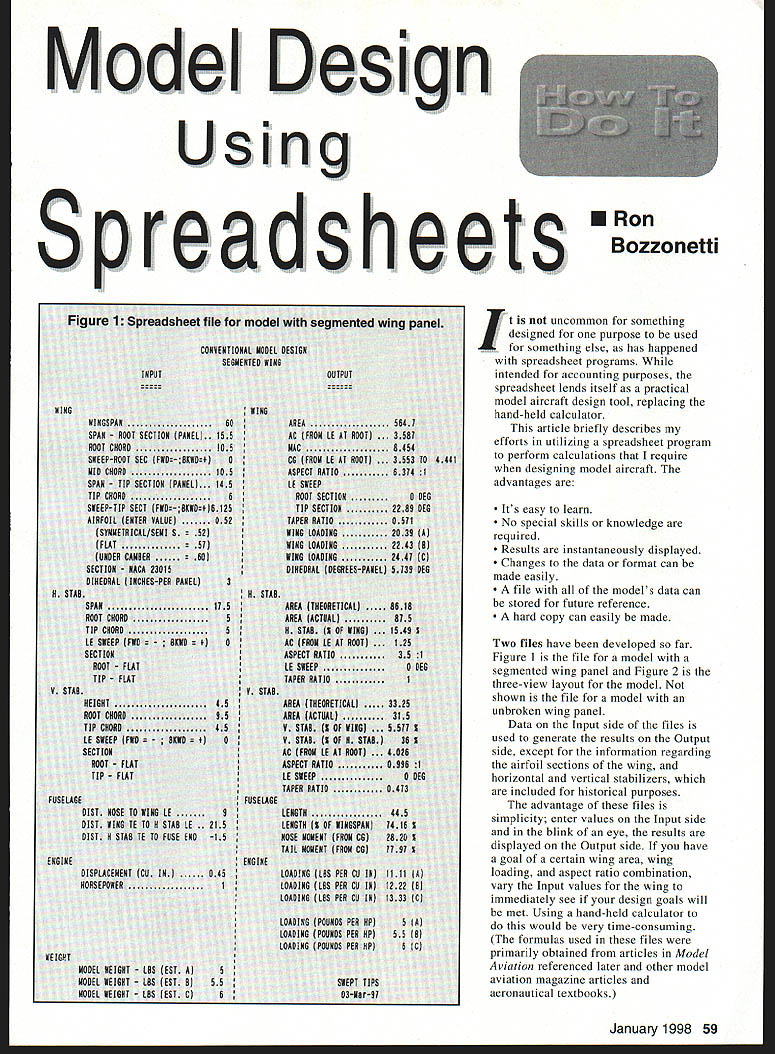
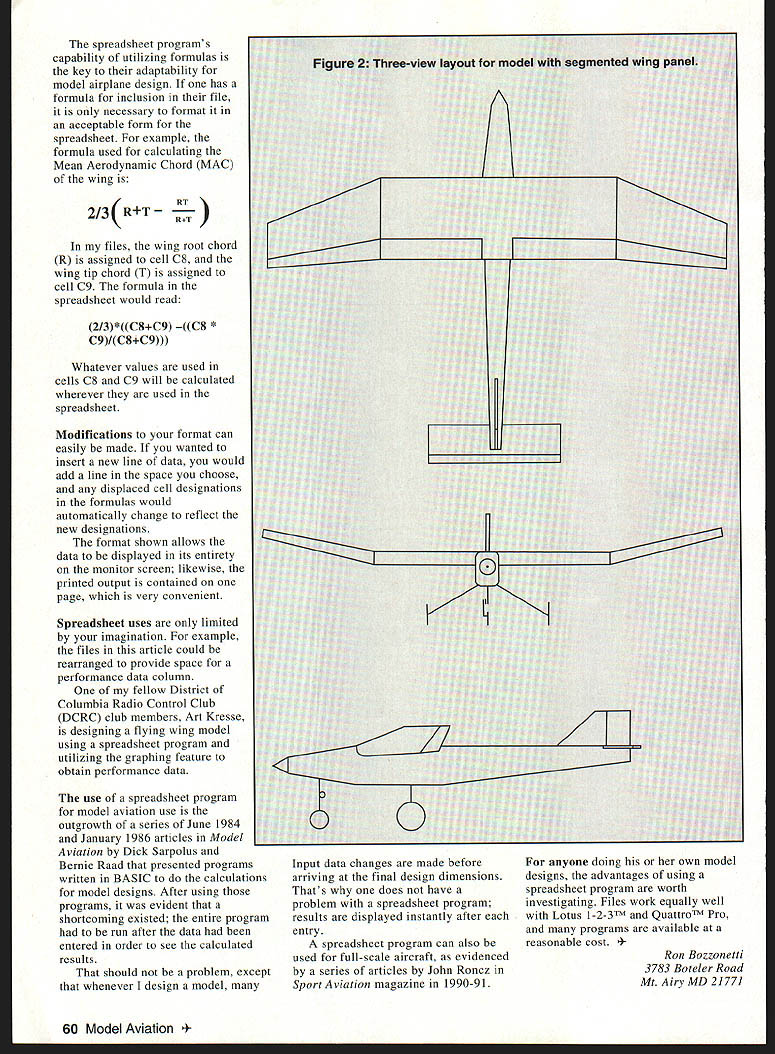
Two files have been developed: one for a model with a segmented wing panel (with an associated three-view layout) and another for a model with an unbroken wing panel.
Input and output
Data on the Input side of the files is used to generate the results on the Output side, except for the information regarding the airfoil sections of the wing and the horizontal and vertical stabilizers, which are included for historical purposes.
The advantage of these files is simplicity: enter values on the Input side and, in the blink of an eye, the results are displayed on the Output side. If you have a goal for a certain wing area, wing loading, and aspect-ratio combination, vary the Input values for the wing to immediately see if your design goals will be met. Using a hand-held calculator to do this would be very time-consuming. The formulas used in these files were primarily obtained from articles in Model Aviation (referenced later), other model aviation magazine articles, and aeronautical textbooks.
How it works
The spreadsheet program's capability of utilizing formulas is the key to its adaptability to model-airplane design. As long as a formula can be expressed in the format acceptable to the spreadsheet, it will work. For example, a formula used in calculating the Mean Aerodynamic Chord (MAC) can reference the cells for the wing root and tip chords; whatever values are placed in those cells will be calculated wherever the MAC is used in the spreadsheet.
Modifications and flexibility
Modifications to the format can be made easily. If you want to insert a new line of data, you simply add the line and the displaced cell designations and formulas will automatically change to reflect the new designations. The format shown allows the data to be displayed in its entirety on the monitor screen and the printed output to be contained on one convenient page.
Spreadsheet use is limited only by the user's imagination. The example files in this article could be rearranged to provide space for performance data columns.
Applications and examples
Fellow District of Columbia Radio Control Club (DCRC) members are using spreadsheet programs in a variety of ways. For example, Art Kresse is designing a flying-wing model using a spreadsheet program and utilizing the graphing feature to obtain performance data.
The use of a spreadsheet program for model aviation grew out of a series of Model Aviation articles (June 1984 and January 1986) by Dick Scarpous and Bernic Raad that presented programs written in BASIC to do the calculations for model designs. After using those programs, it was evident that a shortcoming existed: the entire program had to be run after the data had been entered to see the calculated results. That is not a problem with a spreadsheet program; results are displayed instantly after each entry.
A spreadsheet program can also be used for full-scale aircraft, as evidenced by a series of articles by John Roncz in Sport Aviation magazine in 1990–91.
Compatibility and availability
Files work equally well with Lotus 1-2-3 and Quattro Pro, and many spreadsheet programs are available at a reasonable cost.
For anyone doing their own model designs, the advantages of using a spreadsheet program are worth investigating.
Ron Bozzonetti 3783 Boteler Road Mt. Airy, MD 21771
Transcribed from original scans by AI. Minor OCR errors may remain.

