
Model Flying and Vision: Testing for Eye Pointing
Jeffrey D. Hansen
Environment and age, more than anything, affect your vision, which is distance-oriented by nature. The stress of excessive office/computer work or model building reduces most visual skills. But take heart—there are ways to train your eyes to "see" better.
HOW WE SEE the action at the flying field—that is, how our vision works—greatly influences our success at flying models. Consider the case of a fellow modeler who was buying a new Radio Control Mustang at the Hobby Lobby counter in Burbank, CA because he had no other planes to fly: his last two had been blown to smithereens in recent midair collisions. Bad luck? Maybe. But both times he was creamed by the same pilot while flying at the same field.
Circumstances were identical: good weather, clear visibility, and our soon-to-be-Mustang-owner was practicing figure eights in a quiet corner of the field. Suddenly a biplane swooped in overhead from behind and—BLAM!—his Pattern ship exploded in front of his eyes. The first time he shouted, “Where the heck did that come from?” The second time he was less restrained. From his perspective, it seemed there had been no time to see and react because the kamikaze attack happened so quickly.
Other fliers, citing their superior ability, insist such midairs are avoidable. Behavioral optometrists have shown that this is a fallacy, amassing evidence that individual differences in visual performance—especially under stress—can cause exactly this sort of accident. At the highest levels of model competition these differences are magnified: a normally insignificant visual weakness can erupt into something that seriously alters what a flier sees and how he reacts.
Vision Training and Behavioral Optometry
Behavioral optometrists define vision as how well you use a number of specific, interrelated eye skills. Vision level is measured by overall performance across the entire range of eye skills. They advocate the idea that vision is a learned trait that can be developed with training.
A behavioral vision exam is a comprehensive evaluation that goes well beyond the Snellen eye chart. It typically consists of a one- to two-hour series of about 60 tests measuring performance across the spectrum of eye skills and how well an individual applies visual information. Vision training programs developed by these specialists have been shown effective in real-world applications—for example, some members of the 1984 Olympic men's volleyball team and professional baseball players have received vision training.
Numerous studies and tests have consistently shown:
- Take the best people in any pursuit—sports to business—and about one in five will be found to have a significant vision problem of which they are unaware.
- Without exception, winners are those who possess the best visual skills.
Behavioral optometrists generally see potential achievers performing below expectations: smart kids failing at school due to undetected visual problems, people with crossed eyes, senior citizens seeking to slow aging effects on vision, and athletes seeking a competitive edge. Before suggesting therapy, optometrists ask two key questions: Does your vision allow you to function well in your environment, or does it hold you back? Those who feel handicapped by their vision are candidates for training.
Why does vision training make a difference? Many people confuse having 20/20 eyesight (clarity) with perfect vision. Twenty-twenty eyesight measures only a tiny fraction of what the eyes do. The other visual skills fall into two broad areas:
- Motor skills: eye/hand coordination, eye pointing, tracking, and convergence.
- Processing skills: the ability to identify objects, use visual memories, understand implications, and imagine future events.
More gray matter is devoted to vision than to all other senses combined. Tests show that when you turn your head or look down off-balance, a conflict is set up in the brain. Since maintaining balance is a high priority, the brain can momentarily shut off visual input until balance is reestablished. The visual apparatus still works, but the brain temporarily doesn't compute the input—“the picture doesn’t register.” This vision/brain nexus also determines how well you coordinate body movements and perform hand-eye activities—from construction to flight.
Motor Skills: Eye-Pointing and Tracking
Eye pointing is the ability to aim the eyes at the same target. When both eyes are aimed correctly, the visual fields combine for excellent depth perception and spatial judgments. When eye pointing is inaccurate, one eye tends to dominate while the other is suppressed, leading to poor depth perception and mistakes in judging distance and relative motion.
Questions to assess your motor skills:
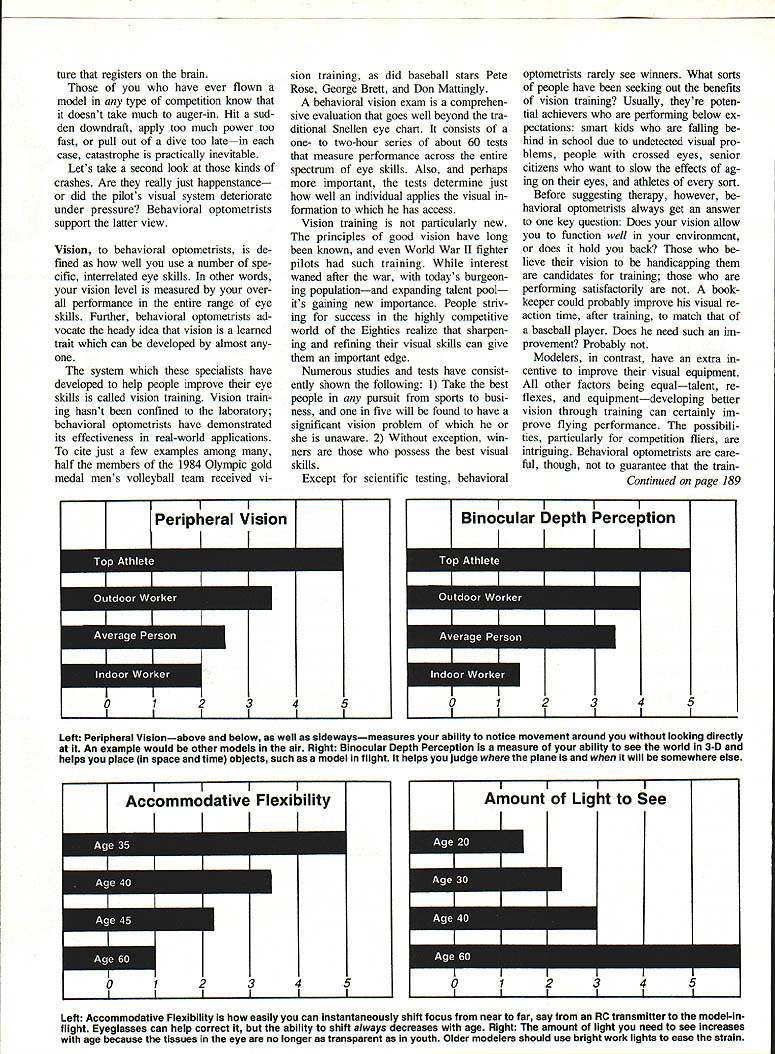
- Do your eyes aim accurately and track smoothly? Errors of as little as 2% can cause problems.
- Can your eyes point straight ahead for distance sight and converge inward for close work? Excessive close work can cause eye muscles to lock in on a close position and blur distance sight, or cause one eye to drift or suppress.
- Do you know where you are in relation to other objects? Discrepancies between how each eye performs can lead you to misjudge a model’s distance and position.
- How does stress (a contest) or being off-balance affect your vision? For example, a CL Combat flier who stumbles may lose visual effectiveness.
- Do you have the flexibility to switch from near to far vision instantly—e.g., glance at your transmitter then shift back to a rapidly approaching model?
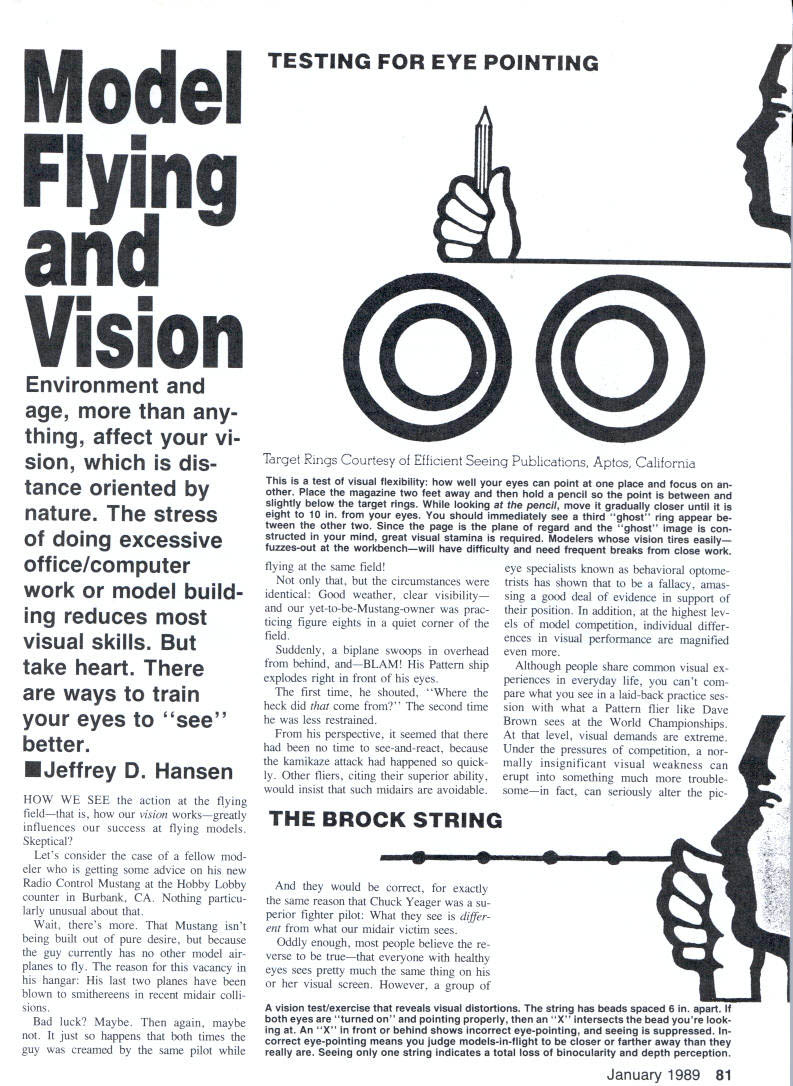
Target Rings (Visual Flexibility Test)
A simple test of visual flexibility:
- Place a page with concentric target rings about two feet away.
- Hold a pencil so the point is between and slightly below the target rings.
- While looking at the pencil, move it gradually closer until it is 8–10 inches from your eyes.
- You should immediately see a third “ghost” ring appear between the other two. The page is the plane of regard and the ghost image is constructed by your mind; sustaining this requires visual stamina.
Modelers whose vision tires easily will have difficulty with this test and need frequent breaks from close work.
The Brock String
The Brock string is a quick, reliable, inexpensive way to test and train eye pointing and binocular function.
- Tie one end of a 5–10 foot string to the bridge of your nose and place three beads on it at different distances (beads spaced about 6 inches apart is typical).
- Fix your gaze on the nearest bead, then the middle, then the far bead.
- When the eyes are pointing correctly, an X will appear at the bead (one image from each eye crossing), and you should see double images of the other beads.
- An X in front of or behind the bead indicates incorrect eye pointing; if one eye is suppressed you won’t see the X. Seeing only one string indicates a loss of binocularity and depth perception.
Training with the Brock string:
- Start with one bead near the nose and gradually work out to the farther beads.
- Keep the X clear for increasing periods and practice smooth eye movements from bead to bead.
- Use a target such as a sticker on the bead and practice several times a day for minutes at a time. Within a few weeks you should notice improved alignment and better depth perception.
Convergence Near-Point Test
Another simple test:
- Hold a small target (pen tip) at arm’s length and slowly move it toward the bridge of your nose.
- Normal convergence is about 2–3 inches.
- If you cannot converge that close or you experience double vision, you may have convergence insufficiency.
Processing Skills
Processing skills help you identify objects (moving or static), draw on past visual memories, understand implications of what you see, and imagine what will happen next. Modelers use processing skills every day—distinguishing aircraft types at a distance, deciding when to pull out of a dive, rehearsing evasive maneuvers mentally, and integrating engine sounds into spatial judgments.
Questions to assess your processing skills:
- In flying an RC model, can you keep your eyes on your model and, without moving your head, monitor movements of other planes in the same airspace?
- How keen is your awareness of the world around you? If your perception of visual space is poorly organized, you become stimulus-bound and depend on visual clues (trees, hills) to form spatial relationships. This explains why some fliers do well at their home field but poorly elsewhere.
- Can you visualize things in your mind’s eye—rehearse maneuvers, picture aerobatic patterns, reverse orientation for mirror images, and anticipate an opponent’s next move?
Tachistoscope and Visual Processing Speed
Behavioral optometrists use a Tachistoscope (a projector with a strobe) to train and measure visual processing speed. A string of numbers is flashed at controlled speeds (from 0.1 to 0.01 seconds). Initially a subject may identify only a couple of numbers; after training they can identify very lengthy number strings that were previously unreadable. The final phase may require recalling the first and last digits in a long string. This measures how much information you can get in one quick glance—an ability directly applicable to seeing a glimpse on the flying field and making the right decision based on minimal data.
Motorcycle racer Eddie Lawson and WWII ace Fred Arnold have been tested on such machines; their results illustrate the extreme levels of processing some top performers can achieve.
Why Vision Matters in Model Flying
Consider the visual dynamics that may have contributed to the midair collisions described earlier:
- Peripheral vision: Failure to pick up movement in the superior gaze (overhead) area means you can be surprised by an incoming aircraft.
- The ability to see-and-react: If you “freeze at the stick,” you take no evasive action.
- Visualization: After a close call, mentally rehearsing evasive sequences and transmitter inputs can prevent a repeat.
- Balance/vision connection: Head tilt, being off-balance, or startle can disrupt visual input and delay reaction.
If both eyes are working together harmoniously and efficiently, you make better space-and-time judgments and faster decisions.
Training and Practical Tips
How can you improve visual skills to be a safer flier?
- Remember that close work and distance work are incompatible. When you go out to fly (especially after work), give yourself time to adjust visually to the changing space. Shift your gaze among objects at varying distances.
- Relax. Trying too hard to see—squinting or tensing eye muscles—creates visual misjudgments. If you feel tension, rub your eyes lightly to massage it out.
- In bright sunlight wear lightly tinted sunglasses (e.g., Blue Blockers) that filter ultraviolet and increase contrast. Most dark glasses merely reduce light and do not improve contrast.
- Don’t fly through the sun; fly around it. Recovery time from sun glare is slow.
- Don’t fly directly overhead unless necessary. A shallow head angle helps prevent vision/balance conflicts.
- Don’t get emotionally pumped up. Adrenaline (fight-or-flight) adversely affects vision—stay cool.
- Fly with an observer if you have a tendency to lapse into tunnel vision.
- Do not use eyeglasses with close-work (reading) lenses for flying or driving—they worsen visual perception. An optometrist can prescribe performance lenses for these activities.
- Practice simple tests and exercises (Target Rings, Brock string, convergence near-point) regularly to build stamina and coordination.
If you think your vision may be limiting your flying, seek out a behavioral optometrist. Don't be satisfied with routine eye-chart tests; ask for an evaluation of eye-pointing, convergence, eye movement control, and visual processing speed. Vision training can be cost-effective and yield dramatic improvements in flying performance.
If you'd like to learn more or contact a behavioral optometrist, write: The College of Optometrists in Vision Development P.O. Box 285 Chula Vista, CA 92012
It's possible you’ll be pleasantly surprised by your performance on vision tests—some people have naturally superior vision. If your performance is middling, however, you have the option to improve it with training that can make a real difference.
Transcribed from original scans by AI. Minor OCR errors may remain.

