
For Model Helicopters: Exotic Rotors
By James M. Wang
Introduction
In both RC and full-size helicopter design, the rotor head holds the key to improving flight performance. Researchers are continually searching for the ultimate design. This is part one of a two-part article. Part two will discuss wind-tunnel testing of a 1/6-scale state-of-the-art bearingless rotor system for future full-size applications.
In my professional work I conduct research on full-size helicopter rotor systems. Experimenting with RC helicopter design in my spare time sharpens my intuition about the analogous but different problems encountered with full-size choppers. Working out problems with RC helicopters is a great way to predict how a new helicopter design will behave before I crunch through complex theories on the computer.
Rotor function and control
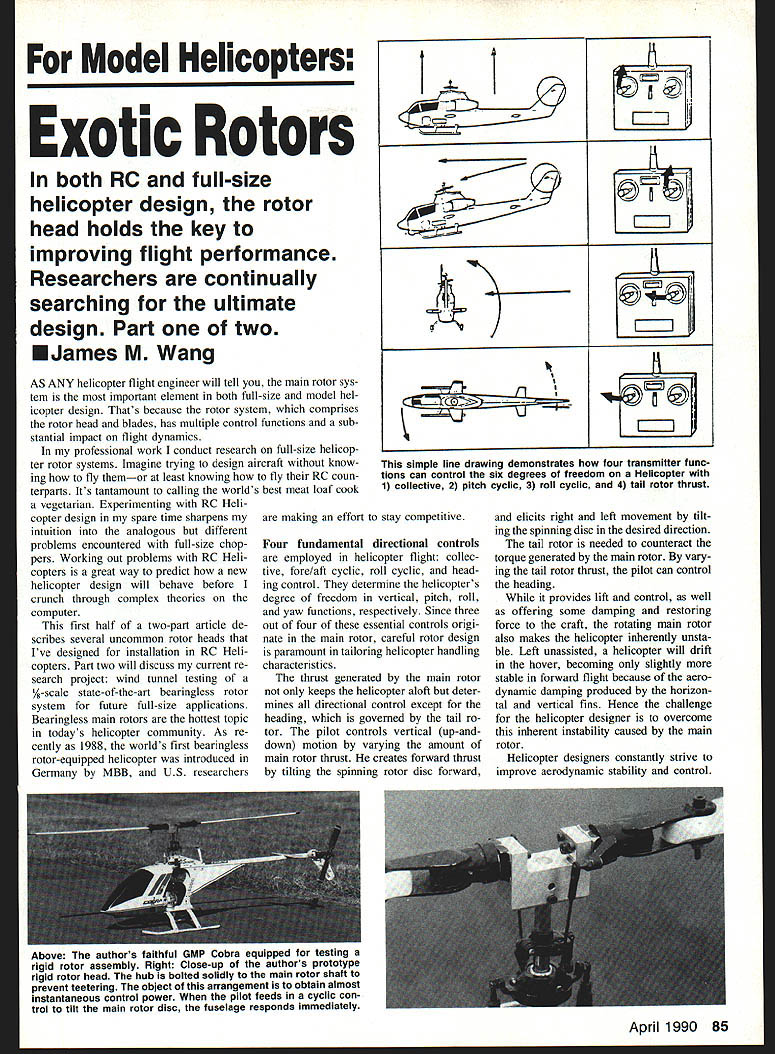
Four fundamental directional controls are employed in helicopter flight:
- Collective (vertical — up and down)
- Fore/aft cyclic (pitch)
- Roll cyclic (roll)
- Heading control (yaw)
Three of these four essential controls originate in the main rotor. The thrust generated by the main rotor not only keeps the helicopter aloft but determines all directional control except for heading, which is governed by the tail rotor. The pilot controls vertical motion by varying main rotor thrust, creates forward motion by tilting the spinning rotor disc forward, and elicits lateral motion by tilting the disc to the desired side. The tail rotor counters the torque generated by the main rotor; by varying tail-rotor thrust the pilot controls heading.
While the main rotor provides lift, control, damping, and restoring forces, it also makes the helicopter inherently unstable. Left unassisted, a helicopter will drift in the hover, becoming only slightly more stable in forward flight because of aerodynamic damping from the horizontal and vertical fins. Hence the challenge for the designer is to overcome this inherent instability caused by the main rotor.
Rotor-head design elements
Helicopter designers constantly strive to improve aerodynamic stability and control by redefining design elements such as:
- rotor stiffness
- blade inertia
- rotor rpm
- shaft height
- blade chordwise center-of-gravity location
- blade airfoil
- blade diameter
- fuselage inertia
In the full-size helicopter industry, many engineers are involved in rotor head and blade design or testing for manufacturers such as Bell, Boeing, Kaman, McDonnell-Douglas, and Sikorsky.
Main categories of rotor heads
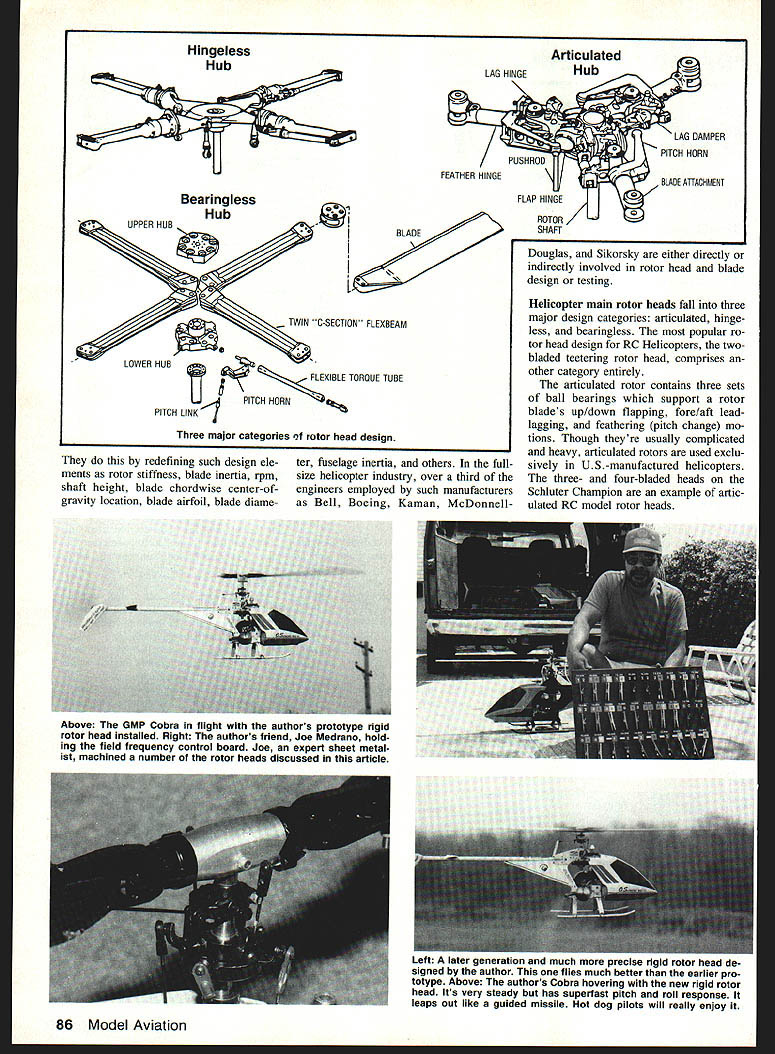
Helicopter main rotor heads fall into three major categories:
- Articulated
- Hingeless
- Bearingless
Additionally, the two-bladed teetering rotor head, common in RC helicopters, is often treated as its own category.
#### Articulated rotors
An articulated rotor contains three sets of bearings to support a rotor blade's up-and-down flapping, fore-and-aft lead-lagging, and feathering (pitch-change) motions. Though usually complicated and heavy, articulated rotors have been widely used in U.S. full-size helicopters. The three- and four-bladed heads on the Schuler Champion are an example of articulated RC model rotor heads.
#### Hingeless rotors
Introduced in the 1970s, the hingeless rotor uses a single set of bearings for feathering. Flapping and lead-lag motions are achieved by flexing a nonrigid rotor hub or a pliable blade root. Advantages include fewer parts and an aerodynamically clean layout with good control response. Full-size examples include the MBB BO-105, Westland Lynx, and Aerospatiale Ecureuil. Hingeless rotors on RC models include the 30MX on the Kalt Baron and the K4-SB and K3-SB heads on the Kalt Cyclone and Baron 60.
#### Bearingless rotors
First developed in the 1980s, bearingless rotors use a supple composite element called a Flexbeam instead of bearings. Flapping, lead-lagging, and feathering are accomplished by flexing and twisting the Flexbeam. Bearingless systems are exciting but difficult to design correctly; incorrect flexibility or stiffness can lead to flutter and ground or air resonance. Peka of West Germany made two- through five-bladed bearingless heads for RC helicopters, though they were not always available in the U.S.
For a detailed comparison of these three types and their effects on RC performance, see my article "RC Rotor Head Theory" (Model Builder, June 1989).
Two-bladed teetering and rigid rotors
The two-bladed teetering head is popular in RC helicopters because it is simple to build and set up. The hub pivots on a pin, allowing the blades to teeter. This design works only for two-bladed systems. Full-size examples include the Bell Jet Ranger, UH-1 Huey, and Cobra gunship.
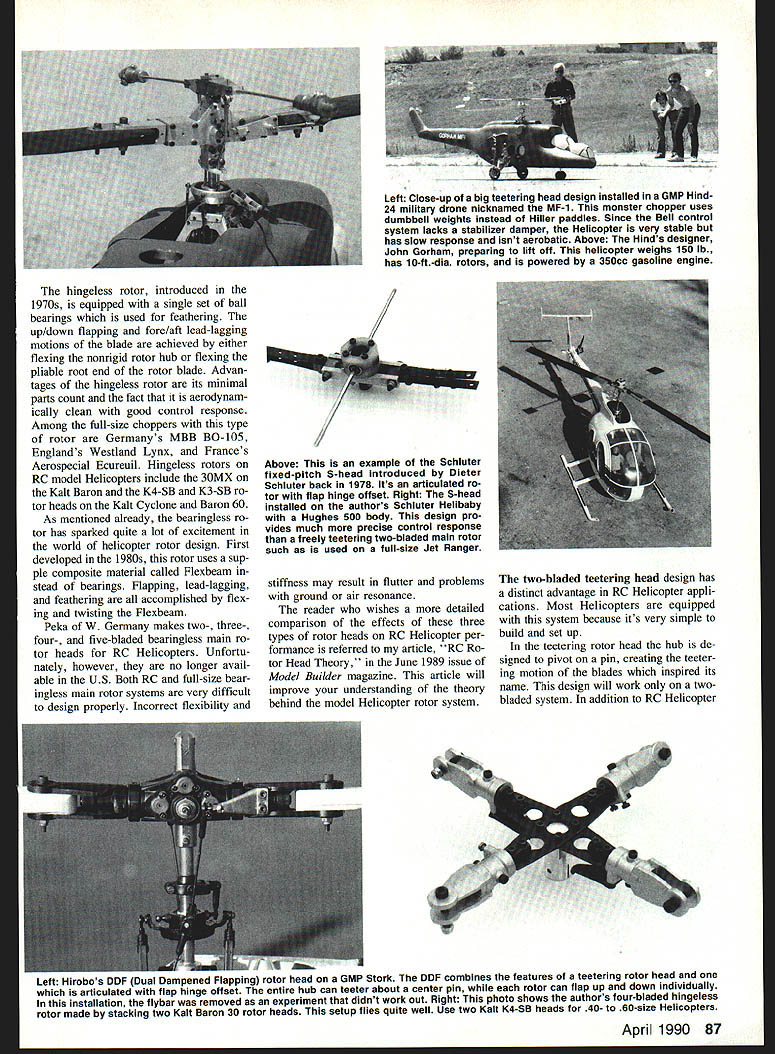
A variation is the rigid rotor, where the hub is bolted solidly to the main rotor shaft to prevent teetering. The rigid rotor offers superb, almost instantaneous control power: when the pilot inputs cyclic, the fuselage responds immediately. By contrast, the teetering rotor can be sluggish in cyclic control because the main rotor disc can tilt independently of the shaft, transferring less direct pitch or roll moment to the fuselage.
Model helicopters have mitigated the teetering sluggishness by using a rubber damper or O-ring inside the teetering hub. As the hub teeters, the rubber functions like a spring to transmit rotor tilt as a moment to pitch or roll the fuselage, enabling aerobatics. Stiffer dampers make the teetering head behave more like a rigid rotor, improving response but also increasing vibration transmitted to the fuselage, which can affect receivers and servos.
#### My rigid-rotor experiments
I built a prototype rigid rotor by cutting a GMP Custom head into two halves and coupling them with a machined aluminum hub that fits tightly over a 10 mm main rotor shaft. Achieving exact alignment of the feathering axes is critical; any misalignment causes serious vibration. A second hub I had precision machined eliminated vibration, and the helicopter flew superbly.
However, the rigid-rotor Cobra I tested tended to nose up in forward flight. Rigid rotor heads are typically flybarless; increasing blade weight or using flexible blades functioning like a stiff hingeless rotor would likely mitigate the nose-up tendency. The GMP flybarless Legend, which uses a stiff-teetering head, did not share the nose-up tendency and I prefer flying it for gentler handling.
The full-size MBB BO-105 illustrates a hybrid approach: a rigid titanium hub paired with flexible fiberglass blades to provide flapping flexibility without teetering slop or dead-band.
Wik Modellprodukte of West Germany makes a BO-105 rigid hub with flexible fiberglass blades for RC helicopters; I plan to try this unit and report results.
Other notable rotor heads and systems
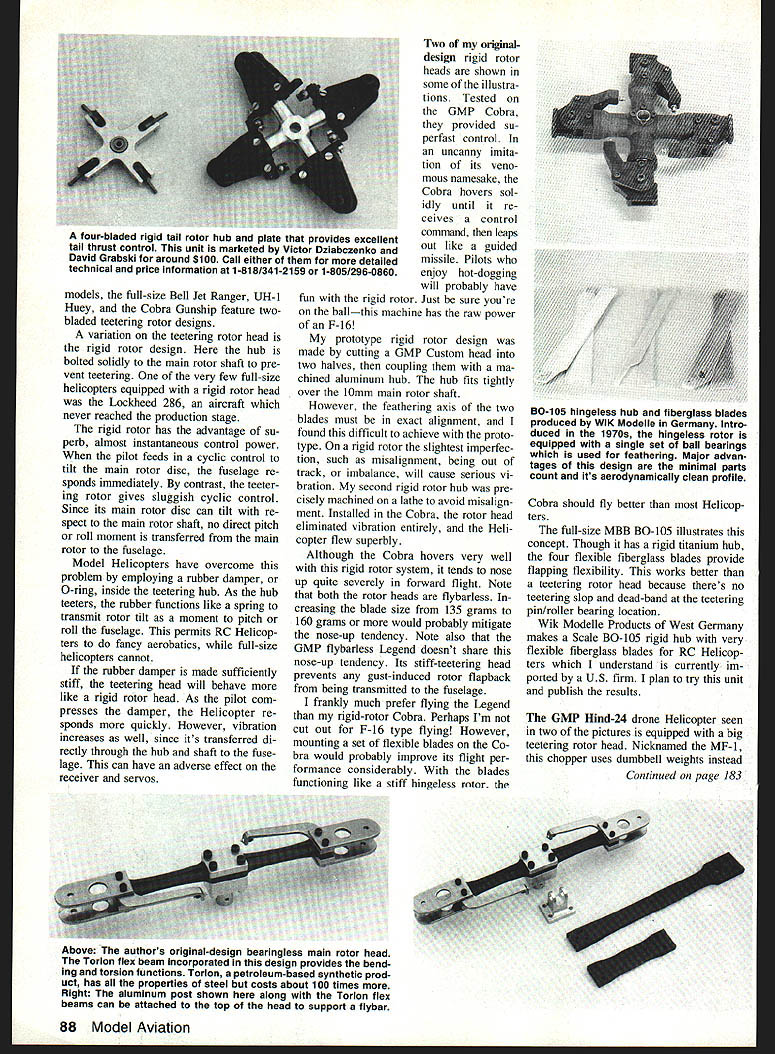
- The GMP Hind-24 drone (the MF-1) uses a large teetering rotor with dumbbell weights instead of Hiller paddles. Lacking a stabilizer damper, it is stable but not aerobatic. At 150 lb and powered by a 350 cc gasoline engine, it uses a 10-ft.-diameter main rotor — a very large machine.
- Schluter fixed-pitch S-head: introduced by Mr. Schluter in 1978, this two-bladed articulated rotor has flap-hinge offset (not to be confused with a teetering head). Flap-hinge offset provides better control response than a freely teetering two-bladed main rotor. Kyosho's Concept 30 is an example of a collective-pitch helicopter with a two-bladed flap-hinge-offset articulated main rotor.
- Hirobo DDF (Dual Dampened Flapping) head: combines teetering and articulated flap-hinge-offset features. The entire hub can teeter about a center pin, while each rotor blade can flap individually, producing a "softness" that yields very stable flight characteristics.
- Hirobo Shuttle evolution: the original Shuttle (1985) had an overly soft flapping head, which risked blades striking the tail boom on hard landings. Since 1987, Hirobo has used a floating-axle design similar to that in the Schluter Champion and the Miniature Aircraft X-Cell, making the Shuttle both stable and aerobatic.
- Flybarless experiments: I removed the stabilizer bar from a Stork to test flybarless behavior and found it did not fly well. Extra damping and quick control response are needed to tame RC helicopters; flybarless RC helicopters depend on a stiff main rotor head for pitch and roll damping and control power.
- A four-bladed hingeless head: I made one by stacking two Baron 30MX two-bladed hingeless heads, producing a result similar to the full-size Westland Lynx rotor head. The steel flexbeam hub gives flap flexibility comparable to the Lynx. MBB's BO-105 achieves flap flexibility through fiberglass blades; Mikado also produces a BO-105 hingeless hub and blades.
My bearingless rotor design and fabrication help
My original bearingless rotor head uses a Flexbeam for bending and torsion, and is machined from Torlon, a petroleum-based synthetic manufactured by Amoco. Torlon has properties similar to steel but is much more expensive. A 2-ft.-square piece sells for around $700. An aluminum post can be added on top of the head to support a flybar.
My friend Joe Medrano, an expert sheet metal worker, machined many of the rotor heads shown in the photos, stamped Cobra side frames, and welded a rear exhaust muffler. Thank you, Joe!
Conclusion and next article
Next month's sequel will present the 1/2-scale four-bladed bearingless model rotor tested at the Glen L. Martin wind tunnel at the University of Maryland. Along with the million-dollar tunnel, you'll see exotic blades, swashplates, miniature hydraulic servo actuators, and control systems.
Transcribed from original scans by AI. Minor OCR errors may remain.

