
Model These?
The home-built crowd keeps coming up with odd but proven aircraft which appeal to modelers who wish to try something different.
Don Berliner
THE SIGN on the side of the pretty airplane in 2 in. block letters, says "Experimental." But exactly what does it mean? Is it there because the airplane is the brainchild of some mad genius with a basement full of bubbling test tubes? Or is it simply the end result of some bureaucrat's redtape machine?
The airplane—whether it be an absolutely standard type of home-built which can be seen in greater numbers than some factory-built planes, or a truly original design which encompasses a bunch of radical ideas—must be decorated with "Experimental" in order to meet the rules of the Federal bureaucracy. To the Government, it's either a fully tested and certified production craft, or it's Experimental. And if it's the latter, there has to be a sign warning anyone who might enter.
Just how experimental it is depends on why the builder is involved in the amateur-airplane-building hobby, and the nature of his or her goals. Some airplanes are built at home because a factory-built airplane would be too expensive. Others are built because the builder just likes to build things, and an airplane is a much more interesting project than another bookcase. Still others are built at home because no factory airplane meets the builder's very special needs. A few are built because the head designer/builder is simply bursting with unusual ideas and can try out a genuinely experimental flying machine.
Give the devil its due: the Federal Aviation Agency places fewer restrictions on the design, construction and use of home-built airplanes than does the comparable agency in other countries' governments. As long as an airplane is built to accepted standards using aircraft-quality materials and used for educational or recreational purposes, the Feds won't get in the way. In fact they don't have anything to say about the design of a home-built airplane. Some pilots willing to risk their necks flying an airplane probably shouldn't leave the ground; that's their business. Of course, before he's allowed to carry passengers or take a trip, the airplane must be tested at least 50 hours to show it is flyable and reasonably safe. To fly a weird-looking thing just takes an eager pilot and a solid airframe.
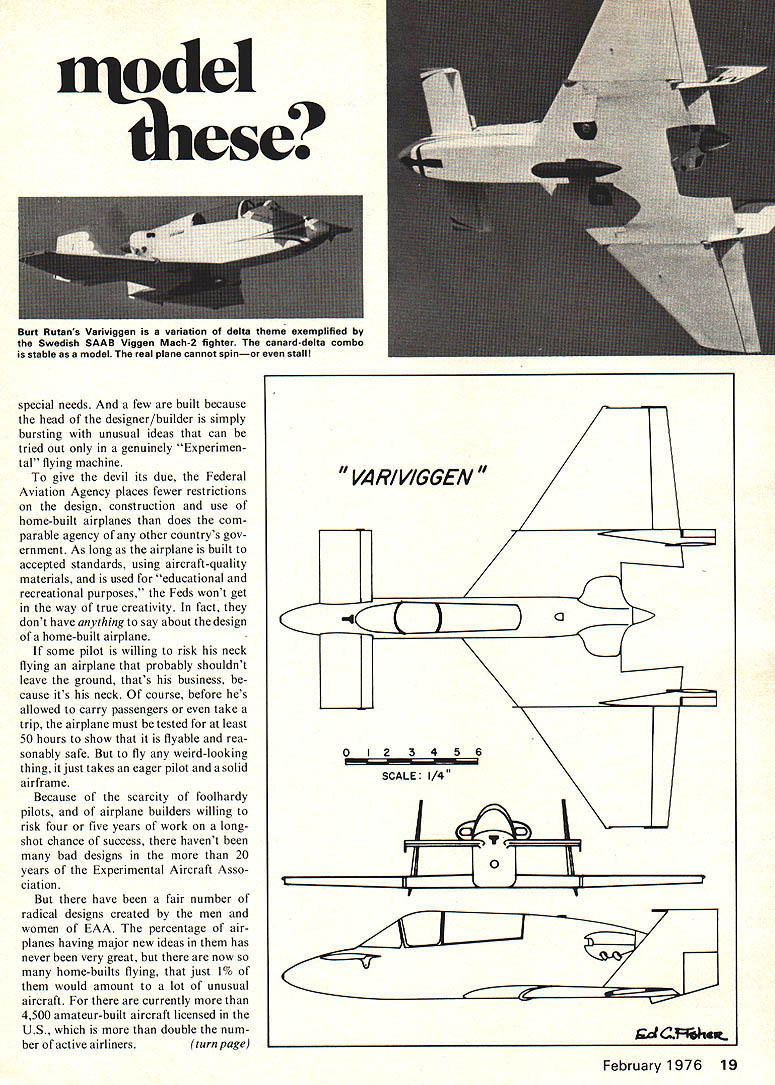
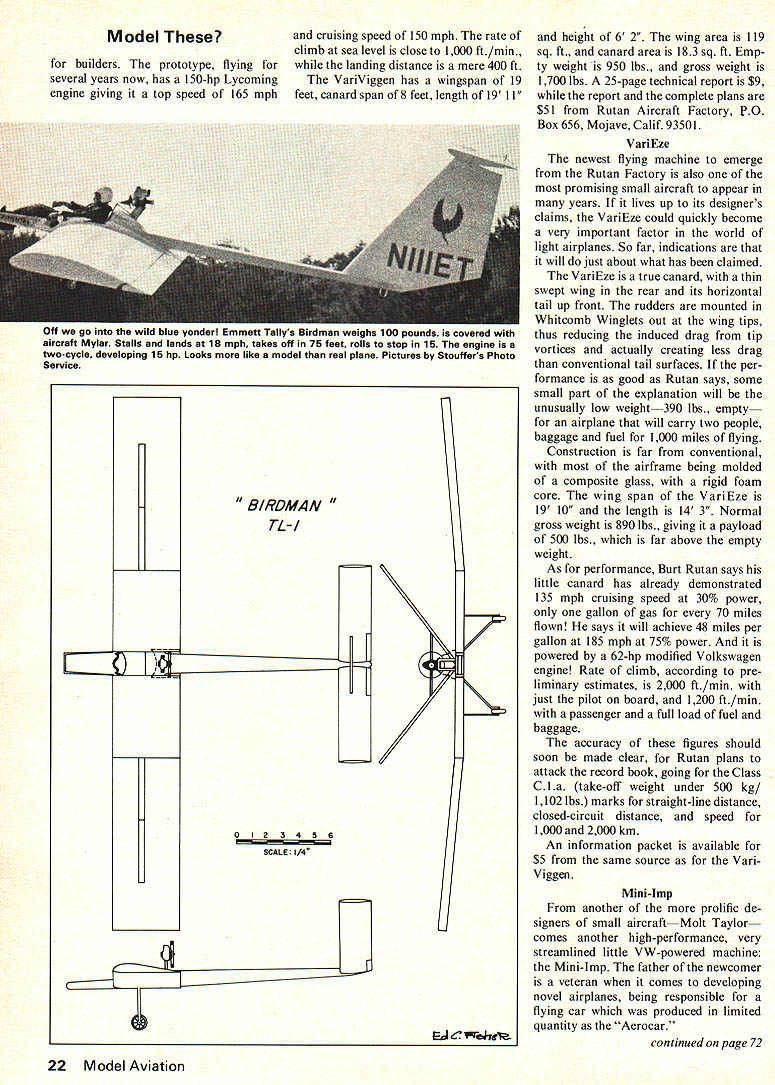
Because of the scarcity of foolhardy pilots and airplane builders willing to risk four or five years' work on a long-shot chance of success, we haven't had many bad designs. In the 20 years the Experimental Aircraft Association has existed there have been a fair number of radical designs created by men and women. The FAA percentage of airplanes having major new ideas has never been very great. If home-builts now flying are just 1%, it would still amount to a lot of unusual aircraft. Currently 4,500 amateur-built aircraft are licensed in the U.S., double the number of active airliners. Burt Rutan's Variviggen is a variation of the delta theme exemplified by the Swedish SAAB Viggen Mach‑2 fighter. The canard‑delta combo is stable as a model. The real plane cannot spin—or even stall!
Model These?
Two major factors have combined to keep the supply of radical home-builts down: the great time required to design, build, test and prove a novel aircraft; and the very special skills demanded for such a project. While thousands of men and women are capable of building an airplane from a well-drawn set of plans, relatively few have the engineering training and/or natural talent needed to create something unique that will leave the ground and then return in the same condition.
But balanced out against these drawbacks is the splendid opportunity to experiment with a minimum of cost and a minimum of fuss. No wind tunnels, no computers, no thick books of government or foundation specifications to be met. Just take an idea, convert it into wood and metal and fiberglass, and take off.
Probably every person who has built an airplane has given at least idle thought to creating something truly different. An airplane that is shaped unlike anything before it, and thus should fly better or faster or more economically than all those produced by the greatest minds in aviation history. A few hundred or more of these ideas have gotten as far as a drawing board before reality took over. Scores have gotten to the shop, and dozens have been rolled out of the shop, well on the way to fame or failure.
Of the many that have actually flown—sometimes much better than comparable airplanes we all know—a few are herein presented for your edification and amusement. The collection is by no means intended to be complete. Rather, it is a sampling of the creativity of amateur airplane designers. And, perhaps, a look at the future of small manned aircraft.
Dyke Delta
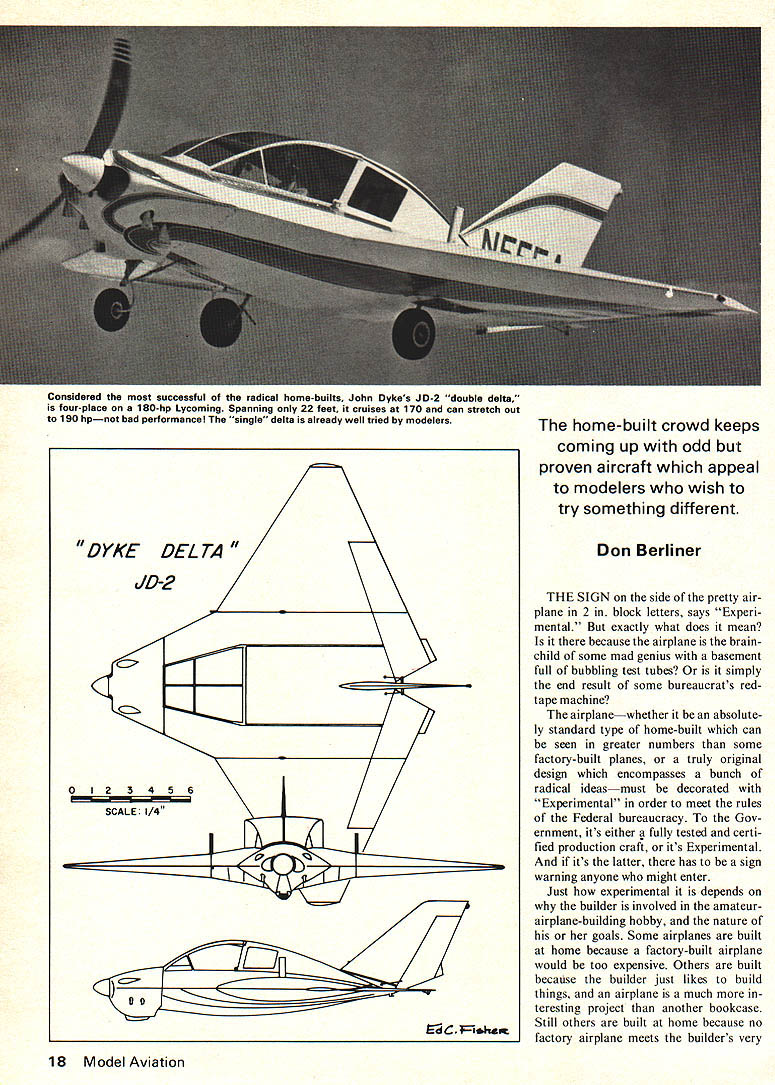
Delta-wings are good for Mach-2 airplanes like the Concorde SST, and for Mach-.02 aircraft like hang gliders. But they aren't supposed to be of any particular value between those extremes. That clear-cut challenge, plus the undeniably interesting appearance of a triangular airplane, has spurred on more than one designer of Mach-.2 airplanes.
Actually a double-delta or diamond shape, John Dyke's JD-2 is not only the most successful of the radical-design home-builts, but just about the only native American four-place airplane available in the form of construction drawings. Rather than being a one-only wild idea, it is generally seen as a family airplane, combining good performance and such practical concepts as folding wings, with looks guaranteed to draw a crowd at every airport stop. Contrary to the reputation which high-speed deltas have earned for high landing and take-off speeds and steep attitudes, the Dyke flies pretty much like a conventional airplane. It may not be the easiest airplane to build, for it is loaded with strangely-shaped parts. But the construction is of welded steel tubing, covered with fiberglass, just like a lot of airplanes with ordinary shapes. Powered by a standard 180-hp Lycoming engine, it will cruise at 170 mph, top out at 190 mph, and land at about 70 mph. Cruising range at 75% power is 700 miles, while the service ceiling is 14,000 feet.
The Dyke Delta has a wingspan of 22 feet, length of 19 feet, height of 6 feet and wing area of 180 sq. ft. Empty weight is 1,000 lbs, and gross weight is 1,750 lbs. It will carry 41 gallons of fuel. An information packet is $3 and the full plans are $125 from J. Dyke, 2840 Old Yellow Springs Road, Fairborn, Ohio 45324.
VariViggen
Another variation on the delta theme is Burt Rutan's two-seat "VariViggen," based on the sensational-performing Swedish SAAB Viggen Mach-2 fighter. Like the big fast one, Rutan's home-built is a canard-delta, but that's about the end of the similarity. While the turbojet Viggen is designed for maximum performance, the VariViggen shines brightest at the low end of the speed range. Its handling characteristics as slow as 50 mph are truly remarkable; Rutan's demonstrations of maneuverability at low speed at air shows are a sure winner.
While the VariViggen looks like it was designed for high speed, it is more of a testbed for some true improvements of the breed. With stall/spin accidents still a major cause of lightplane fatalities, Rutan has created an airplane that will not stall, but will mush or even climb at 50 mph with the control stick all the way back. At the same speed it will make steeply-banked turns without buffeting. And if it won't stall, it won't spin.
Construction is conventional, requiring the use of only the standard workshop tools. The few doubly-curved parts are of fiberglass and are to be produced by Rutan for builders. The prototype, flying for several years now, has a 150-hp Lycoming engine giving it a top speed of 165 mph and cruising speed of 150 mph. The rate of climb at sea level is close to 1,000 ft./min., while the landing distance is a mere 400 ft.
The VariViggen has a wingspan of 19 feet, canard span of 8 feet, length of 19' 11" and height of 6' 2". The wing area is 119 sq. ft., and canard area is 18.3 sq. ft. Empty weight is 950 lbs., and gross weight is 1,700 lbs. A 25-page technical report is $9, while the report and the complete plans are $51 from Rutan Aircraft Factory, P.O. Box 656, Mojave, Calif. 93501.
VariEze
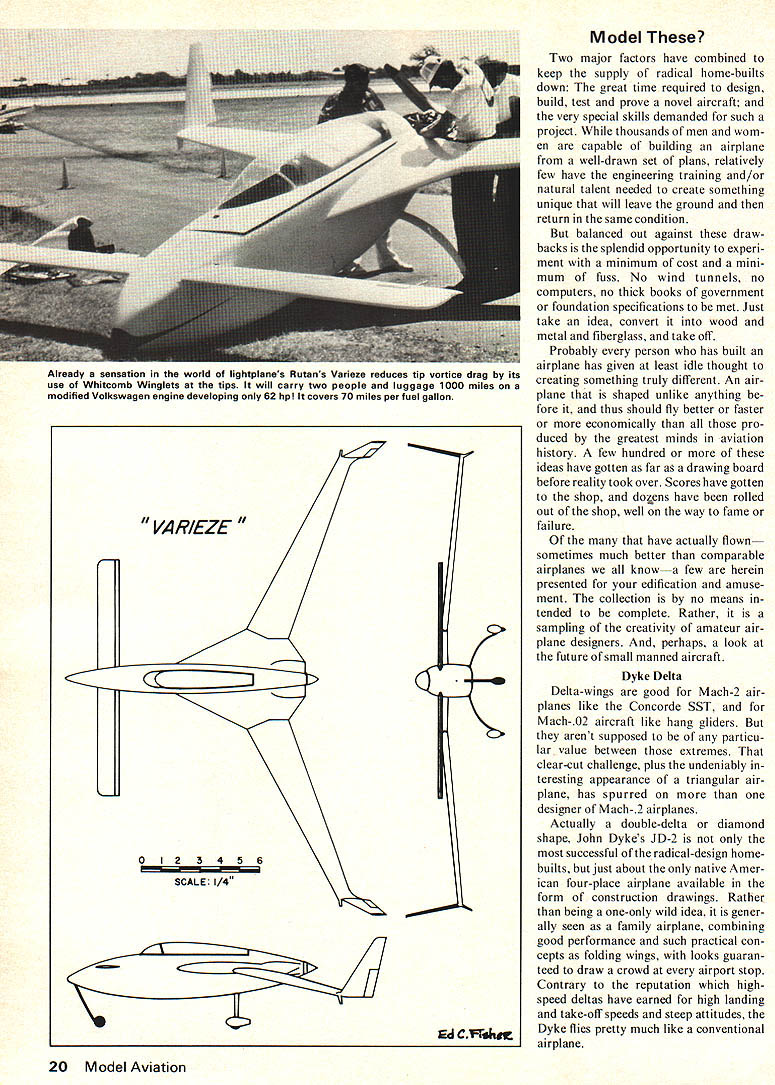
The newest flying machine to emerge from the Rutan Factory is also one of the most promising small aircraft to appear in many years. If it lives up to its designer's claims, the VariEze could quickly become a very important factor in the world of light airplanes. So far, indications are that it will do just about what has been claimed.
The VariEze is a true canard, with a thin swept wing in the rear and its horizontal tail up front. The rudders are mounted in Whitcomb winglets out at the wing tips, thus reducing the induced drag from tip vortices and actually creating less drag than conventional tail surfaces. If the performance is as good as Rutan says, some small part of the explanation will be the unusually low weight—390 lbs., empty—for an airplane that will carry two people, baggage and fuel for 1,000 miles of flying.
Construction is far from conventional, with most of the airframe being molded of a composite glass, with a rigid foam core. The wing span of the VariEze is 19' 10" and the length is 14' 3". Normal gross weight is 890 lbs., giving it a payload of 500 lbs., which is far above the empty weight.
As for performance, Burt Rutan says his little canard has already demonstrated 135 mph cruising speed at 30% power, only one gallon of gas for every 70 miles flown! He says it will achieve 48 miles per gallon at 185 mph at 75% power. And it is powered by a 62-hp modified Volkswagen engine! Rate of climb, according to preliminary estimates, is 2,000 ft./min. with just the pilot on board, and 1,200 ft./min. with a passenger and a full load of fuel and baggage.
The accuracy of these figures should soon be made clear, for Rutan plans to attack the record book, going for the Class C.1.a. (take-off weight under 500 kg/1,102 lbs.) marks for straight-line distance, closed-circuit distance, and speed for 1,000 and 2,000 km.
An information packet is available for $5 from the same source as for the VariViggen.
Mini-Imp
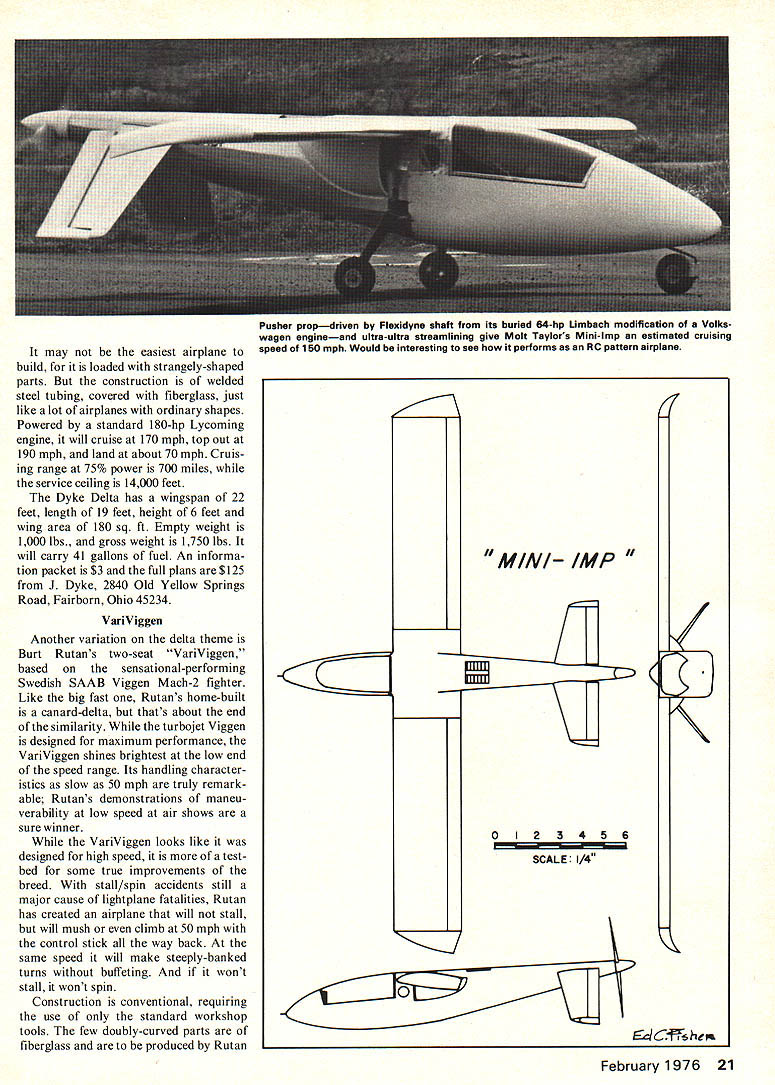
From another of the more prolific designers of small aircraft—Molt Taylor—comes another high-performance, very streamlined little VW-powered machine: the Mini-Imp. The father of the newcomer is a veteran when it comes to developing novel airplanes, being responsible for a flying car which was produced in limited quantity as the "Aerocar."
Model These?
Considered successful radical home-builts: John Dyke's JD-2 double-delta, four-place, 180-hp Lycoming. Spanning 22 feet, cruises 170, can stretch out to 190 — not bad performance. The single-delta already well tried by modelers; the home-built crowd keeps coming up with odd proven aircraft that appeal to modelers who wish to try something different.
Don Berliner
The sign on the side of this pretty airplane, in two block letters, says "Experimental." Exactly what does that mean? Because an airplane is not the brainchild of some mad genius in a basement full of bubbling test tubes, nor simply the end result of some bureaucrats' red-tape machine. Whether an absolutely standard type home-built can be seen in greater numbers than some factory-built planes, a truly original design encompasses a bunch of radical ideas and must be decorated "Experimental" to meet the rules of the Federal bureaucracy. Government classifies it as either a fully tested certified production craft or it's Experimental. The latter has a sign warning anyone who might enter. Being "Experimental" depends on the builder involved and the amateur airplane-building hobby and the nature of the goals. Some airplanes are built at home because a factory-built airplane would be too expensive. Others are built because the builder just likes to build things—an airplane is a much more interesting project than another bookcase. Still others are built at home because no factory airplane meets the builder's very special needs. A few are built because the head designer/builder is simply bursting with unusual ideas and can try them out.
Give the devil its due: the Federal Aviation Agency places fewer restrictions on the design, construction and use of home-built airplanes than any comparable agency in other countries' governments. As long as the airplane is built to accepted standards, using aircraft-quality materials, and used for educational or recreational purposes, the Feds won't get in the way of true creativity. In fact they don't have anything to say about the design of a home-built airplane. If some pilot, willing to risk his neck flying an airplane he probably shouldn't let leave the ground, that's his business. Before he's allowed to carry passengers or take trips the airplane must be tested at least 50 hours to show it's flyable and reasonably safe. Flying a weird-looking thing just takes an eager pilot and a solid airframe.
Two major factors have combined to keep the supply of radical home-builts down: the great time required to design, build, test and prove a novel aircraft, and the very special skills demanded by such a project. Thousands of men and women are capable of building an airplane from a well-drawn set of plans; relatively few have the engineering training and/or natural talent needed to create something unique that will leave the ground and return in the same condition. Balanced against the drawbacks is the splendid opportunity to experiment at minimum cost and minimum fuss. No wind tunnels, no computers, no thick books, government or foundation specifications to meet. Just take an idea, convert it to wood, metal or fiberglass and take off. Probably everyone who has built an airplane has given at least idle thought to creating something truly different. An airplane shaped unlike anything before it should fly better, faster and be more economically produced.
The greatest minds in aviation history had a few hundred ideas get no farther than the drawing board before reality took over. Scores have gotten into the shop; dozens have rolled out of the shop and, well on the way to fame or failure, have actually flown—sometimes much better than comparable airplanes. The few herein presented are for the edification and amusement of a collection and are by no means intended to be complete. Rather, they are a sampling of the creativity of amateur airplane designers and perhaps a look at the future of small manned aircraft.
Dyke Delta
John Dyke's JD-2 is an example of the delta theme applied to the home-built. The double-delta, four-place design powered by a 180-hp Lycoming spans 22 feet and cruises at about 170 mph, with top speeds reaching near 190. Not bad performance for such an unconventional planform. Single deltas have already been well tried by modelers, and the home-built crowd continually shows up with odd proven aircraft that tempt modelers to try something different.
Burt Rutan's Variviggen variation of the delta theme is another example. The Variviggen, inspired by the Swedish SAAB Viggen Mach-2 fighter, uses a canard-delta combination which Rutan has adapted to a small, efficient home-built design. The canard-delta combination is inherently stable; a model of the real airplane cannot be made to spin easily. Rutan's designs emphasize efficiency and novel use of materials and configurations to achieve exceptional performance from comparatively small engines.
These and other experimental home-builts show that inventive thinking, careful design and the willingness to take measured risks can produce aircraft that are economical, fast and often simpler to build and maintain than conventional factory types. The amateur designer-builder has long been a source of fresh ideas for aviation, and despite the hurdles, continues to produce airplanes that are both practical and imaginative.
Transcribed from original scans by AI. Minor OCR errors may remain.

