
Model Transport Cartons
Traveling? Here's a simple, inexpensive way to protect and transport your models for ground or air travel.
Do you need an inexpensive method to transport your models by car or airplane? Try this homemade transporter. Transporting large models is difficult if you don't own a van, truck, or trailer; air travel presents the greatest challenge because adequate packing and cartons are required.
Many people asked how I transported my 80-inch electric B-17 to Costa Rica for a fun-fly. The carton design described here is simple, strong, lightweight, and low-cost, and can be adapted for any model. The B-17 was broken down into two subassemblies (wing and fuselage) for transport. The 80-inch wing can be removed in one piece so wiring for the four motors and the ailerons remains intact, simplifying field assembly. The rudder and elevator were permanently glued to the fuselage.
Construction
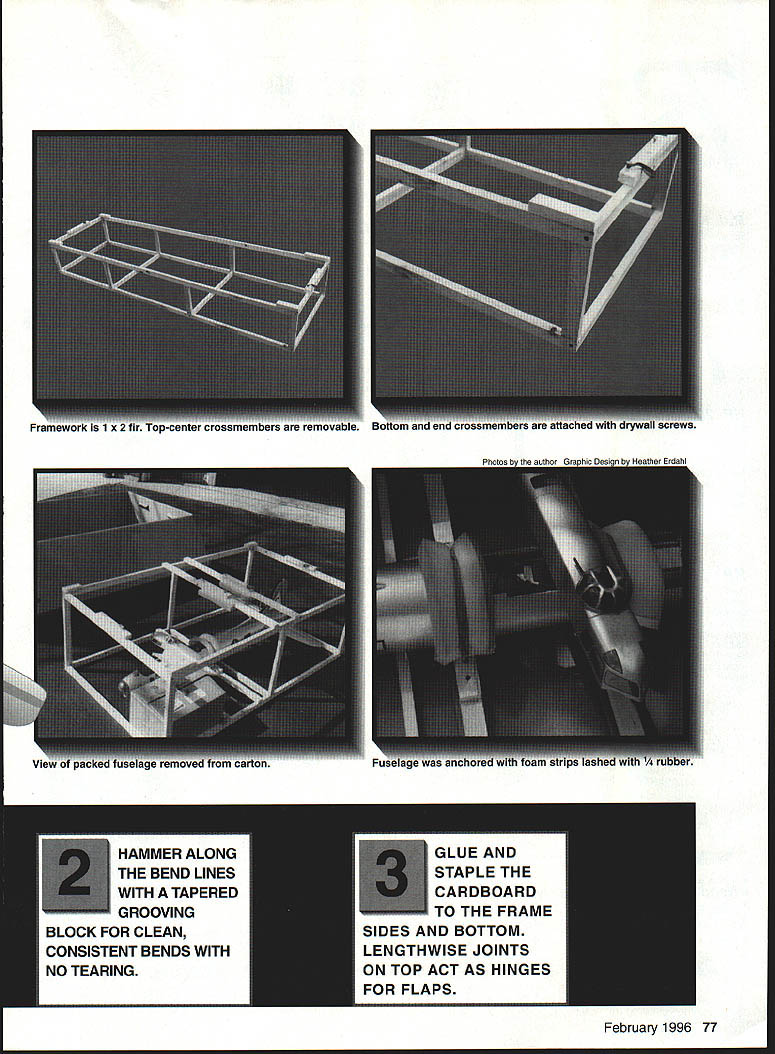
All framework is constructed from 1 x 2-inch fir wall strip. This material is inexpensive, especially if purchased at a discount building supply outlet. My cost was less than $10.
- Spacing of uprights and crossmembers should not exceed 30 inches.
- After cutting the fir strips to length, assemble the front and rear frames. Glue the joints and reinforce them with corrugated fasteners.
- Assemble the bottom crossmembers with glue, then screw them together using 1-1/2-inch self-tapping flat-head drywall screws (best driven with a power screwdriver).
- Assemble the top crossmembers in the same manner, except that the center members should not be glued so they remain removable.
Exterior panels
Double-wall cardboard is used for the exterior — the kind used for refrigerator cartons. These are usually available from appliance stores or carton manufacturers, who often discard them.
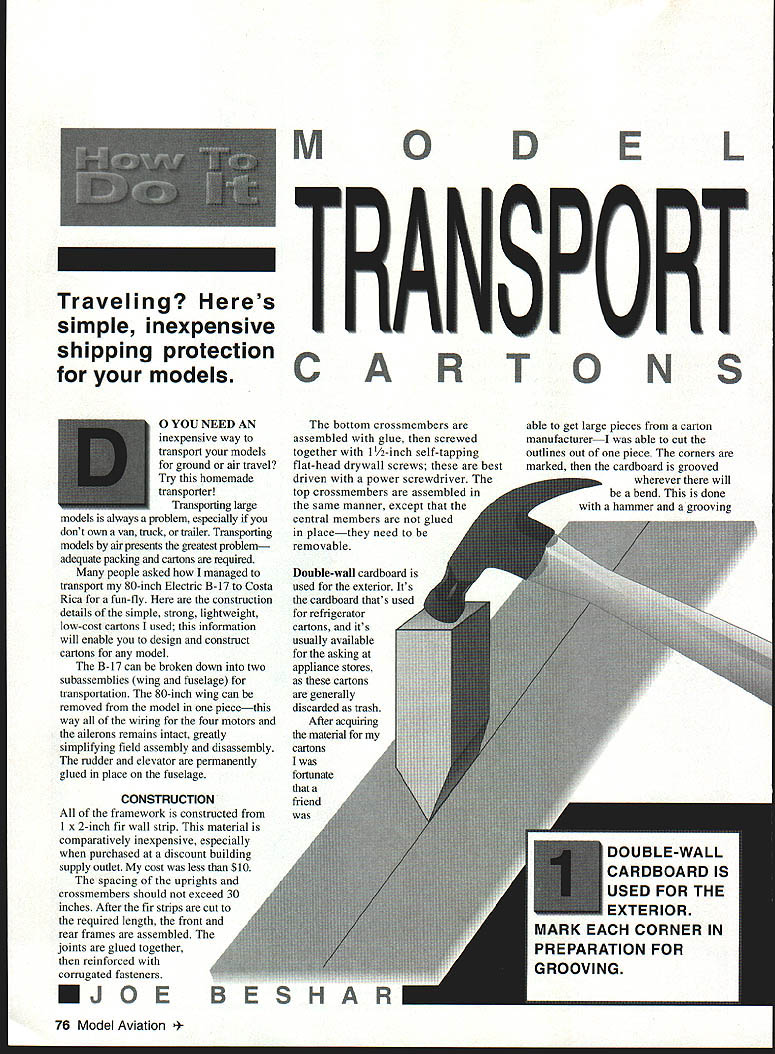
- Mark each corner on the cardboard in preparation for grooving.
- Groove the cardboard along bend lines using a hammer and a tapered grooving block for clean, consistent bends with no tearing.
- Glue and staple the cardboard to the frame sides and bottom. Do not glue the top.
If one piece of cardboard is too small, trim and join multiple pieces as needed. Make sure top joints run lengthwise so they act as hinges for the top flaps.
Top flaps and closures
The top flaps are held closed with rubber bands strung between screws.
- Cut 1-inch-diameter holes through the cardboard six inches apart over the top crossmembers.
- Drive pan-head screws into the crossmembers at those hole locations. Use screws 1 inch long with a 1/2-inch head diameter.
- With the top flaps closed, string #62 rubber bands between the screw heads to hold the flaps down and provide easy access to the box interior.
Internal filler and packing
Foam from discarded mattresses works very well as internal filler. Check local mattress outlets — when they deliver a new mattress they often remove and discard the old one.
- To pack a wing: sandwich it between two pieces of foam and hold it down by screwing the crossmembers in place.
- To pack a fuselage: wrap it in foam strips and anchor it to the bottom of the carton with 1-inch rubber strips laced across the fuselage. I used the same rubber strips used on rubber-powered free-flight models.
I went through customs with these boxes and found the mattress-foam filler especially helpful.
Performance and transport tips
- One of my boxes was dropped five feet from a truck at the San Jose airport without damage.
- The boxes fit on a car roof rack and in a trunk for airport transport.
- For weather protection, the boxes could be wrapped with polypropylene. I took a chance and did not experience weather problems.
Materials summary and sources
- Framework: 1 x 2-inch fir wall strip (cut to length, spaced ≤ 30 inches)
- Fasteners: corrugated fasteners for joints; 1-1/2-inch self-tapping flat-head drywall screws for bottom crossmembers
- Exterior: double-wall refrigerator cardboard (often available from appliance stores or carton manufacturers)
- Grooving tools: hammer and tapered grooving block
- Top closure: 1-inch-diameter holes, 1-inch-long pan-head screws with 1/2-inch head diameter, and #62 rubber bands
- Internal filler: discarded mattress foam
- Lashing: 1-inch rubber strips (laced) for fuselage anchoring
Photos by the author. Graphic design by Heather Erdahl.
Transcribed from original scans by AI. Minor OCR errors may remain.

