
Modeling in the Classroom
A Different Approach
Nearly all of us have shared our love of model aviation by teaching its very special skills in some manner. This teaching often takes place in a formal classroom—perhaps even in a public school. Few educators can remember a significant number of years passing without some sort of modeling program.
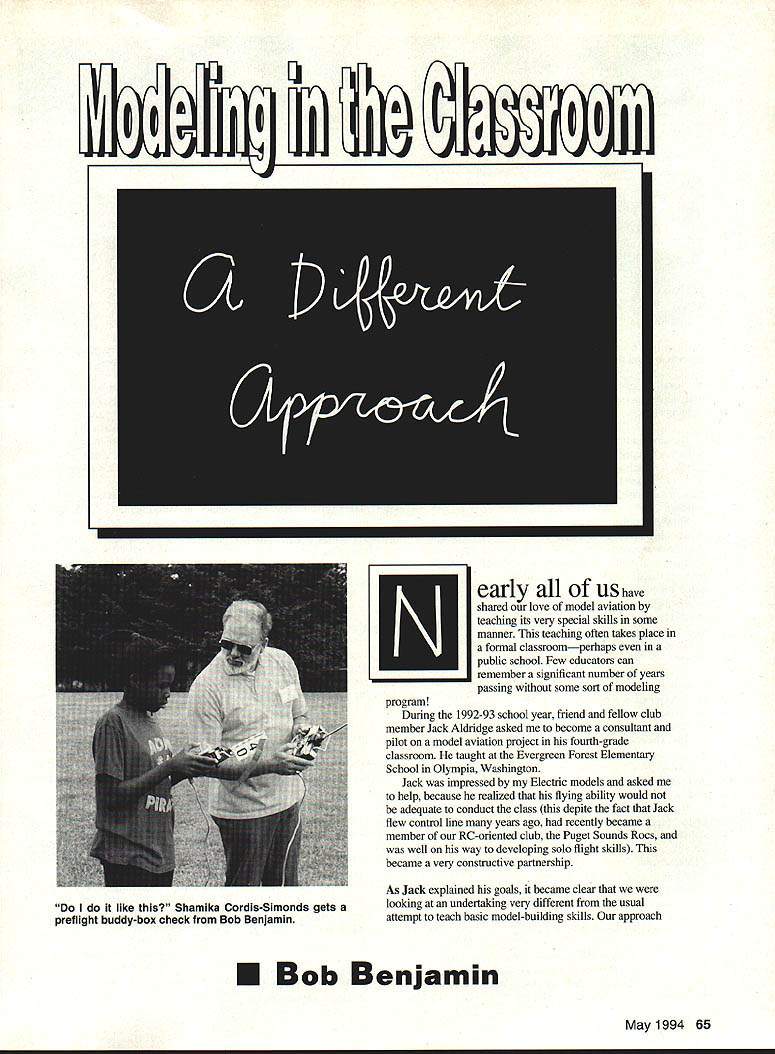
During the 1992–93 school year, friend and fellow club member Jack Aldridge asked me to become a consultant and pilot on a model aviation project in his fourth-grade classroom. He taught at Evergreen Forest Elementary School in Olympia, Washington.
Jack was impressed by my electric models and asked me to help because he realized that his flying ability would not be adequate to conduct the class (this despite the fact that Jack flew control-line many years ago, had recently become a member of our RC-oriented club, the Puget Sound Rocs, and was well on his way to developing solo flight skills). This became a very constructive partnership.
As Jack explained his goals, it became clear that we were looking at an undertaking very different from the usual attempt to teach basic model-building skills. Our approach was based on several premises quite different from the rationale of the traditional model-building class:
- Classroom time devoted to model aviation is best spent using models as the focus of a unit dealing with a wide range of academic subjects (science, reading, social studies, etc.), rather than simply teaching model building.
- Since few skilled modelers who have a broad base of experience are certified classroom teachers, and since relatively few teachers are skilled modelers, the notion of a team approach to present model aviation to public school students should be pursued.
- For a variety of reasons, a radio-controlled model is a good choice for the instructional vehicle. Likewise, electric power is a better power option than the traditional glow engine.
Considering the time and monetary demands made on public schools, it is not hard to understand why administrators might be reluctant to approve school time for building models. The alternative is an after-school activity, but these nearly always exclude many kids for such reasons as travel complications, competing activities, and the like.
Jack’s successful approach was that building models was not the principal goal; rather, he designed a series of curriculum activities—referred to in educational terms as a thematic unit—around the concept of aviation and used a class-built radio-controlled model as a focus. This eliminated any concern that might have been expressed over extracurricular activities and gained a place for model aviation in the academic curriculum.
This method can readily be made to work in a self-contained elementary classroom such as Jack’s, or as a multidisciplinary project in a departmentalized middle school, since as many academic subjects as possible were included.
Selecting the Model
Considerable thought went into selecting the model. Based on concerns of cost, skill level, and the notion of teaching basic building and flight-trimming skills, it was thought best to start elementary-school-age kids on simple glider and rubber-powered free flight models.
While these are all valid points—with which I, as a former active free flighter, agree—our aim was to expose a maximum number of students to model aviation in a limited time, in a manner that would facilitate integration into the academic curriculum.
Since the average elementary-school child is aware of radio-controlled models, the other model types might be viewed as less challenging, so he or she might not be enthusiastic about them. If we only have one chance to get a student’s attention, we need to grab it while we can.
We used a single construction project that was more complicated than would have been appropriate for individual children: the Great Planes ElectriCub.
The obvious advantages of electric power include:
- Absence of noise.
- Freedom from fuel and oil stains and the safety risk of children trying to start glow engines on their own.
- No vibration and reliable starting on cue.
(Those unfamiliar with good-quality electric-power equipment may be skeptical—please accept my word on what I am describing.)
We discarded the supplied motor and installed an Astro Flight geared .05. It ran on the recommended seven-cell battery pack and an Astro Model 207 speed control, all working from a four-channel Vanguard FM radio generously supplied for the project by Airtronics.
The ElectriCub flies as though a good .10 or .15 glow engine were installed. It takes off from grass easily, cruises well at about half power, does loops and rolls cleanly in level flight, and has an honest six- to seven-minute duration for training flights.
Classroom Implementation
The problem of limited building skills was solved by the way Jack ran his program. The ElectriCub combined relatively docile flight characteristics with interesting scale appearance. The kit instructions are reasonably well done for beginner skill levels, and the performance of the finished model was appropriate for the schoolyard flying site.
Each student was assigned to a team responsible for tasks such as:
- Fuselage assembly
- Covering
- Motor installation
- Part identification and cleanup
- Dry assembly without glue
Team members proceeded through part identification, cleanup of parts, and dry assembly. A team would satisfactorily complete a tail assembly or wing panel; the teacher would do the actual glue assembly that evening, and the model was returned to the classroom the next day.
Much of the covering was put in the hands of the more motivated kids, using extra plastic film covering to replace the results of less-than-perfect first efforts. While it might be argued that traditional modeling skills were not fully taught, the entire class was involved and was exposed to the construction of the model that was flown successfully.
Jack used the model as the focus of a science unit at a classroom center under a "Young Engineers" banner. Not surprisingly, concepts such as wing area and weight and speed measurements found their way into math classes.
Social studies and history time was devoted to a unit on pioneers of flight and to discussions about the nearby aerospace industry giant Boeing. There was a natural progression into reading skills as the kids reported on books about famous aviators.
The fourth-graders were so enthusiastic that their families couldn't help but be aware of it. When Jack arranged a field trip to the nearby Seattle Museum of Flight, he had—much to everyone’s pleasant surprise—more parent volunteers to accompany the group than he could use. Several fathers were prepared to take time off work. This response is outstanding, especially when we hear so much about apathy toward our schools.
It is unlikely that this degree of enthusiasm and support would have been generated by just another after-school model-building class.
Halfway through the assembly process, Jack arranged for me to visit the classroom, meet the kids, and display a completed model similar to the Cub under construction. I brought a modified Astro Viking that has a very successful history as a small-field demonstration model.
Following a talk about what models could be expected to do, we retired to the school playground, which was clear of other classes, and the Viking made a demonstration flight.
It was preceded by comments such as, "My uncle has a bigger model than that (it smashed)," and "I don't think that model is really going to fly..." Jack told of this even after the flawless demonstration flight, which indicated that many kids did not believe their model would be completed, much less fly the way mine had. These comments suggest an attitude of today’s younger generation toward completing involved tasks and toward undertaking a complex project on a step-by-step basis.
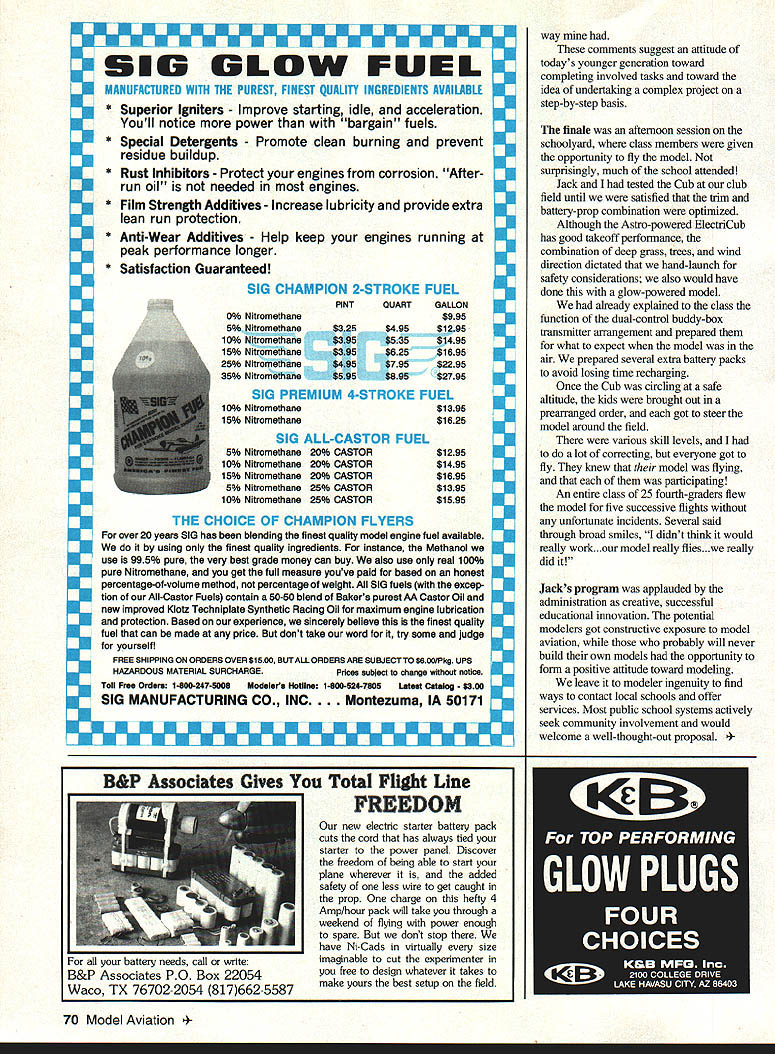
The finale was an afternoon session on the schoolyard, where class members were given the opportunity to fly the model. Much of the school attended. Jack and I had tested the Cub at our club field until we were satisfied that the trim and battery-prop combination were optimized.
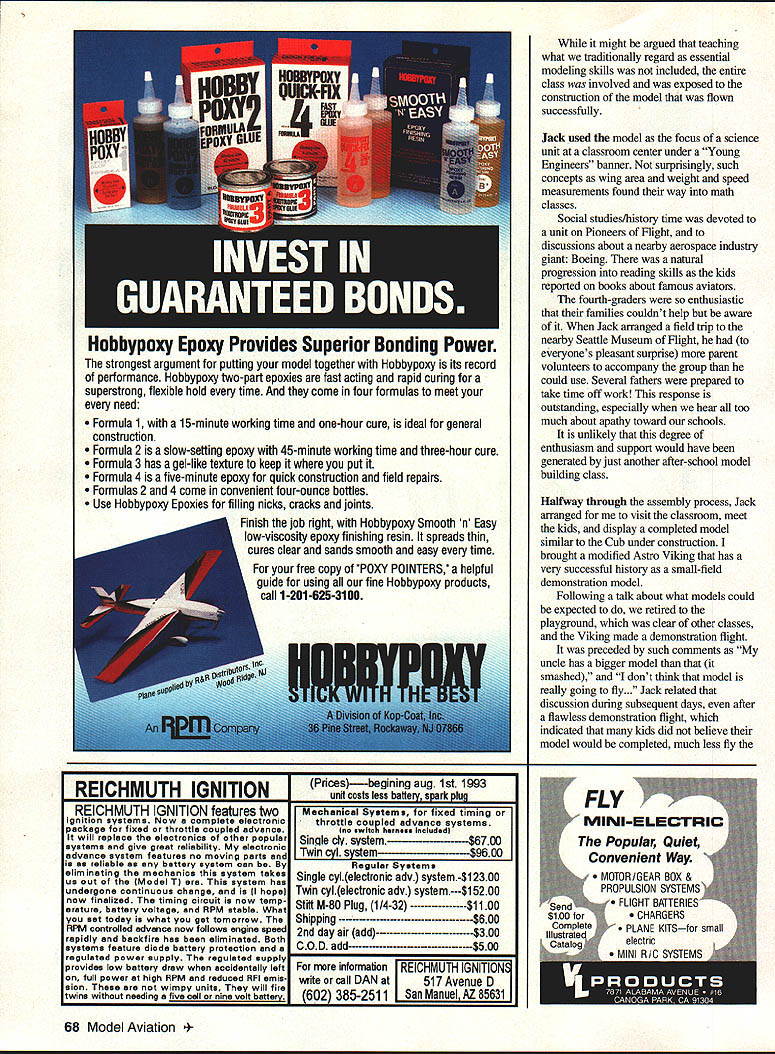
Although the Astro-powered ElectriCub has good takeoff performance, the combination of deep grass, trees, and wind direction dictated that we hand-launch for safety considerations; we would have done the same with a glow-powered model.
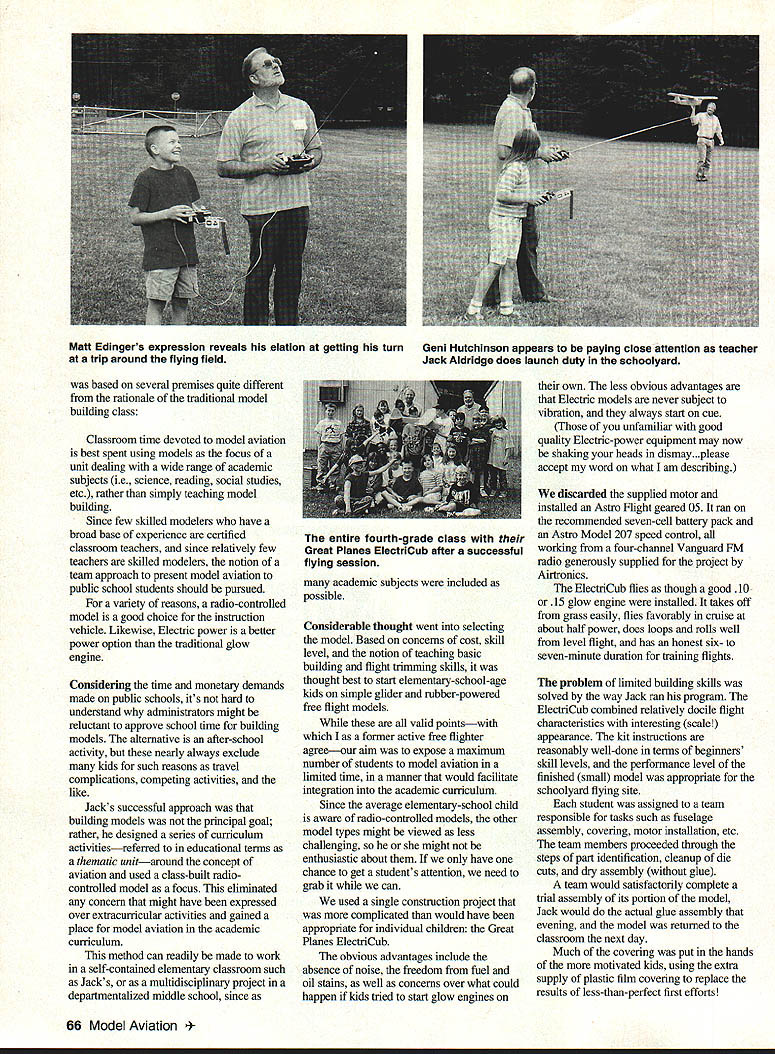
We had already explained to the class the function of the dual-control buddy-box transmitter arrangement and prepared them for what to expect when the model was in the air. We prepared several extra battery packs to avoid losing time recharging.
Once the Cub was circling at a safe altitude, the kids were brought out in a prearranged order, and each got to steer the model around the field. There were various skill levels, and I had to do a lot of correcting, but everyone got to fly. They knew that their model was flying and that each of them was participating.
An entire class of 25 fourth-graders flew the model for five successive flights without any unfortunate incidents. Several said through broad smiles, "I didn't think it would really work... our model really flies... we really did it!"
Jack’s program was applauded by the administration as a creative, successful educational innovation. The potential modelers got constructive exposure to model aviation, while those who probably will never build their own models had the opportunity to form a positive attitude toward model aviation.
We leave it to modeler ingenuity to find ways to contact local schools and offer services. Most public school systems actively seek community involvement and would welcome a well-thought-out proposal.
Transcribed from original scans by AI. Minor OCR errors may remain.

