
Modeling Spoken Here - 2001/01
Bob Hunt Aeromodeling Editor
Remembering George Aldrich
George was bigger than life to many of us.
The news of the passing of George Aldrich came right at our editorial deadline for the last issue, and I just couldn't gather my feelings and thoughts quick enough to write something that I felt was appropriate.
Sandy Frank, District VIII vice president (George's district), wrote an eloquent and heartfelt obituary in that issue that really covered George's many contributions and accomplishments. I wanted to add just a few thoughts of my own about George this month.
I knew George for many years as a friend, but his impact on my life began a number of years before I ever had the pleasure of getting to know him personally.
I suspect that the following thoughts may have a familiar ring for many who grew up learning about modeling through the late 1950s and the 1960s.
As a youngster I was luckier than most because not only was my father a modeler, but most of his friends and even most of his employees were modelers. In fact, they were all Control Line (CL) Stunt fliers, so I naturally gravitated in that direction.
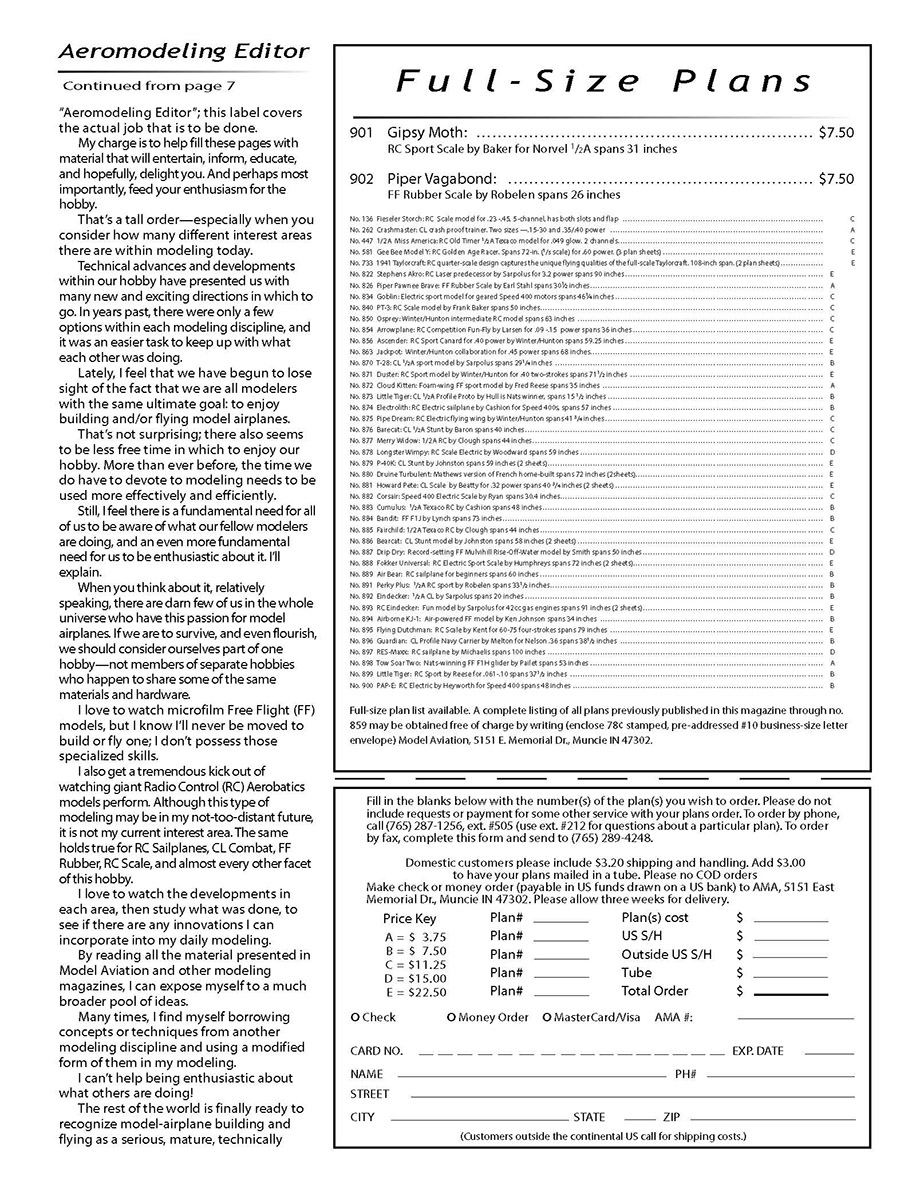
One of the hottest and most desired models for Stunt flying in that era was the George Aldrich–designed Nobler. It was kitted by Top Flite Models in roughly 1957 and was an instant best-seller.
Most Stunt fliers of the time had built at least a few Noblers before venturing off to design their own Stunt models, and, even then, most used the well-proven Nobler wing and moment arm numbers just to be sure that their "original" creations would perform well.
To own a Nobler was a sign that you were at least trying to become a serious Stunt flier.
It was not a particularly easy model to build, however. George designed it to have the capability to be built light, and that meant many ribs in the built-up stabilizer and elevator and even the vertical fin.
I wanted one bad! But my building skills were not yet up to the task in the late 1950s, and my dad knew this.
Each Christmas morning, I would run down the stairs from my bedroom, looking for a certain-aspect-ratio box (all young and aspiring Stunt fliers knew the exact measurements of that famous "Green Box" Nobler kit), only to see a somewhat different shaped, wrapped box than the one I was hoping for.
Dad made sure the model kits I received matched my abilities, but I was impatient to own a Nobler!
Then in 1962 my waiting came to an end; my first Nobler kit was placed prominently under the tree and I was deliriously happy! Sound familiar?
I waited until the 1963 summer vacation to build that first Nobler. My father made me a deal. He said that if I could build that kit, ready for finish, in a week, he'd buy me an engine for it!
Now remember, we didn't have cyanoacrylate glues in those days, and each part had to be preglued with model-airplane cement before final assembly. I worked diligently and almost finished the airframe in the allotted time—but not quite.
I didn't get the engine (dad was, and is, a man of his word), but I learned so many great building lessons that helped me go on to be a good builder that I really didn't mind. It was the best summer of my life.
All through that week I had the box top perched so I could look at the model on the cover. Just the thought of having my own Nobler kept me going.
I remember telling George that story many years later, and he was smiling during all of it. He told me that he'd heard similar stories from dozens of modelers throughout the years, and that he was very proud and flattered that so many people had learned so many lessons about modeling from building and flying his design.
George reached legendary status in the event at an early age, and even though he stopped seriously competing, his designs and influence continued to shape the sport.
My Charge as Aeromodeling Editor
My charge is to help fill these pages with material that will entertain, inform, educate, and hopefully, delight you. And perhaps most importantly, feed your enthusiasm for the hobby.
That's a tall order—especially when you consider how many different interest areas there are within modeling today.
Technical advances and developments within our hobby have presented us with many new and exciting directions in which to go. In years past, there were only a few options within each modeling discipline, and it was an easier task to keep up with what each other was doing.
Lately, I feel that we have begun to lose sight of the fact that we are all modelers with the same ultimate goal: to enjoy building and/or flying model airplanes.
That's not surprising; there also seems to be less free time in which to enjoy our hobby. More than ever before, the time we do have to devote to modeling needs to be used more effectively and efficiently.
Still, I feel there is a fundamental need for all of us to be aware of what our fellow modelers are doing, and an even more fundamental need for us to be enthusiastic about it. I'll explain.
When you think about it, relatively speaking, there are darn few of us in the whole universe who have this passion for model airplanes. If we are to survive, and even flourish, we should consider ourselves part of one hobby—not members of separate hobbies who happen to share some of the same materials and hardware.
I love to watch Free Flight (FF) models, but I know I'll never be moved to build or fly one; I don't possess those specialized skills.
I also get a tremendous kick out of watching giant Radio Control (RC) Aerobatics models perform. Although this type of modeling may be in my not-too-distant future, it is not my current interest area. The same holds true for RC sailplanes, CL, Combat, FF Rubber, RC Scale, and almost every other facet of this hobby.
I love to watch the developments in each area, then study what was done, to see if there are any innovations I can incorporate into my daily modeling.
By reading all the material presented in Model Aviation and other modeling magazines, I can expose myself to a much broader pool of ideas.
Many times, I find myself borrowing concepts or techniques from another modeling discipline and using a modified form of them in my modeling.
I can't help being enthusiastic about what others are doing!
The rest of the world is finally ready to recognize model-airplane building and flying as a serious, mature, technically relevant, worthwhile, and fun hobby/sport—things we've known it is all along.
Proof is the ever-more-widespread use of model‑airplane flying segments in television commercials for upscale automobiles, banks, and other real‑world products. Advertisers wouldn't use models in those ads if they didn't feel they had a positive effect on the consumer.
There's a whole new generation of modelers waiting in the wings, and it's up to us to show them the magnitude and possibilities of this hobby. To do this, we must present a unified front. We are not RC modelers, CL modelers, or FF modelers—we are all model‑airplane enthusiasts.
Want to remind yourself on a daily basis that you're a model‑airplane flier? Build yourself a small glider, such as my MDR, and fly it first thing each morning, to get your minimum daily requirement of model‑airplane flying.
And when you watch it glide across the room and make a smooth touchdown, be enthusiastic!
I'll be visiting and working from the Model Aviation office several times each year, but most of the time I'll be doing my thing from my home office.
Transcribed from original scans by AI. Minor OCR errors may remain.

