
Modeling Spoken Here
Bob Hunt — Aeromodeling Editor
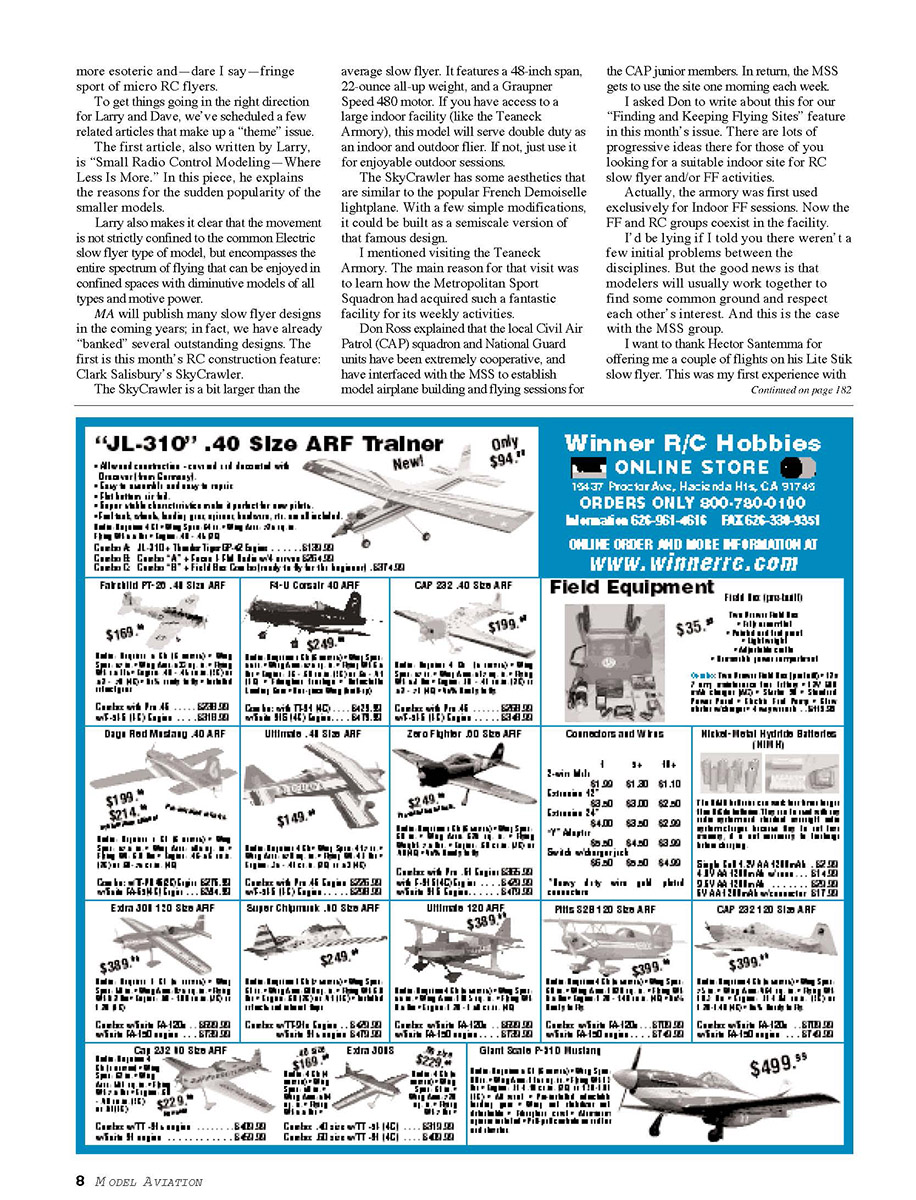
In November of last year, my very good friend Don Ross invited me to visit one of the Wednesday-morning flying sessions of the Metropolitan Sport Squadron (MSS).
This group is made up of Radio Control (RC) and Free Flight (FF) types who meet once a week and share one of the finest indoor sites in the East — the Teaneck Armory in Teaneck, New Jersey.
Indoor FF has been with us for decades. In 1953, when I was a very young boy, my father took me to watch the indoor portion of the Nationals (Nats). In those days the indoor events were flown in one of the behemoth blimp hangars at Lakehurst Naval Air Station in Lakehurst, New Jersey. (I understand that indoor models are still being flown there on a regular basis!)
I can still remember the awe I felt watching the graceful micro models slowly circle their way to just below the ceiling beams. Once you’ve seen these gossamer models fly, your perspective on modeling will never be the same. It’s an experience every modeler should enjoy—often.
I guess I was thinking of those days when I opened the door of the armory and walked onto the 110-yard-long, 60-yard-wide floor. There is something mysterious, and even spiritual, about indoor FF, and whatever building it is being done in always feels very much like a church to me.
First Impressions — Slow Flyers
I soon learned that indoor RC flying has at least an equal amount of mystery and spirituality. This was to be my first experience with the type of models that have come to be known as “slow flyers.”
As a young teenager I lived with my family in a northern suburb of Philadelphia. The house we lived in at that time had a huge back yard. I flew lots of Control Line (CL) there, but I had this recurring vision of a small-scale “airport” from which I could fly small RC scale models. Never mind that the RC technology of the era (1961) was not nearly at a point that made this dream even remotely possible. The thought of a backyard airport was so overwhelming that I did the most logical thing (at least from the viewpoint of a 13-year-old): I began building the airport!
I figured that the easy part would be to figure out how to make and control the airplanes. The dream died when Mom and Dad put their collective feet down and used—of all things—logic to sway me from ripping up too much grass! The thought of having the ability to fly an RC model from my back yard, and land it confidently on the runway at the end of each flight, has remained carefully tucked away all these years.
Now, some 40 years later, the easy part appears to be the making and controlling of the models. Getting my wife to allow me to rip up the grass to install the runways in the back yard is going to be the challenge!
I guess these thoughts were going through my mind when the first RC slow flyer took wing that day at the Teaneck Armory. I was truly mesmerized by the reality of the type of flying I had envisioned so many years earlier.
I want to take this opportunity to thank and heartily commend those who have long labored to bring the state of the art in radio control technology to the point where this type of model airplane flying is easily achievable for any who wish to try it.
The Movement: Slow, Park, and Micro Flyers
This relatively new type of flying has taken several forms, and has been given several labels: slow flyers, park flyers, micro flyers, etc. These descriptors point to an entirely new genre of model airplanes. Its growth has been meteoric in a way that has rarely been seen in any other type of model flying. Perhaps this is partly because many modelers had the same dream I had when I was young, and were just waiting for technology to make it all possible.
Whatever the reason for the popularity, I predict that this form of flying is here to stay, and we have just seen the beginning of what will be possible in the near future.
In celebration of slow/park/micro RC flying, we are announcing the establishment of a new department in Model Aviation (MA) that will be authored in alternate months by Larry and Dave. We’ve scheduled a few related articles that make up a "theme" issue.
The first article, also written by Larry, is “Small Radio Control Modeling — Where Less Is More.” In this piece he explains the reasons for the sudden popularity of the smaller models.
Larry also makes it clear that the movement is not strictly confined to the common electric slow-flier type of model, but encompasses the entire spectrum of flying that can be enjoyed in confined spaces with diminutive models of all types and motive power.
MA will publish many slow-flyer designs in the coming years; in fact, we have already banked several outstanding designs. The first is this month’s RC construction feature: Clark Salisbury’s SkyCrawler.
SkyCrawler — A Featured Design
The SkyCrawler is a bit larger than the average slow flyer. It features a 48-inch span, 22-ounce all-up weight, and a Graupner Speed 480 motor. If you have access to a large indoor facility (like the Teaneck Armory), this model will serve double duty as an indoor and outdoor flier. If not, just use it for enjoyable outdoor sessions.
The SkyCrawler has some aesthetics similar to the popular French Demoiselle lightplane. With a few simple modifications, it could be built as a semiscale version of that famous design.
Teaneck Armory and MSS — How the Site Came About
I mentioned visiting the Teaneck Armory. The main reason for that visit was to learn how the Metropolitan Sport Squadron had acquired such a fantastic facility for its weekly activities.
Don Ross explained that the local Civil Air Patrol (CAP) squadron and National Guard units have been extremely cooperative, and have interfaced with the MSS to establish model airplane building and flying sessions for the CAP junior members. In return, the MSS gets to use the site one morning each week.
I asked Don to write about this for our "Finding and Keeping Flying Sites" feature in this month’s issue. There are lots of progressive ideas there for those of you looking for a suitable indoor site for RC slow-flyer and/or FF activities.
Actually, the armory was first used exclusively for indoor FF sessions. Now the FF and RC groups coexist in the facility.
I’d be lying if I told you there weren’t a few initial problems between the two disciplines. But the good news is that modelers will usually work together to find some common ground and respect each other’s interests. This is the case with the MSS group.
Personal Flights and Demonstrations
I want to thank Hector Santemma for offering me a couple of flights on his Lite Stik slow flyer. This was my first experience with flying an RC model indoors, and I enjoyed myself thoroughly.
Hector’s model was capable of roughly 15 minutes of usable flying time. I circled the armory several times, shot numerous touch-and-goes, played around near the floor in ground effect, and circled up near the armory lights.
I had not expected such outstanding performance and am now itching to get my own slow flyer going.
A rather interesting thing happened while I was at the Teaneck Armory. There was a fellow who had several Peanut Scale–type FF models with him. All of his models appeared to be well-trimmed free-flight models.
One model in his fleet was a profile FF MG-15 that was made from sheet-sheathed polystyrene foam. Although it was not even remotely an endurance design, this model had a complete flight profile. Its designer/builder, Tony Peters, would launch it into its shallow climb and right-circling flight path, then walk to a specific spot on the floor and wait for the MG-15 to complete its “mission.”
Each time (and Tony made several flights with the MG-15) the model would descend to the exact point where Tony was standing, and he’d simply raise his hand slightly and let the little "jet" fly right over his thumb and forefinger. What a show!
This impressed me, but more importantly, it seemed to impress even the most experienced FF modelers there. I began watching the crowd of spectators whenever Tony flew the MG-15, and they all stopped what they were doing to enjoy the perfected show.
I asked Tony to work up an article about the MG-15 for this issue. Even though it’s not an RC slow flyer, I felt it was relevant to this theme: you can enjoy RC and FF in the same flying session. This design is really fun. Build one!
A Senior’s Perspective — Alex “Sandy” Morton
The startle in this park-flyer/slow-flyer theme came as an unsolicited submission, but it fit the subject matter perfectly.
Alex “Sandy” Morton is a long-time RC modeler who is beginning to feel the effects of aging as it relates to his modeling. His eyesight and reflexes are beginning to diminish, and he is smart enough to acknowledge the safety issues these natural changes will cause.
Instead of continuing with the larger, faster, heavier, and, by his own admission, more dangerous models, Sandy has begun to enjoy the park-flyer type of model for the benefit it affords him at this point in his life.
These models are lighter, they fly slower, and they can be flown at closer proximity, where their images are seen relatively close to the pilot. They are a safer way for seniors who are experiencing the aforementioned eyesight and reflex problems to continue enjoying the RC sport.
Sandy’s article is “Don’t Quit The Greatest Sport On Earth!” Please take time to read and consider Sandy’s thoughts if you are nearing the age where these issues will, or might, be something you will soon have to address in your modeling life.
Opportunities, Concerns, and the Future
This new form of modeling is exciting in many non-obvious ways. For the first time in many years, RC models can be flown in urban areas where noise, space, and safety considerations have combined to exclude the sport.
In those years, whole generations have grown up without firsthand knowledge of the old airplanes, what fun they are, and what they are capable of.
Many of those who have never watched a model airplane play the close “whoop, whoop” are the ones who grow up with a distinct digital awareness. Video games and computer simulators are not foreign to them, and they are used to joystick movements. Radio control is a natural progression, sort of a real ride to a real sport.
If we play our cards right, this new part of the sport could usher in a fresh generation of modelers. It’s up to us to expose them to our passion, then to guide them into safe modeling practices.
It’s no secret that RC frequency control in the vicinity of an AMA‑sanctioned field is of great concern these days. The proliferation of Almost-Ready-to-Fly (ARF) and Ready-to-Fly (RTF) versions of slow/park flyers has already caused a few accidents.
There is no easy answer to this problem, and those who fly these models safely and courteously in accordance with local field rules should not be made to feel guilty for the transgressions of an uninformed, and sometimes careless, few.
These models are easy and relatively inexpensive to build, so the average modeler can afford to have several at one time or augment their fleet of “normal” RC models with one or two more alternatively fun flyers.
If you can’t make it home from work in time to grab your “big” stuff and get to the field for a quick outing in the evening, you can most certainly walk to the local ballfield and get a couple of flights with a park-flyer-type model before the sun goes down.
At most trade shows I’ve attended in the past year or so, the most common denominator in purchased products seen under the arms of the attendees has been park flyers and micro/microflyer kits and accessories.
This is a strong new trend, and is certainly not a fad. I predict that in less than a year we will see local, regional, and even national events conducted specifically for this class of RC models.
Imagine a "Nats" for them, with:
- Pylon Racing
- Scale
- Aerobatics
- Carrier-deck landing
- Spot landing
- Maybe even Combat events
This is an exciting time to be in this sport!
Contact
As always, contact and/or correspondence on any modeling or magazine-related subject is welcome.
My address is P.O. Box 68, Stockton, NJ 08083 Tel.: (610) 614-1747 E-mail: robinhunt@earthlink.net
Transcribed from original scans by AI. Minor OCR errors may remain.

