
Modeling Spoken Here
Bob Hunt — Aeromodeling Editor
We have needed something that would interest the younger generation ... and this might be it.
This past month (March) has flown by for me, and so much has happened that I really don't know where to begin to give you a report.
Tucson and the Vintage Stunt Championships
The month started with my annual trek to Tucson, Arizona, to attend the 16th-annual Vintage Stunt Championships (VSC). I drive out to this meet each year with Bill Werwage and really look forward to the trip because it gives me the opportunity to spend a lot of quality conversation time with a kindred spirit. Having an entire week to spend with many other kindred spirits once we arrive is also a very neat thing.
Many of my VSC friends who have been living in California are beginning to retire, and most of them have decided to move to Tucson. In fact, several are already settled into beautiful new homes there and hosted parties during this year's VSC.
I would like to take this opportunity to thank Bill and Elaine Heyworth for opening their hearts and home to us on two occasions at VSC. They hosted two great evenings of food and fun at their new house, which is wonderfully decorated in true cowboy fashion. The same goes out to my old and dear friends Lucky and Ricki Pyatt for the great party they hosted in their equally beautiful new home. Seems like we are going to need a social secretary to keep track of our evening engagements there next year!
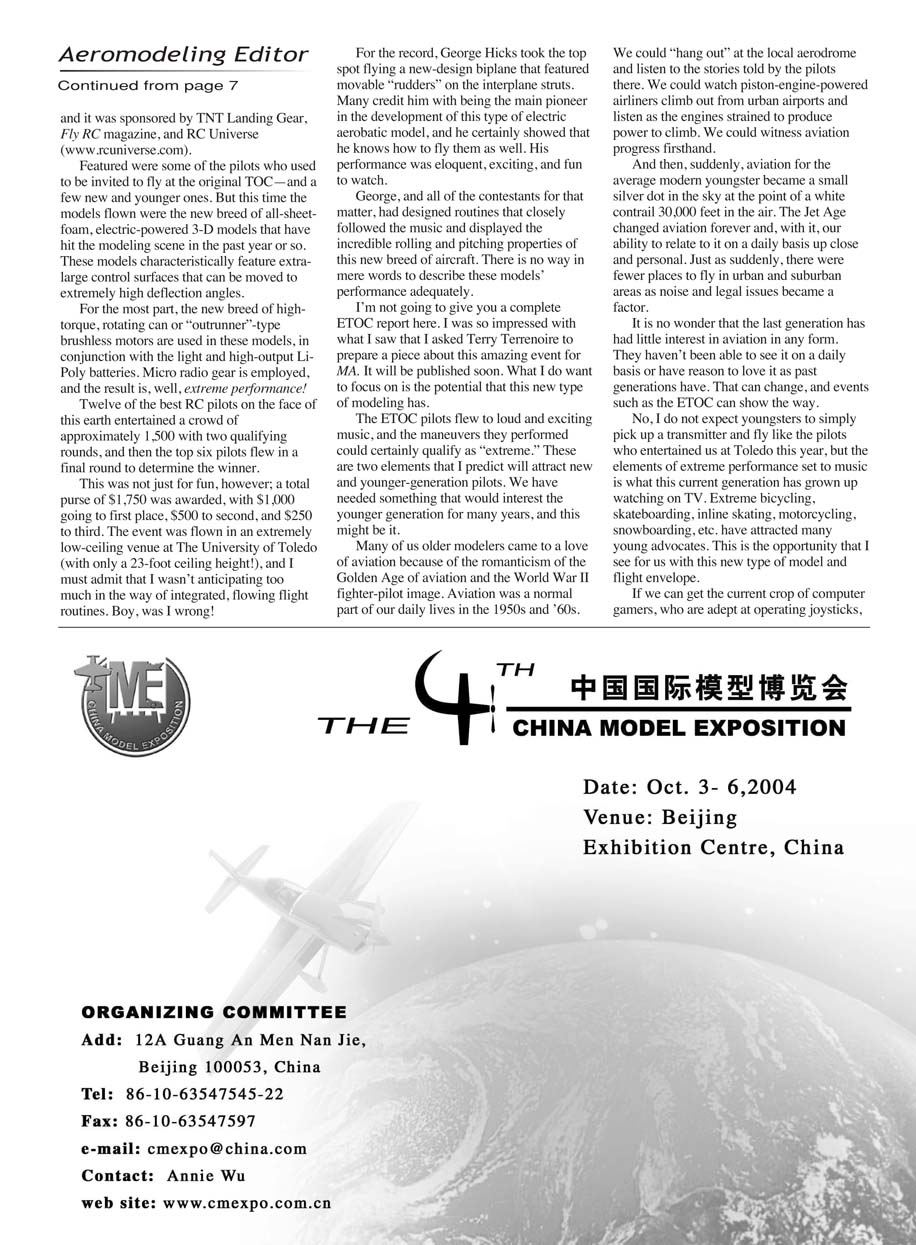
A very special thanks goes out to Larry Foster, who saved the day for me when two engine-mounting plates in my Caprice broke during a practice session. Larry currently lives with Bart and Donna Klapinski at their gorgeous home, which is just a two-minute drive from the Cholla Choppers' field. There, he has a complete machine shop, including a milling machine. He was able to whip up a new set of plates that were much better than the original units, and he had me back in the air in a little more than an hour. Foster, you're the best!
Bart and Donna, by the way, tied the knot during VSC and exchanged their vows at the Rodeway Inn courtyard. The Rodeway is where almost all of the VSC contestants stay during the event, and we were all invited to be witnesses to their wedding. I'm sure the entire VSC family joins me in wishing them everlasting happiness.
Upon my return from VSC (a total of a 5,100-mile trip for me), I had to quickly change gears and get into trade-show mode in preparation to attend the 50th-anniversary Weak Signals RC Exposition, or simply the "Toledo Show," as we modelers have come to know it. (Another 1,200 miles on the road!)
The story of this group and this show is very interesting, and in celebration of this golden milestone I've asked John Worth to write a piece on the Weak Signals and the history of the "Toledo Show." Look for it soon in MA. In the meantime, I'd like to express my personal congratulations, and those of the entire Academy of Model Aeronautics, to the Weak Signals club for their monumental effort each year and the success that this effort has yielded. I truly believe that this great hobby/sport would not be where it is today without the Toledo Show.
Toledo Show and the Electric Tournament of Champions (ETOC)
I arrived at Toledo, Ohio, on Thursday, which is setup day for exhibitors, and learned then that a special event had been planned for the following evening. I'm sure you've all heard about the Tournament of Champions (TOC)—the invitational scale aerobatics event that was sponsored and hosted in Las Vegas by the late and great Bill Bennett. That event evolved through the years to be a showcase for arguably the best RC aerobatics talent in the world. The format included spectacular 3-D-type maneuvers flown to music in tightly choreographed programs. I never had the pleasure of attending a TOC, but from all accounts the aerial action and the pilots' imagination in coming up with wild new maneuvers was simply amazing.
The special event planned for Friday night in Toledo was the first Electric Tournament of Champions, or ETOC. This event was dreamed up collectively by Tom Kroggel, Greg Poppel, and Mike Skibinski, and it was sponsored by TNT Landing Gear, Fly RC magazine, and RC Universe (www.rcuniverse.com).
Featured were some of the pilots who used to be invited to fly at the original TOC—and a few new and younger ones. But this time the models flown were the new breed of all-sheet-foam, electric-powered 3-D models that have hit the modeling scene in the past year or so. These models characteristically feature extra-large control surfaces that can be moved to extremely high deflection angles.
For the most part, the new breed of high-torque, rotating-can or "outrunner"-type brushless motors are used in these models, in conjunction with the light and high-output Li-Poly batteries. Micro radio gear is employed, and the result is, well, extreme performance!
Twelve of the best RC pilots on the face of this earth entertained a crowd of approximately 1,500 with two qualifying rounds, and then the top six pilots flew in a final round to determine the winner. This was not just for fun, however; a total purse of $1,750 was awarded:
- $1,000 to first place
- $500 to second place
- $250 to third place
The event was flown in an extremely low-ceiling venue at the University of Toledo (with only a 23-foot ceiling height!), and I must admit that I wasn't anticipating too much in the way of integrated, flowing flight routines. Boy, was I wrong!
For the record, George Hicks took the top spot flying a new-design biplane that featured movable "rudders" on the interplane struts. Many credit him with being the main pioneer in the development of this type of electric aerobatic model, and he certainly showed that he knows how to fly them as well. His performance was eloquent, exciting, and fun to watch.
George, and all of the contestants for that matter, had designed routines that closely followed the music and displayed the incredible rolling and pitching properties of this new breed of aircraft. There is no way in mere words to describe these models' performance adequately.
I'm not going to give you a complete ETOC report here. I was so impressed with what I saw that I asked Terry Terreniore to prepare a piece about this amazing event for MA. It will be published soon. What I do want to focus on is the potential that this new type of modeling has.
Attracting the Next Generation
The ETOC pilots flew to loud and exciting music, and the maneuvers they performed could certainly qualify as "extreme." These are two elements that I predict will attract new and younger-generation pilots. We have needed something that would interest the younger generation for many years, and this might be it.
Many of us older modelers came to a love of aviation because of the romance of the Golden Age of aviation and the World War II fighter-pilot image. Aviation was a normal part of our daily lives in the 1950s and '60s. We could "hang out" at the local aerodrome and listen to the stories told by the pilots there. We could watch piston-engine-powered airliners climb out from urban airports and listen as the engines strained to produce power to climb. We could witness aviation progress firsthand.
And then, suddenly, aviation for the average modern youngster became a small sliver dot in the sky at the point of a white contrail 30,000 feet in the air. The Jet Age changed aviation forever and, with it, our ability to relate to it on a daily basis was cut off, and as a result, there were fewer places to fly in urban and suburban areas as noise and legal issues became a factor.
It is no wonder that the last generation has had little interest in aviation in any form. They haven't been able to see it on a daily basis or have reason to love it as past generations have. That can change, and events such as the ETOC can show the way.
No, I do not expect youngsters to simply pick up a transmitter and fly like the pilots who entertained us at Toledo this year, but the elements of extreme performance set to music are what this current generation has grown up watching on TV. Extreme bicycling, skateboarding, inline skating, motorcycling, snowboarding, etc., have attracted many young advocates. This is the opportunity that I see for us with this new type of model and flight envelope.
If we can get the current crop of computer gamers—who are adept at operating joysticks to play the extreme video games, which are the latest craze—to take a look at this type of flying, we might be able to attract them to try it. We must realize that the next generation of modelers will probably have to come to an appreciation of aviation, and especially model aviation, from a completely different perspective than we did.
Kids learn fast, and they generally have much better eye-hand coordination than previous generations. We can thank video games for that. I'm by far not the first person to realize that RC flying is just one step beyond a video game. They will be able to learn quickly how to competently fly these new electric-powered foam models in limited spaces. The result could be a whole new vista of entertainment for them.
Much like the old game of "Horse" in basketball, I can foresee kids challenging each other to try new maneuvers that they have invented. Extrapolate this a bit further, and you might agree that school-sponsored teams of 3-D aerobatics competing in leagues is not too far-fetched.
The preceding could happen. It could be a whole new vista of modeling for the current and the next generation. I believe that we now have the proper elements in place for all of this—and much more—to happen in the near to foreseeable future.
The challenges will be many, including properly introducing youngsters to the genre, educating them on safety and practice, and us older modelers having the ability to adjust to the needs of the new generation without expecting them to see it from our perspective. Turn up the volume, turn on the motors, and let the games begin! Hey, cotton balls for the ears are cheap ...
Sharper Focus
"Focal Point" continues to be one of the most popular features in MA. It seems that most of our readers/members have more than a passing interest in what others are building and flying. The proof of this is that we receive many more "Focal Point" submissions each month than we can possibly run in a timely manner. The backlog continues to grow.
We have begun running 16 "Focal Point" submissions on the AMA Web site each month in addition to the 16 that we present in MA. Still, catching up seems to be all but impossible at this point. If you have submitted a "Focal Point" photo and story, please have patience. It may take more than 1-1/2 years for it to appear in the magazine or on the Web site.
Occasionally we come across a model that, for whatever reason, catches our eye. It may be an unusual subject or one that has a special story behind it. It may be a massive project or a simple one. We have wished on those occasions that we could highlight the model in question a bit more than the "Focal Point" format allows.
Therefore, we have started a new section in MA called "Sharper Focus" to spotlight these special models. This section will not run on a monthly basis; it will appear whenever we find a model that we feel deserves some extra attention.
We are presenting our first "Sharper Focus" piece this month. It is Joe Beshar's gorgeous, turbine-powered Me 163 Komet. The model itself is a work of art, but the reason why Joe built it is the real story. That should be enough of a tease to get you to turn to page 66 and give it a look.
Please do not send in dedicated submissions for "Sharper Focus." We will determine which airplanes will be presented in this section. We may see a "Focal Point" submission that catches our eye, and then we will get in touch with the modeler who sent it in to get further information. We may see a model in our travels that fits the requirements, and we will photograph it and get the story then. We hope you will agree with our picks!
Need to reach this old-timer? You can call me at (610) 614-1747 (talk loud) or you can reach me on this newfangled Internet thing at bobhunt@mapisp.com. For those who still know where the post office is, my address is Box 68, Stockertown PA 18083. MA
Transcribed from original scans by AI. Minor OCR errors may remain.

