
Modeling Spoken Here — 2007/02
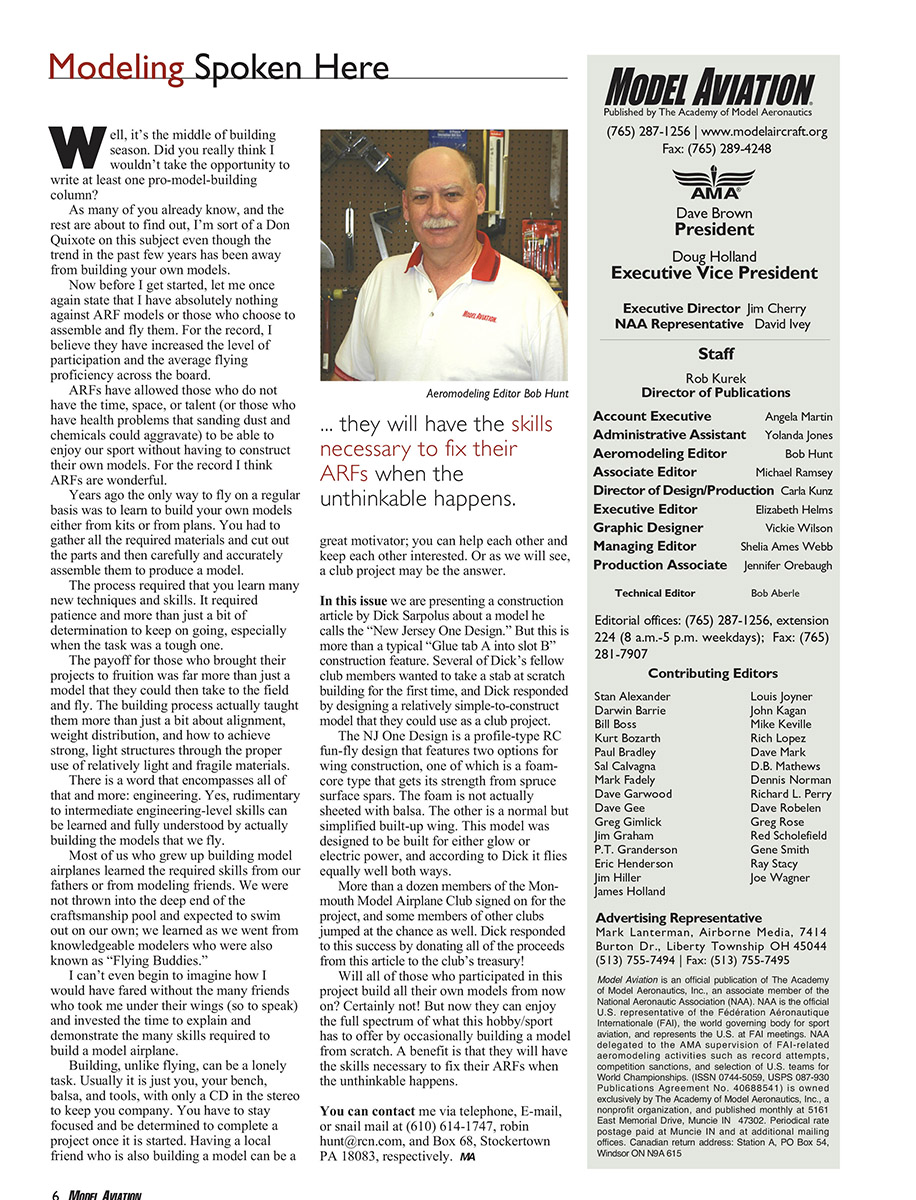
Well, it's the middle of building season. Did you really think I wouldn't take the opportunity to write at least one pro–model-building column?
As many of you already know, and the rest are about to find out, I'm sort of a Don Quixote on this subject even though the trend in the past few years has been away from building your own models.
ARFs and scratch building
Now before I get started, let me once again state that I have absolutely nothing against ARF models or those who choose to assemble and fly them. For the record, I believe they have increased the level of participation and the average flying proficiency across the board.
ARFs have allowed those who do not have the time, space, or talent (or those who have health problems that sanding dust and chemicals could aggravate) to enjoy our sport without having to construct their own models. For the record, I think ARFs are wonderful.
Years ago the only way to fly on a regular basis was to learn to build your own models either from kits or from plans. You had to gather all the required materials, cut out the parts, and then carefully and accurately assemble them to produce a model.
The process required that you learn many new techniques and skills. It required patience and more than just a bit of determination to keep on going, especially when the task was a tough one.
The payoff for those who brought their projects to fruition was far more than just a model that they could then take to the field and fly. The building process actually taught them more than just a bit about alignment, weight distribution, and how to achieve strong, light structures through the proper use of relatively light and fragile materials.
There is a word that encompasses all of that and more: engineering. Yes, rudimentary to intermediate engineering-level skills can be learned and fully understood by actually building the models that we fly.
Most of us who grew up building model airplanes learned the required skills from our fathers or from modeling friends. We were not thrown into the deep end of the craftsmanship pool and expected to swim out on our own; we learned as we went from knowledgeable modelers who were also known as "Flying Buddies."
I can't even begin to imagine how I would have fared without the many friends who took me under their wings (so to speak) and invested the time to explain and demonstrate the many skills required to build a model airplane.
Building, unlike flying, can be a lonely task. Usually it is just you, your bench, balsa, and tools, with only a CD in the stereo to keep you company. You have to stay focused and be determined to complete a project once it is started. Having a local friend who is also building a model can be a great motivator; you can help each other and keep each other interested. Or, as we will see, a club project may be the answer.
The New Jersey One Design — a club project
In this issue we are presenting a construction article by Dick Sarpolus about a model he calls the "New Jersey One Design." But this is more than a typical "glue tab A into slot B" construction feature. Several of Dick's fellow club members wanted to take a stab at scratch building for the first time, and Dick responded by designing a relatively simple-to-construct model that they could use as a club project.
The NJ One Design is a profile-type RC fun-fly design that features two options for wing construction, one of which is a foam-core type that gets its strength from spruce surface spars. The foam is not actually sheeted with balsa. The other is a normal but simplified built-up wing. This model was designed to be built for either glow or electric power, and according to Dick it flies equally well both ways.
Key features of the project:
- Profile-type RC fun-fly design
- Two wing construction options: foam-core with spruce surface spars, or simplified built-up wing
- Designed for glow or electric power
- Intended as an approachable scratch-build project for first-timers
More than a dozen members of the Monmouth Model Airplane Club signed on for the project, and some members of other clubs jumped at the chance as well. Dick responded to this success by donating all of the proceeds from his article to the club's treasury.
Will all of those who participated in this project build all their own models from now on? Certainly not. But now they can enjoy the full spectrum of what this hobby/sport has to offer by occasionally building a model from scratch. A benefit is that they will have the skills necessary to fix their ARFs when the unthinkable happens.
Contact
You can contact me via:
- Telephone: (610) 614-1747
- E-mail: bobhunt@rcn.com
- Snail mail: Box 68, Stockertown, PA 18083
Transcribed from original scans by AI. Minor OCR errors may remain.

