
Models Go To The Movies
As a Russian and a modeler, I can tell where you'll find any aircraft used in filming a movie in my country. But first I'd like to introduce you to some people—the modelers who help make the magic of the movies happen.
The modelers
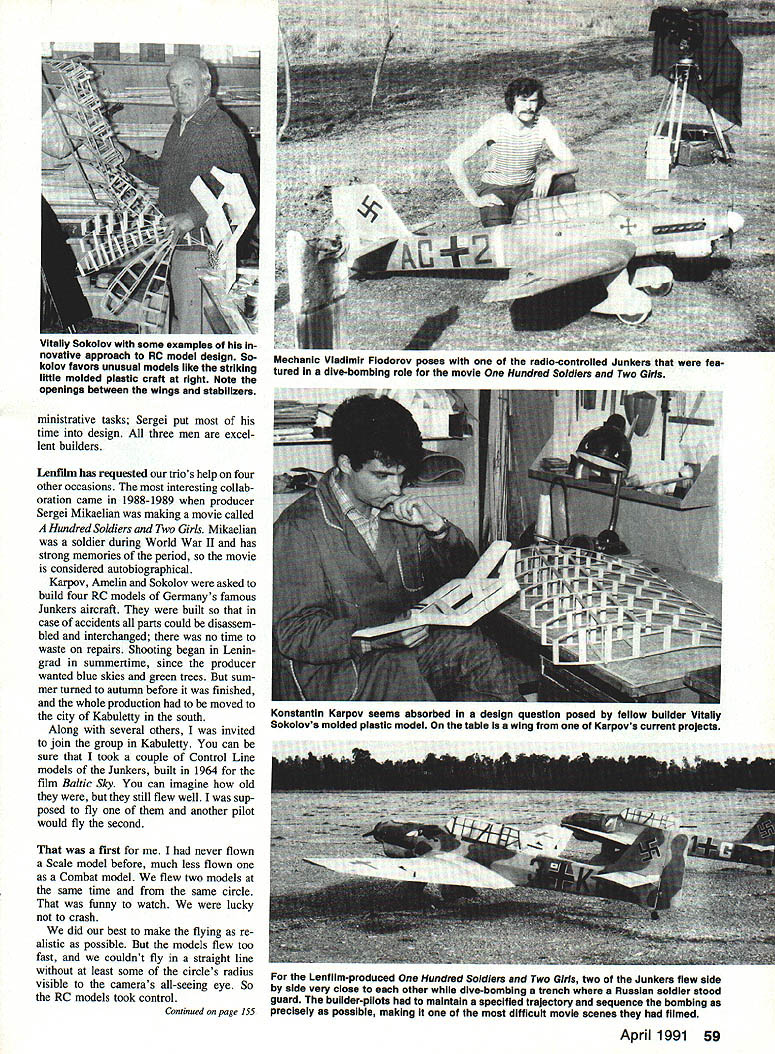
- Konstantin Karpov — 27 years old, a modeler for 14 years. He flies F3B models and radio-controlled gliders, and he placed first on our national team in the European Championships held in Czechoslovakia this year.
- Sergei Amelin — 32 years old, among the top three champions in the U.S.S.R. many times. He flies RC scale and racers seriously, and RC helicopters as a hobby. Sergei has been flying for 18 years.
- Vitaliy Sokolov — 54 years old; he has been flying for many years and likes to build unusual model airplanes.
Konstantin and Vitaliy teach the sport of model airplanes in a school for young people. Sokolov won this year's Antonov Cup, an international contest for sport veterans held in Kiev, flying a Free Flight F1A model.
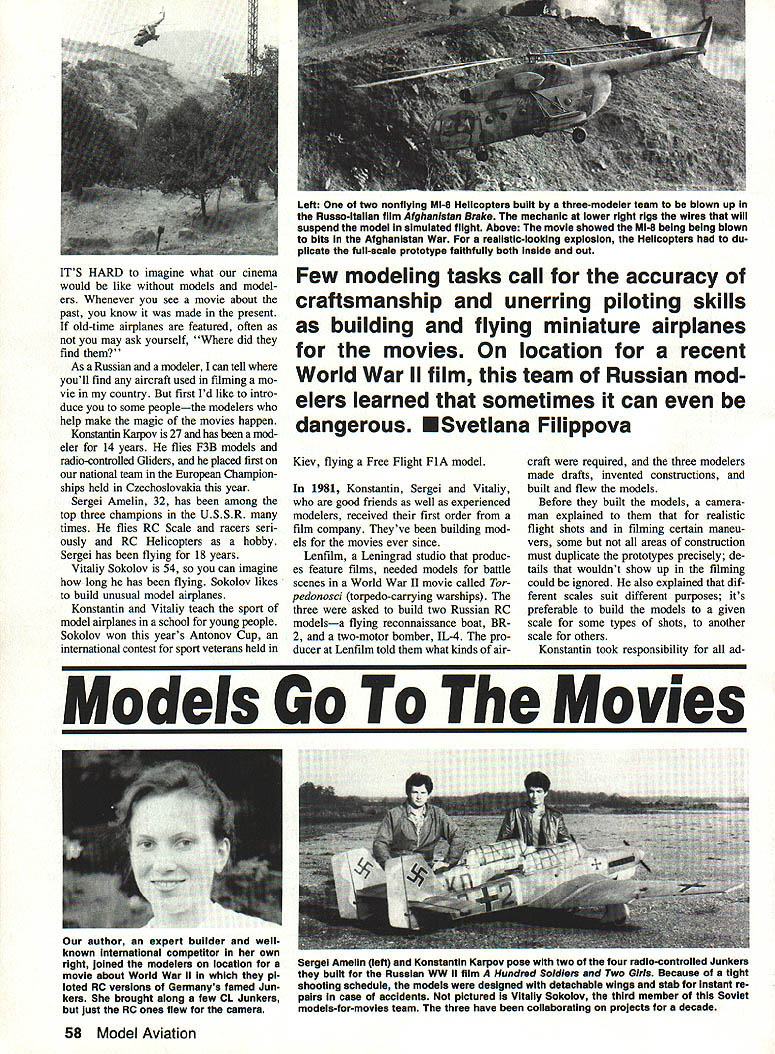
Few modeling tasks call for the accuracy of craftsmanship and unerring piloting skills as building and flying miniature airplanes for the movies. On location for a recent World War II film, this team of Russian modelers learned that sometimes it can even be dangerous. ■ Svetlana Filippova
First film work: Torpedonostsi (1981)
In 1981, Konstantin, Sergei and Vitaliy, who are good friends as well as experienced modelers, received their first order from a film company. They've been building models for the movies ever since.
Lenfilm, a Leningrad studio that produces feature films, needed models for battle scenes in a World War II movie called Torpedonostsi (torpedo-carrying warships). The three were asked to build two Russian RC models — a flying reconnaissance boat, BR-2, and a two-motor bomber, IL-4. The producer at Lenfilm told them what kinds of aircraft were required, and the three modelers made drafts, invented constructions, and built and flew the models.
Before they built the models, a cameraman explained that for realistic flight shots and in filming certain maneuvers, some but not all areas of construction must duplicate the prototypes precisely; details that wouldn't show up in the filming could be ignored. He also explained that different scales suit different purposes; it's preferable to build the models to a given scale for some types of shots, and to another scale for other types of shots.
As for administrative tasks, Sergei devoted most of his time to design. All three men are excellent builders.
Lenfilm has requested our trio's help on four other occasions. The most interesting collaboration came in 1988–1989 when producer Sergei Mikaelian was making a movie called A Hundred Soldiers and Two Girls. Mikaelian was a soldier during World War II and has strong memories of the period, so the movie is considered autobiographical.
Junkers for A Hundred Soldiers and Two Girls
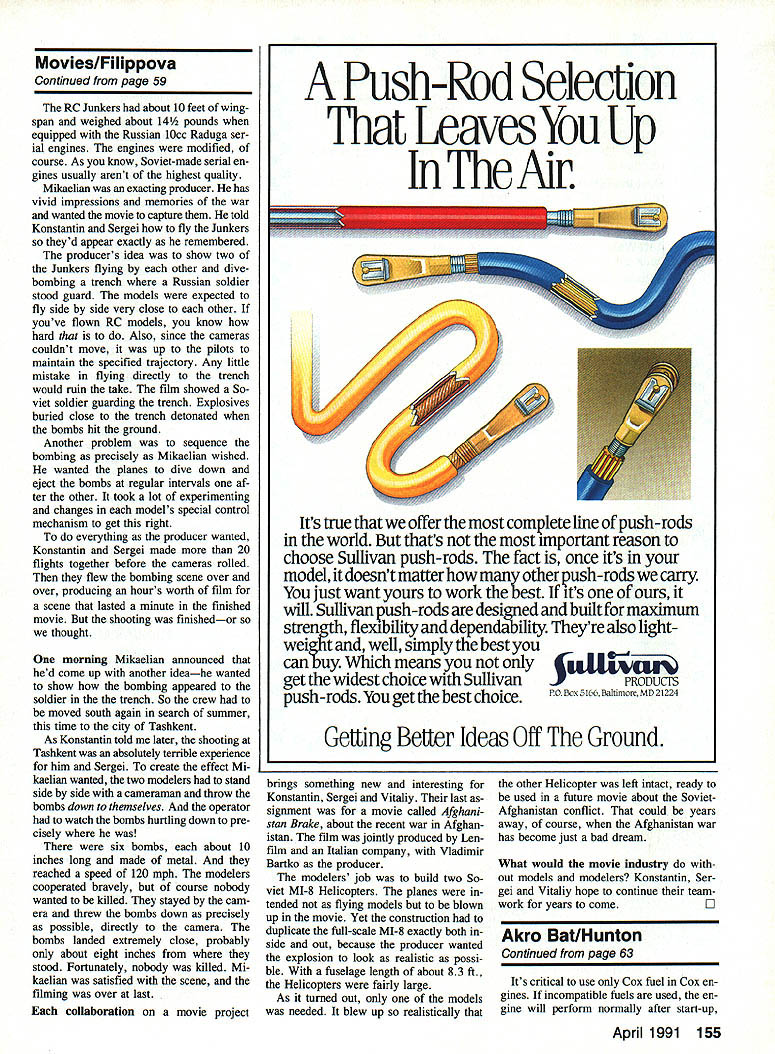
Karpov, Amelin and Sokolov were asked to build four RC models of Germany's famous Junkers aircraft. They were built so that in case of accidents all parts could be disassembled and interchanged; there was no time to waste on repairs. Shooting began in Leningrad in summertime, since the producer wanted blue skies and green trees. But summer turned to autumn before it was finished, and the whole production had to be moved to the city of Kabuletty in the south.
Along with several others, I was invited to join the group in Kabuletty. I took a couple of Control Line models of the Junkers, built in 1964 for the film Baltic Sky. They were old, but they still flew well. I was supposed to fly one of them and another pilot would fly the second.
That was a first for me. I had never flown a scale model before, much less flown one as a combat model. We flew two models at the same time and from the same circle. That was funny to watch. We were lucky not to crash.
We did our best to make the flying as realistic as possible. But the models flew too fast, and we couldn't fly in a straight line without at least some of the circle's radius visible to the camera's all-seeing eye. So the RC models took control.
The RC Junkers had about 10 feet of wingspan and weighed about 14½ pounds when equipped with the Russian 10 cc Raduga serial engines. The engines were modified, of course. As you know, Soviet-made serial engines usually aren't of the highest quality. Mikaelian was an exacting producer. He has vivid impressions and memories of the war and wanted the movie to capture them. He told Konstantin and Sergei how to fly the Junkers so they'd appear exactly as he remembered.
The producer's idea was to show two of the Junkers flying by each other and dive-bombing a trench where a Russian soldier stood guard. The models were expected to fly side by side very close to each other. If you've flown RC models, you know how hard that is to do. Also, since the cameras couldn't move, it was up to the pilots to maintain the specified trajectory. Any little mistake in flying directly to the trench would ruin the take. The film showed a Soviet soldier guarding the trench. Explosives buried close to the trench detonated when the bombs hit the ground.
Another problem was to sequence the bombing as precisely as Mikaelian wished. He wanted the planes to dive down and eject the bombs at regular intervals one after the other. It took a lot of experimenting and changes in each model's special control mechanism to get this right.
To do everything as the producer wanted, Konstantin and Sergei made more than 20 flights together before the cameras rolled. Then they flew the bombing scene over and over, producing an hour's worth of film for a scene that lasted a minute in the finished movie.
The Tashkent bombing sequence
One morning Mikaelian announced that he'd come up with another idea — he wanted to show how the bombing appeared to the soldier in the trench. So the crew had to be moved south again in search of summer, this time to the city of Tashkent.
As Konstantin told me later, the shooting at Tashkent was an absolutely terrible experience for him and Sergei. To create the effect Mikaelian wanted, the two modelers had to stand side by side with a cameraman and throw the bombs down toward themselves. And the operator had to watch the bombs hurling down to precisely where he was!
There were six bombs, each about 10 inches long and made of metal. They reached a speed of 120 mph. The modelers cooperated bravely, but of course nobody wanted to be killed. They stayed by the camera and threw the bombs down as precisely as possible, directly to the camera. The bombs landed extremely close, probably only about eight inches from where they stood. Fortunately, nobody was killed. Mikaelian was satisfied with the scene, and the shooting was over at last.
Afghanistan Brake
Each collaboration on a movie project brings something new and interesting for Konstantin, Sergei and Vitaliy. Their last assignment was for a movie called Afghanistan Brake, about the recent war in Afghanistan. The film was jointly produced by Lenfilm and an Italian company, with Vladimir Bartko as the producer.
The modelers' job was to build two Soviet Mi-8 helicopters. The models were intended not as flying models but to be blown up in the movie. Yet the construction had to duplicate the full-scale Mi-8 exactly both inside and out, because the producer wanted the explosion to look as realistic as possible. With a fuselage length of about 8.3 ft., the helicopters were fairly large.
As it turned out, only one of the models was needed. It blew up so realistically that the other helicopter was left intact, ready to be used in a future movie about the Soviet–Afghanistan conflict. That could be years away, of course, when the Afghanistan war becomes just a bad dream.
Conclusion
What would the movie industry do without modelers and model makers? Konstantin, Sergei and Vitaliy hope to continue their teamwork for years to come.
Transcribed from original scans by AI. Minor OCR errors may remain.

