
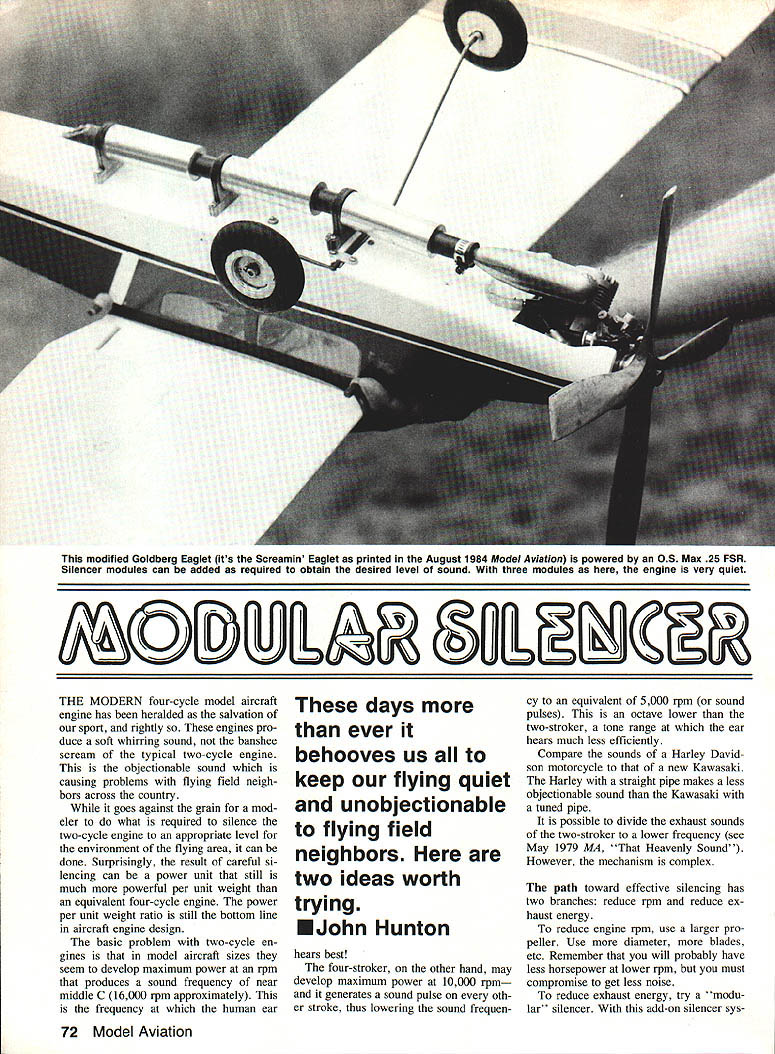
Modular Silencer
The modern four-cycle model aircraft engine has been heralded as the salvation of our sport, and rightly so. These engines produce a soft whirring sound, not the banshee scream of the typical two-stroke engine. That objectionable sound is causing problems with flying-field neighbors across the country.
While it goes against the grain for a modeler to do what is required to silence the two-stroke engine to an appropriate level for the flying area, it can be done. Surprisingly, careful silencing can produce a power unit that is still much more powerful per unit weight than an equivalent four-cycle engine. Power per unit weight is still the bottom line in aircraft engine design.
The problem with two-stroke engines
The basic problem with two-stroke engines in model-aircraft sizes is that they seem to develop maximum power at an rpm that produces a sound frequency near middle C (about 16,000 rpm). This is the frequency at which the human ear hears best.
The four-stroke, on the other hand, may develop maximum power at about 10,000 rpm — and it generates a sound pulse on every other stroke, lowering the effective sound frequency to the equivalent of 5,000 rpm (sound pulses). This is an octave lower than the two-stroke, a tone range at which the ear is much less sensitive.
Compare the sounds of a Harley-Davidson motorcycle to that of a new Kawasaki. The Harley with a straight pipe sounds less objectionable than the Kawasaki with a tuned pipe.
It is possible to divide the exhaust sounds of the two-stroke to a lower frequency (see May 1979 MA, "That Heavenly Sound"). However, the mechanism is complex.
Two approaches to silencing
The path toward effective silencing has two branches:
- Reduce rpm.
- Reduce exhaust energy.
To reduce engine rpm:
- Use a larger propeller.
- Use greater diameter and/or more blades.
- Remember you will probably have less horsepower at lower rpm; you must compromise to get less noise.
To reduce exhaust energy:
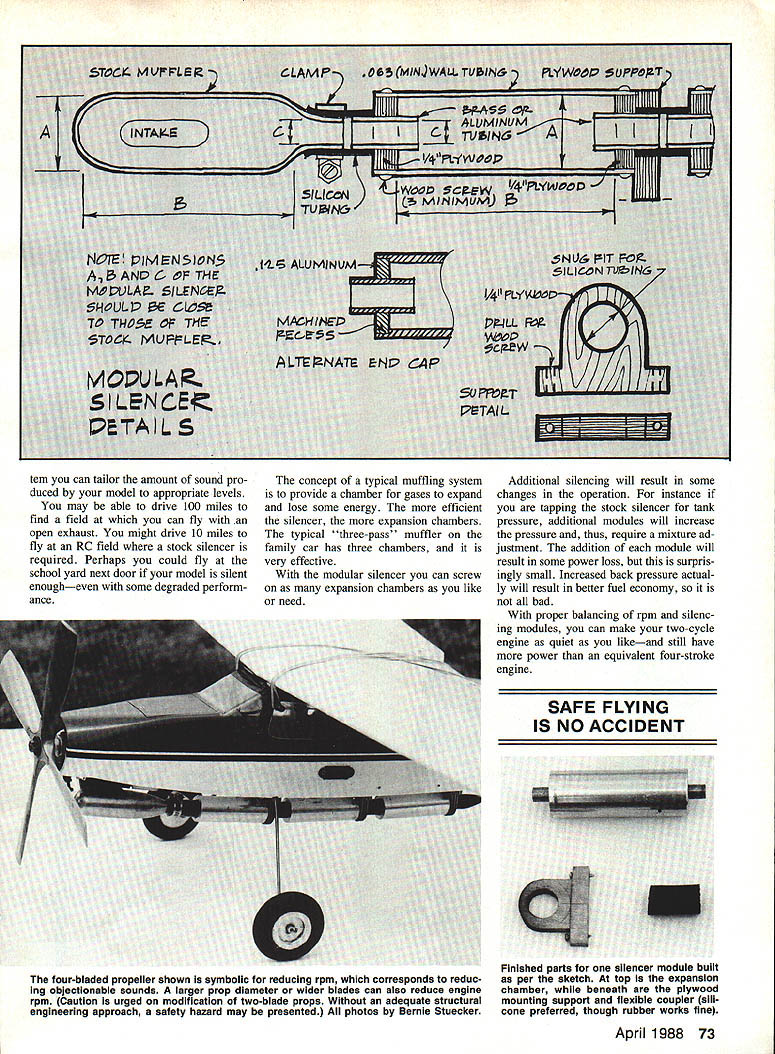
- Try a modular silencer. With this add-on system you can tailor the amount of sound produced by the model to the appropriate level for the flying area.
Modular silencer concept
A typical muffling system provides a chamber in which the gases expand and lose some energy. An efficient silencer, such as the three-pass muffler used in family cars, has multiple chambers and is very effective. The modular silencer allows you to screw expansion chambers on as needed. Additional modules increase silencing while allowing you to adjust the system for local restrictions and performance needs.
Effects and trade-offs
- Additional silencing will change engine operation. If you are tapping the stock silencer for tank pressure, adding modules will increase that pressure and require mixture adjustment.
- Each added module will cause some power loss, but this loss is surprisingly small.
- Increased back pressure can actually improve fuel economy when rpm and silencing are properly balanced.
- With proper balancing of rpm and silencing modules, you can make a two-stroke engine as quiet as you like and still retain power equivalent to — or greater than — an equivalent four-stroke engine.
Transcribed from original scans by AI. Minor OCR errors may remain.

