

Monarch Butterfly
By John Dyal
Overview
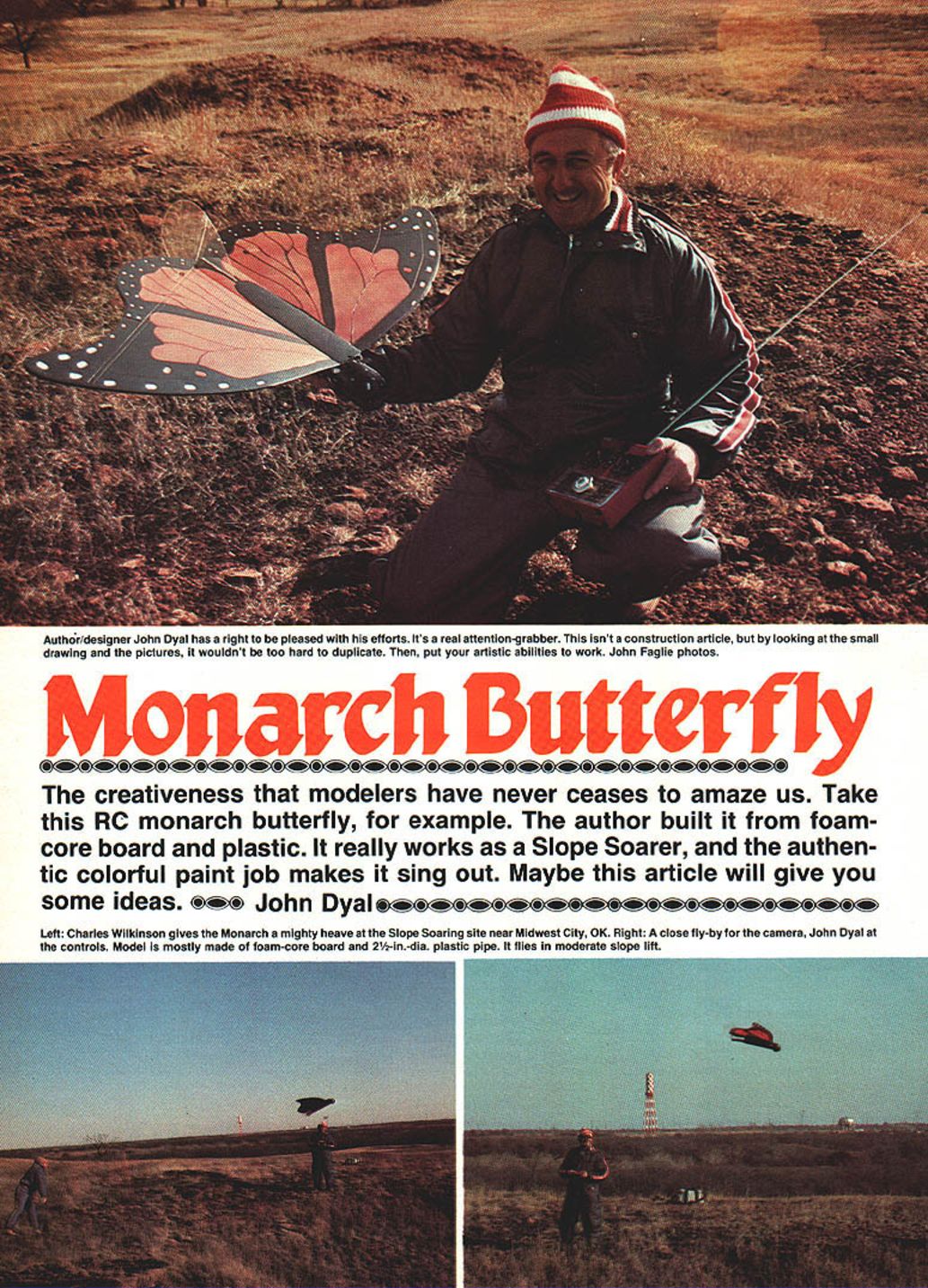
The creativeness of modelers never ceases to amaze. This RC monarch butterfly was built from foam‑core board and plastic and works well as a slope soarer. The authentic, colorful paint job really makes it sing. Maybe this article will give you some ideas.
This configuration began as a "someday, I gotta" project. Whenever I saw monarchs migrating I'd say, "Someday, I gotta build a butterfly." Someday finally came, and I got started.
Design and Performance
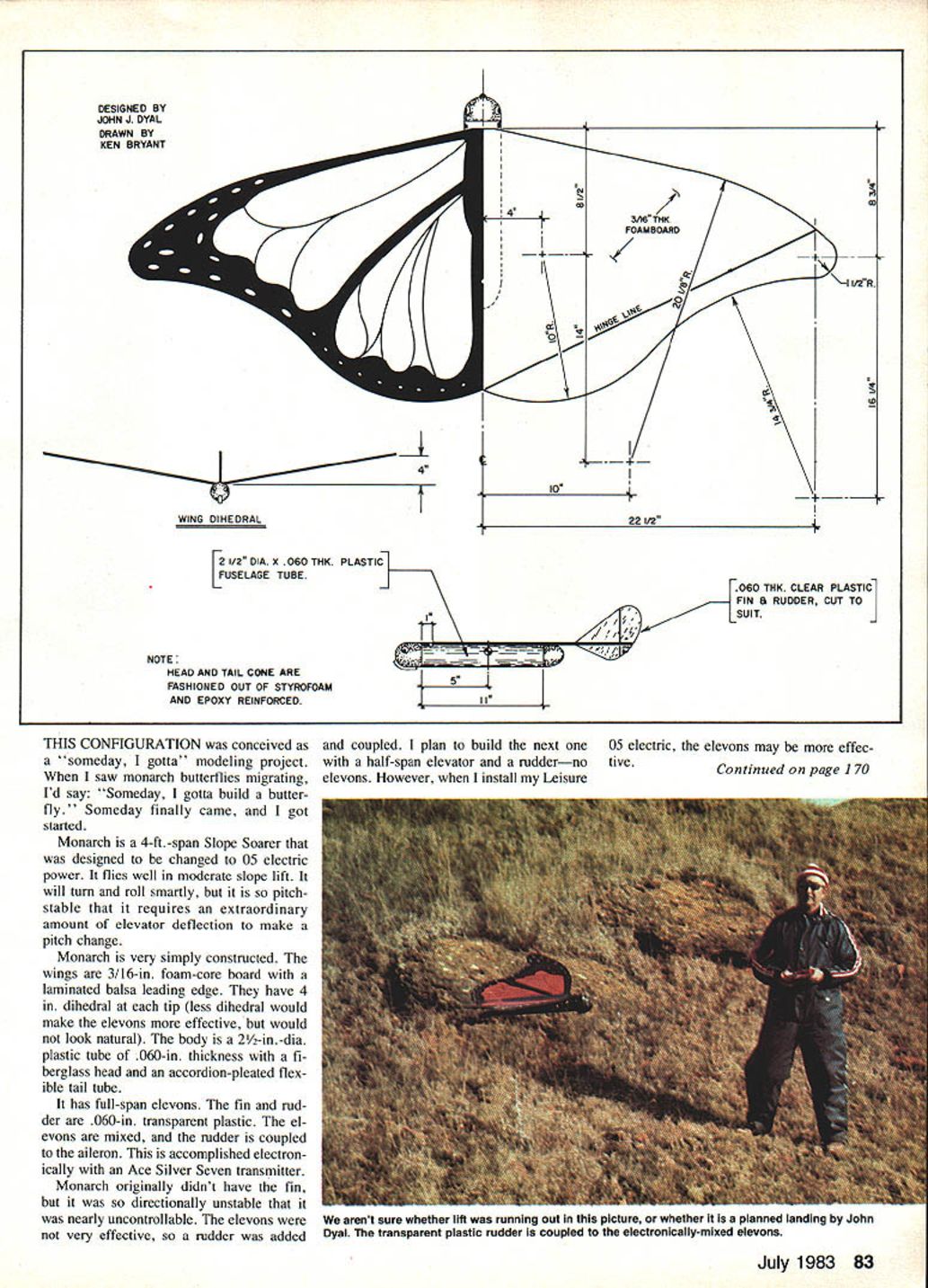
- 4-ft.-span slope soarer, designed to be convertible to .05 electric power.
- Flies well in moderate slope lift; turns and rolls smartly.
- Very pitch‑stable — requires an extraordinary amount of elevator deflection to make a pitch change.
Construction
- Wings: 3/16‑in. foam‑core board with a laminated balsa leading edge. Wings have 4 in. dihedral at each tip (less dihedral would make the elevons more effective but would not look natural). The wing dihedral break is strengthened with a 3‑in. width of foam‑core board that has been sanded to fit.
- Body (fuselage): 2‑1/2‑in. dia. plastic tube of .060‑in. thickness with a fiberglass head and an accordion‑pleated flexible tail tube. Body length (less head and tail tube) is 11 in. to provide room for a future electric battery pack and switch servo.
- Control surfaces: full‑span elevons. Fin and rudder are .060‑in. transparent plastic. The elevons are mixed, and the rudder is coupled to the ailerons electronically (using an Ace Silver Seven transmitter).
- Fastening and skin: Wing attached with two 4‑40 nylon screws through 1/4‑in. plywood blocks in the wing and body. For skin strength, Hobbypoxy II was squeegeed onto both sides of the foam‑core board.
Originally the model had no fin and was directionally unstable and nearly uncontrollable. The elevons were not very effective, so a rudder was added and coupled. I plan to build the next one with a half‑span elevator and a rudder — no elevons. However, when I install my Leisure .05 electric, the elevons may be more effective.
Assembly and Balance
- Servos are installed at the extreme rear of the body.
- Battery and receiver are mounted at the front, with 2 oz. of lead placed in the head.
- Balance point is 5 in. aft of the center of the wing's leading edge.
Finishing
Monarch was painted with epoxy from an aerosol can (Coverite's Black Baron should be great). The paint scheme was derived from a full‑scale monarch butterfly, of course.
Music‑wire legs would make the model look better, but if they were functional they would add too much weight.
Notes
Some guy said the airfoil was a flat plate. I prefer to think it is a scientifically designed symmetrical airfoil that just happens to be flat on both sides!
I saw dragonflies migrating yesterday. "Someday, I gotta..."
Transcribed from original scans by AI. Minor OCR errors may remain.

