
Monocoupe
Don Berliner
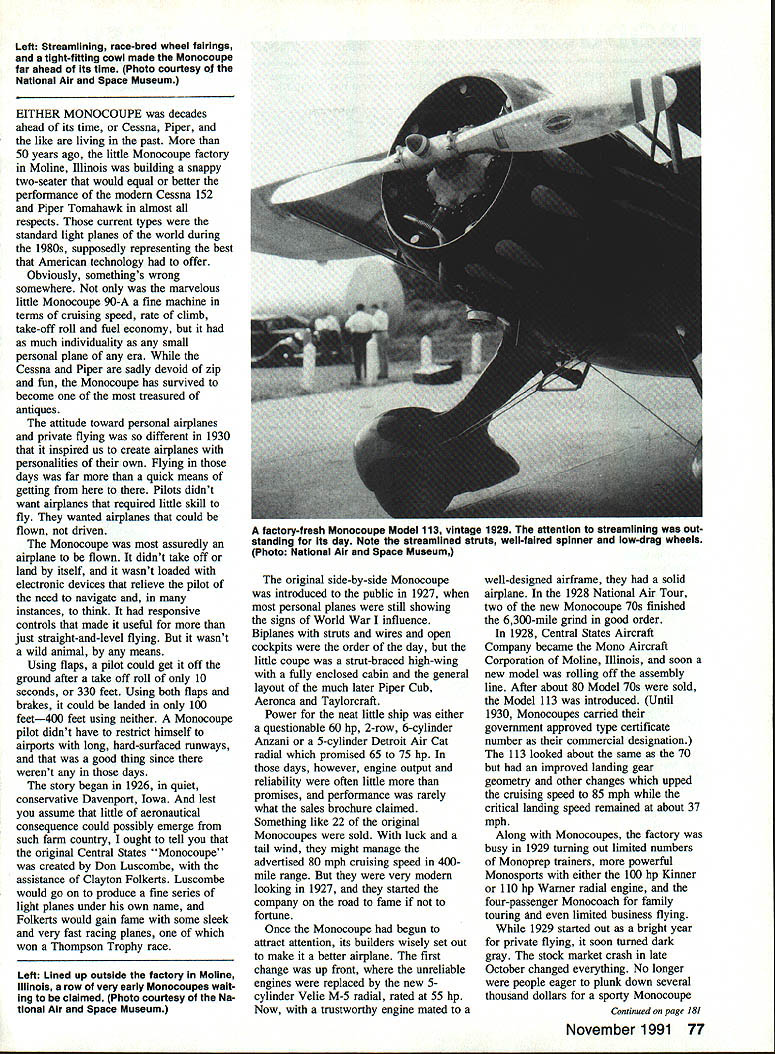
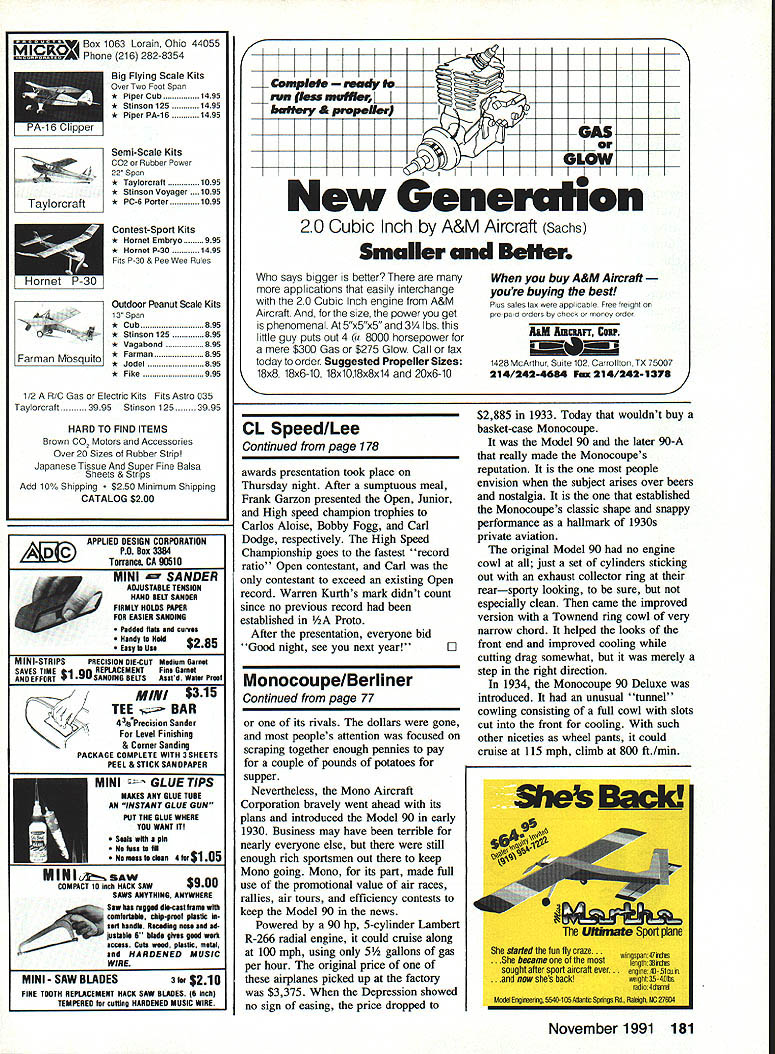
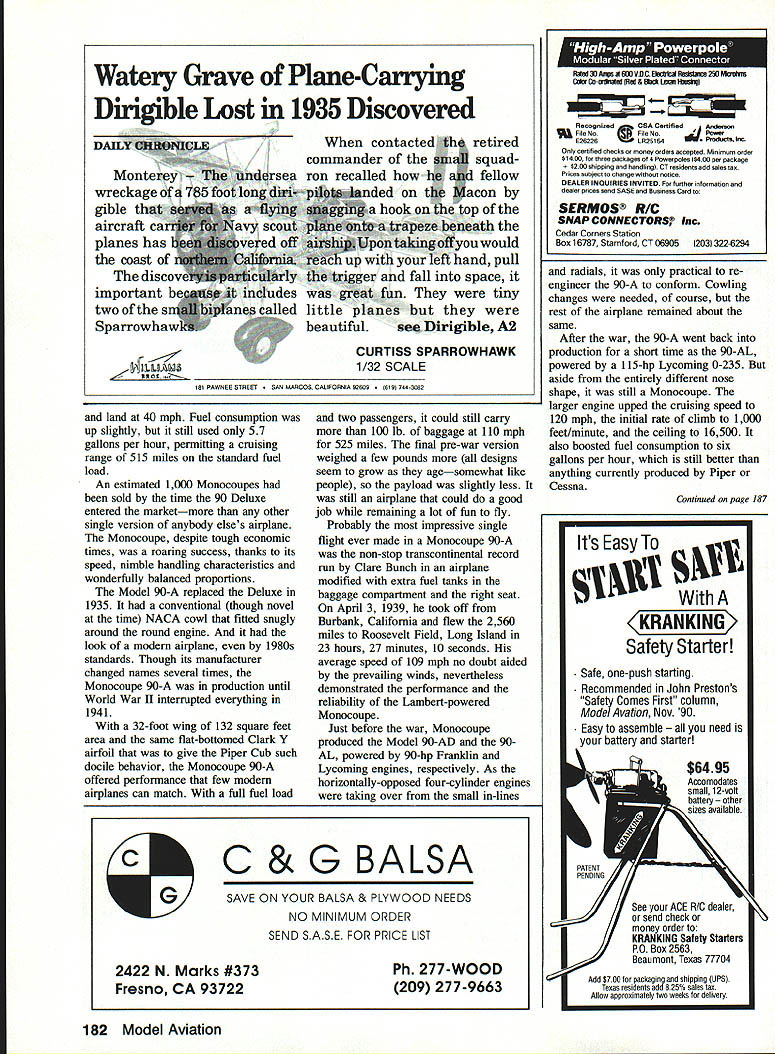
Either the Monocoupe was decades ahead of its time, or Cessna, Piper and the like have been looking the wrong way. More than 50 years ago the little Monocoupe factory in Moline, Illinois, was building a snappy two‑seater that equaled or bettered the performance of later trainers such as the Cessna 152 and Piper Tomahawk in cruising speed, rate of climb, takeoff roll and fuel economy. The Monocoupe also had individuality and zest—qualities largely absent from many later standard light planes—and it has survived to become one of the most treasured antiques of private aviation.
Origins and early development
The story began in 1926 in quiet, conservative Davenport, Iowa. The original Central States Monocoupe was created by Don Luscombe with the assistance of Clayton Folkerts. Luscombe later produced a notable series of light planes under his own name; Folkerts gained fame designing sleek, fast racing aircraft.
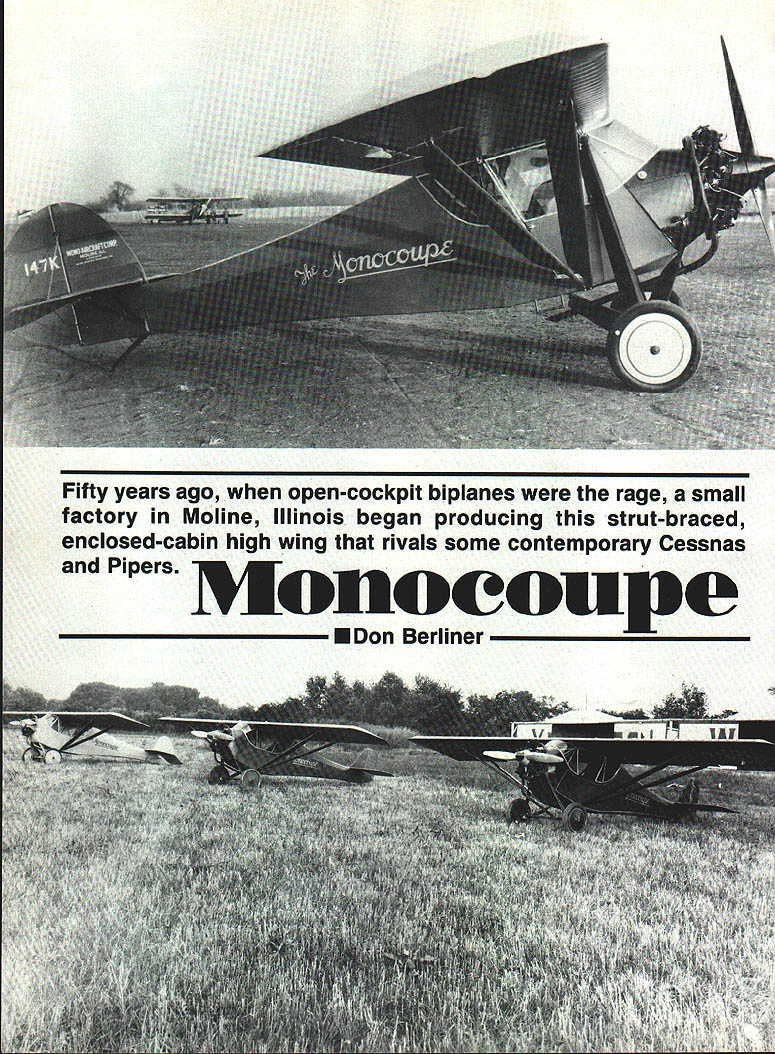
The side‑by‑side Monocoupe was introduced to the public in 1927. While most personal planes then still reflected World War I influence—biplanes with struts, wires and open cockpits—the little coupe was a strut‑braced high‑wing with a fully enclosed cabin, a layout similar to later high‑wing two‑seat types such as the Piper Cub, Aeronca and Taylorcraft.
Original powerplants included a questionable 60‑hp two‑row, six‑cylinder Anzani and a 5‑cylinder Detroit Air‑Cat radial rated about 65–75 hp. Only about 22 of the original Monocoupes were sold; with luck and a tailwind they might reach the advertised 80 mph cruise and 400‑mile range. The modern‑looking 1927 design, however, put the company on the road to recognition.
The builders soon improved the design, replacing unreliable engines with the 5‑cylinder Velie M‑5 radial (55 hp), producing a sturdier, dependable airplane. Two Monocoupe 70s completed the 6,300‑mile 1928 National Air Tour in good order.
In 1928 Central States Aircraft became Mono Aircraft Corporation of Moline, Illinois. After roughly 80 Model 70s, the Model 113 was introduced (Monocoupes carried government type certificate number 113 until 1930). The Model 113 retained the basic appearance of the 70 but had improved landing‑gear geometry and other refinements that raised cruise speed to about 85 mph while keeping the critical landing speed near 37 mph.
Models and performance
Alongside Monocoupes, the factory produced Monoprep trainers, Monosports (with either 100‑hp Kinner or 110‑hp Warner radials), and the four‑passenger Monocoach for family touring and limited business use.
In early 1930 Mono introduced the Model 90, powered by a 90‑hp, 5‑cylinder Lambert R‑266 radial. Key facts and performance for the Model 90 series:
- Cruise: ~100 mph (original Model 90)
- Fuel consumption: ~5.5 gallons per hour
- Factory price (original): $3,375; dropped to $2,885 by 1933 during the Depression
The Model 90 Deluxe (1934) added a "tunnel" cowling (full cowl with cooling slots) and aerodynamic refinements such as wheel pants:
- Cruise: ~115 mph
- Rate of climb: ~800 ft/min
- Landing speed: ~40 mph
- Fuel consumption: ~5.7 gph
- Range (standard fuel): ~515 miles
An estimated 1,000 Monocoupes had been sold by the time the 90 Deluxe appeared—more than any other single version of many competitors' designs.
The Model 90‑A (1935) replaced the Deluxe with a NACA cowl that gave a more modern nose profile. Production continued—under several corporate names—until World War II halted civilian manufacture in 1941.
Notable airframe and payload figures for the 90‑A:
- Wing span: 32 ft
- Wing area: 132 sq ft
- Airfoil: Clark Y (flat‑bottom)
- With full fuel and two passengers: could still carry over 100 lb of baggage while cruising about 110 mph for ~525 miles
Late pre‑war variants included the 90‑AD (90‑hp Franklin) and 90‑AL (90‑hp Lycoming). After the war the 90‑AL returned briefly with a 115‑hp Lycoming O‑235:
- Cruise: ~120 mph
- Initial climb: ~1,000 ft/min
- Service ceiling: ~16,500 ft
- Fuel consumption: ~6 gph
Clare Bunch made one of the most impressive flights in a Monocoupe 90‑A modified with extra fuel: on April 3, 1939, he flew non‑stop from Burbank, California, to Roosevelt Field, Long Island—2,560 miles in 23 h 27 m 10 s—averaging 109 mph.
Handling, short‑field capability and pilot experience
The Monocoupe was designed to be flown, not to fly itself. It had responsive controls and required pilot skill rather than automation—fun to handle yet not unmanageable. Short‑field performance was excellent for its day:
- Takeoff (with flaps): ~10 seconds, ~330 ft
- Landing (with flaps and brakes): ~100 ft
- Landing (without flaps): ~400 ft
Such figures allowed Monocoupe pilots to operate from small, unprepared fields common in the era.
Racing, aerobatics and sporting success
Beyond civil touring and training, the Monocoupe earned a proud record as a true sport airplane. Versions from stock Model 90s to heavily modified racers (clipped wings, engines up to ~145 hp) performed extremely well in pylon races and cross‑country events. Noted racers included Johnny Livingston and Vern Roberts, who extracted remarkable speeds from the trim airframe.
Howard’s famous high‑wing racer "Mr. Mulligan" was an admitted (if unauthorized) variation on the Monocoupe theme, and the type inspired other high‑performance designs.
Woody Edmondson’s 110 Special—clipped wings and a 180‑hp Warner radial—won the 1948 National Aerobatic Championship, making it the only monoplane to win the major American contest between 1932 and the later dominance of aircraft like the Laser 2000. That airplane was donated to the National Air and Space Museum by its last owner, John McCullough.
Legacy
The Monocoupe combined attractive aesthetics, lively performance, economical operation and pilot‑centered handling. It represented an era when personal airplanes had personality and required skill to exploit. Today the Monocoupe remains a treasured antique—a reminder that effective, enjoyable light aircraft were built long before the standardized trainer models of later decades.
Transcribed from original scans by AI. Minor OCR errors may remain.

