

Mr. Gulfhawk
Kenneth D. Wilson
A remarkable blend of pure showmanship, and an absolute precision that thrilled millions, made Al Williams perhaps the greatest of air-show pilots. Oldtimers speak the truth when they say it was a thrill even to see him taxi his Gulfhawk.
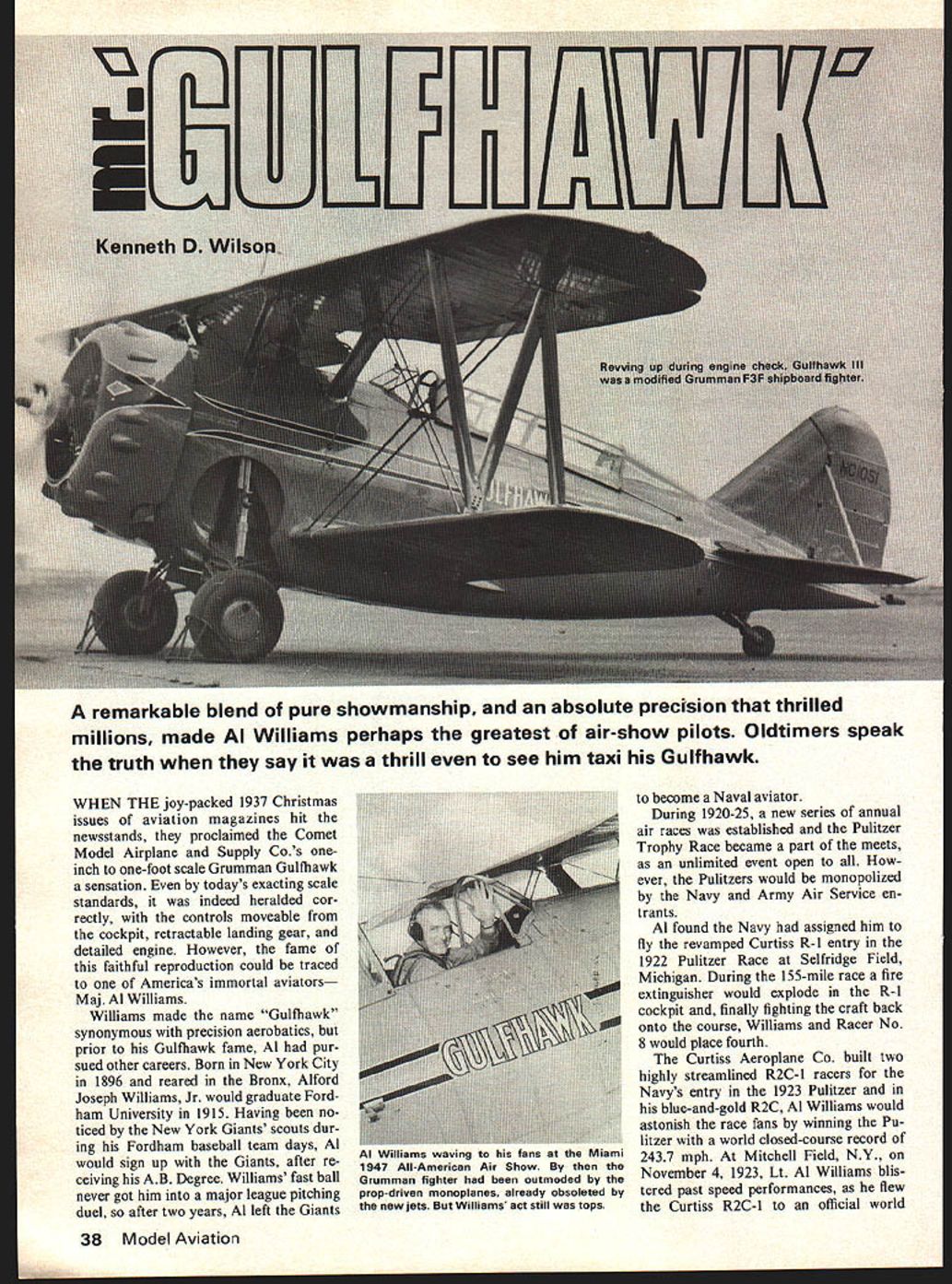
WHEN THE joy-packed 1937 Christmas issues of aviation magazines hit the newsstands, they proclaimed the Comet Model Airplane and Supply Co.'s one-inch to one-foot scale Grumman Gulfhawk a sensation. Even by today's exacting scale standards, it was indeed heralded correctly, with the controls moveable from the cockpit, retractable landing gear, and detailed engine. However, the fame of this faithful reproduction could be traced to one of America's immortal aviators—Maj. Al Williams.
Williams made the name "Gulfhawk" synonymous with precision aerobatics, but prior to his Gulfhawk fame, Al had pursued other careers. Born in New York City in 1896 and reared in the Bronx, Alford Joseph Williams, Jr. would graduate Fordham University in 1915. Having been noticed by the New York Giants' scouts during his Fordham baseball team days, Al would sign up with the Giants, after receiving his A.B. Degree. Williams' fast ball never got him into a major league pitching duel, so after two years, Al left the Giants to become a Naval aviator.
During 1920-25, a new series of annual air races was established and the Pulitzer Trophy Race became a part of the meets, as an unlimited event open to all. However, the Pulitzers would be monopolized by the Navy and Army Air Service entrants.
Al found the Navy had assigned him to fly the revamped Curtiss R-1 entry in the 1922 Pulitzer Race at Selfridge Field, Michigan. During the 155-mile race a fire extinguisher would explode in the R-1 cockpit and, finally, fighting the craft back onto the course, Williams and Racer No. 8 would place fourth.
The Curtiss Aeroplane Co. built two highly streamlined R2C-1 racers for the Navy's entry in the 1923 Pulitzer and in his blue-and-gold R2C, Al Williams would astonish the race fans by winning the Pulitzer with a world closed-course record of 243.7 mph. At Mitchell Field, N.Y., on November 4, 1923, Lt. Al Williams blistered past speed performances, as he flew the Curtiss R2C-1 to an official world speed record of 266.59 mph.
Along with obtaining a law degree from Georgetown Univ. in 1925, Williams would place second in the 1925 Pulitzer and, in 1929, would be awarded the Distinguished Flying Cross for his testing and flying achievements.
Aviation was not all victories for Al, as he directed his talents to designing racers. Al would put his life savings in the 1927 Kirkham-Williams seaplane, designed for Schneider Trophy Race competition. The craft was not finished for the event, so it was converted to a landplane in which Williams claimed to fly to an unofficial world speed record of 322.6 mph. The ill-fated 1929 Mercury racer, again built for the Schneider under great secrecy at the Naval Aircraft Factory, and with most of Williams' personal funds being sunk into the private project, would only become airborne once for a few hundred yards.
Becoming disillusioned with the military's inability to visualize the full potential of aircraft, Al resigned the Navy in 1930, but would later serve in the Marine Corps Reserve with the rank of Major from 1935-40.
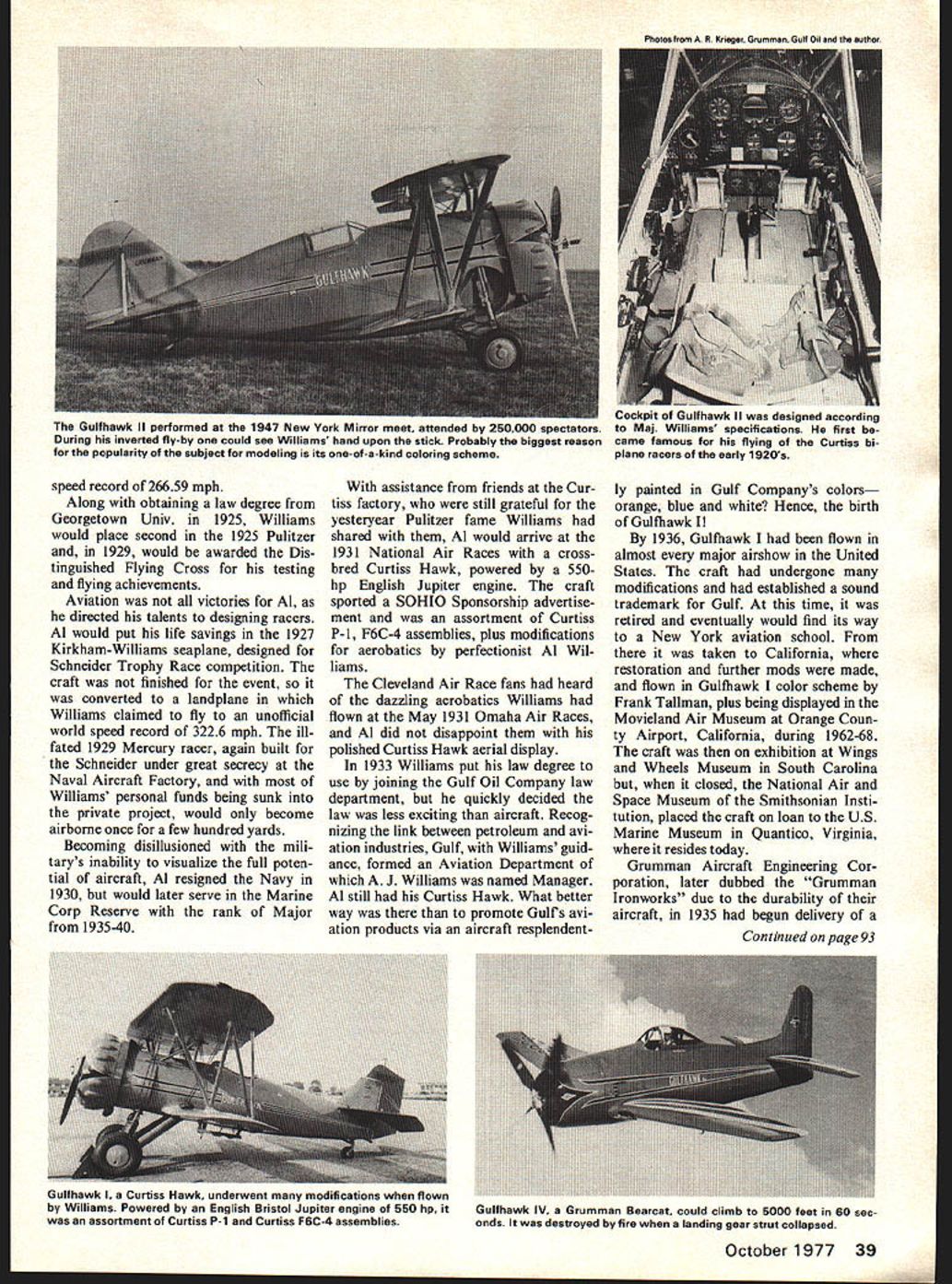
With assistance from friends at the Curtiss factory, who were still grateful for the yesteryear Pulitzer fame Williams had shared with them, Al would arrive at the 1931 National Air Races with a cross-bred Curtiss Hawk, powered by a 550-hp English Jupiter engine. The craft sported a SOHIO sponsorship advertisement and was an assortment of Curtiss P-1, F6C-4 assemblies, plus modifications for aerobatics by perfectionist Al Williams.
The Cleveland Air Race fans had heard of the dazzling aerobatics Williams had flown at the May 1931 Omaha Air Races, and Al did not disappoint them with his polished Curtiss Hawk aerial display.
In 1933 Williams put his law degree to use by joining the Gulf Oil Company law department, but he quickly decided the law was less exciting than aircraft. Recognizing the link between petroleum and aviation industries, Gulf, with Williams' guidance, formed an Aviation Department of which A. J. Williams was named Manager. Al still had his Curtiss Hawk. What better way was there than to promote Gulf's aviation products via an aircraft resplendently painted in Gulf Company's colors—orange, blue and white? Hence, the birth of Gulfhawk II!
By 1936, Gulfhawk I had been flown in almost every major airshow in the United States. The craft had undergone many modifications and had established a sound trademark for Gulf. At this time, it was retired and eventually would find its way to a New York aviation school. From there it was taken to California, where restoration and further mods were made, and flown in Gulfhawk I color scheme by Frank Tallman, plus being displayed in the Movieland Air Museum at Orange County Airport, California, during 1962-68. The craft was then on exhibition at Wings and Wheels Museum in South Carolina but, when it closed, the National Air and Space Museum of the Smithsonian Institution placed the craft on loan to the U.S. Marine Museum in Quantico, Virginia, where it resides today.
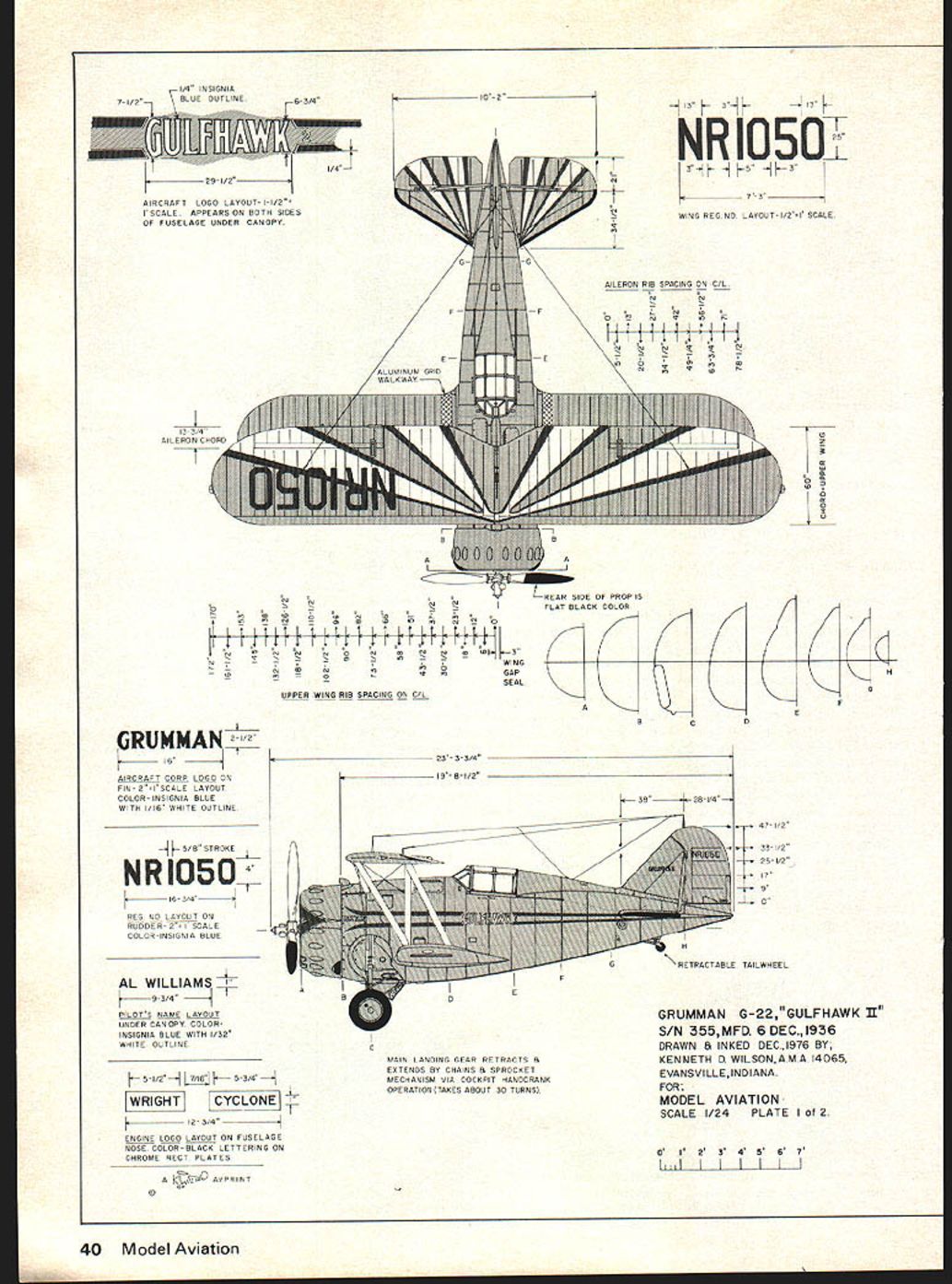
Grumman Aircraft Engineering Corporation, later dubbed the "Grumman Ironworks" due to the durability of their aircraft, in 1935 had begun delivery of a MAIN LANDING GEAR RETRACTS & EXTENDS BY CHAINS & SPROCKET MECHANISM VIA COCKPIT HANDBRAKE OPERATION (MAKES ABOUT 30 TURNS).
RETRACTABLE TAILWHEEL
AL WILLIAMS PILOT'S NAME LAYOUT UNDER CANOPY. COLOR — INSIGNIA BLUE WITH 1/32" WHITE OUTLINE.
GRUMMAN AIRCRAFT CORP. LOGO ON FIN — 2-1/2" SCALE LAYOUT. COLOR — INSIGNIA BLUE WITH 1/16" WHITE OUTLINE.
WRIGHT CYCLONE ENGINE LOGO LAYOUT ON FUSELAGE NOSE. COLOR — BLACK LETTERING ON CHROME NAME PLATES.
GRUMMAN G-22, "GULFHAWK II" S/N 355, MFD. 6 DEC, 1936 DRAWN & INKED DEC., 1976 BY KENNETH D. WILSON, AMA #4065, EVANSVILLE, INDIANA. FOR: MODEL AVIATION SCALE 1/24 PLATE 1 of 2.
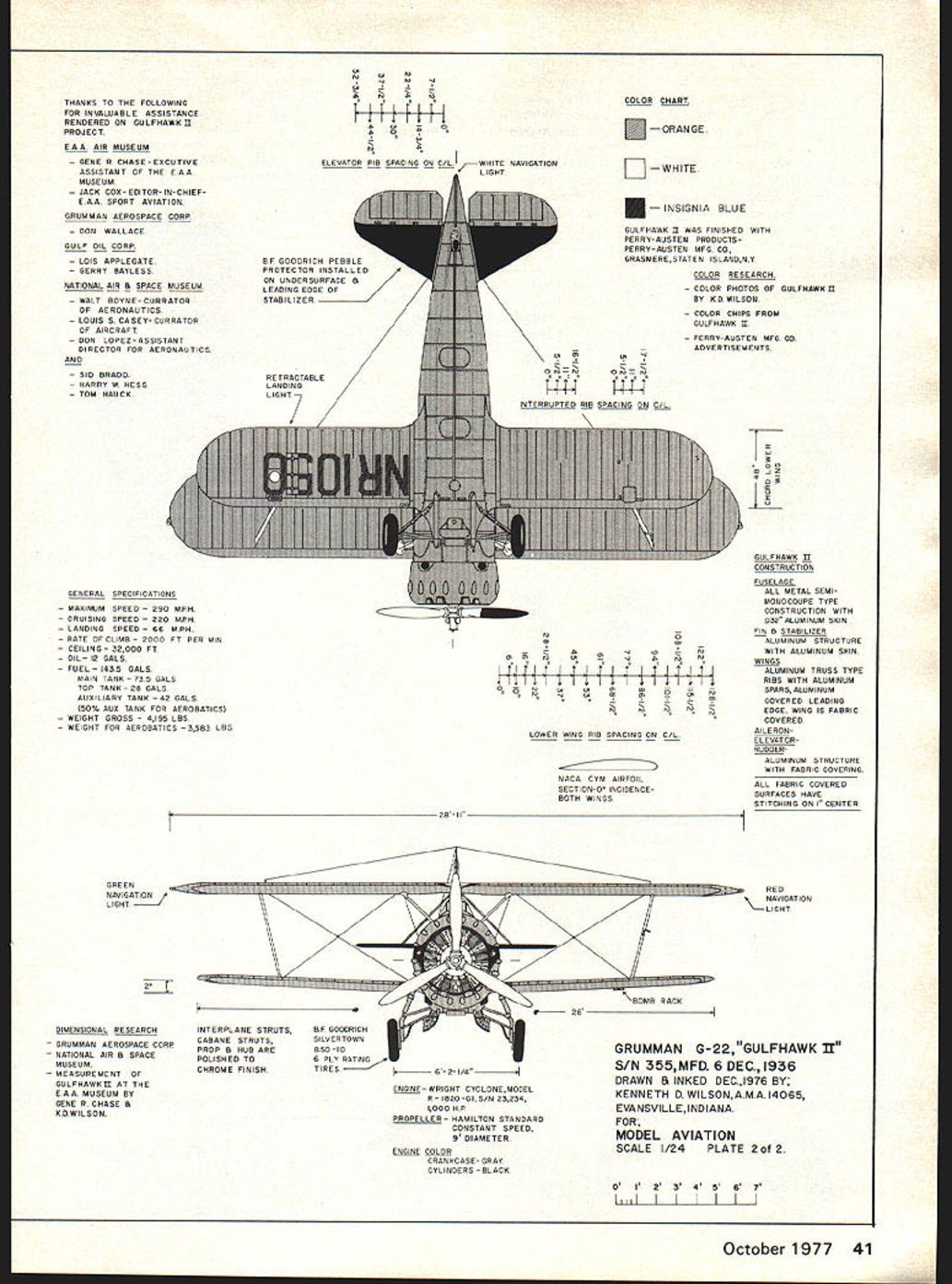
THANKS TO THE FOLLOWING FOR INVALUABLE ASSISTANCE RENDERED ON GULFHAWK II PROJECT
E.A.A. AIR MUSEUM
- GENE E. CHASE - EXECUTIVE ASSISTANT OF THE E.A.A. MUSEUM
- JACK COX - EDITOR-IN-CHIEF, E.A.A. SPORT AVIATION
GRUMMAN AEROSPACE CORP.
- DON WALLACE
GULF OIL CORP.
- LOIS APPLEGATE
- GERRY BAYLESS
NATIONAL AIR & SPACE MUSEUM
- WALT BOYNE - CURATOR OF AERONAUTICS
- LOUIS S. CASEY - CURATOR OF AIRCRAFT
- DON LOPEZ - ASSISTANT DIRECTOR FOR AERONAUTICS
AND
- SID BRADDOCK
- HARRY W. NESS
- TOM MALICK
COLOR CHART
- ORANGE
- WHITE
- INSIGNIA BLUE
Gulfhawk II was finished with Perry-Austen products. Perry-Austen Mfg. Co., Grassmere, Staten Island, N.Y.
COLOR RESEARCH
- Color photos of Gulfhawk II by K.D. Wilson.
- Color chips from Gulfhawk II.
- Perry-Austen Mfg. Co. advertisements.
B.F. GOODRICH pebble protection installed on undersurface & leading edge of stabilizer.
WHITE NAVIGATION LIGHT
RETRACTABLE LANDING LIGHT
INTERRUPTED RIB SPACING ON C/L
LOWER WING RIB SPACING ON C/L
NACA 6W AIRFOIL SECTION - 0° INCIDENCE - BOTH WINGS
GREEN NAVIGATION LIGHT
RED NAVIGATION LIGHT
GENERAL SPECIFICATIONS
- MAXIMUM SPEED - 290 MPH.
- CRUISING SPEED - 210 MPH.
- LANDING SPEED - 68 MPH.
- RATE OF CLIMB - 2000 FT. PER MIN.
- CEILING - 32,000 FT.
- OIL - 12 GALS.
- FUEL - 143.5 GALS.
- MAIN TANK - 72.5 GALS.
- TOP TANK - 28 GALS.
- AUXILIARY TANK - 42 GALS.
(BOTH MAIN TANKS FOR AEROBATICS)
- WEIGHT GROSS - 4,195 LBS.
- WEIGHT FOR AEROBATICS - 3,583 LBS.
DIMENSIONAL RESEARCH
- GRUMMAN AEROSPACE CORP.
- NATIONAL AIR & SPACE MUSEUM
- MEASUREMENT OF GULFHAWK II AT THE E.A.A. MUSEUM BY GENE R. CHASE & K.D. WILSON.
INTERPLANE STRUTS, CABANE STRUTS, PROP & HUB ARE POLISHED TO CHROME FINISH.
B.F. GOODRICH SILVERTOWN 6.00-16 6 PLY RATING TIRES
ENGINE — WRIGHT CYCLONE, MODEL R-1820-G1, S/N R-???-G1, 1000 H.P. (engine data shown on drawing)
PROPELLER — HAMILTON STANDARD CONSTANT SPEED, 9' DIAMETER
ENGINE COLOR
- CRANKCASE - GRAY
- CYLINDERS - BLACK
GRUMMAN G-22, "GULFHAWK II" S/N 355, MFD. 6 DEC, 1936 DRAWN & INKED DEC., 1976 BY: KENNETH D. WILSON, A.M.A. 14065, EVANSVILLE, INDIANA.
FOR: MODEL AVIATION SCALE 1/24 PLATE 2 of 2 the iron.
The fuselage is covered with 2‑in. scale camouflage Super Coverite fabric. This iron‑on material was applied without any fuss. First the bottom, then the sides, and finally the top areas are covered. It soon becomes apparent that a very uniform overlap width has to be achieved, since the camouflage patterns do not generally match around the fuselage corners. To do this, use a short 1/4‑in. plywood guide. Cut against this with a freshly sharpened X‑acto knife and a good edge lap will result.
The wing is covered with Super Coverite, the bottom first, then the top. At the tips you really can pull the covering around without gores since these tips are truly solid. Most of the stub wing is done in the 2‑in. camouflage with the sides painted last. The dark green paint for the wing, cowl, and struts is Superpoxy brush‑type paint that is slightly thinned and mixed one part black to two parts green. A small Badger‑Propel spray gun was used for the required two coats. This produces a weathered dull finish.
The wheels are painted with black and white Superpoxy. The cowl, struts, and wheel backs are painted with the dark green mix. Finally, after all the covering and spraying operations are completed you should rub down all the shiny surfaces with very fine steel wool. This achieves a more uniform dull finish.
My aircraft was finally completed, test run and taxied around the back yard using three tanks of fuel. This was done to make sure that nothing was about to loosen, fail, or fall off! It also checked the fuel consumption of the Fox bushed‑bearing .45 engine.
Later, at the club field, as I fought cold feet, my wife, the mechanic, said, "You built a scale model; the original flew, didn't it? Well when are you going to try?" The challenge had been called! Our club has a 200‑ft. grass strip field. The taxi to the far edge was completed and the wind O.K. A final control check, an engine run up, and the throttle back to 3/4. Let go. She rolls. So back to 1/2 throttle, all with full up elevator. With some good speed now, a neutral elevator, some left rudder and I firewalled the throttle. The lift off was less than half field! This had to be the greatest thrill in modeling since my solo.
I gained some altitude and warmed up to the flying. She flew hands off at all throttle settings without major trim changes. Large, perfect aileron‑only turns were made, but in the tight maneuvers the rudder was the only way to go. (In fact, flying three‑channel without ailerons would be quite natural, and would simplify the wing construction. However, the rolling ability would suffer if this is done.) According to the timer I had about five minutes more fuel. Some stalls, stall turns, and slow flight were tried with good smoothness of control. The landing, from my wife's point of view, was a steep approach, nice flare‑out into a fast roll‑out.
After over three months of no flying this had to be the aircraft, because I was flying with two fists inside mittens. The D VIII almost landed by itself. I put her through three hours of air time before the Rhinebeck meet. I think it only fair to do this as far as public safety is concerned. At the meet I looked at the balsa‑consuming trees bending in the wind and said "here goes my first design effort, first major contest, and first time flying away from the big club field."
As a "realistic" speed made points with the judges I flew the first flight slowly. Actually too slowly! Fifty feet over trees with minimum air speed and on the downward leg is not the best place to have the engine quit! That D VIII tucked her nose into a nice glide, made a one‑eighty on descent and flared deadstick into the 50‑ft. spot circle. And that is the truth. After that the D VIII and I had a time that will long be pleasantly remembered. Many modelers saw the aircraft first hand and performing in the air. Amazement was expressed that a biplane, short span, thick‑winged aircraft could be so stable and fly with only a .45 engine (using a 12 x 4 Tornado prop).
If you decide to build the Fokker, don't expect a pattern aircraft that will do clean aileron rolls and fly all day inverted. It won't. Expect a smooth, stable aircraft with a reasonable amount of penetration capability, good ground handling, and just realistic flight.
I would like to express my gratitude to all the people who made this project possible: to my wife Ginny, for encouragement; to Mr. Otto Loorents, who made these fine photographs; and to Mr. Cole Palen and the members of the Mid‑Hudson R.C. Society who gave their permission and dedication to inspire this project.
A remarkable blend of pure showmanship and absolute precision thrilled millions and made Al Williams perhaps the greatest air‑show pilot. Old‑timers speak the truth when they say it was a thrill to see him taxi the Gulfhawk.
When the joy‑packed 1937 Christmas issues of aviation magazines hit newsstands, Comet Model Airplane Supply Co.'s one‑inch, one‑foot scale Grumman Gulfhawk was proclaimed a sensation. By today's exacting scale standards it indeed heralded correctly — controls, movable cockpit, retractable landing gear, detailed engine. However, the fame of the faithful reproduction can be traced to America's immortal aviator, Maj. Al Williams.
Williams made the name Gulfhawk synonymous with precision aerobatics. Prior to Gulfhawk fame Al pursued other careers. Born in New York City in 1896 and reared in the Bronx, Alford Joseph Williams Jr. graduated Fordham University in 1915. Having been noticed by New York Giants scouts during his Fordham baseball team days, Al signed with the Giants after receiving his A.B. degree. Williams' fast ball never got him a major league pitching duel; after two years Al left the Giants to become a Naval aviator.
During 1920‑25 a new series of annual air races was established. The Pulitzer Trophy Race became part of the meets — an unlimited event open to all. Pulitzers would be monopolized by Navy and Army Air Service entrants. Al found himself assigned to fly the revamped Curtiss R‑1 entry in the 1922 Pulitzer Race at Selfridge Field, Michigan. During the 155‑mile race a fire extinguisher exploded in the R‑1 cockpit, finally fighting the craft back onto course; Williams' racer No. 8 placed fourth.
Curtiss Aeroplane Co. built two highly streamlined R2C‑1 racers, the Navy's entry for the 1923 Pulitzer. In the blue‑and‑gold R2C Al Williams astonished race fans, winning the Pulitzer and setting a closed‑course world record of 243.7 mph at Mitchell Field, N.Y., on November 4, 1923. Lt. Al Williams blistered past previous speed performances flying the Curtiss R2C‑1. Later he set a speed record of 266.59 mph.
Along with obtaining a law degree from Georgetown Univ. in 1925, Williams placed second in the 1925 Pulitzer. In 1929 he was awarded the Distinguished Flying Cross for his testing and flying achievements. Williams also directed his talents toward designing racers. He put his life savings into the 1927 Kirkham‑Williams seaplane, designed for Schneider Trophy Race competition. The craft finished the event and was converted to a landplane. Williams claimed to have flown an unofficial world speed record of 322.6 mph in the ill‑fated 1929 Mercury racer, again built under great secrecy. The Naval Aircraft Factory project, Williams' personal funds being sunk into the private project, became airborne only a few hundred yards before crashing.
Becoming disillusioned with the military's inability to visualize the full potential of aircraft, Al resigned from the Navy in 1930. He would later serve in the Marine Corps Reserve with the rank of Major during 1935‑40. With assistance from friends at the Curtiss factory, still grateful for his yesteryear Pulitzer fame, Williams shared his expertise. He arrived at the 1931 National Air Races with a cross‑bred Curtiss Hawk powered by a 550‑hp Bristol Jupiter engine. The craft sported SOHIO sponsorship and an assortment of Curtiss P‑1 and F6C‑4 assemblies plus modifications for aerobatics. Perfectionist Al Williams dazzled the Cleveland Air Races crowds with aerobatics.
In May 1931 at the Omaha Air Races Al did not disappoint; his polished Curtiss Hawk aerial display continued to draw acclaim. In 1933 Williams put his law degree to use by joining the Gulf Oil Company law department, but quickly decided law was less exciting than aircraft. Recognizing the link between petroleum and the aviation industries, Gulf, with Williams' guidance, formed an Aviation Department and named J. Williams (Al) Manager. What better way to promote Gulf's aviation products than via an aircraft resplendent in company colors?
Thus was born the Gulfhawk. Painted in Gulf orange, blue and white, the Grumman fighter became the company’s flying advertisement. The Gulfhawk was flown at almost every major airshow in the United States. The craft underwent modifications over time, and Gulf time‑retired examples eventually found their way to New York aviation schools and to California for restoration and further mods. The Gulfhawk, flown in the classic Gulf color scheme by pilots such as Frank Tallman, has been displayed at the Movieland Air Museum, Orange County Airport. Grumman on acquiring a civilian version of the F2F-F3F design. At this time, the G-11 design was a first-line Navy fighter. However, Williams required modifications of non-military nature and the price quoted to Gulf was $12,225.00, which was approved. Design G-22 was assigned to the project and custom equipment installed included dual sets of fuel and oil systems for 30-minute maximum inverted flying, exhaust gas analyzer, a new-type power accelerator, cockpit-operated engine starter, custom panel and cockpit layout, and a Williams-designed close-fitting bump cowling.
On December 6, 1936, at Roosevelt Field, N.Y., Al Williams would take delivery of the aircraft which would become one of the most colorful and famous in America—Gulfhawk II.
Gulfhawk II also had been structurally strengthened to take the high G load Williams demanded of the aircraft in his acrobatic routine. The crowd at the Oklahoma City Airshow on June 10, 1937, saw the Grumman buzz the runway inverted at 15-foot altitude, pull up into a vertical climb and, as the spectators cheered, Al piloted the craft through eight consecutive loops. A surprise for the fans would be Gulfhawk II’s first public dive-bombing exhibition. Frank Tye, the person who kept Gulfhawk II in perfect mechanical condition, along with Williams, had rigged up a bomb rack under the left lower wing which would accommodate four bombs. Using 4,000-ft. altitude, Williams put Gulfhawk II into a vertical dive attack, registering speeds at close to 400 mph. The bombs destroyed a fort at the far end of the field.
The Royal Air Force Display was always one of the highlights of aviation in the British Empire, but for 1937, the Government had canceled the annual event. Lord Beaverbrook, one of the foremost publishers in England, had decided the London Daily Express would sponsor an aircraft display at Gatwick, England and, in late June 1937, Al Williams and a dismantled Gulfhawk II were aboard the Queen Mary to be guest stars at Gatwick, being personally invited by his Lordship. The 150,000 persons at Gatwick would see low loops after takeoff, followed by rolls on top of loops. After slow rolls, Williams turned Gulfhawk II into “flight without wings” (Williams’ label for knife-edge), plus Williams’ turns (rolling 180’s). Al put the G-22 into low inverted passes, then inverted Chandelles! The performance would close with Williams’ “shadow boxing,” another special he had perfected.
The airshow was radio broadcast throughout England and, after the Gulfhawk II dive-bombing demonstration, the announcer commented, “It makes you pray at church next morning that no kind of hostile aircraft will ever be seen over London like that!” Williams had met German Air Force Major General Ernst Udet at the 1931 N.A.R.
And, upon completion of his visit in England, Al was invited to fly Gulfhawk II to Germany. While there, Udet paid a tribute to Williams by turning over to him a Messerschmitt 109, one of the most deadly of all fighting ships then, and one which no pilot outside the German Air Force had ever flown. Al subjected the ME 109 to every known maneuver for 33 minutes, trying to develop a deficiency somewhere, but upon landing, he pronounced the ship the finest he had flown. In return for this honor, Maj. Williams turned Gulfhawk II over to Gen. Udet, who would be the only pilot besides Williams to ever fly it. After flying the gamut of German types of aircraft, Williams flew to Italy upon invitation of the Royal Italian Air Force.
Gulfhawk III would come to Gulf’s aircraft inventory on May 12, 1938. The $21,400 Gulfhawk III was a sister ship to LeRoy Grumman’s G-32, having the F3F fuselage modified for tandem cockpits and split flaps on the 32-ft. upper wing. Mainly used by Williams to ferry company executives, Gulfhawk III never did gain fame as did Gulfhawk II. Gulf sold the craft to sportsman Woolworth Donohue, but during November 1942, the Grumman was impressed by the U.S.A.A.C., carrying a military designation of UC-103-GR. The aircraft would crash in the Everglades later to be junked at Homestead A.F.B., Fla.
Favored by Al, Gulfhawk II would appear at the 1938 N.A.R. at Cleveland where, besides performing daily, Williams would radio broadcast the "big-bore" Thompson Trophy Race on Labor Day.
The year 1940 would see another airplane added to Gulf's executive fleet, Gulfhawk Jr., a Franklin-powered Standard Stinson 105 often referred to as a "putt-putt" by Williams. The craft did bring publicity to Gulf's 1940-41 lightplane Air Cavalcades in the Miami Air Maneuvers. With Gulf refueling stops spaced at intervals from 40-120 miles, over 600 light planes would participate in the staggered arrival, departure set up by Gulf's Aviation Department. Gulfhawk Jr. was sold to a private owner, again being out-publicized by Gulfhawk II.
Through his Scripps-Howard newspaper column, plus the NBC "Flying With Al Williams" weekly radio show, Al stressed Air Power, and December 7, 1941, would prove him correct.
Gulfhawk II would serve Gulf Oil Company as an Aviation Petroleum Laboratory with many of Gulf's new fuels and lubricants being tested under actual conditions. During WW II, and in 1943, it would enter a mission of morale.
Commanding General of the Army Air Forces, Gen. H. H. Arnold, invited Williams to visit Air Force stations for the specific purpose of demonstrating perfection of flight and the necessary physical fitness for its accomplishment. Williams' reply was that he would be glad to go, if it was understood he would have no rank, would receive no pay, and he could take his own aircraft, Gulfhawk II.
The three-month itinerary included 12 fighter-pilot schools, flying 11,000 miles, 39 lectures, and 18 flight demonstrations in Gulfhawk II. Working out his own schedule, Al would start with an early morning lecture to the line mechanics, stressing the importance between them and the man in the cockpit. Next would be a flight demonstration before the entire station personnel, with Gulfhawk II flying every maneuver below the level of the field control tower. Al had to make every take-off, every flight, and every landing as perfect as if it were the only one he was ever going to make! As the student pilots would gather around Al Williams and Gulfhawk II, after the aerobatic flight, Al would tell them what they could accomplish by self-discipline, and from the knife-edge flight at 50 feet, they knew Al Williams lived what he preached.
Oil Progress Week was ushered in at the Washington National Airport on October 11, 1948, by the presentation of a historical aircraft, Gulfhawk II, to the Smithsonian Institution's National Air Museum. The program started with the final flight of Gulfhawk II, with Williams going through a memorable exhibit of precision aerobatics with the same grace displayed before at thousands of airports in the United States. The snarling little biplane bowed out of the picture like anything but a museum piece! After bringing the Grumman back to earth, Williams removed the control stick from the cockpit to symbolize the fact that Gulfhawk II would never fly again. Gulfhawk II was then presented on behalf of the Gulf Oil Corp. by Dr. Paul D. Foote, executive vice-president of Gulf, to Mr. John F. Graf, assistant secretary of the Smithsonian.
Awaiting Maj. Al Williams after the ceremony was a Grumman F8F Bearcat, Gulfhawk IV. The new Grumman was christened with a traditional bottle of champagne broken over the propeller by Mrs. Alford Williams. Having more than a thousand pounds of military items removed from the craft, the Bearcat seemed to be hurled from a gigantic cannon as Williams released JATO rockets on take-off. Perhaps the F8F would have established the same tradition as its predecessor. Returning from a New York-to-Miami flight, Williams found bad weather ahead. The landing gear briefly touched the strip at New Bern, N.C., and then the left gear collapsed. The long-range belly tank ruptured, fire engulfed the F8F and Williams barely escaped the inferno!
After a long period of declining health, Maj. Al Williams passed away on June 16, 1958, at his farm "Eyrie," near Elizabeth City, N.C., and was buried in Arlington National Cemetery.
America's most spectacular show plane, Gulfhawk II, was displayed for a time in the Arts and Industry building of the Smithsonian but, due to lack of space and changing displays, it was taken to the National Air Museum's aircraft storage at Silver Hill, Md.
The National Air and Space Museum was approached by EAA President Paul Poberezny, regarding the loan of some of the stored aircraft for display. In late 1969, Gulfhawk II was again available for public viewing at the EAA Air Museum, Oshkosh, and later at Hales Corners, Wisconsin EAA Air Museum. Upon completion of the fabulous new National Air and Space Museum in Washington, D.C., Gulfhawk II was suspended from the ceiling of the West Gallery, displaying in flight position. The only aircraft of this Grumman series still in existence, Gulfhawk II looks just as it did during the 1936-48 glory years.
Transcribed from original scans by AI. Minor OCR errors may remain.

