
Mr. Mulligan
Don Berliner
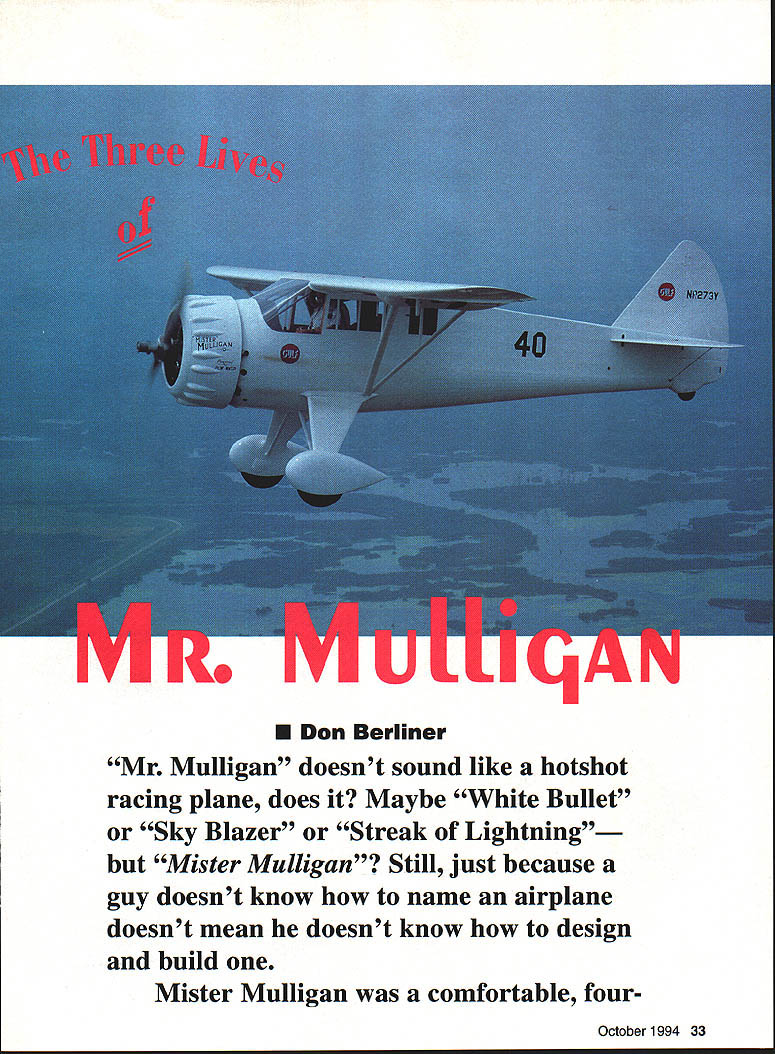
"Mr. Mulligan" doesn't sound like a hotshot racing plane, does it? Maybe "White Bullet" or "Sky Blazer" or "Streak of Lightning"—but "Mister Mulligan"? Still, just because a guy doesn't know how to name an airplane doesn't mean he doesn't know how to design and build one.
Mister Mulligan was a comfortable, four-passenger, high-wing cabin monoplane in an era dominated by sleek low-wing speedsters such as the Gee Bee, Firecracker, and Goon. The rather dignified yet muscular design from Ben O. Howard (which looked like an oversized Monocoupe) pulled off one of the great coups in American air racing history: it won both the prestigious Bendix Trophy and the Thompson Trophy in a span of only four days during the 1935 Cleveland National Air Races.
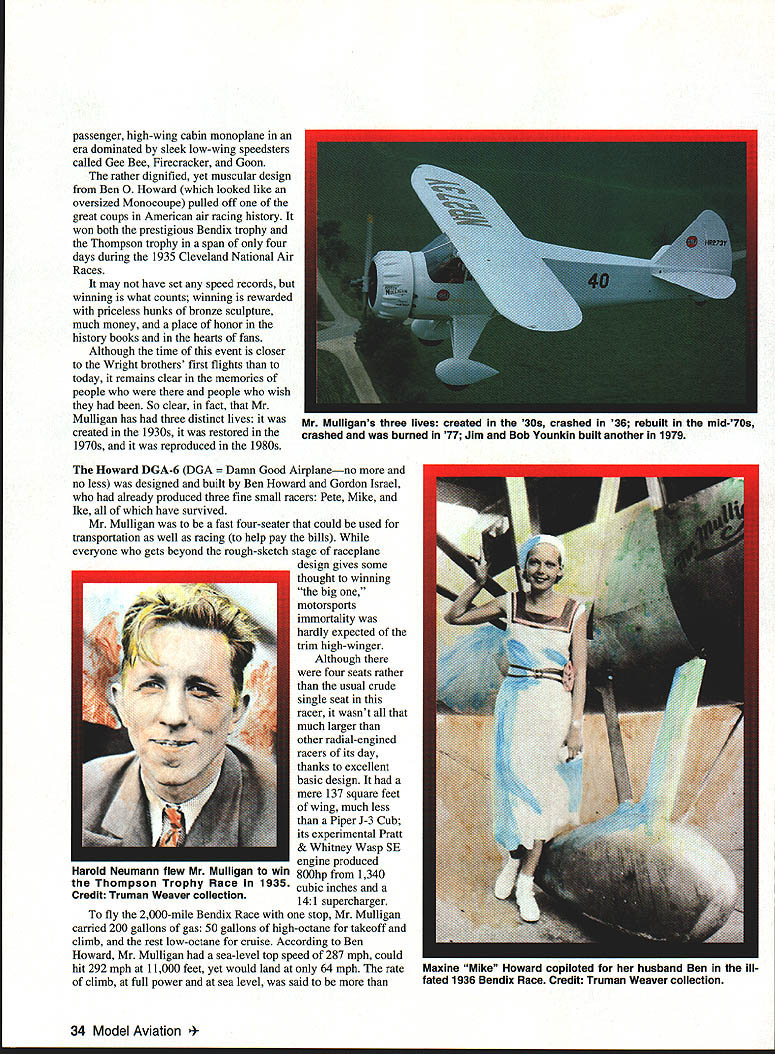
Although it may not have set any extreme speed records, winning is what counts; winning is rewarded with priceless bronze trophies, prize money, and a place of honor in history and in the hearts of fans. The airplane has had three distinct lives: it was created in the 1930s, was restored in the 1970s, and was reproduced in the 1980s.
Design and specifications
- Model: Howard DGA-6 (DGA = "Damn Good Airplane").
- Designers/builders: Ben Howard and Gordon Israel.
- Role: Fast four-seater usable for transportation and racing.
- Wing area: 137 sq ft (remarkably small for a four-seat cabin airplane).
- Engine (original): Experimental Pratt & Whitney Wasp SE — about 800 hp from 1,340 cu in with a 14:1 supercharger.
- Fuel for Bendix: 200 gallons (50 gallons high-octane for takeoff/climb, remainder low-octane for cruise).
- Performance (Ben Howard’s figures): sea-level top speed ~287 mph; ~292 mph at 11,000 ft; landing speed ~64 mph; rate of climb at full power >5,000 fpm.
Mr. Mulligan was unusually efficient for the mid-1930s: clean, minimum in size for its type, and powerful. Its high-wing layout made it look atypical among contemporary unlimited-displacement racers, most of which were low-wingers that "looked" faster. That visual prejudice contributed to a rocky start in racing.
Early racing and the 1934 setback
At the Bendix Race starting line near Los Angeles in August 1934, pilot Harold Neumann ran into oxygen and fuel system problems and made an unscheduled landing at an unfinished airport near Henderson, Nevada. The landing tore off the gear and badly damaged wing and propeller, leaving the airplane unrepairable in time for the race. So much for 1934.
1935: Bendix and Thompson victories
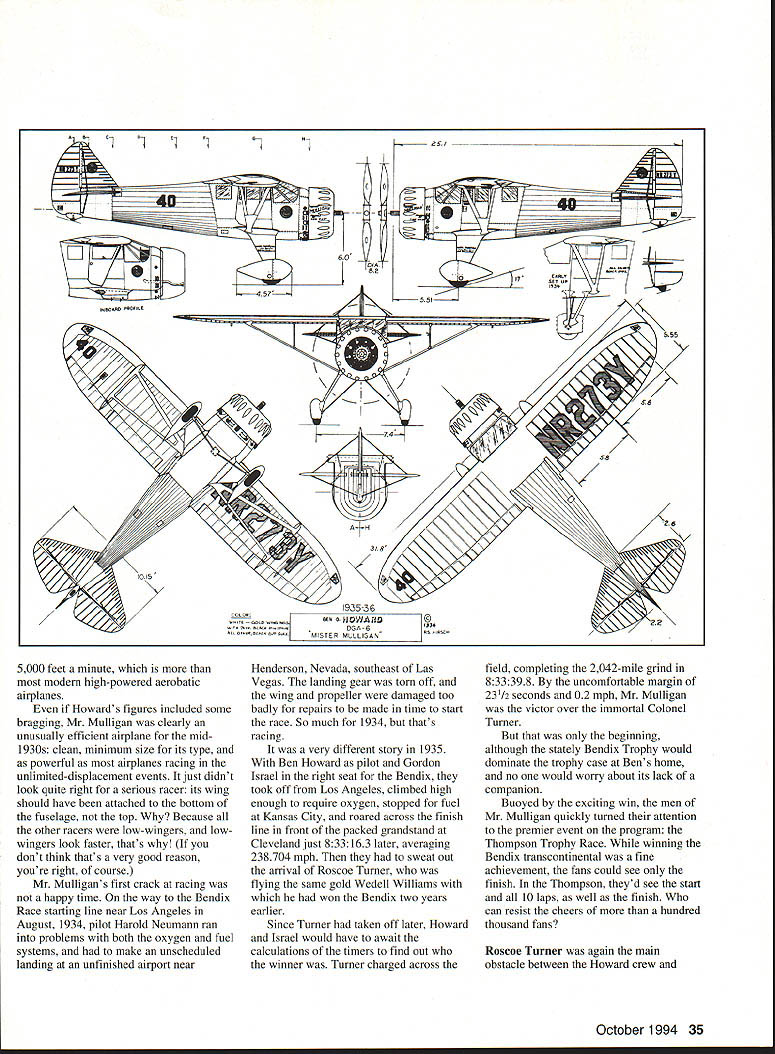
In 1935 the story changed. Ben Howard, with Gordon Israel in the right seat for the Bendix, took off from Los Angeles, climbed high enough to require oxygen, stopped for fuel in Kansas City, and roared across the finish line at Cleveland after 8:33:16.3, averaging 238.704 mph over the 2,042-mile course. They had to await the timers to see if Roscoe Turner, flying his gold Wedell-Williams (which had won the Bendix two years earlier), would beat them. Turner finished in 8:33:39.8 — 23½ seconds (about 0.2 mph) slower — making Mr. Mulligan the Bendix winner.
Buoyed by that transcontinental triumph, the Howard team turned immediately to the Thompson Trophy Race, the premier event seen by the crowds: a ten-lap pylon race where fans could watch the start, the laps, and the finish.
Roscoe Turner again stood as the chief rival. Turner had the faster Wedell-Williams and experience; Harold Neumann, though experienced, had flown mostly lower-powered planes. Neumann had flown Howard's "Mike" in the 1934 Thompson and finished fourth.
At the Thompson start, officials delayed the signal until Mr. Mulligan’s engine was hot. Neumann almost quit when the Pratt & Whitney faltered at the throttle push — carbon fouling and fouled spark plugs made him baby the engine for the first two laps. As the engine smoothed out, he increased power and began passing other racers: Roger Don in San Francisco, Joe Jacobsen in Mike, Marion McKean in Miss Los Angeles, then Steve Wittman in Bonzo, and finally attempted to close on Roscoe Turner.
Neumann recalled: "It finally started smoothing out. So I just set a higher power setting and just let her go, and I started catching up to the slower planes and passing them... I saw Roscoe way up there, and I figured there was no use trying to catch him. It was getting close to the finish, and I was in second place, so I was very happy. I came around the home pylon and I saw Roscoe landing, but I didn't see him pull out and smoke, or know what he had — engine trouble. I didn't get my signal for the end of the race, so I kept going, made another lap and I got the right signal at the finish of the race. I came in and landed, and that's where I found out I had won the race! It was a poor start and an unknown finish... but that's the way the racing business is."
With fine piloting and some luck, the big white high-winger captured the two biggest prizes in American air racing within four days. The favored Roscoe Turner failed to finish both races — a reminder that in racing, being on the ground costs you the win.
1936 crash
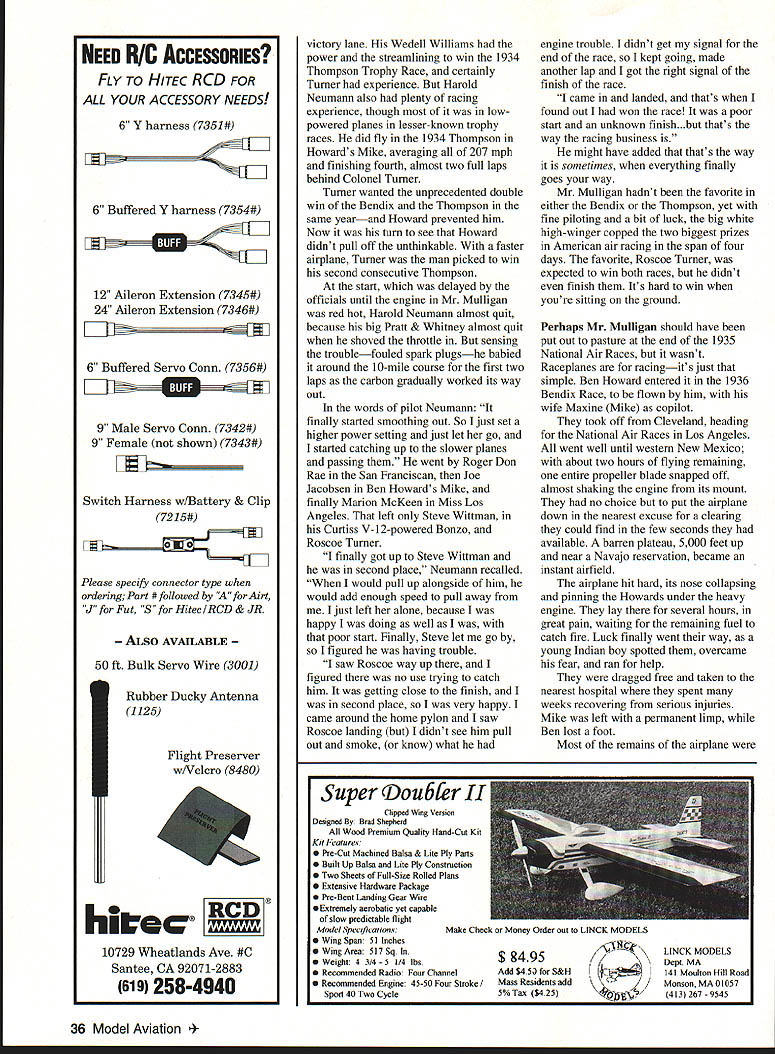
One might have expected Mr. Mulligan to be retired after 1935, but raceplanes are for racing. Ben Howard entered the airplane in the 1936 Bendix, planning to fly it with his wife Maxine ("Mike") as copilot. They took off from Cleveland en route to Los Angeles. All went well until western New Mexico, with about two hours remaining: one propeller blade snapped off, producing severe vibration that nearly ripped the engine from its mount. Forced to land on a barren 5,000-foot plateau near a Navajo reservation, the airplane hit hard, the nose collapsed, and the Howards were pinned beneath the heavy engine.
They lay in pain for hours, waiting for the remaining fuel to catch fire, until a young Navajo boy found and got help. Both were rescued and taken to hospital; they spent many weeks recovering. Maxine was left with a permanent limp; Ben Howard lost a foot.
Most of the remains were recovered and used as patterns for the first of a line of commercial four-seaters, the DGA-8. Remaining pieces were eventually broken up for souvenirs. Mr. Mulligan’s first life had ended.
Second life: Reichardt restoration (mid-1970s)
For decades the shattered bits lay abandoned until the mid-1970s, when Robert Reichardt found what little was left, aided by an old Navajo who remembered the crash. Reichardt salvaged what he could and built an airplane around the pieces. Technically a restoration, it was in many ways a new machine — but the FAA and the public recognized it as the original.
Reichardt intended not only to recreate the airplane but to fly it and to set official speed records. On October 25, 1977, at Tonopah, Nevada, he made four ground-skimming passes on the 3 km course and established a world speed record for FAI Class C.1.c (empty weight 1,000–1,750 kg) of 284.376 mph — almost a third of a century after the original had first flown.
That same day Reichardt attempted the Class C.1.d (1,750–3,000 kg) record by adding his wife to push the weight into the higher category. During a second 3 km attempt he flew so low that the tires left tracks in the sand; the airplane struck a rise, cartwheeled, and was destroyed, killing both Reichardts. Reportedly, their son later burned the remaining wreckage to prevent anyone building another airplane from it. No known piece of the original is extant. Thus even its dramatic second life was brief.
Third life: Younkin reproduction (1979–1982)
Shortly after the Reichardt crash, Jim and Bob Younkin of Fayetteville, Arkansas, set out to build a full-scale reproduction. With no original plans available, they based their work on Paul Matt's accurate scale drawings, many photographs from race historian Truman "Pappy" Weaver, and advice from Eddie Fisher of Kansas City, who had been involved with the original.
- November 1979: The Younkins were ready to begin construction.
- Materials: parts scavenged from DGA-8 and DGA-15 fuselages in their hangar, copied parts, and many components built from scratch. Some elements were modified for practicality (electric wing-flap actuator replacing a hand crank; redesigned ailerons to reduce stick forces).
- Skin and fairings: big round cowling hand-hammered from aluminum with 18 streamlined bumps over the rocker boxes. Wheel pants were made from fiberglass for practicality. Covering used Dacron rather than original natural fabric; 1.5-ounce fiberglass cloth was applied to plywood surfaces for extra strength.
The reproduction uses a production Pratt & Whitney R-1340 with a 10:1 blower (similar to an AT-6 trainer). With a Hamilton Standard constant-speed propeller, it produces about 600 hp. Cruising at 11,000 ft at 1,800 rpm and 25 inches manifold pressure, it achieves a true airspeed around 235 mph. The reproduction was built as a tribute and showpiece — a racer that is not meant to race — hence the reduced power relative to the original experimental engine.
After about two and a half years of steady work, the third life of Mr. Mulligan began. The Younkin reproduction flew from Arkansas to Wisconsin in late July 1982 for the 30th annual EAA Fly-In at Oshkosh. Its brilliant white finish attracted tens of thousands of admiring onlookers. It won the Grand Champion Replica Award easily.
Cooling problems limited its flying at Oshkosh to a few laps around the fly-by pattern, flown in formation with "Harold's Little Mulligan," a radial-engined Monocoupe painted by Harold Neumann to resemble the big brother. Harold later flew the big machine and pronounced it an authentic reproduction of the airplane he had flown to victory in 1935.
Neumann said: "I think I could take 'Mulligan' or any airplane resembling it and fly it. Anybody who's flown a Howard DGA-15 would be qualified to fly 'Mulligan,' if he doesn't get carried away with the idea that it's a hotrod and gets all worked up about it. The airplane was just wonderful, and all you'd have to do is be a pilot, to fly it. It's just a big Monocoupe, that's all."
A big Monocoupe with the power, streamlining, strength, and breeding to carry its pilots to victory in some of America's most important air races — and with enough mystique to motivate people to restore it, then reproduce it, extending its life over more than half a century.
Transcribed from original scans by AI. Minor OCR errors may remain.

