
Multi-Bladed Props
— George F. Abbott
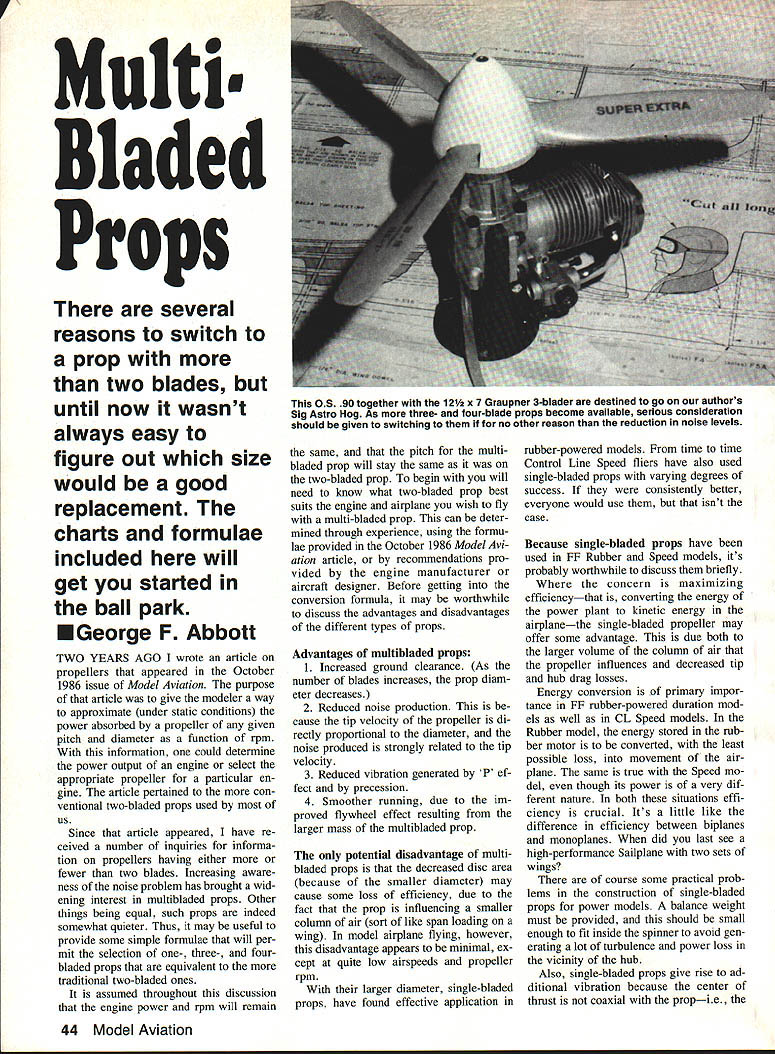
There are several reasons to switch to a prop with more than two blades, but until now it wasn't always easy to figure out which size would be a good replacement. The charts and formulae included here will get you started in the ballpark.
Two years ago I wrote an article on propellers that appeared in the October 1986 issue of Model Aviation. The purpose of that article was to give the modeler a way to approximate (under static conditions) the power absorbed by a propeller of any given pitch and diameter as a function of rpm. With this information, one could determine the power output of an engine or select the appropriate propeller for a particular engine. That article pertained to the more conventional two-bladed props used by most of us.
Since that article appeared, I have received a number of inquiries for information on propellers having either more or fewer than two blades. Increasing awareness of the noise problem has brought a widening interest in multibladed props. Other things being equal, such props are indeed somewhat quieter. Thus, it may be useful to provide some simple formulae that will permit the selection of one-, three-, and four-bladed props that are equivalent to the more traditional two-bladed ones.
It is assumed throughout this discussion that the engine power and rpm will remain the same, and that the pitch for the multi-bladed prop will stay the same as it was on the two-bladed prop. To begin with you will need to know what two-bladed prop best suits the engine and airplane you wish to fly with a multi-bladed prop. This can be determined through experience, using the formulae provided in the October 1986 Model Aviation article, or by recommendations provided by the engine manufacturer or aircraft designer. Before getting into the conversion formula, it may be worthwhile to discuss the advantages and disadvantages of the different types of props.
Advantages of multibladed props
- Increased ground clearance. As the number of blades increases, the prop diameter usually decreases.
- Reduced noise production. Tip velocity is directly proportional to diameter, and noise is strongly related to tip velocity.
- Reduced vibration generated by P-effect and by precession.
- Smoother running, due to the improved flywheel effect resulting from the larger mass of the multibladed prop.
The only potential disadvantage of multibladed props is that the decreased disc area (because of the smaller diameter) may cause some loss of efficiency, due to the fact that the prop is influencing a smaller column of air (similar to span loading on a wing). In model airplane flying, however, this disadvantage appears to be minimal except at quite low airspeeds and propeller rpm.
Single-bladed props
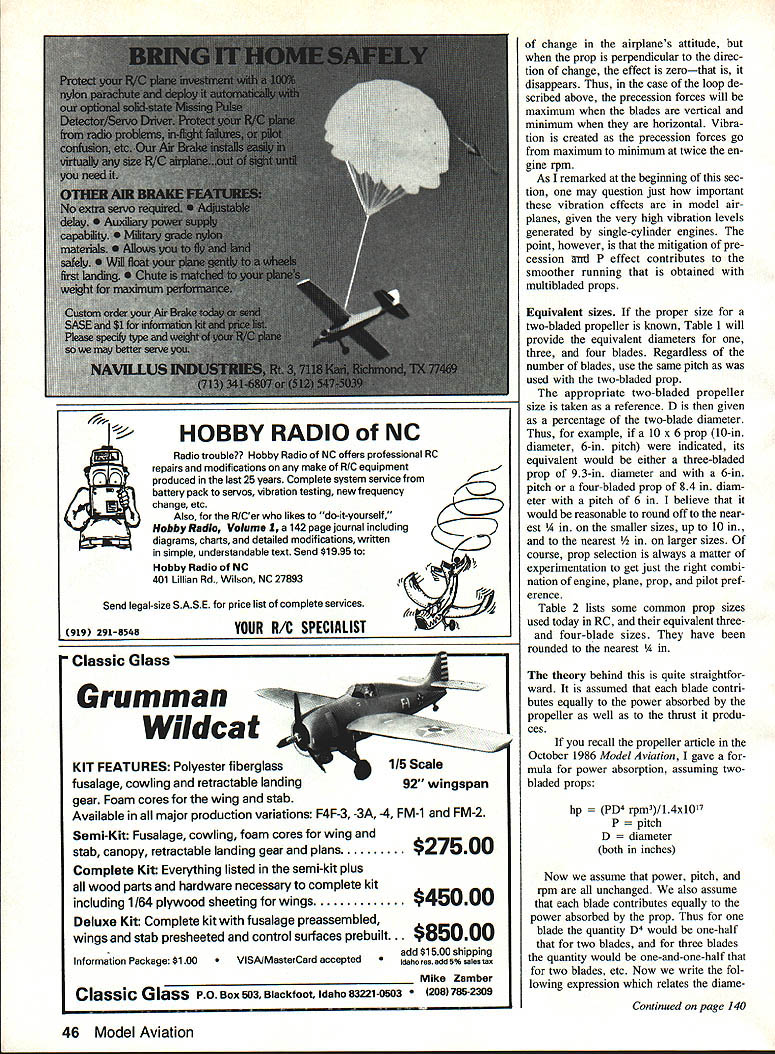
With their larger diameter, single-bladed props have found effective application in free-flight (FF) rubber-powered models. From time to time control-line speed fliers have also used single-bladed props with varying degrees of success. If they were consistently better, everyone would use them, but that isn't the case.
Where the concern is maximizing efficiency—that is, converting the energy of the power plant to kinetic energy in the airplane—the single-bladed propeller may offer some advantage. This is due both to the larger volume of the column of air that the propeller influences and to decreased tip and hub drag losses.
Energy conversion is of primary importance in FF rubber-powered duration models as well as in control-line speed models. In the rubber model, the energy stored in the rubber motor is to be converted, with the least possible loss, into movement of the airplane. The same is true with the speed model, even though its power is of a very different nature. In both these situations efficiency is crucial. It's a little like the difference in efficiency between biplanes and monoplanes—when did you last see a high-performance biplane with two sets of wings?
There are, of course, some practical problems in the construction of single-bladed props for power models. A balance weight must be provided, and this would have to be small enough to fit inside the spinner to avoid generating a lot of turbulence and power loss near the hub.
Also, single-bladed props give rise to additional vibration because the center of thrust is not coaxial with the prop—i.e., the center of the prop itself and the center of thrust do not share a common axis. The thrust vector is one-half to two-thirds of the prop radius away from the center, and it is rotating at the prop speed.
In general, single-bladed props are neither practical nor desirable except in very specialized applications.
P effect and precession
While vibration due to P effect (explained below) and precession is probably of secondary importance when compared to that produced by single-cylinder engines, it's still worthwhile to discuss these two phenomena for the sake of completeness. P effect is an important factor in the behavior of power airplanes no matter how many blades are on the propeller, and it is widely misunderstood.
P effect occurs when the airplane is flying along a path that is not parallel to the axis of the propeller, causing differences in the angle of attack on the right prop blade versus the left prop blade.
Assume that the airplane is climbing steeply at a high angle of attack. Also assume that a "right-handed" propeller is being used—one where the blades are descending on the right side of the airplane and ascending on the left. Under these conditions, the descending blade will see a higher angle of attack than the ascending blade. Thus there will be more thrust produced by the right side of the propeller disc than by the left. Because of this, the airplane will tend to turn to the left. This is exactly what happens when airplanes take off and climb out. It is also why tail-draggers have a tendency to swing to the left during the takeoff roll. (This is frequently referred to erroneously as torque effect.)
This phenomenon explains why twin-engine airplanes, both full-size and model, are so hard to handle if the critical engine (the left one) fails. It's also why counter-rotating engines are often used in full-size twins. In counter-rotating installations, the right-hand engine has a left-hand rotation, bringing the descending blades closer to the centerline of the airplane.
The variability of the P effect produces vibration in two-bladed and single-bladed props. When the prop blades are in a horizontal position, the P effect is at a maximum; when they are vertical it vanishes. The resultant vibration has a frequency of twice the engine rpm for a two-bladed prop. However, with a single-bladed prop the vibration is much greater and occurs at the frequency of the engine speed.
With a multibladed prop the P effect is still present, but the vibration is not. In the case of a four-bladed prop, the two blades on each side are descending and ascending blades on both sides at all times, which cancels the vibration. For three-bladed props: at any instant one blade is horizontal and the other two on the opposite side are each at an angle of 60° to the horizontal. Each of those two contributes less P effect than a horizontal blade, and their combined effect equals that of one blade in the horizontal position, effectively canceling vibration.
Precession, or the familiar gyroscopic effect that occurs when an effort is made to move the axis of a rotating object, is another source of propeller vibration. The gyroscope responds by moving 90° from the applied force in the direction of rotation.
The rotating propeller is a gyroscope with mass concentrated in the blades. When the airplane maneuvers, the direction of the propeller axis changes, and as a result of precession a force is generated 90° to the direction caused by the maneuver. For example, if the airplane is executing a loop, the force of precession will tend to yaw it to the right. In conventional airplanes today the effect is not very noticeable, but in the rotary engines which were widely used in World War I it was significant, due to the great rotating mass of such engines (the Sopwith Camel had a particularly nasty reputation in this regard).
Because the mass of the propeller is in the blades, the precession effect is at maximum when the blades are parallel to the direction of change in the airplane's attitude. When the prop is perpendicular to the direction of change, the effect is zero. Thus, in the loop example, precession forces will be maximum when the blades are vertical and minimum when they are horizontal. Vibration is created as the precession forces go from maximum to minimum at twice the engine rpm.
One may question how important these vibration effects are in model airplanes, given the very high vibration levels generated by single-cylinder engines. The point, however, is that mitigation of precession and P effect contributes to the smoother running obtained with multibladed props.
Equivalent sizes
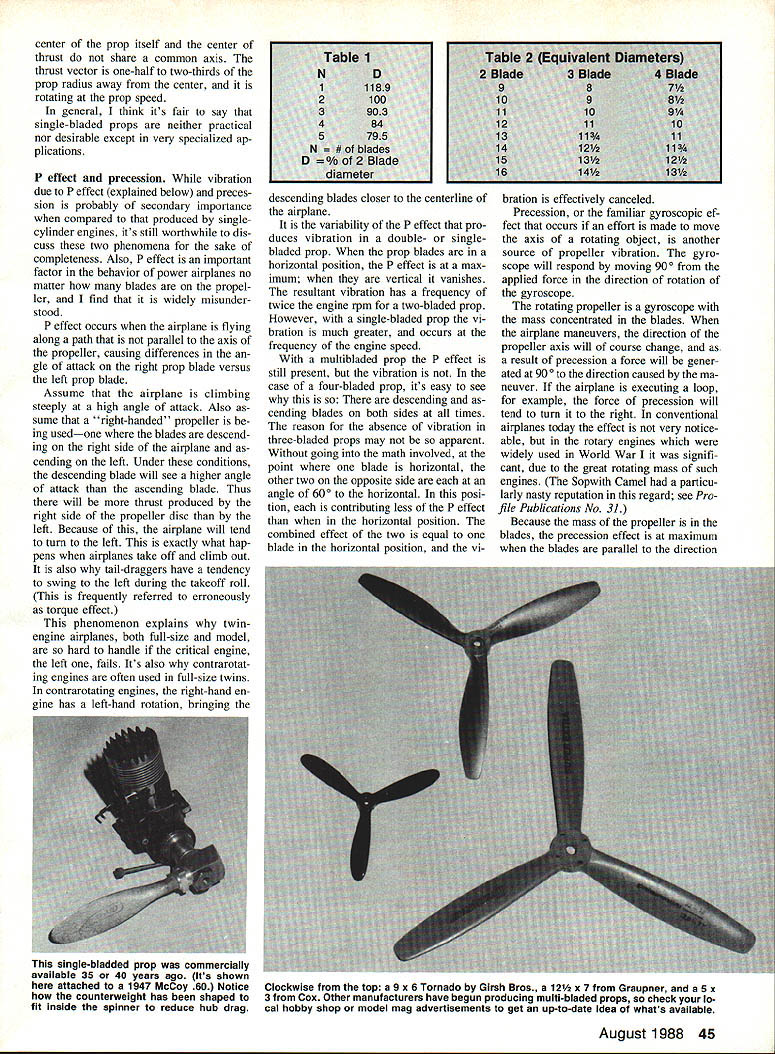
If the proper size for a two-bladed propeller is known, the following relation will provide the equivalent diameters for props with different numbers of blades. Regardless of the number of blades, use the same pitch as was used with the two-bladed prop.
Assume the appropriate two-bladed propeller size is taken as a reference (D2). Then the diameter Dn for an n-bladed prop is given by:
Dn / D2 = (2 / n)^(1/4)
where
- n = number of blades
- D2 = diameter of the two-bladed prop
- Dn = diameter of the prop with n blades
For example, if a 10 x 6 prop (10 in. diameter, 6 in. pitch) is indicated, its equivalent would be either a three-bladed prop of about 9.3 in. diameter with a 6 in. pitch or a four-bladed prop of about 8.4 in. diameter with a 6 in. pitch. It is reasonable to round off to the nearest 1/4 in. on smaller sizes (up to 10 in.) and to the nearest 1/2 in. on larger sizes. Of course, prop selection is always a matter of experimentation to get the right combination of engine, plane, prop, and pilot preference.
Table 2 in the original article lists some common prop sizes used in RC and their equivalent three- and four-blade sizes, rounded to the nearest 1/4 in.
The theory behind this is straightforward: it is assumed that each blade contributes equally to the power absorbed by the propeller as well as to the thrust it produces.
If you recall the propeller article in the October 1986 Model Aviation, I gave a formula for power absorption, assuming two-bladed props:
hp = (P * D^4 * rpm^3) / (1.4 x 10^7)
where
- P = pitch (in inches)
- D = diameter (in inches)
Now we assume that power, pitch, and rpm are unchanged, and that each blade contributes equally to the power absorbed. Thus for one blade the quantity D^4 would be one-half that for two blades, and for three blades the quantity would be one-and-one-half that for two blades, etc. The expression above relating diameters for various numbers of blades to the diameter for two blades follows from this assumption and yields the Dn/D2 formula given earlier.
What's available
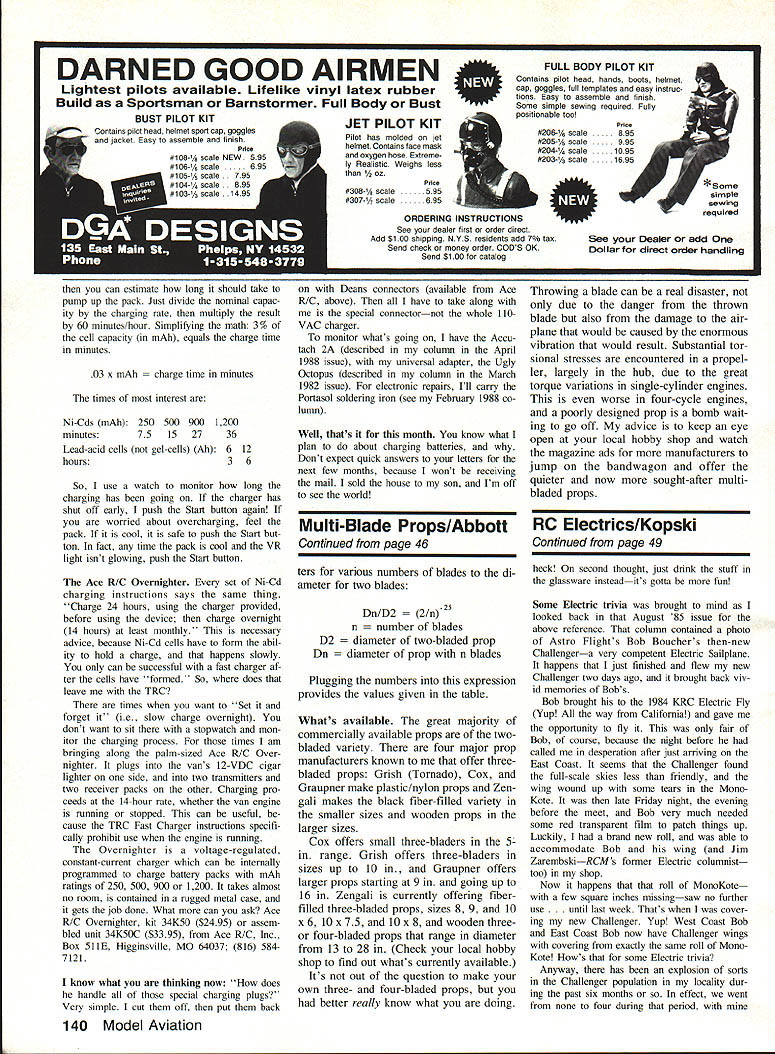
The great majority of commercially available props are two-bladed. Several manufacturers offer three-bladed props: for example, Graupner (Tornado) and Cox make plastic/nylon three-bladers, while Zengali makes black fiber-filled and wooden three- and four-bladed props.
- Cox offers small three-bladers in the 5-in. range.
- Graupner offers three-bladers in sizes up to about 10 in.
- Zengali currently offers fiber-filled three-blade props in sizes 8, 9, and 10 x 6, 10 x 7.5, and 10 x 8, and wooden three- and four-bladed props ranging in diameter from about 13 to 28 in.
It's not out of the question to make your own three- and four-bladed props, but you had better really know what you are doing. Throwing a blade can be a real disaster—not only due to the danger from the thrown blade but also from the damage to the airplane that would be caused by the enormous vibration that would result. Substantial torsional stresses are encountered in a propeller, largely in the hub, due to the great torque variations in single-cylinder engines. This is even worse in four-cycle engines, and a poorly designed prop is a bomb waiting to go off.
My advice is to watch what your hobby shop and the advertisements offer as more manufacturers enter the market and offer the quieter and now more sought-after multibladed props.
Transcribed from original scans by AI. Minor OCR errors may remain.

