
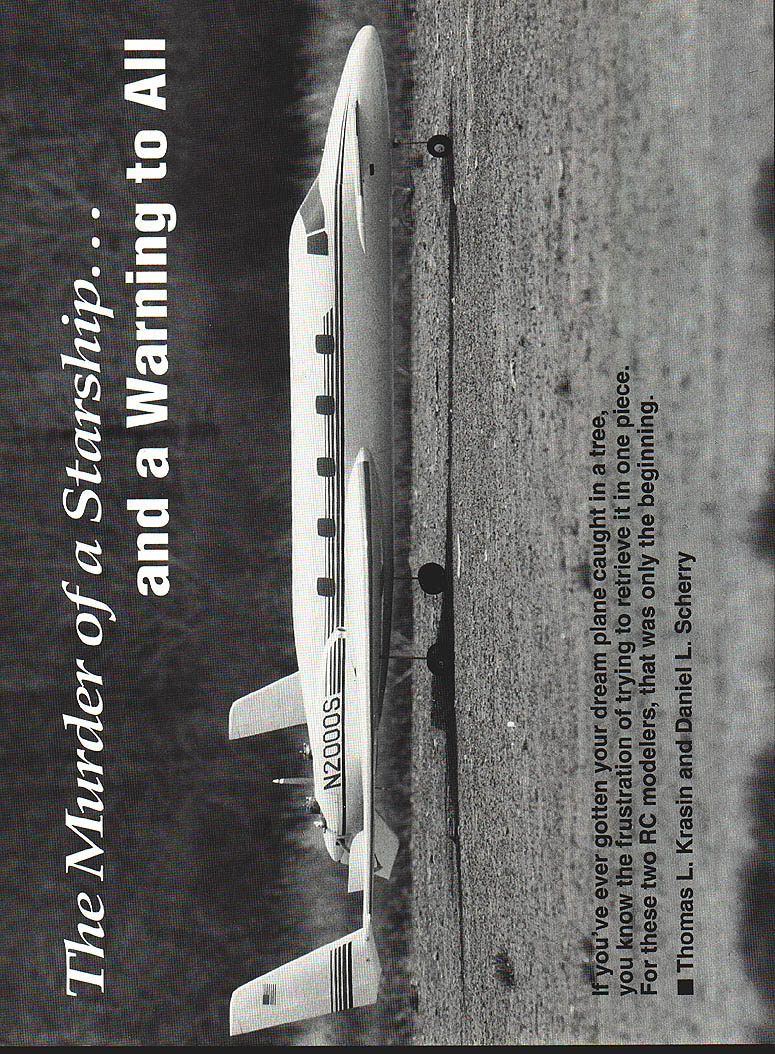
The Murder of a Starship...and a Warning to All
I'm sitting in my office/den, looking at the tip-sail from the wing of a Beechcraft Starship RC model—scratch-built.
Dan has the other tip-sail. They are the only pieces of our airplane still intact.
Our Starship was murdered!
When people are murdered, the criminals go to jail. Whoever killed our model may one day go to jail, too!
How it began
Like many a modeling story, this one begins at the flying field. Several months ago, a bunch of us were gabbing about—what else?—RC airplanes.
I had produced a marketing video for a company that makes titanium alloy products for corporations like Beechcraft. The footage from Beechcraft included its Starship. The airplane fascinated me immediately—it was gorgeous.
While talking with coauthor Dan, an exceptional scratch-builder, I remarked, "You know, Dan, we ought to build a Beechcraft Starship." He laughed.
About a week later, Dan showed up at the field with a book that documented Beechcraft designs. Sure enough, there was the Starship. I knew I had Dan hooked.
This was in August 1991. A few weeks later, our conversation about the Starship grew more serious—especially after I volunteered to fund the project and call Beechcraft for some three-views.
The leaves had turned color, there was a bite in the air, and the rich blue skies of summer had given way to mostly cloudy days. Just about that time, a bulky envelope arrived in the mail.
Beechcraft had sent—well, a lot: several 8 x 10 glossies, a detailed three-view, and two detailed drawings for a 1/32-scale model. We were impressed. By the time the first snowflakes began to fly, things were really getting serious.
During the next few weeks Dan and I pored over the material from Beechcraft. We had a problem. We wanted to build the model to 1/8-scale, but redrawing everything would probably take too much time. So, armed with the vellums, I happily thought to check my local blueprint shop about enlarging the drawings—like a Xerox machine. (Sometimes I'm so smart.)
"How much?" I asked, gulping a bit as my wallet tried to crawl out of my pocket and run. Shaking his head in confirmation of the amount, the fellow at the blueprint shop said, "Yeah, that's right, about $650; a lotta work, and we'll have to cut these up and do it section by section."
A little voice in my head said, "No way, Jose!" I mumbled something about getting back to him, and returned home feeling more than a little downcast. Our first real snag. Maybe this wasn't going to happen after all. Maybe it shouldn't have.
About a week later, I was showing the drawings to another flying pal and relating the problem of enlarging them. "You know," he remarked, "these look like they were done on a CAD (Computer Assisted Design) system."
"So?" I prompted.
"Well," he explained, "I think if you call Beechcraft back and talk real nice, they might come through with a 1/8-scale set."
"Is that right?" says I. And what do you know, with the name of an engineer and some doing, I did get a set of 1/8-scale drawings from Beechcraft—all 33 feet of them. Merry Christmas to all! "Hey, Dan, you won't believe what just came in the mail. I'll be right over."
Winter work and problems
January—and our club's first unofficial New Year's Day fun-fly. Hot dogs and a fire in a barrel, slop and glop all around. Guys taking off and landing, with varying degrees of success, on the mushy, cinder-topped parking lot. Guys doing touch-and-goes off picnic tables. Winter hadn't really begun, but flying fever had rotted a few brains already.
As for the Starship project, it was more than serious—it was real! Dan had templates in the works, and he had put together a materials list.
Now came an almost daily series of questions and debates about the very real problems encountered in scratch-building an RC model aircraft—and a model that, as far as Beechcraft knew, no one had ever built before.
Step by step the bird began to take shape: wing spars, carbon-fiber laminates, ribs, Warren trussing. Measuring, building the jigs, gluing, drilling, lightening holes and more holes. Lighter—it's got to stay light. But it's also got to be strong—a seven-foot wing with no twisting.
The model went together part by part. The main wing was completed except for the sheeting. Then came the servos, pushrods, and tip-sails. Wow! Is this starting to look impressive.
Next came the forward wing and elevators. The swept-wing configuration made it a bit of a challenge to install the control rods, but we worked it out.
Oops! Hold everything! Dan had a full-size silhouette of the fuselage hanging from the 2 x 12s in his basement. Attached to the silhouette were little plastic cups filled with lead weights.
Dan wasn't happy. After he showed me our problem, neither was I.
The center-of-gravity was way out of whack. This aircraft has a propulsion system with twin pusher turboprops, which means that a ton of weight is sitting on—no, hanging off—the trailing edge of the wing, about seven-eighths of the way down the fuselage. Dan had hoped to keep the weight of the aircraft at about 12 pounds, with 14 pounds as the outside limit. That would keep the wing loading between 27 and 34 ounces per square foot.
The engines and their power output had been a source of concern and debate since we began. I never really thought we'd need a problem—worst case, we'd go to a couple of SuperTigre .61 ABCs at 1.85 hp each. No sweat!
Wrong, nitro-breath! There was no way we could hang three pounds-plus off the back of the wing and get close to the center-of-gravity we needed. The engines had to weigh in at no more than one pound each with the muffler. Even so, we still had to stick 12 ounces of lead weight up in the nose. I had a problem with that; so did Dan.
I started calling kit manufacturers to ask about their formulas for matching planes with engines. Hang on to your hat, folks—there ain't none. Nope, they do it by hook and by crook. They think it might work, and they test it out. This really threw me for a loop (pardon the pun).
Finding the right engines took some digging. Some manufacturers publish brake horsepower, but don't tell you how that translates to thrust. Others publish no evaluative data at all. It can be confusing, to say the least.
All the while we talked to people, and everybody had an opinion, with or without varying degrees of corroboration and fact. Still, no one convinced us that there was a pair of engines that met our specs—i.e., maximum available horsepower at minimum weight.
In the end, we solved the CG problem by making the fuselage eight inches longer. The engines? With some help from a couple of people who publish RC aircraft magazines, we arrived at a consensus—Webra Speed .50s.
Our to-do list grew shorter as the days grew longer. The white of winter moved from the trees and grass to the sheeted skin of the Starship—accented by navy blue and maroon striping, NASA-gray windows, and the stars and stripes riding proudly on each tip-sail. An absolute work of art—or should I say, "of Dan"?
On May 4th, our baby was born—13 pounds even. How could we have guessed what lay ahead?
Thursday, May 7 — engine and taxi tests
11:00 a.m.—Engine and taxi tests: I met Dan and Ray, the club's chief flight instructor, at Dan's house to see if we could fit the wing into my car and get the fuse into Dan's. Ray has a van, just in case. The wing (including the engine nacelles) is one seven-foot hunk, although the tip-sails are removable. It takes several tries, but we get it in. Ray has a good time at our expense.
The fuselage goes in with much less trouble, and we're off to the field.
It's a beautiful day, perfect for engine break-in and taxi tests—a gentle north breeze at about 5 to 10 mph, sunshine aplenty, and the temperature around 60 degrees. Interested club members are there with cameras and videotape camcorders.
It's a pretty normal shakedown; the engines take the usual amount of coaxing and diddling. Pretty soon, both engines are roaring at 11,600 rpm with 11 x 6 props. Boy, she really has a voice! The Webra Speed .50s are more than up to the job; we have power to spare and then some. A session comes to an end after we blow a cap and stinger off one of the modified Webra mufflers. All in all, quite a satisfactory day.
Wednesday, May 13 — another try
11:30 a.m.—Dan's house: Same crazy fire drill with the wing, but we're learning. We meet Ray and others at the field. One engine still needs some tweaking. Who knows? This might be the day. Dan and I are charged with nervous excitement.
The weather is excellent, with the temperature about 75 degrees.
We pinch both fuel lines while fastening the wing. This leads to some comic moments. The fuel pump blows the line off the pump output nozzle, and Dan and I both get sprayed.
We correct the problem, begin a final dial-in of the engines, then turn the radio over to Ray for a couple of high-speed taxi runs before takeoff.
Oh my gosh! The Starship leaps about six feet off the ground with a straight-up attitude. Ray is quick enough to kill the throttles, but the plane banks down tail-skid-first, then flops over onto the gear with the engines still idling. The damage is relatively minor, but enough to halt flying for the day.
"I just barely touched the elevators," Ray reported in his debriefing, "and she jumped off the ground—surprised me!" To say the least. But we gained some important information.
Both Dan and I have busy schedules for the next few days, so things go on hold.
Memorial Day weekend and May 28 — the successful flight
Monday evening, Memorial Day, May 25: The phone rings. It's Dan. I haven't seen him for a few days—the holiday weekend has been miserable for flying.
"Well, she's all set—ready to go," Dan says. I sense some frustration in his voice. With the crummy weather we've been having, we're both in a "Let's do it!" frame of mind. The forecast for Thursday is perfect, so we agree to make a go/no-go decision that morning by phone. We decide on 11:00 a.m.
Thursday, May 28, 11:30 a.m.—Dan's house: We slip the wing in my car with practiced ease and drive to the field. This is the day!
Dan and I are charged up. So is everybody else: cameras and camcorders are ready.
The Starship is ready too. We've changed the elevator setup and added some weight to the nose so that the forward wing won't cause an overrotation on takeoff.
One engine still isn't quite the way we'd like, so we diddle. Bang! Another muffler cap blows off. We gotta fix it. With the three-tank fuel system, we need the pressure from the muffler to get the starboard engine turning faster than 10,000 rpm.
Off we go to Dan's house amid a lot of good-natured ribbing from our clubmates. It's one o'clock in the afternoon.
Armed with a bottle cap, a 4-40 bolt, and some high-temperature silicone compound, we set about doing a quick fix on the troublesome muffler. So much for the guys who sell aluminum welding rods at the swap shops! By 1:30 p.m., we're ready. Cameras roll as the model glides down the runway, gathering speed all the way. The engines scream in perfect sync. Up goes the nose—she's airborne! The attitude is too steep; Ray corrects. She yaws to the left; Ray corrects. The Starship ascends in a climbing right turn. She's flying; she's fast and beautiful!
The plane levels out downwind at about 150 feet; Ray does some trimming and remarks that it's a handful to turn. I was struck by the model's unconventional, even unique, appearance in the air. Ray gently rolls her into a shallow 180° turn and directs her upwind. All the while we're hearing that distinctive synchronous sound that only twin engines make.
Another turn, and she heads toward us—overhead and away again. Ray guides her through a huge, sweeping 270° arc around the field. The sky fills with the sleek white shape and noise as she crosses overhead again.
Ray takes her through a couple of small reversing turns and a 180°, setting up for a low pass down the runway. As she comes abreast, the starboard engine quits.
Our field is framed on two sides by 50- to 80-foot trees and on the other two by 30-foot-high power lines, so landing is always a challenge. With one engine out, it's closer to a struggle.
Ray nurses the Starship through another 180° turn into a long upwind leg just over the trees. She's holding altitude but won't gain—things look okay. No one says a word; the only sound comes from that lone engine working like crazy.
Ray eases her into the base leg to set up for a downwind landing. He turns on final with the model five feet too low—and the trees reach up and grab her. It happens so fast that none of us see it. We exchange looks of amazement, and start walking. Now it is too quiet.
The theft and destruction
In this situation you're in the hands of the tree gods—they're either angry or they aren't. I've put two planes into those oaks. One is still flying. The other? Well, the tail feathers are hanging from a joist in my workshop.
As we emerge from the thicket into the trees, there's good news and bad news. The good news: The plane appears to be virtually intact, caught in the smallest branches as it cradled gently in a net. The bad news: It's 80 feet off the ground in the very top of the tallest tree, so getting it down without damage is going to be tough.
We're standing there discussing the best course of action, when a bystander volunteers the help of a friend who's a monkey at climbing trees. At the same time, some telephone workers show up. They seem to know what happened, and they're debating whether the truck's bucket will reach it. It won't.
The helpful bystander returns with us to the pits and calls his friend on a car phone. The friend never shows. Darkness falls.
That night, I make arrangements with a professional tree trimmer to retrieve the plane the next day. The time is uncertain—late morning or, more likely, late afternoon. Timing is everything.
Friday, May 29—The day of the murder: I have a 10:00 a.m. meeting. It's over at 11:00. At 11:30 a.m. I drive past the field. The wind is picking up, but the bird is still there. Hard to see, but there.
I go back to my office—there are phone calls to return and paperwork to be done. I'm hoping to find a message from the tree service fellow about the time, but no such luck.
At 1:30, Dan drives by the field and checks on the plane.
I get busy at the office. About 2:00, I notice that the wind is blowing even harder and begin cleaning up to head for the field.
At 3:00 I leave the office and head for the field. The wind is gusting 20 to 25 mph. I'm concerned, and can't shake a funny feeling I've had all day.
Yesterday, you could see a white glint in the trees every now and then when the breezes blew. Today—nothing. I walk faster. As I enter the clearing through the thicket, my heart sinks. I see something white—and large—on the ground. Oh, no! Don't tell me Mother Nature has thrown the bird from the nest.
It's an 18-inch hunk of the fuse. This is not good! Other pieces are strewn about, but something is wrong here—very wrong! There aren't nearly enough pieces—and we're the wrong ones.
I see the tip-sails but no part of the wing. I see 18 inches of the fuse, but only the section extending from the forward wing and control hatch to the rear. I see the scoops from the engine nacelles and a lot of small balsa pieces. That's it—nothing else!
I double-check that the plane is not in the tree. Looking down again, I spot a pair of sunglasses, cigarettes, and a lighter.
At that point I let out a string of expletives that is definitely unprintable. Dan and I have been robbed—and they murdered the bird in the process. Ripped it apart, or tried to!
I just stand there, letting everything I see confirm my diagnosis.
There is no doubt—none! My heart is breaking.
Dan lives five minutes from the field.
I'm there in two. "Dan, you aren't going to believe this. Sit down."
We return to the tree. Dan comes to the same, inescapable conclusion. Like a true detective, he starts following the trail of pieces—a path of least resistance that continues for at least an eighth of a mile through the woods. Emerging from the woods behind a small manufacturing plant, we follow the crushed grass to a parking lot. The plant foreman remembers seeing a couple of strange cars around 2:00.
End of trail.
Saturday, May 30, 12:00 to 3:30 p.m.: It has rained all night; it's dreary, wet, and cold. The weather matches my mood.
We go from the police station to the scene of the crime. Trust me when I say crime—the amount of money involved in the theft warrants felony theft charges. I thought the police would take the information and say they'd get back to us if anything broke. No way—they treated this seriously, God bless 'em.
Will they ever find the vermin who murdered our plane? Probably not. It's not the loss of money and time that bothers me. We had a good time debating and solving the problems we faced almost daily. The result was magnificent, and it flew. Nobody can rob us of that.
What bothers me most is that outsiders did this thing. To my mind, no true RCer would ever consider trashing a unique bird like this one just for the parts. Stealing it, maybe. But murdering it? No!
So learn from our experience. Beware of outsiders: what you tell them and where you let them go at your field. Until they're made the commitment to join, build, and fly, keep them at arm's length and tell them nothing about what your planes, engines, and radios are worth.
Will we try again? No—at least, not now. Not for a long time, I think.
I saw Dan today at the field. I had stopped by on my way home from a client meeting. Dan had a couple of his planes; he likes to fly. He asked me what I'd brought.
"Nothing," I told him. "I haven't touched my RC stuff since the murder."
It was a nice day, too.
Postscript — late June 1992
Time has passed, and with it the shock and depression. The perpetrators have not been caught, but the word is out to all the clubs and hobby shops in the area. We've even got our swap-shop junkies on the lookout. Dan and I are both determined not to carry on with our project exactly as before. We have found something really interesting, and a couple of idiots aren't going to take it away from us. We're going to find out how the Starship behaves with an articulating forward wing, flaps, and retracts.
Today, we began construction of our Phoenix.
Transcribed from original scans by AI. Minor OCR errors may remain.

