
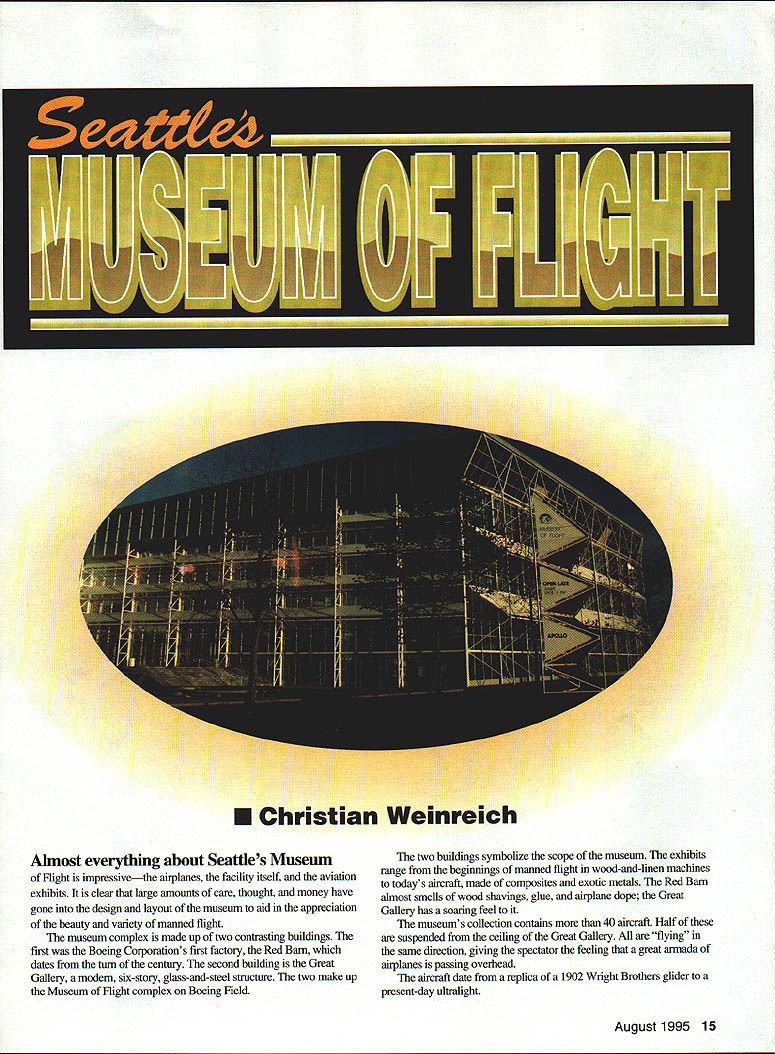
Museum of Flight
Christian Weinreich
Overview
Almost everything about Seattle's Museum of Flight is impressive — the airplanes, the facility itself, and the aviation exhibits. Large amounts of care, thought, and money have gone into the design and layout to aid appreciation of the beauty and variety of manned flight. The museum's collection contains more than 40 aircraft, many suspended from the ceiling of the Great Gallery to give the impression of a great armada passing overhead.
Buildings
The Red Barn
- The Red Barn was Boeing Corporation's first factory and dates from the turn of the century.
- It has the feel and smell of traditional woodworking: wood shavings, glue, and airplane dope.
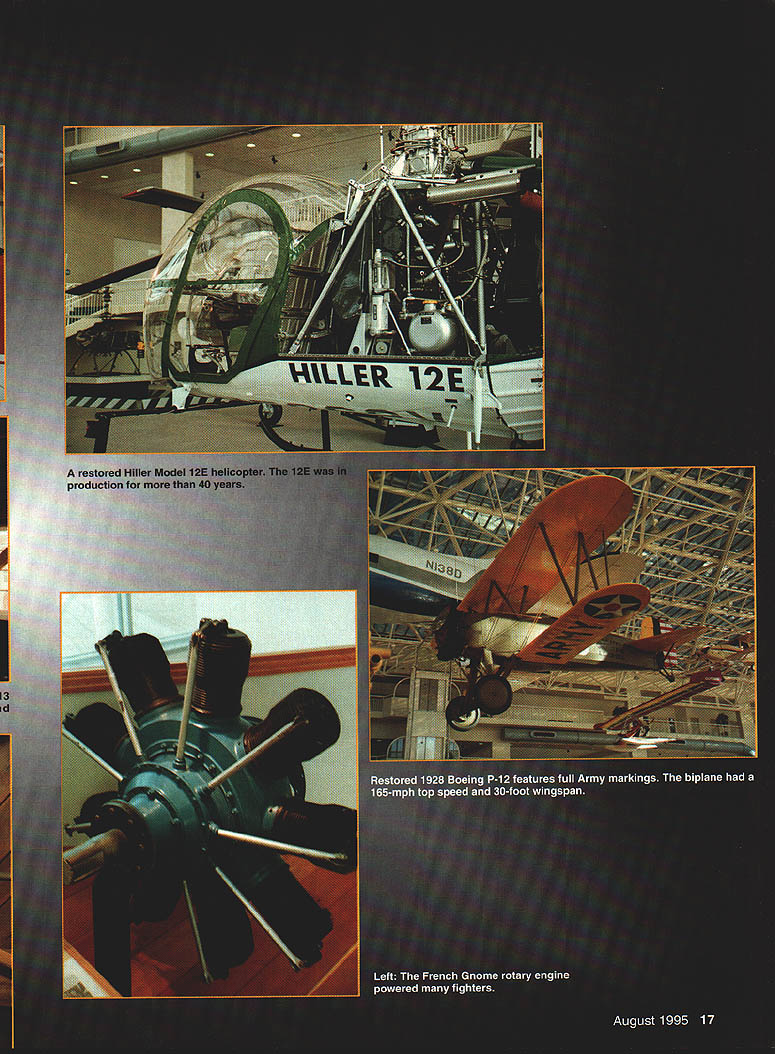
- The first floor houses some of the museum's most arresting restored aircraft.
The Great Gallery
- A modern, six-story glass-and-steel structure with a soaring feel.
- More than half the museum's aircraft are suspended from the ceiling of the Great Gallery, all oriented in the same direction.
- The roof is clear-span construction covering more than an acre with no center supports; it is designed to carry large aircraft (it flexed only six inches under the nine-ton DC-3).
Aircraft Collection
General
- The collection spans from a 1902 Wright Brothers glider replica to present-day ultralights.
- Emphasis tends toward civilian aircraft and aviation stories of the Pacific Northwest and the Pacific Rim.
Notable and Rare Aircraft
- Boeing 80A-1 (tri-motor airliner of the late 1920s) — meticulously restored after years as a cargo hauler in Alaska; rescued from an Anchorage garbage dump in 1965.
- Aerocar III — an early car-airplane hybrid (early 1950s); could fly about 100 mph and convert for highway use in about 10 minutes.
- Curtiss JN-4D "Jenny" — completely restored and displayed uncovered in the Red Barn; restoration required roughly 12,000 hours.
- British Handley-Page HP42E — 1930s four-engine biplane airliner.
- Boeing 40A — mail-and-passenger aircraft from the mid-1920s.
- Vickers FB5 Gunbus (1914).
- Curtiss Robin — beautifully restored orange-and-yellow example.
- M-21 Blackbird with its parasite drone — a display unique to the museum.
- Boeing P-12 / Navy F4B — biplane fighter of the late 1920s and early 1930s, hanging with the armada.
Aircraft Displayed Outside
- Boeing WB-47E — swept-wing, six-engine bomber, predecessor to the B-52.
- Boeing B-29 Superfortress.
- Douglas DC-3.
- AD-4 Skyraider — used extensively in Korea and Vietnam.
Space Exhibits
- Replica Mercury space capsule — representing the first U.S. space explorations.
- Apollo Command Module — originally built to go to space but used as a training mock-up; the Apollo program module was part of the first moon missions.
- Lunar rover mock-up.
- Resurs 500 capsule — representing the Russian space program.
- The museum plans to expand its space-travel holdings.
Engines and Technical Displays
- Packard 1A-1500 engine — powered the 1923 dirigible Shenandoah.
- 12-cylinder Liberty engine — from World War I.
- de Havilland Gipsy — air-cooled, four-cylinder engine.
- Other technical displays show fabric-sewn wing ribs, hand-carved wooden propellers, and welded-tube fuselage construction of early mail planes.
- An unusual exhibit notes Boeing's brief 1930s venture into washing machines.
Restoration Work and Facilities
- Volunteers completed a 14-year restoration of a Boeing 247 (an early all-metal transport preceding the DC-3).
- Restoration work is done at a site about 30 miles north of the museum; this site is planned as a second museum location for larger aircraft (e.g., Boeing 727, B-52).
- A Boeing B-17 owned by a trustee is under restoration and planned for suspension in the Great Gallery.
Education and Programs
Children and School Programs
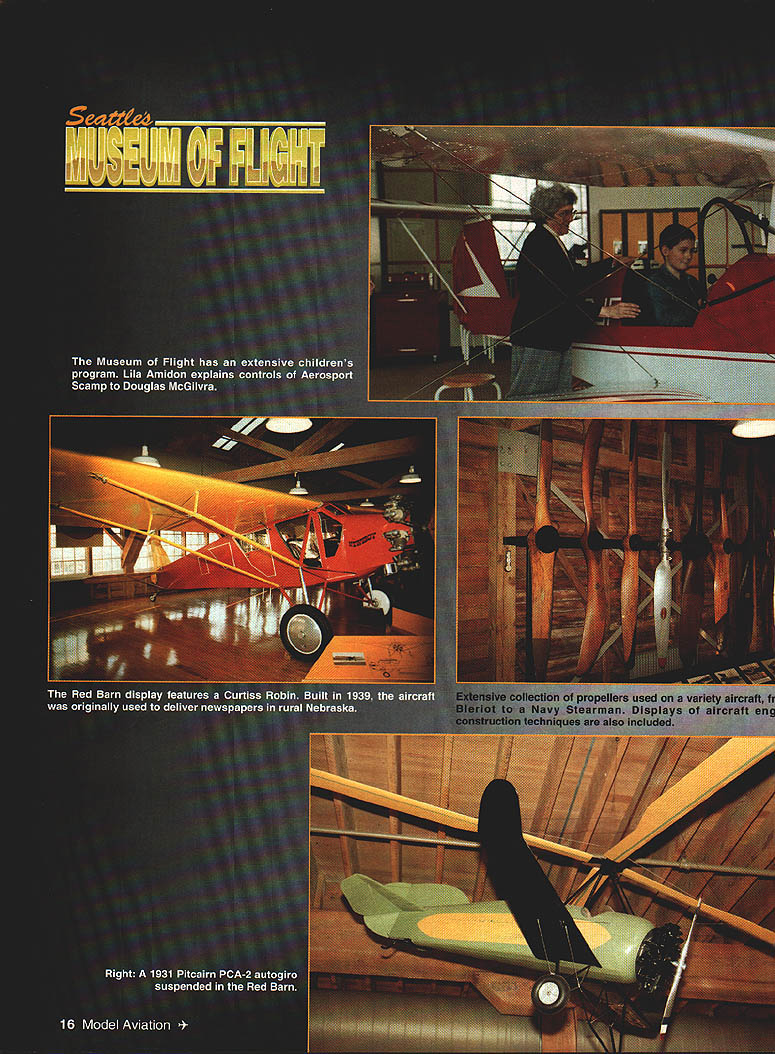
- A mezzanine off the Great Gallery (the Hangar) contains three small aircraft, including a helicopter, where children can sit at the controls and learn by doing.
- Staff demonstrate ailerons, rudders, gauges, and basic flight controls.
- Curriculum includes Junior Mechanics for ages 6–9 (activities include assembling and flying balsa gliders).
- The program was developed in response to parents wanting children to touch and sit in real aircraft.
Adult and General Education
- A 280-seat auditorium with full sound and projection equipment shows aviation movies and feature presentations.
- Research resources include about 45,000 photos and laser data discs from the National Air and Space Museum photo files (available by appointment).
History
- The Red Barn began life as Heath’s Oxbow Shipyard building around the turn of the century.
- In 1905 Heath contracted to build a yacht for William Boeing, then went bankrupt; Boeing bought the company and later converted it for aircraft production by adding a second floor and replacing the dirt floor.
- The mix of boat- and aircraft-building history contributes to unique displays of wooden boat-building equipment and techniques.
Aircraft Suspension and Structural Notes
- Hanging full-scale airplanes requires careful engineering; planes are not stressed to be hung, so attaching cables to landing gear and other structure sometimes "fools" the plane into thinking it’s resting on its gear.
- The same company that hung the airplanes here also worked for the National Air and Space Museum.
Relationship with Boeing
- The museum is independent (a private, non-profit corporation) but is considered a Boeing museum due to strong company involvement.
- Boeing officials helped raise funds and the company contributed roughly one-third of the $26 million construction cost.
Location, Hours, and Admission
- Address: Museum of Flight, Boeing Field, 9404 East Marginal Way South, Seattle (about 10 minutes south of downtown).
- Directions: From Interstate 5 (north or south), take exit 158 and follow signs.
- Hours: Daily 10 a.m. to 5 p.m. (Thursdays until 9 p.m.). Closed Thanksgiving and Christmas.
- Phone: (206) 764-5720.
- Admission: Adults $6; youths (6–15) $3; children under 6 free.
Transcribed from original scans by AI. Minor OCR errors may remain.

