
The Musical Tach
By Richard Porter
This is an inexpensive way to determine in-flight engine speed of control-line (CL) models (or of RC models flown in a circle). It can also be used in static tests.
Inspiration
The idea came from two sources:
- An article in a model magazine about a Speed flier who taped the sound of one of his racing engines as it was destroying itself at top rpm. Later he matched the engine sound to piano notes to identify its pitch. I thought that what worked for a Speed flier would also work for a Stunt flier.
- A graduate course (Trends in Science) taught by Dr. E. Steiner at the University of South Florida. An open-ended assignment led me to the library, where I found a nomogram and text defining musical notes in cycles per second. By multiplying cycles per second by 60, cycles per minute (rpm equivalent) could be obtained. That allowed direct comparison of musical notes to the sound (rpm) of a reasonably smooth-running two-cycle model engine.
Method
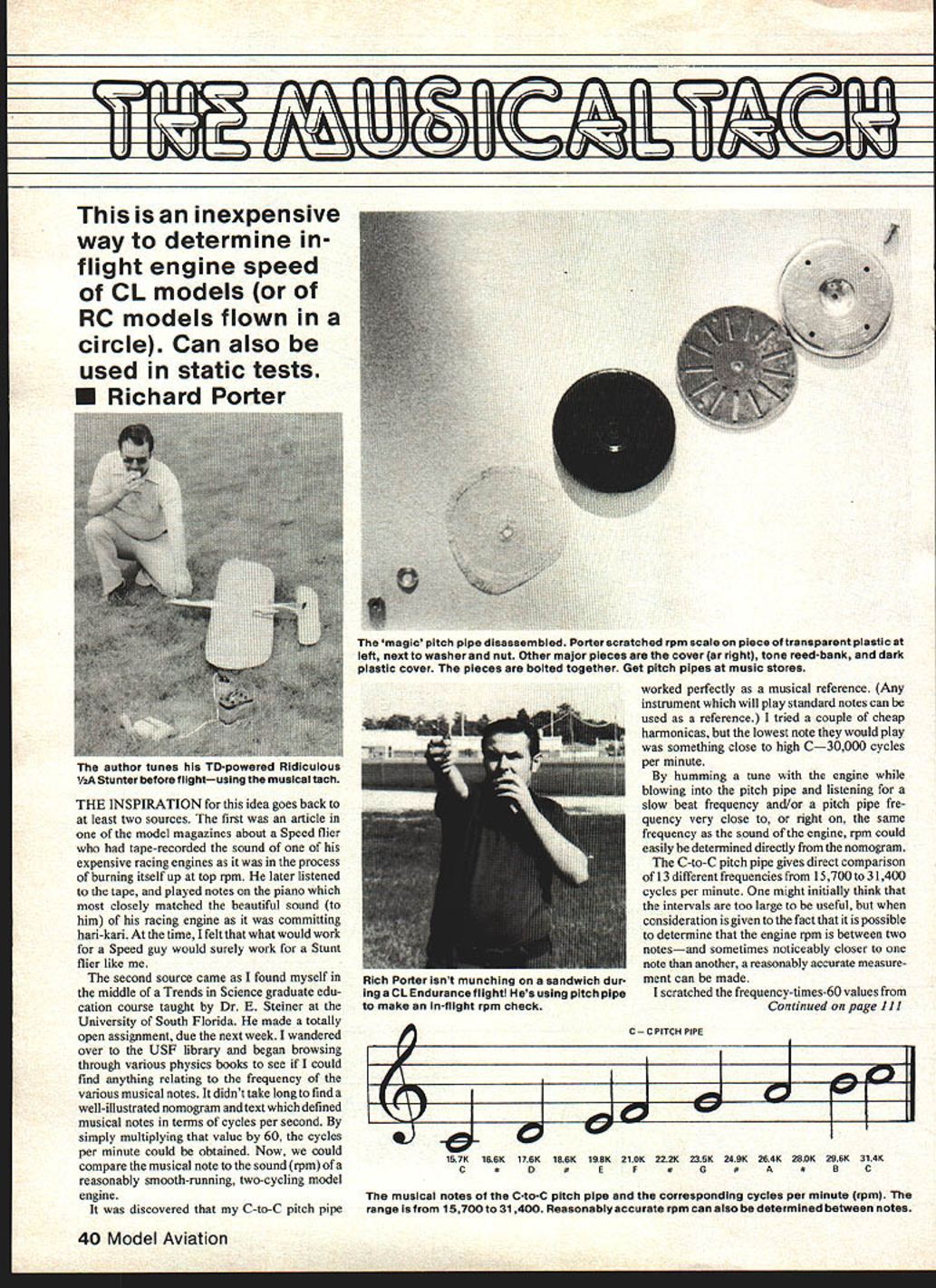
A C-to-C pitch pipe makes an excellent musical reference (any instrument that will play standard notes can be used). I tried cheap harmonicas, but the lowest note they would play was near high C—about 30,000 cycles per minute—so they were not as useful.
By humming along with the engine while blowing a note on the pitch pipe, and listening for a slow beat frequency or a pitch-pipe frequency very close to the engine sound, rpm can be determined directly from the nomogram.
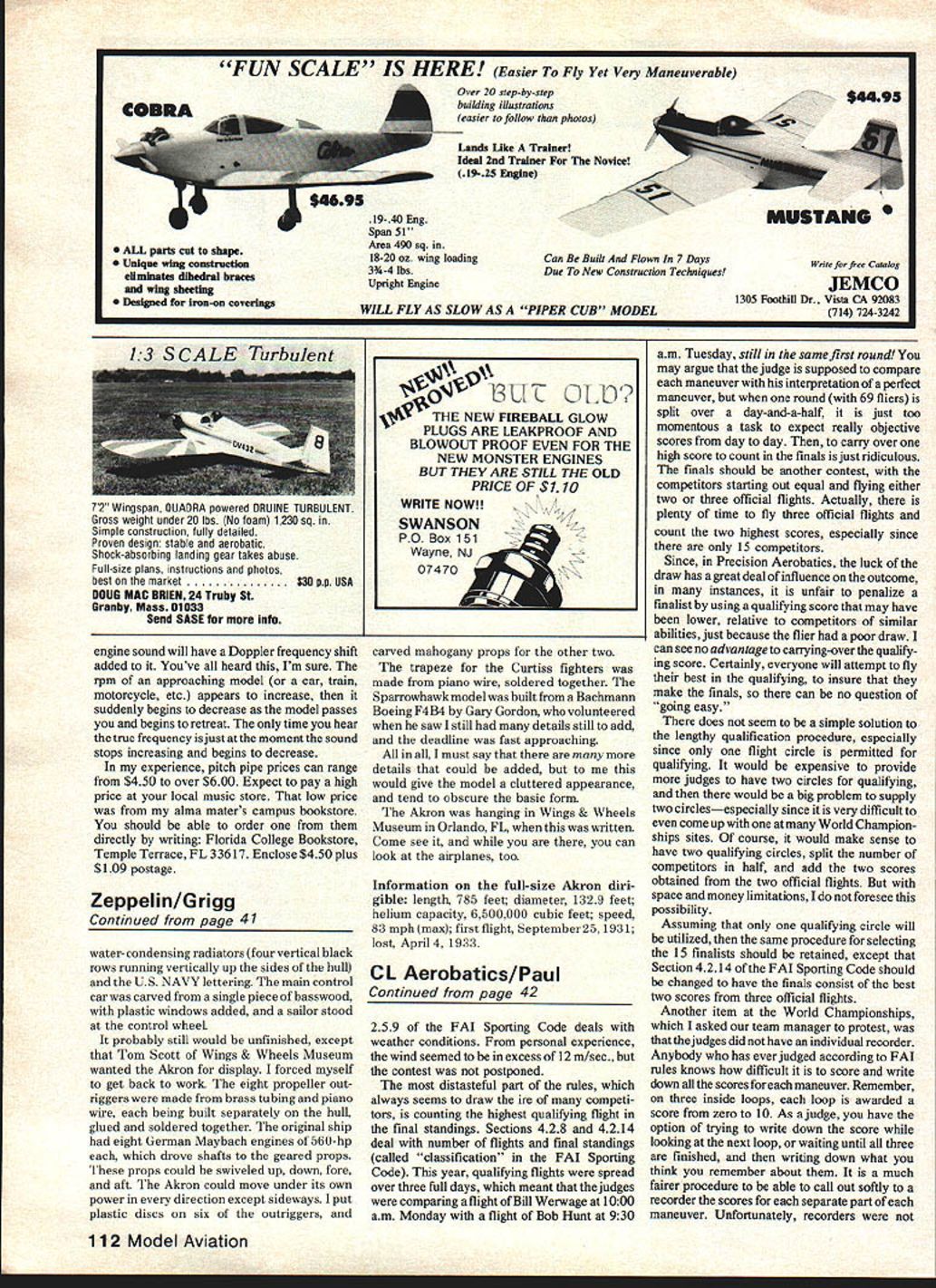
The C-to-C pitch pipe gives direct comparison of 13 different frequencies from 15,700 to 31,400 cycles per minute. Although the intervals between notes may seem large, you can often determine that the engine rpm lies between two notes and sometimes noticeably closer to one note than another, yielding a reasonably accurate measurement.
I scratched the frequency×60 values from the nomogram onto the plastic side of my pitch pipe:
- Middle C — 15,700 cycles per minute
- C♯ — 16,600 cycles per minute
- D — 17,600 cycles per minute
- D♯ — 18,600 cycles per minute
- E — 19,800 cycles per minute
- F — 21,000 cycles per minute
- F♯ — 22,200 cycles per minute
- G — 23,500 cycles per minute
- G♯ — 24,900 cycles per minute
- A — 26,400 cycles per minute
- A♯ — 27,960 cycles per minute
- B — 29,640 cycles per minute
- High C — 31,400 cycles per minute
Extending the Range
The range can be extended above and below the pitch pipe by using harmonics. Humming a lower or higher harmonic while simultaneously blowing a selected note and listening for a low beat frequency lets you determine the value of an unknown harmonic frequency.
For example, high C is the first harmonic above middle C on the pipe. By humming low C and blowing high C, you can detect a clear beat frequency. The same effect occurs by humming high C and blowing low C. When you are very close to—or exactly on—a harmonic, the beat frequency is very low; as you hum a higher or lower note, the beat frequency increases. When humming with the engine sound, you have found the musical tone representing the engine speed.
To find one note lower than middle C: blow into the B below high C and hum at a frequency lower than middle C until a very low beat frequency is heard. This gives a frequency exactly half of B and one note lower than middle C. If you can hum low enough and high enough, you can cover octaves below and above the pitch-pipe frequencies, allowing coverage roughly from 7,800 to 62,800 cycles per minute—wider than needed for full-power two-cycle rpm of almost any modern model engine.
However, most human voices are limited to a range that does not appreciably exceed the pitch pipe, so the most practical application is within the pipe’s range.
Practical Use and Considerations
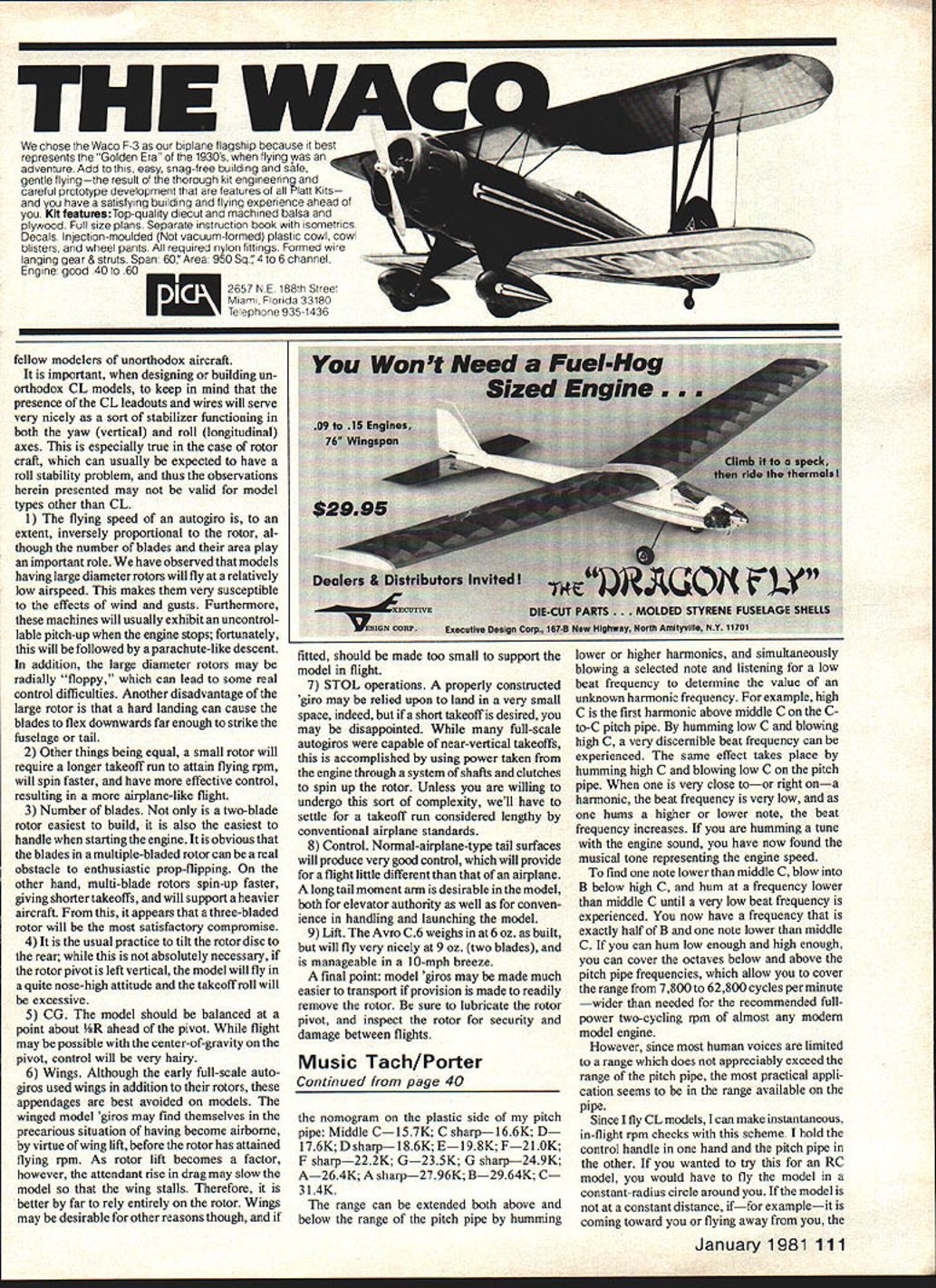
For CL flying, you can make instantaneous in-flight rpm checks: hold the control handle in one hand and the pitch pipe in the other. For RC models you must fly the model in a constant-radius circle around you. If the model is not at a constant distance—for example, coming toward or away from you—the engine sound will have a Doppler frequency shift. You hear the true frequency only at the instant the sound stops increasing and begins to decrease (the moment of closest approach).
Cost and Where to Buy
Pitch pipes typically range from about $4.50 to over $6.00. Expect higher prices at local music stores. I purchased mine at my alma mater’s campus bookstore for $4.50. You could order directly (original contact information):
Florida College Bookstore Temple Terrace, FL 33617
Enclose $4.50 plus $1.09 postage.
Transcribed from original scans by AI. Minor OCR errors may remain.

