
Myers at the '83 WRAM Show
George M. Myers — Photos by Tim Myers
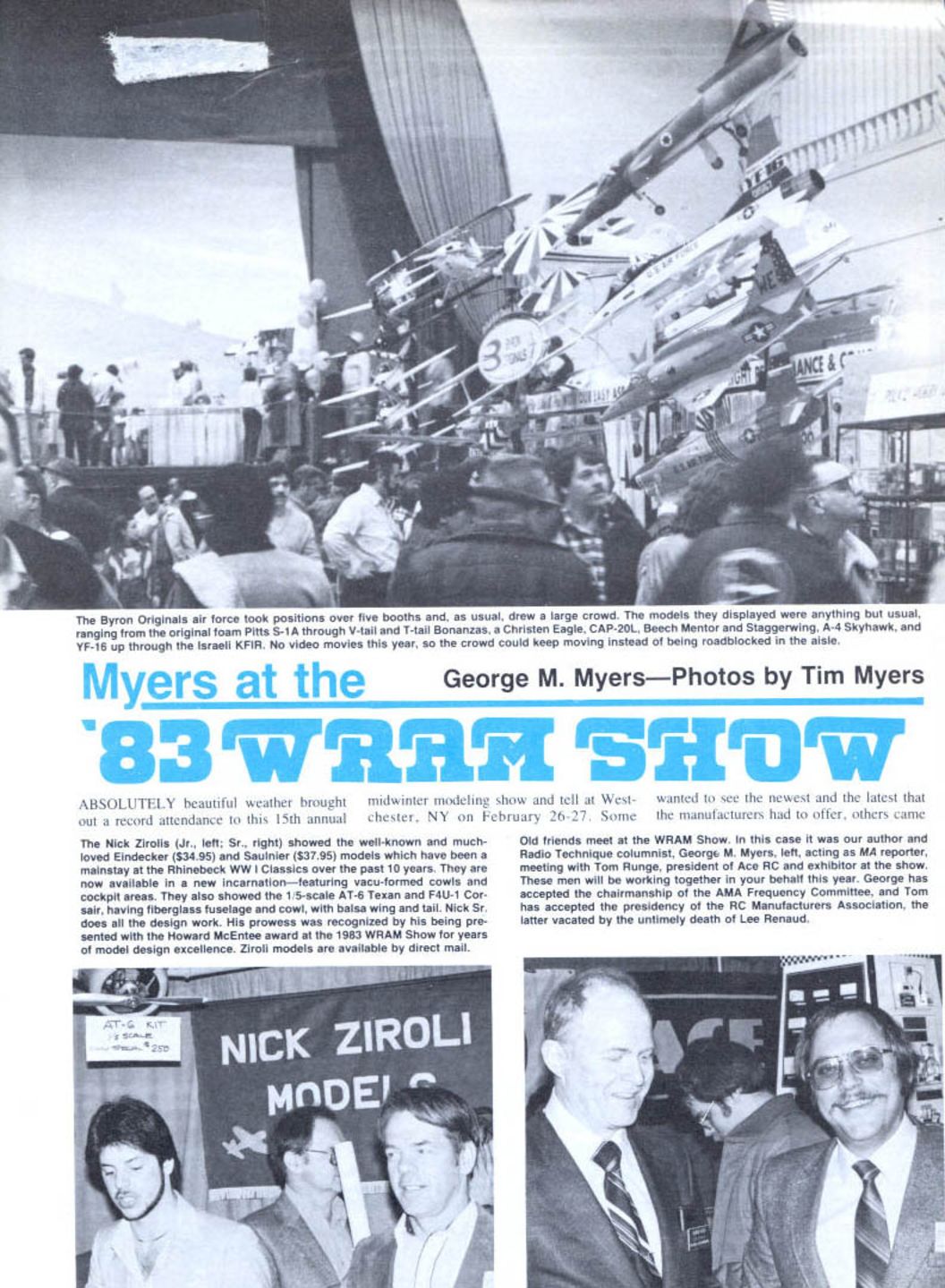
Absolutely beautiful weather brought out a record attendance to the 15th annual midwinter modeling show-and-tell at Westchester, NY, on February 26–27. People came for a variety of reasons:
- To see the newest offerings from manufacturers
- To study the beautiful models presented for static display and judging
- To mingle with other modelers and compete for trophies
- To hunt bargains in the Swap Shop
Judging by the number of models seen leaving, trade was brisk. By the end of the weekend, everyone we saw came away tired and happy.
Ziroli models
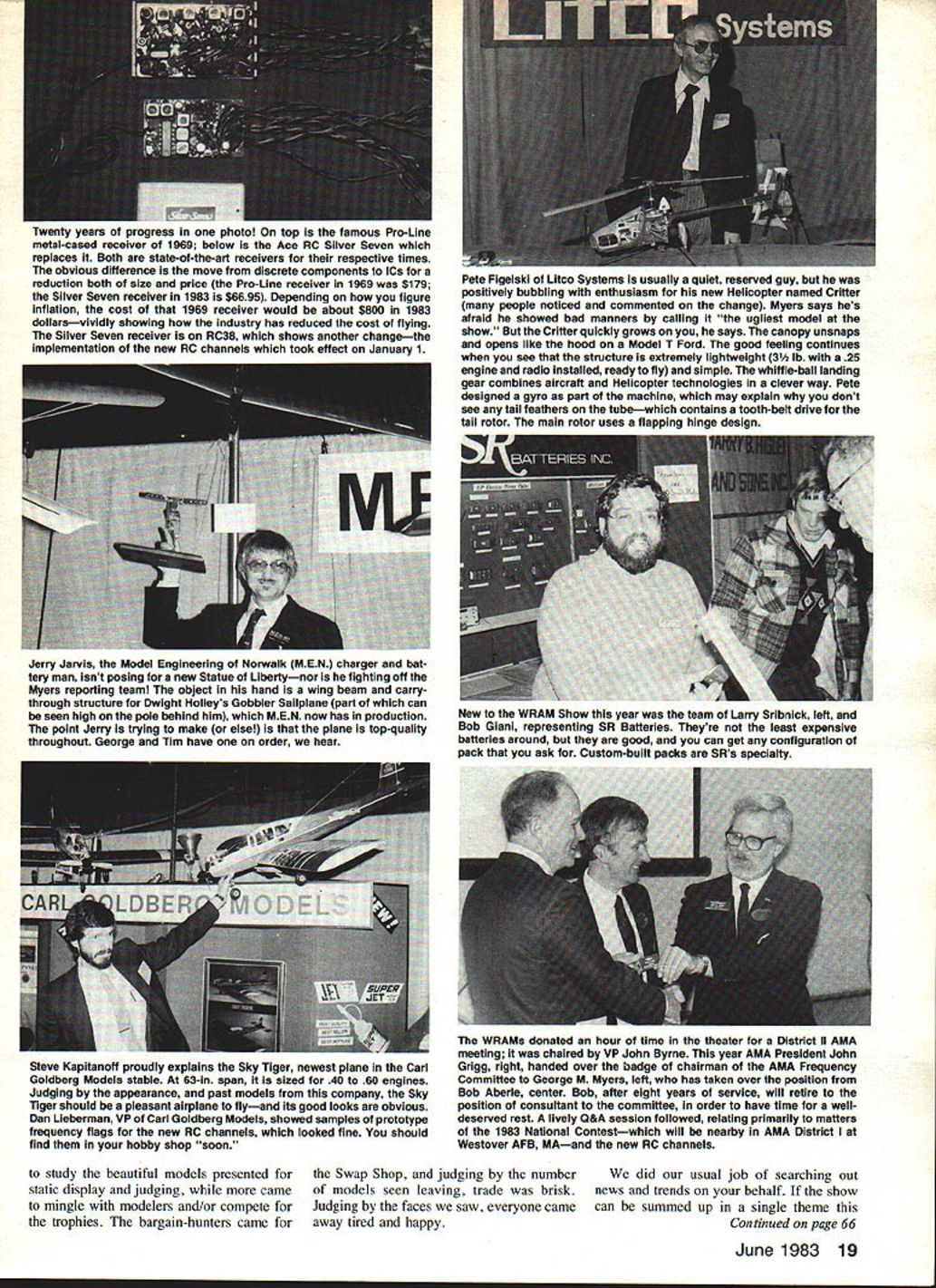
Nick Ziroli Jr. (left) and Nick Ziroli Sr. (right) showed the well-known and much-loved Eindecker ($34.95) and Saulnier ($37.95) models, which have been a mainstay at the Rhinebeck WW I Classics for the past 10 years. These are now available in a new incarnation featuring vacuum-formed cowls and cockpit areas. They also showed 1/5-scale AT-6 Texan and F4U-1 Corsair models with fiberglass fuselage and cowl and balsa wing and tail. Nick Sr. does all the design work; his prowess was recognized when he received the Howard McEntee Award at the 1983 WRAM Show for years of model design excellence. Ziroli models are available by direct mail.
Old friends and organizational news
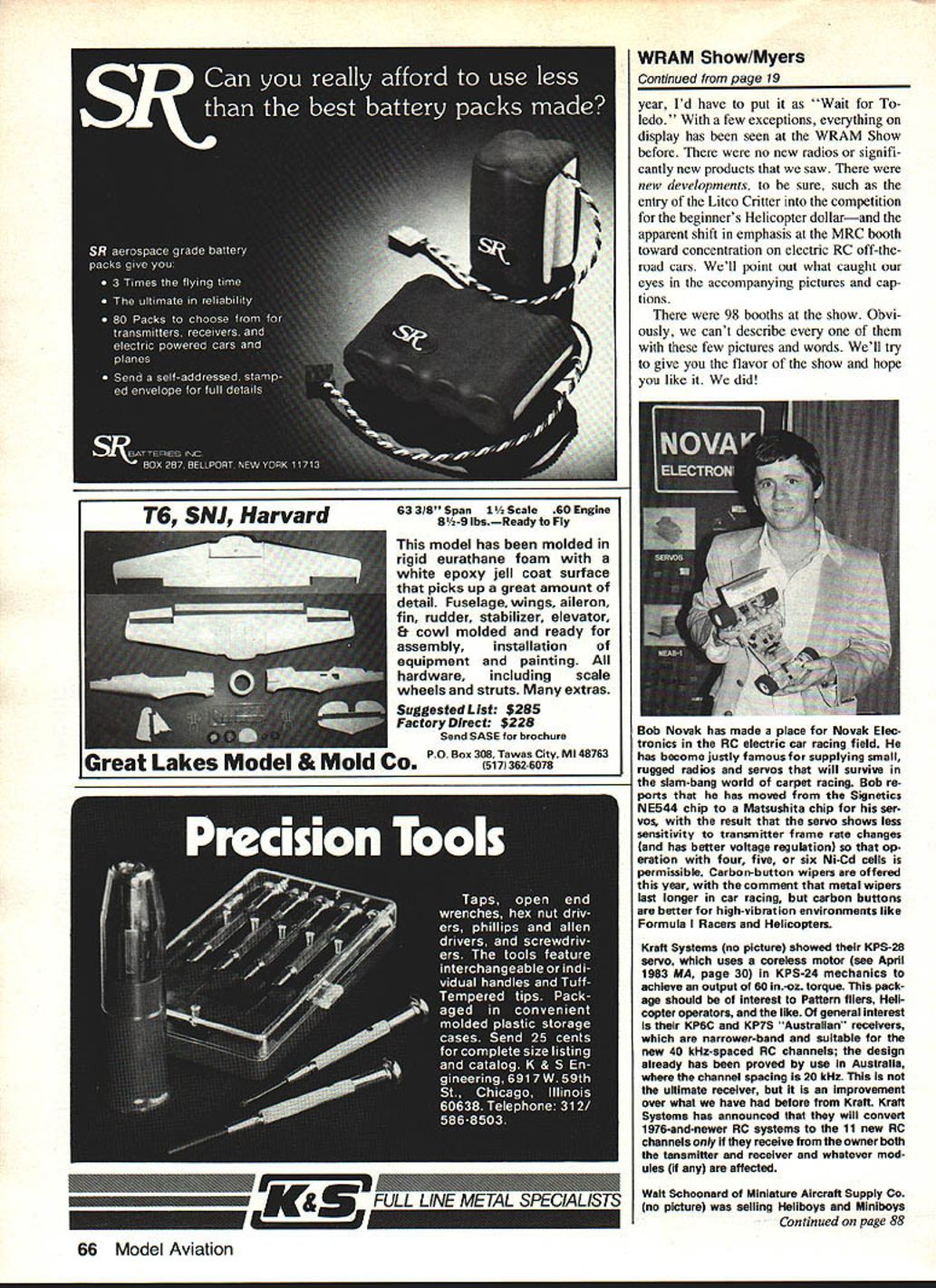
Old friends met at the WRAM Show. Our author and Radio Technique columnist George M. Myers (left, acting as AMA reporter) met with Tom Runge, president of Ace RC and exhibitor at the show. These men will be working together on your behalf this year: George has accepted the chairmanship of the AMA Frequency Committee, and Tom has accepted the presidency of the RC Manufacturers Association, the latter position vacated by the untimely death of Lee Renaud.
The WRAMs donated an hour of theater time for a District II AMA meeting chaired by Vice President John Byrne. AMA President John Grigg handed over the badge of chairman of the AMA Frequency Committee to George M. Myers, who succeeds Bob Aberle. After eight years of service, Bob Aberle will retire to the role of consultant to the committee to have time for a well-deserved rest. A lively Q&A session followed, focusing primarily on matters of the 1983 National Contest (to be held nearby in AMA District I at Westover AFB, MA) and the new RC channels.
Show trends and summary
We searched out news and trends on your behalf. If the show can be summed up in a single theme this year, it would be "Wait for Toledo." With a few exceptions, everything on display had been seen previously at the WRAM Show. There were no new radios or significantly new products on display. There were, however, new developments: for example, the entry of the Litco Critter into the competition for the beginner's helicopter dollar and an apparent shift in emphasis at the MRC booth toward electric RC off‑road cars. We point out what caught our eyes in the accompanying pictures and captions.
There were 98 booths at the show. Obviously we can't describe every one of them here, but we hope this gives you the flavor of the event.
Notable exhibitors and products
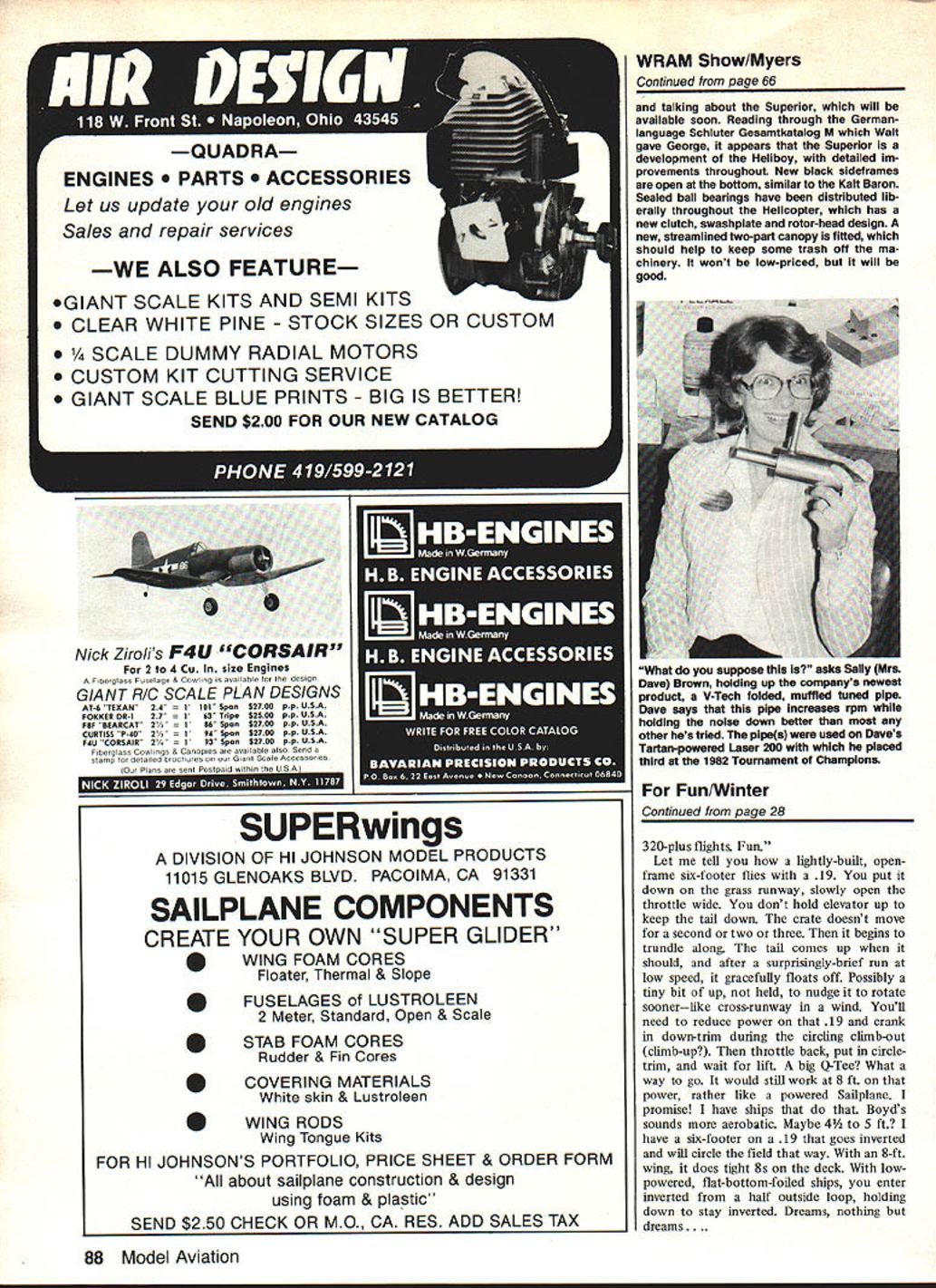
Bob Novak has established Novak Electronics in the RC electric car racing field. He has become known for supplying small, rugged radios and servos that survive the slam‑bang world of carpet racing. Novak reports a change from the Signetics NE544 chip to a Matsushita chip for his servos, resulting in less sensitivity to transmitter frame rate changes and better voltage regulation, permitting operation with four, five, or six Ni‑Cd cells. Carbon-button wipers are offered this year; metal wipers tend to last longer in car racing, but carbon buttons are better for high-vibration environments like Formula I racers and helicopters.
Kraft Systems (no picture) showed their KPS-28 servo, which uses a coreless motor (see April 1983 MA, page 30) in KPS-24 mechanics to achieve an output of 60 in.-oz. torque. This package should interest pattern fliers, helicopter operators, and similar fliers. Of general interest are their KPS6 and KPF7 "Australian" receivers, which are narrow-band and suitable for the new 40 kHz-spaced RC channels; the design has already been proven in Australia, where channel spacing is 20 kHz. While not the ultimate receiver, it is an improvement over previous Kraft units. Kraft Systems announced they will convert 1976-and-newer RC systems to the 11 new RC channels only if they receive from the owner both the transmitter and receiver and any affected modules.
Walt Schoonard of Miniature Aircraft Supply Co. (no picture) was selling Heliboys and Miniboys and talking about the Superior, which will be available soon. From the German-language Schluter Gesamtkatalog that Walt gave George, the Superior appears to be a development of the Heliboy with detailed improvements throughout: new block sideframes open at the bottom (similar to the Kalt Baron); sealed ball bearings distributed liberally throughout the helicopter; a new clutch, swashplate, and rotor-head design; and a streamlined two-part canopy to help keep trash out of the machinery. It won't be low-priced, but it promises to be good.
Transcribed from original scans by AI. Minor OCR errors may remain.

