
NACA and the Under Aircraft Modelmaker
Frank Parmenter
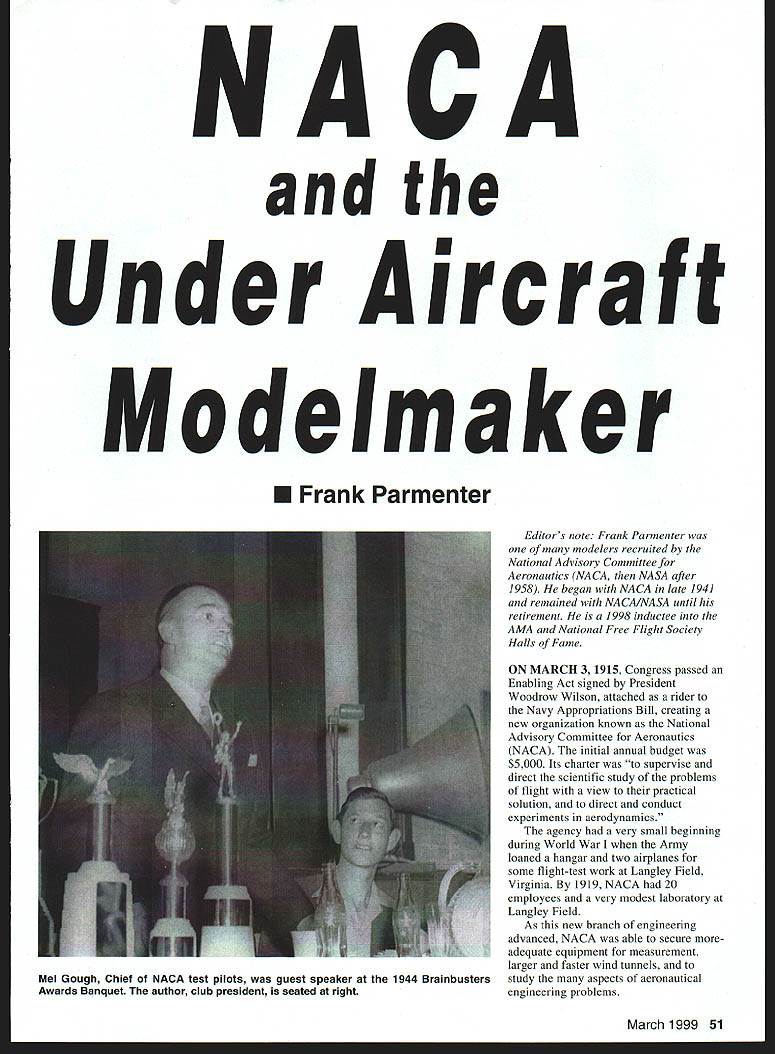
Editor's note: Frank Parmenter was one of many modelers recruited by the National Advisory Committee for Aeronautics (NACA), later NASA after 1958. He began with NACA in late 1941 and remained with NACA/NASA until his retirement. He is a 1998 inductee into the AMA and National Free Flight Society Halls of Fame.
Introduction and early history
On March 3, 1915, Congress passed the Enabling Act, signed by President Woodrow Wilson, creating the National Advisory Committee for Aeronautics (NACA). Its initial annual budget was $5,000. Its charter was "to supervise and direct the scientific study of the problems of flight with a view to their practical solution, and to direct and conduct experiments in aerodynamics."
The agency was very small at first. During World War I the Army loaned a hangar and two airplanes for flight-test work at Langley Field, Virginia. By 1919 NACA had 20 employees and a modest laboratory at Langley Field. As aeronautical engineering advanced, NACA secured better equipment and larger, faster wind tunnels.
During the 1930s NACA became widely recognized as a leading research organization in aeronautics. Notable developments from this period include:
- The NACA cowling for radial engines
- The NACA series airfoils
- Flapped wings
- Tricycle-type landing gear
World events leading up to World War II prompted a major expansion of NACA facilities. Ames Aeronautical Laboratory opened at Moffett Field near San Francisco, and the Lewis Flight Propulsion Laboratory opened at Hopkins Airport, Cleveland, Ohio. Langley Memorial Aeronautical Laboratory supplied the people to supervise design, construction, and staffing of these new centers.
Key individuals
The relationship between NACA and the model airplane builder was shaped primarily by two individuals: Dr. Edward R. "Ray" Sharp and Charles A. "Tom" Hulcher.
Dr. Edward R. "Ray" Sharp
Ray Sharp, a native Virginian, served in the U.S. Navy from 1914–1919 and retired with the reserve rank of lieutenant commander. He joined NACA in February 1922 as its 54th employee. Educated in law at the College of William & Mary, Sharp was assigned to Langley Laboratory and soon became Chief Administrative Officer and second in command of the Laboratory, serving from 1925–1940.
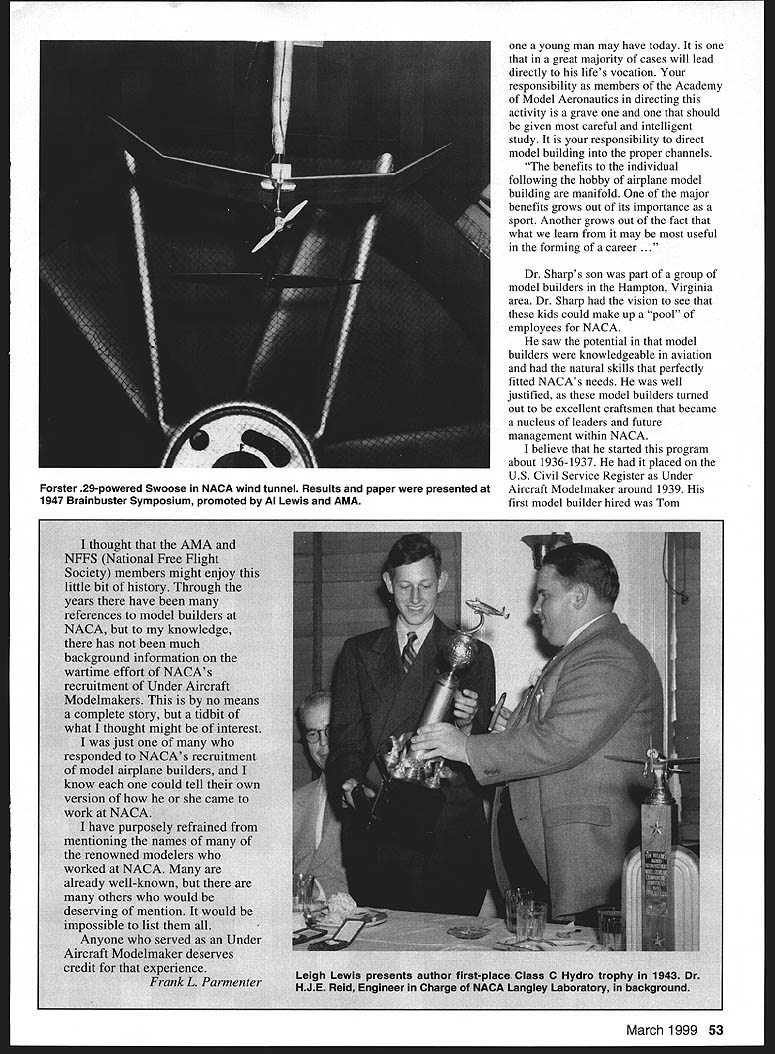
Sharp took a special interest in model airplane builders and promoted model aeronautics as both a hobby and a path to a career. He saw local young modelers—knowledgeable about aviation and skilled in craftsmanship—as a potential pool of employees for NACA. He began recruiting them in the mid- to late 1930s and was key to placing model builders on the U.S. Civil Service Register as "Under Aircraft Modelmaker" around 1939.
From a 1940 talk to modelers, Sharp observed: "Model aeronautics is close to my heart... A young man may have today, in the great majority of cases, a hobby that will lead directly to his life's vocation. The responsibility of members of the Academy of Model Aeronautics in directing this activity is a grave one and should be given careful, intelligent study."
While at the Lewis Flight Propulsion Laboratory, Sharp instituted a strong apprentice program to train technicians in mechanical, electronic, and electrical support. Model builders were primary candidates for this Apprentice Program. He retired as Director of Lewis in 1961.
Charles A. "Tom" Hulcher
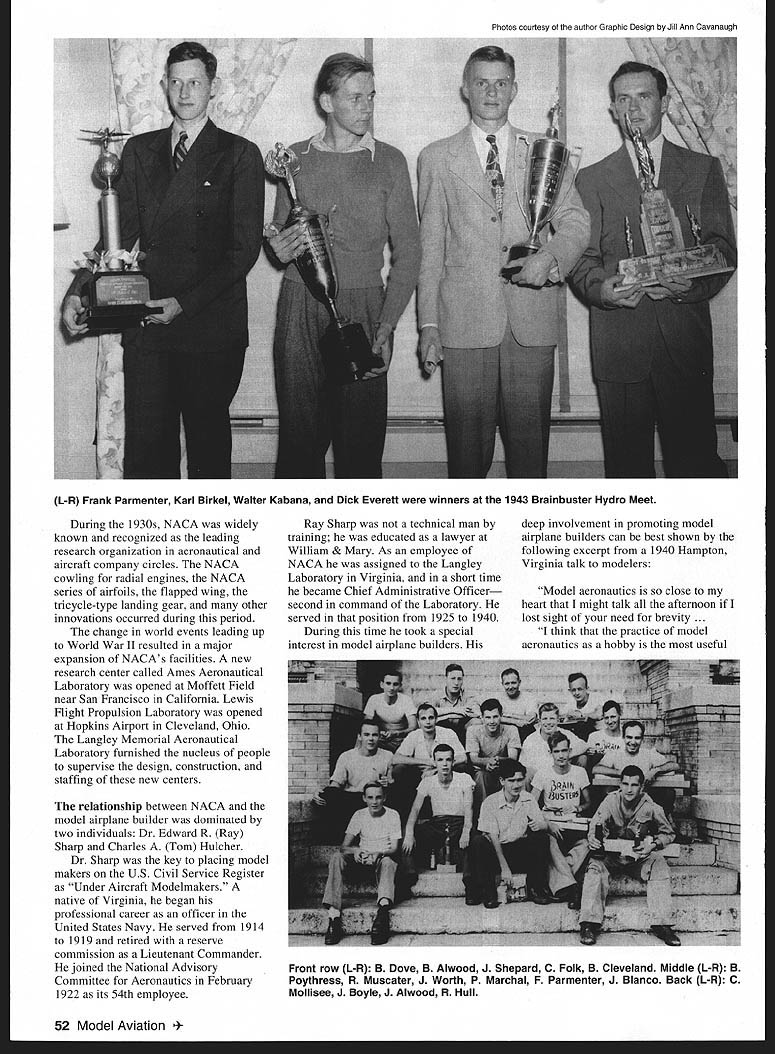
Tom Hulcher was the first model builder hired by NACA, around 1936–1937. He organized the first model airplane club in the Hampton, Virginia area and was renowned for the Hulcher Hurricane gas model. Hulcher participated in NACA's exhibit at the 1939 New York World's Fair, which recruited engineers and model builders.
Hulcher played a major role in expanded recruitment of Under Aircraft Modelmakers and later was placed in charge of NACA's Apprentice Program in 1942. From his remarks at the 50-year reunion of the Brain-Busters Model Airplane Club, Hulcher recalled the urgent wartime need for large laminated Sitka spruce propellers for wind tunnels and how model builders proved ideal candidates for patternmaking, propeller construction, and other tasks. He credited Dr. Sharp with persuading the Civil Service Commission to create a model maker classification based on formal model-building experience and competition.
Hulcher later left NACA in the late 1940s to develop and manufacture the Hulcher 70 High Speed Sequence Camera. He died August 4, 1994, at age 83.
Recruitment, Apprentice Program, and wartime effort
NACA's recruitment of model builders intensified in 1941–1942. Earlier hires (1939–1940) were mostly East Coast modelers reached by word-of-mouth and contest activity—Virginia, Washington D.C., New York, Pennsylvania, and West Virginia.
Recruiting methods included:
- Direct mail to model builders who participated in the 1941 AMA National Championships in Chicago, making the effort nationwide.
- Articles and photo spreads in Model Airplane News (for example, an extensive April 1942 piece titled "Modelers Would Our Fighting Planes: How the Model Builder Serves Uncle Sam at Langley Field Experimental Laboratory").
- A wartime brochure, "Modelmakers Make Your Hobby Pay," distributed to hobby shops and placed in model airplane kits; it targeted 16- and 17-year-olds who were non-draft-eligible.
NACA hired roughly 200 model builders in the 1941–1944 period. In 1942 NACA formally started its Apprentice Program, and some model makers were placed on the Civil Service Register as Under Aircraft Modelmaker. Many early model-builder hires were later enrolled in the Apprentice Program.
Model builders contributed to a wide range of wartime research tasks. One notable project was making the large laminated Sitka spruce propellers for wind tunnels. As Hulcher and others recalled, model builders’ curiosity, practical knowledge, and inventive spirit made them excellent problem-solvers and craftsmen for NACA’s needs.
From an August 1942 Model Airplane News acknowledgement: "I should like to take this opportunity to sincerely thank the Academy for the excellent job you have done in assisting our Laboratory in obtaining so many excellent Under Aircraft Modelmakers... Boys from practically every state in the Union are under our employ at the NACA and are busily engaged in many types of urgent national defense work."
Wartime personnel challenges
Many model builders served only a short time at NACA during the war. Some volunteered for military service; others were drafted despite NACA’s efforts to secure deferments. To address staffing and draft issues, in May 1944 the Air Force inducted all physically qualified NACA employees into the Air Force, placed them on reserve status, and ordered them back to NACA to continue their work. Later in 1944 the Army Air Forces "activated" employees 26 years of age or younger and replaced them "one for one" with returning veterans of similar skills, who were then placed in reserve and ordered to report to NACA.
When the war ended, these veterans received discharges and were free to leave or stay; many returned to NACA after their service.
After the war and legacy
After World War II, NACA continued to recruit model airplane builders for its Apprentice Program and for engineering positions. Model builders produced excellent craftsmen who became a nucleus of leaders and management within NACA and later NASA. The list of notable modelers who worked for NACA/NASA is extensive and includes many former and current Academy of Model Aeronautics members.
Anyone who served as an Under Aircraft Modelmaker at NACA deserves credit for their contribution to wartime and postwar aeronautical research.
Excerpts from Model Airplane News reprinted with permission.
Frank L. Parmenter 4106 Sequoia Trail East Georgetown, TX 78628
Transcribed from original scans by AI. Minor OCR errors may remain.

