
Nagoya Cup 1981
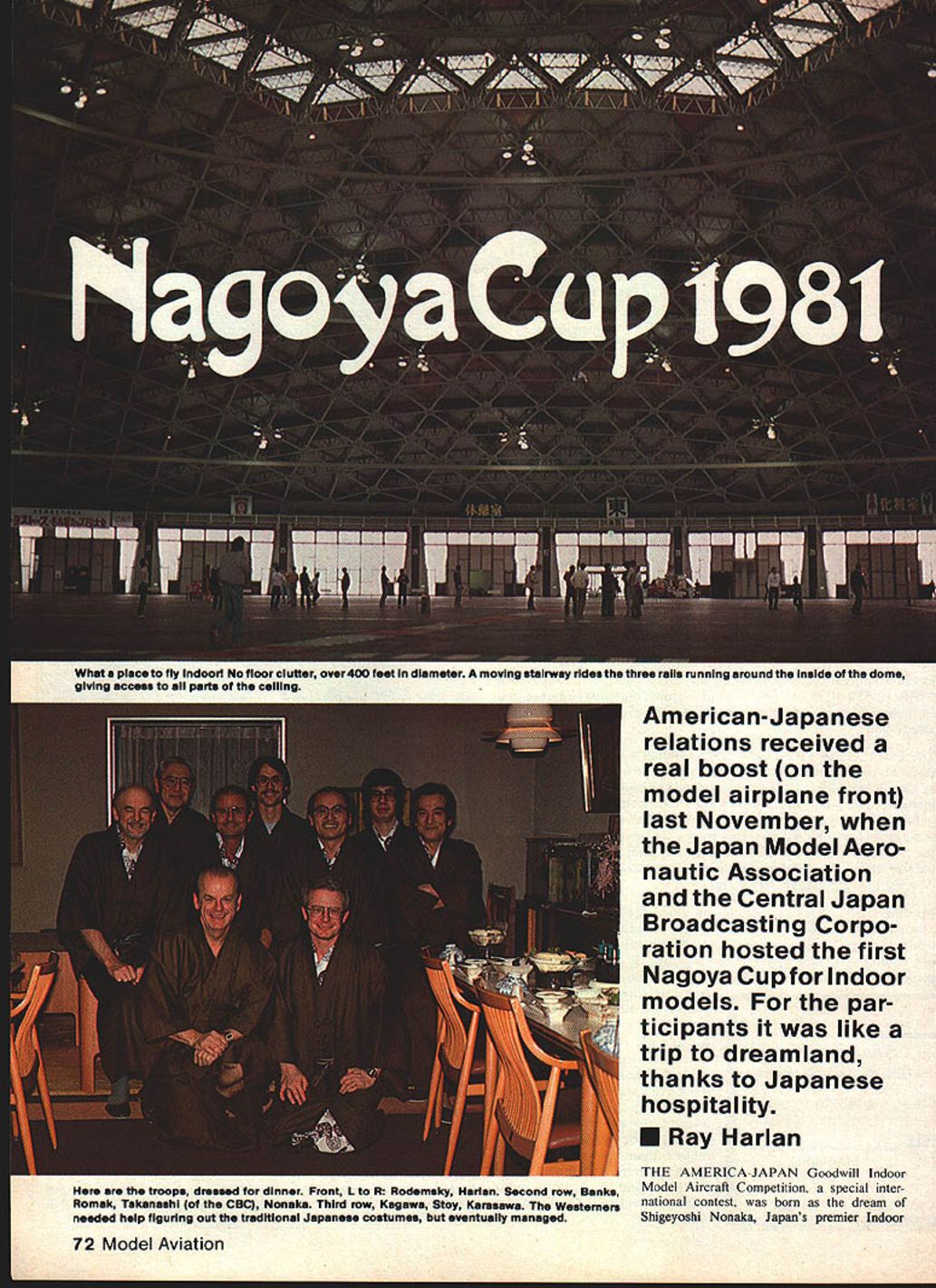
American–Japanese relations received a real boost on the model airplane front last November, when the Japan Model Aeronautic Association and the Chubu-Nippon Broadcasting Company (CBC) hosted the first Nagoya Cup for indoor models. The event grew from the dream of Shigeyoshi Nonaka, Japan's premier indoor modeler, and brought U.S. and Japanese fliers together in a memorable display of flying and hospitality.
Sponsors
- Chubu-Nippon Broadcasting Company (CBC)
- Toyo Stove Sales Company
- Japan Model Aeronautic Association
Team invitations and personnel
- Originally invited U.S. fliers:
- Erv Rodemsky (then World Champion)
- Bud Romak (1976 World Champion)
- Pete Andrews (1971 World Champion) — canceled due to family illness; Ray Harlan chosen in his place
- Jim Richmond (1970, 1978 World Champion) — could not attend; Cezar Banks chosen in his place
- Stan Stoy: invited to demonstrate Hand-Launched Gliders (HLG), especially his folding-wing design
- Jim Kagawa: team manager and interpreter; provided organization, travel details, and cultural guidance
- Other notable participants: Yasutoshi Bamba, George Honda, Samba Yamazaki, Matauzawa, Hiroshi Oishi
Travel and logistics
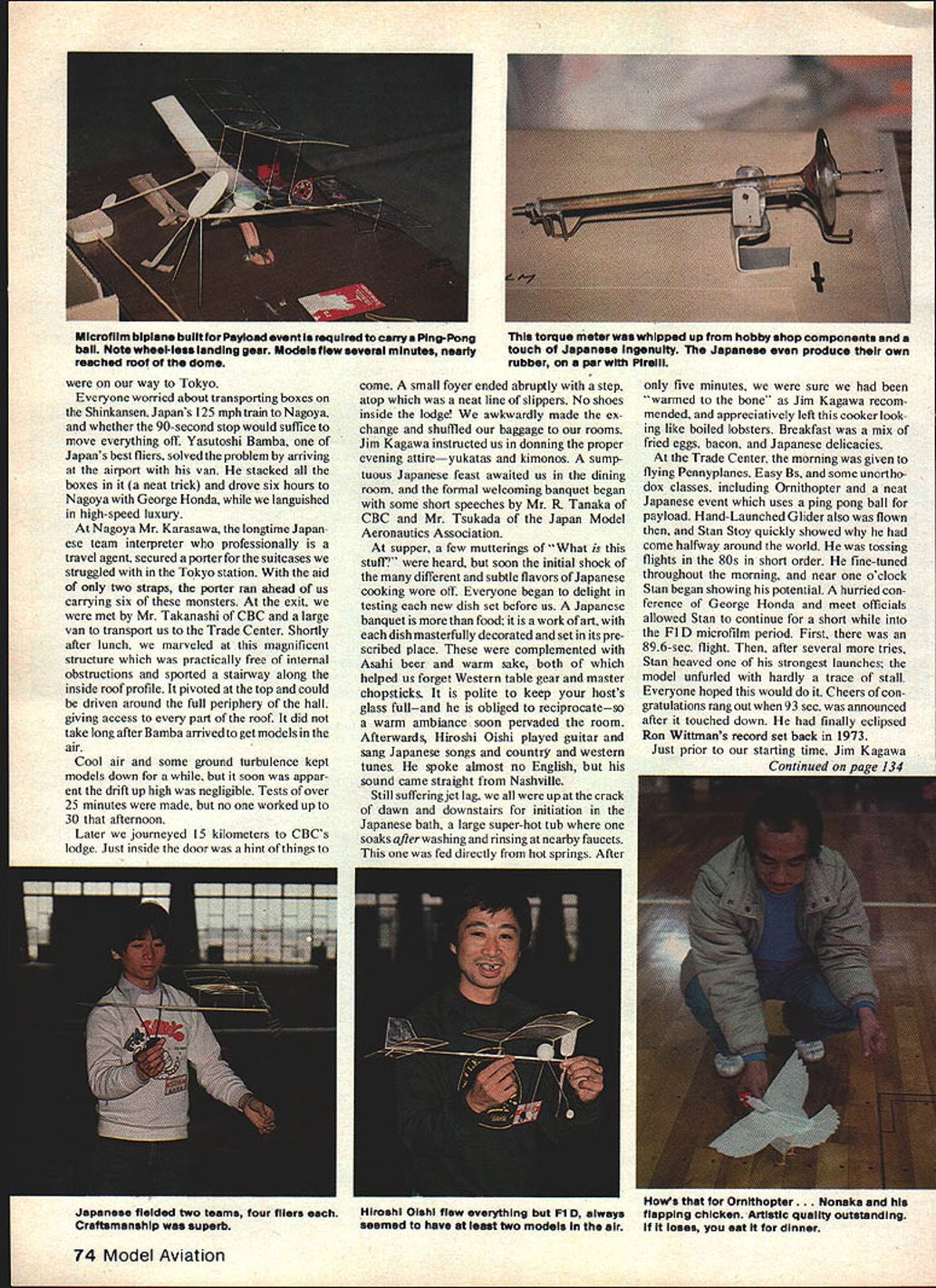
Many worried about transporting large model boxes on the Shinkansen (Japan's 125-mph train) and whether the 90-second station stop would suffice. Yasutoshi Bamba solved the problem by arriving at the airport in a van stacked with boxes and driving to Nagoya. Mr. Karasawa, a longtime Japanese team interpreter and travel agent, arranged a porter at Tokyo Station who carried heavy cases to the exit, where Mr. Takanashi of CBC met the team with a van to transport them to the Trade Center.
Venue: Nagoya Trade Center
The Trade Center impressed everyone with its near lack of internal obstructions and a pivoting stairway/catwalk that provided access to the entire roof periphery. Initial flying was affected by cool air and ground turbulence, but high-altitude drift proved negligible. Early test flights exceeded 25 minutes, and later flights extended to around 30 minutes in the afternoon.
Lodge, banquet, and cultural experiences
The CBC lodge set a cultural tone from the start: slippers at the foyer, no shoes inside, and instruction from Jim Kagawa in donning yukatas and kimonos. A formal welcoming banquet featured short speeches by Mr. R. Tanaka (CBC) and Mr. Tsukada (Japan Model Aeronautic Association). The meal showcased many subtle flavors of Japanese cooking, complemented by Asahi beer and warm sake. Hiroshi Oishi entertained with guitar and songs, including country and western tunes.
The next morning included a traditional hot-spring-fed bath and a mixed Western–Japanese breakfast. Cultural lessons—etiquette with chopsticks, keeping a host's glass full, and other customaries—added to the warmth of the visit.
Events and demonstrations
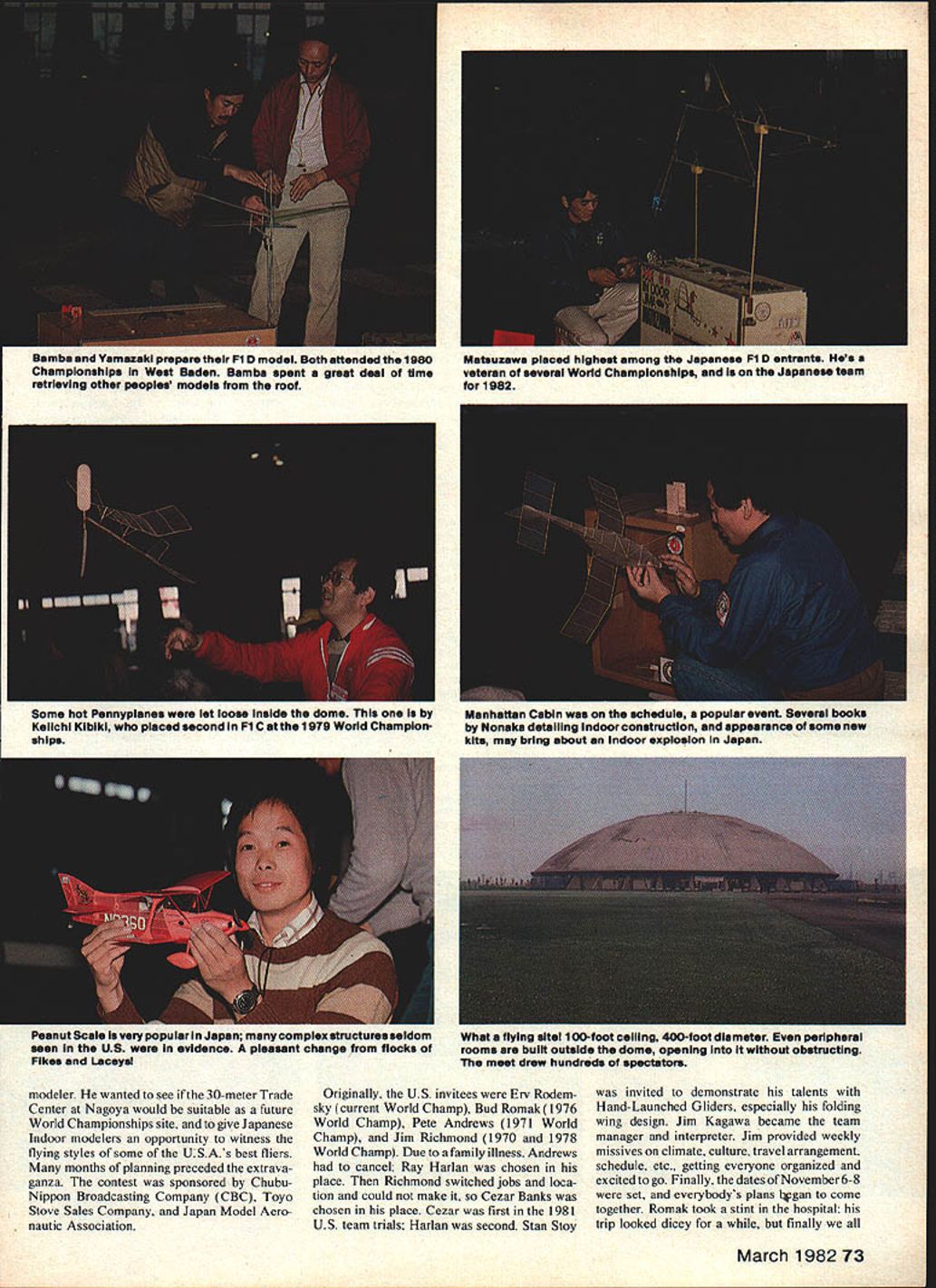
- Classes flown included Pennyplanes, Easy Bs, Ornithopter, payload events (including a ping-pong ball payload), Peanut scale, and Hand-Launched Gliders (HLG).
- Stan Stoy quickly demonstrated HLG excellence, posting flights in the 80+ second range and ultimately achieving an exceptional 93-second flight that eclipsed Ron Whitman's 1973 record.
- Samba Yamazaki and Matauzawa prepared F1D models; both had attended the 1980 World Championships and Matauzawa placed highest among Japanese F1D entrants. Keiichi Kibiki, a notable F1C flier, had previously placed second at the 1979 World Championships.
- Nonaka’s books and new kits were helping spur interest in indoor modeling in Japan; Peanut scale models and complex structures were popular.
F1D competition and results
- Timers were instructed in F1D timing procedures by Mr. Ito, the principal judge.
- Early flights saw Cezar Banks set the pace; Erv Rodemsky and others experienced incidents with the triangular roof vents, requiring Bamba and others to retrieve models from the catwalk.
- Many competitors struggled to find the correct motor power in the cool, turbulent air; conditions favored careful adjustment and retrieval efforts from the catwalk.
- The final dramatic flight came from Ray Harlan. After several attempts and adjustments, his last flight climbed into calm air and landed at 34:47, a mark that secured top honors. The U.S. team finished strongly, taking the top four F1D places.
- Cezar Banks, Erv Rodemsky, Bud Romak, and Ray Harlan were the principal contenders; Romak, Banks, Rodemsky, and Harlan all posted competitive flights during the event.
Observations and Japanese contributions
- Nonaka and other Japanese fliers had posted long-duration flights elsewhere (e.g., Cardington), and the Japanese hosts repeatedly aided visiting teams—retrieving models from catwalks and assisting with timing and logistics.
- The Japanese demonstrated great enthusiasm and are poised to become strong world-class contenders in indoor categories; they already held strong records in at least one indoor class.
Post-contest activities
- The visiting team toured Nagoya Castle and the CBC facilities, had lunch atop a modern skyscraper, and received mementos (calculators and cloisonné trays) from CBC.
- The group returned to Tokyo by Shinkansen and made TV appearances demonstrating F1D modeling on all three major networks—receiving wide publicity across Japan.
- Ray Harlan stayed on to visit automated factories for ten days; other team members enjoyed additional banquets and sightseeing.
Though now a memory, the Nagoya Cup left a lasting impression. The Japanese hosts taught many lessons in hospitality, and organizers thanked Mr. Shigeyoshi Nonaka for making his dream come true. The event strengthened goodwill and left both sides hoping to learn from each other and build future indoor-modeling success.
Transcribed from original scans by AI. Minor OCR errors may remain.

