
The National Stearman Fly-In
By Kenneth D. Wilson
Join the author in an open-cockpit Stearman—still the most magnificent way to fly.
Open-cockpit flying, especially in a biplane, may seem old-fashioned, but once experienced it remains the most magnificent way to travel. The airplane that comes to mind when discussing fabric-covered biplanes is the Stearman.
From 1937 to 1945 the Stearman Aircraft Company of Wichita, Kansas (a Boeing affiliate) assembled 8,428 Boeing-Stearman Model 75 airplanes, with spare-parts production accounting for the equivalent of another 1,918 aircraft. The Model 75 served as the primary trainer for thousands of Army and Navy students during World War II; many Allied students also learned the basics of flight in the Model 75. After the war the surplus trainers sold for as little as $400 each as the Reconstruction Finance Corporation and the War Assets Administration disposed of government surplus.
Galesburg Fly-In: history and scope
Since 1972, during the week following Labor Day, the National Stearman Fly-In has been held at Galesburg, Illinois. There are often over 100 Boeing-Stearman Model 75 airplanes participating, along with a healthy showing of Lloyd Stearman's 1926–1931 designs. The event has become international in scope, with visitors from Australia, Canada, England, Germany, Mexico, and other countries.
Although the Fly-In officially begins the Wednesday after Labor Day, by opening day 40 to 60 Stearmans frequently are already parked at Galesburg Municipal Airport awaiting the ceremonial flag raise at Fly-In headquarters.
Early arrivals and registration
The inaugural day starts with pilot registration and many pilots "buddy-hopping" in their Stearmans—a chance to renew or make new Stearman friends.
Among the early and regular arrivals are Tom and Nancy Lowe with their Antique Airplane Association Grand National Champion 1931 Stearman C-3R Business Speedster and their Boeing-Stearman Model B75N1 (U.S. Navy N2S-3 Midshipman). Tom Lowe’s interest in aviation dates to the late 1950s and early 1960s when he flew model contests in Iowa and Illinois. While serving in the U.S. Air Force in the Far East in 1964, he flew a Stearman in Formosa—his first experience in the type.
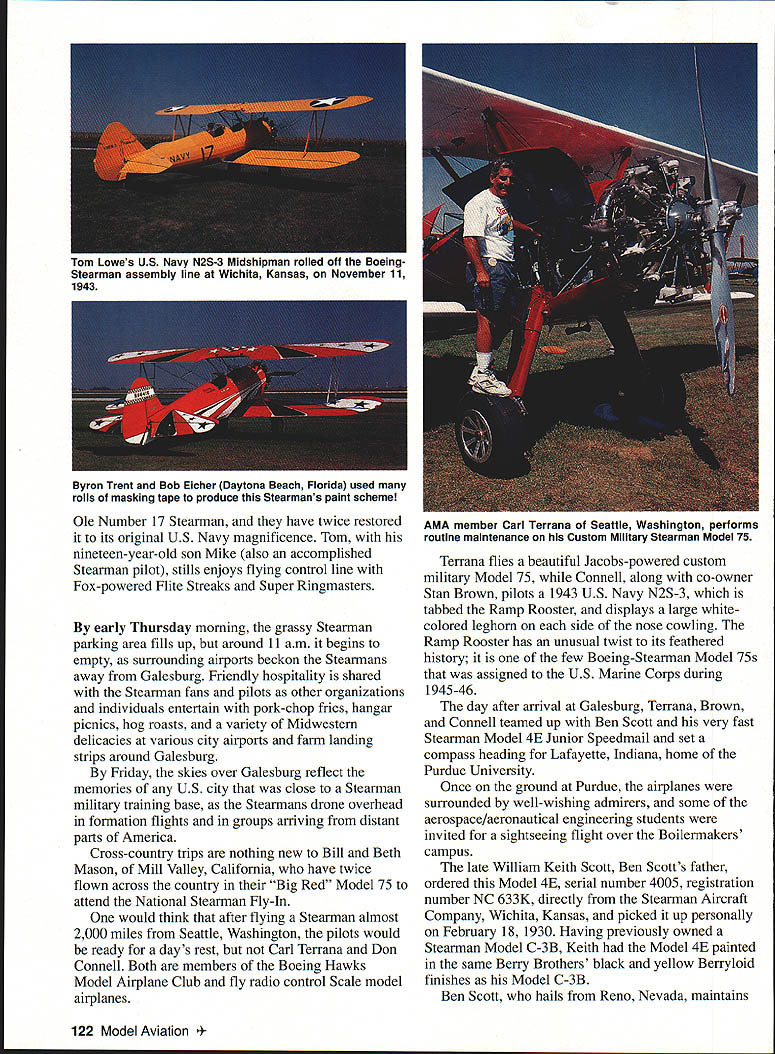
Tom and Nancy Lowe’s N2S-3, BuAer No. 07222, rolled out of Boeing’s Wichita Division on November 11, 1942. It was assigned to Naval Air Station Bunker Hill, Peru, Indiana (the “Cornfield Sailors”), and later to Naval Auxiliary Air Field Cabaniss, Dallas, Texas, in October 1945. Stricken from Navy records on March 31, 1946, it was sold as surplus and used by the Florida State Mosquito Control Office as a sprayer. The Lowes purchased the airplane in April 1969 (nicknamed Ole Number 17) and have twice restored it to its original Navy configuration.
Notable participants and airplanes
- Bill and Beth Mason of Mill Valley, California, have twice flown their "Big Red" Model 75 cross-country—nearly 2,000 miles—to attend the Fly-In.
- Carl Terrana and Don Connell (members of the Boeing Hawks Model Airplane Club) fly radio-control scale models; Terrana pilots a Jacobs-powered custom military Model 75, while Connell and co‑owner Stan Brown fly a 1943 U.S. Navy N2S-3 dubbed the Ramp Rooster, which carries a large white leghorn on each side of the nose cowling. The Ramp Rooster is one of the few Model 75s that was assigned to the U.S. Marine Corps during 1945–46.
- Terrana, Brown, Connell, and Ben Scott have teamed up in cross-country formation flights. Ben Scott flies a very fast Stearman Model 4E Junior Speedmail originally ordered by his father, the late William Keith Scott, on February 18, 1930 (serial number 4005, NC 633K). Keith Scott painted it in Berry Brothers' black-and-yellow Berylloid finishes and used a wolf’s head logo (the University of Nevada Wolfpack trademark), a scheme Ben Scott preserves.
Daily schedule and activities
- Wednesday: Registration and early arrivals; pilots buddy-hop and socialize.
- Thursday: By early morning the grassy Stearman parking area fills; by late morning many Stearmans depart for surrounding airports. Local hospitality includes pork-chop fries, hangar picnics, hog roasts, and Midwestern fare at city airports and farm strips around Galesburg.
- Friday: The skies over Galesburg fill with Stearmans in formation and arrivals from across the country. At 5:30 p.m. flying at Galesburg Municipal Airport is halted for a Stearman mini-airshow featuring aerobatic routines (e.g., Dave "Cowboy of the Skies" Dacy’s 450-hp Pratt & Whitney–powered Stearman).
- Evenings: The Fly-In headquarters hotel hosts informal social gatherings with movies and slides of past Fly-Ins and technical conversation about Stearmans (color schemes, markings, and topics such as Model 75 wing leading-edge spin strips).
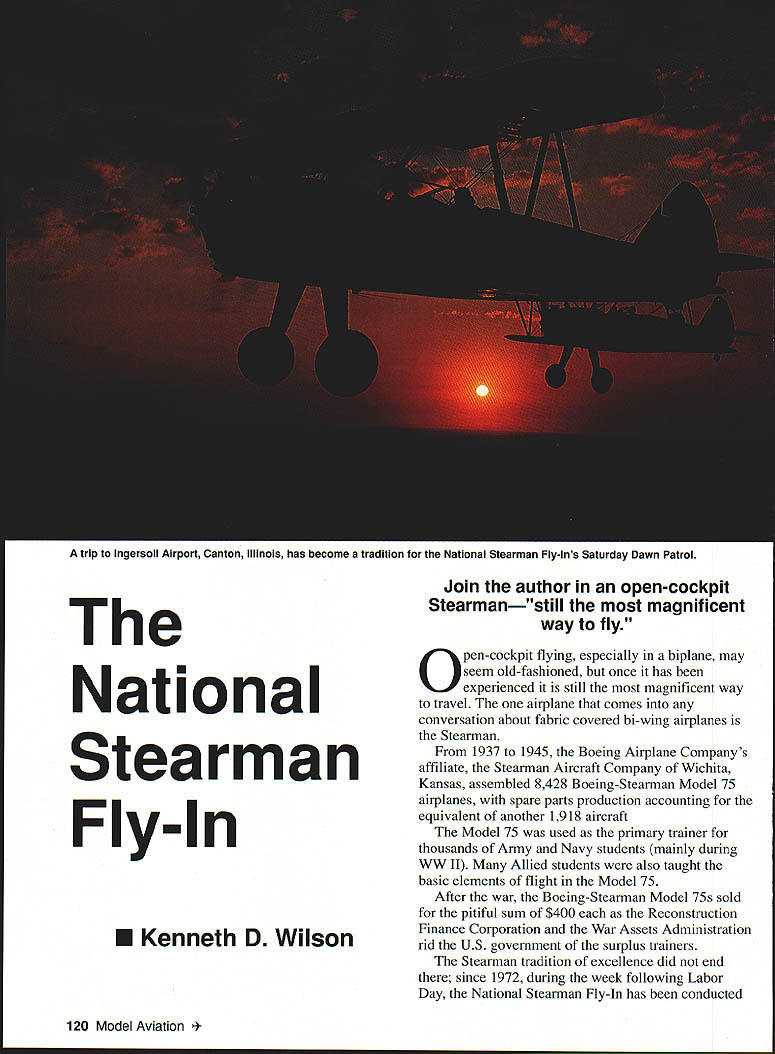
- Saturday morning: The Fly-In’s traditional Dawn Patrol departs—recently to Ingersoll Airport, Canton, Illinois (formerly to Monmouth, Illinois). The Fulton County Flying Club in Canton directs parking and serves breakfast. After the group photo the Stearman Aerobatic contest begins.
Competitions and contests
The Fly-In features low-key, fun events for Stearman pilots. The Fly-In Board of Directors devised a plan where one flight entry can qualify an airplane for three separate events. Typical contests include:
- Short Field Takeoff
- Distance measured from a designated starting line to the point where the main wheels left the runway and the airplane was fully airborne.
- The Stearman must enter the established left-hand traffic pattern from the Short Field Takeoff and fly back over the airport for the next challenge.
- Flour Bombing Contest
- A white limed target circle is laid out in a grassy area beside the runway.
- Each pilot gets two passes and drops one flour bomb per pass from a minimum altitude of 100 feet.
- Scores are often separated by only inches.
- Spot Landing Contest
- A white line is limed on the grass runway adjacent to the paved runway.
- Landings short of the line indicate a mishap; distance is measured from the line to where the tail wheel touches down.
- Formation Flying Contest
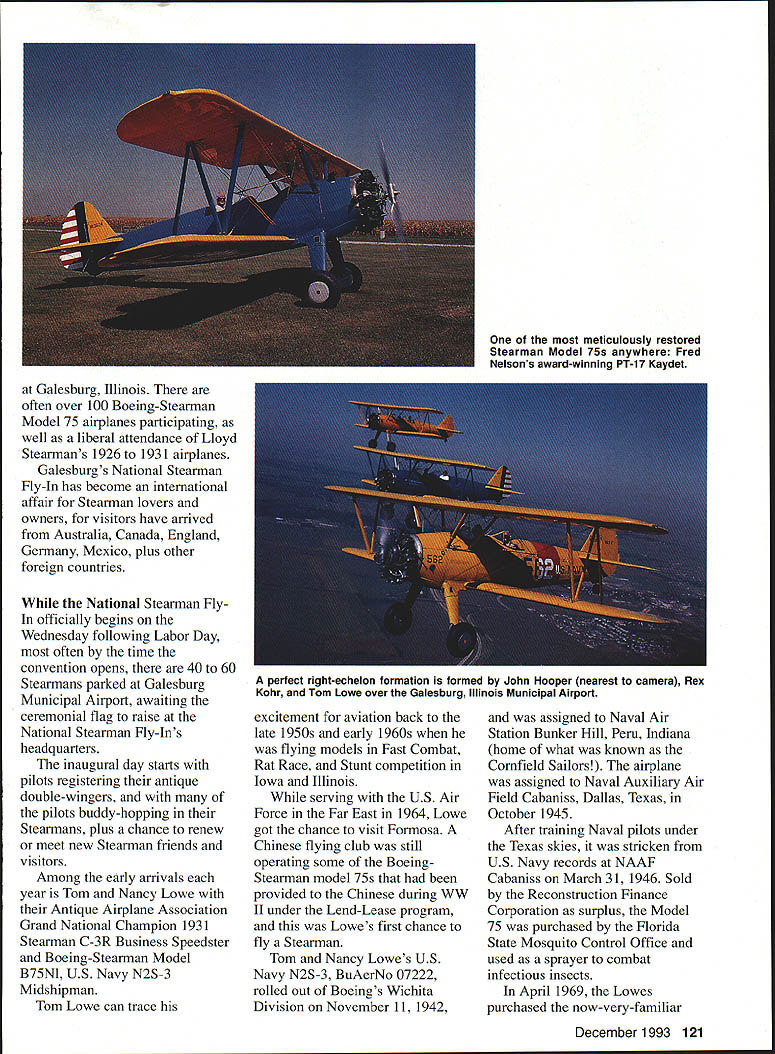
- Aircraft are judged on takeoff and join-up, Finger Four, Diamond, Right Echelon formations, and the break for landing.
- Teams from the same region practice to tight tolerances; only a few points often separate scores.
The Stearman Aerobatic contest is intended to be friendly: pilots choose uncomplicated maneuvers flown within a judged box (each maneuver scored one to five). The first-place winner is retired from future competition and typically joins the judges’ committee in subsequent years.
Saturday evening
Saturday’s events conclude with a hotel banquet and awards presentation. Special guests with notable Stearman experiences are invited to speak. A popular speaker has been Sammy Mason, who flew his orange-and-white Checkers airshow Stearman during the 1945–50 airshow seasons. Sammy’s accomplishments include:
- Operating the first airshow Model 75.
- First to install a 450-hp Pratt & Whitney on an airshow Model 75.
- First to install a dual aileron system on a Model 75.
- First to use a 1,000-lb-thrust JATO unit on a Model 75.
Sammy Mason received the Lloyd Stearman Award from the Stearman Restorers Association. His Checkers airshow Stearman was popularized further when a model of it was entered in the 1948 National Model Airplane Championships; the model plans were published in the April 1950 issue of Air Trails.
Stearman Restorers Association
The Stearman Restorers Association, an independent non-profit dedicated to preserving and flying Stearman aircraft, traces its roots to 1960 and has approximately 2,000 members. While it has no official capacity at the National Stearman Fly-In, many SRA members volunteer time and effort to support the event.
Membership and contact
- Anyone interested in Stearman airplanes is invited to join the Stearman Restorers Association.
- Membership information: Brian Riggs, President, Stearman Restorers Association, P.O. Box 10663, Rockville, MD 20850.
Visitor information and etiquette
- The National Stearman Fly-In Board of Directors welcomes all Stearman enthusiasts to Galesburg, but due to insurance regulations, access to the Stearman airplane parking area is restricted. Persons permitted in the parking area must be:
- A pilot or airplane owner, or
- An A&P mechanic, or
- A member of the Experimental Aircraft Association, the Antique Airplane Association, the Academy of Model Aeronautics, or a similar aviation organization.
- Upon arrival at Galesburg Municipal Airport, go to the National Stearman Fly-In Headquarters on the flight line and show your AMA membership card. After paying a nominal registration fee you will be allowed in the parking area to photograph and speak directly with owners and pilots.
- Courtesy: Never touch or climb on a Stearman without the owner’s permission. If you do not know the owner, ask around. Politeness and a brief explanation of your purpose usually gain an introduction and a new Stearman friend.
Modeling and the Fly-In
The Fly-In is a mecca for Stearman modelers. Models range from 1/48-scale plastic kits to 1/3-scale radio-control aircraft, and model plans are widely available (model master John Pond offers at least 14 Stearman plans). The Fly-In attracts modelers and builders who appreciate the type from full scale to scale models.
Transcribed from original scans by AI. Minor OCR errors may remain.

