
Nationals: Behind the Scenes
WHEN THE NAVY in 1972 phased out 25 years of hosting the Nats, AMA began a series of adventures to test the feasibility of going it alone. Each Nats since then has been a challenge to find the best combination of site and schedule, with the 1976 event the most complicated to date.
In each Nats situation since 1972 it has been necessary to adapt to sites available—not much choice has been involved. Event scheduling, however, has been subject to experimentation; somewhat related to the site situation but also in response to pressures from various competition interests.
Ever since the '73 Nats at Oshkosh, Wisconsin, where Free Flight interests had a bad time due to an inadequate site, AMA's Nats Executive Committee and the AMA Executive Council have sought to improve the Nats FF situation. There was some improvement in '74 at Lake Charles, Louisiana, although compromised by difficult model retrieving conditions. Better weather in '75 at the same site minimized that problem so it was a happier Nats for free flighters.
We could have stayed at Lake Charles another year but there was a general clamor in 1975 to move the Nats around the country. AMA officers, anxious to show a willingness to have the Nats in different places, moved on to Ohio for '76, but not without problems.
The initial Ohio site possibility fizzled out when the former Air Force base at Wilmington turned out to be unavailable. Negotiations for the use of Wright Field were more successful but almost turned sour when it was realized that, because not all of the field would be available, Free Flight operations would be seriously restricted. Wright Field is marginal as a free-flight site even when the entire airfield is available but, when it was discovered that most of two major areas of the field (two sides of the airfield triangle) would be off-limits to Nats operations, a search began for still another Ohio site.
Luckily, Springfield airport, about 30 miles away from Wright Field, was available for a limited operation. Springfield could accommodate the higher performance Free Flight events and also RC Soaring, while Wright Field could take care of the rest: Control Line, Scale, RC Pylon and Pattern.
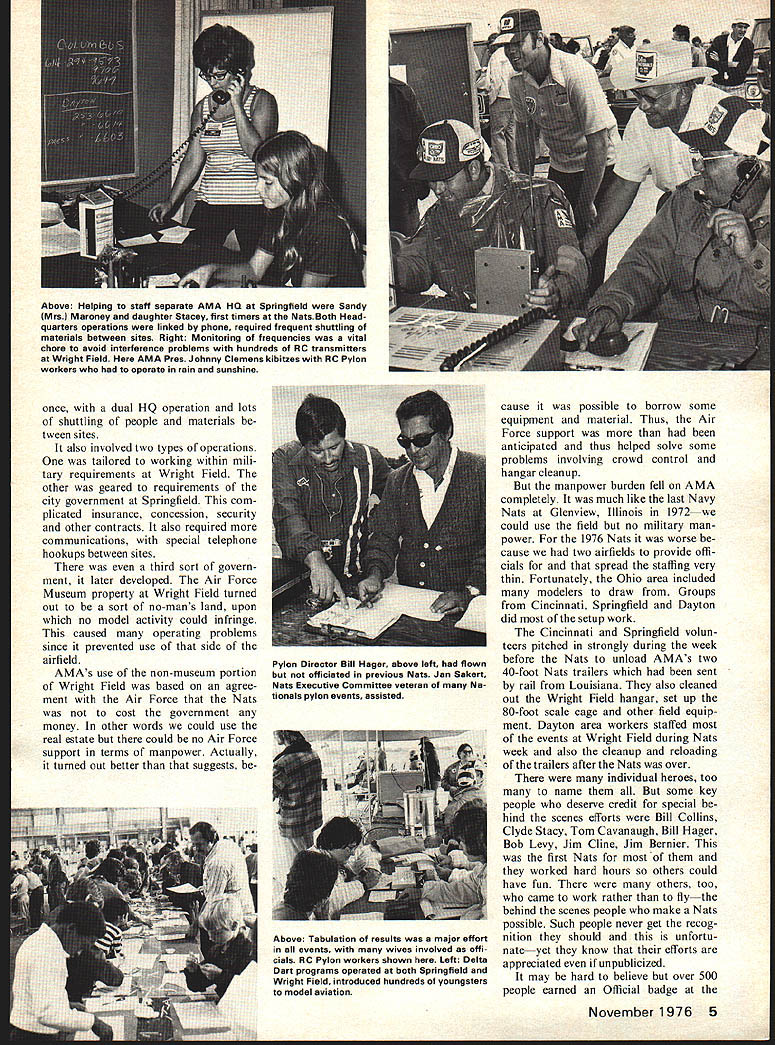
Thus a two site operation was developed. It was an extension of the '75 Nats plan which had RC Soaring at a second site. But the '76 Nats plan was far more extensive. In many ways it was a gamble. It was equivalent to running two Nats at once, with a dual HQ operation and lots of shuttling of people and materials between sites.
It also involved two types of operations. One was tailored to working within military requirements at Wright Field. The other was geared to requirements of the city government at Springfield. This complicated insurance, concession, security and other contracts. It also required more communications, with special telephone hookups between sites.
There was even a third sort of government, it later developed. The Air Force Museum property at Wright Field turned out to be a sort of no-man's land, upon which no model activity could infringe. This caused many operating problems, since it prevented use of that side of the airfield.
AMA's use of the non-museum portion of Wright Field was based on an agreement with the Air Force that the Nats was not to cost the government any money. In other words we could use the real estate but there could be no Air Force support in terms of manpower. Actually, it turned out better than that suggests, because it was possible to borrow some equipment and material. Thus, the Air Force support was more than had been anticipated and thus helped solve some problems involving crowd control and hangar cleanup.
But the manpower burden fell on AMA completely. It was much like the last Navy Nats at Glenview, Illinois in 1972—we could use the field but no military manpower. For the 1976 Nats it was worse because we had two airfields to provide officials for and that spread the staffing very thin. Fortunately the Ohio area included many modelers to draw from. Groups from Cincinnati, Springfield and Dayton did most of the setup work.
The Cincinnati and Springfield volunteers pitched in strongly during the week before the Nats to unload AMA's two 40-foot Nats trailers which had been sent by rail from Louisiana. They also cleaned out the Wright Field hangar, set up the 80-foot scale cage and other field equipment. Dayton area workers staffed most of the events at Wright Field during Nats week and also the cleanup and reloading of the trailers after the Nats was over.
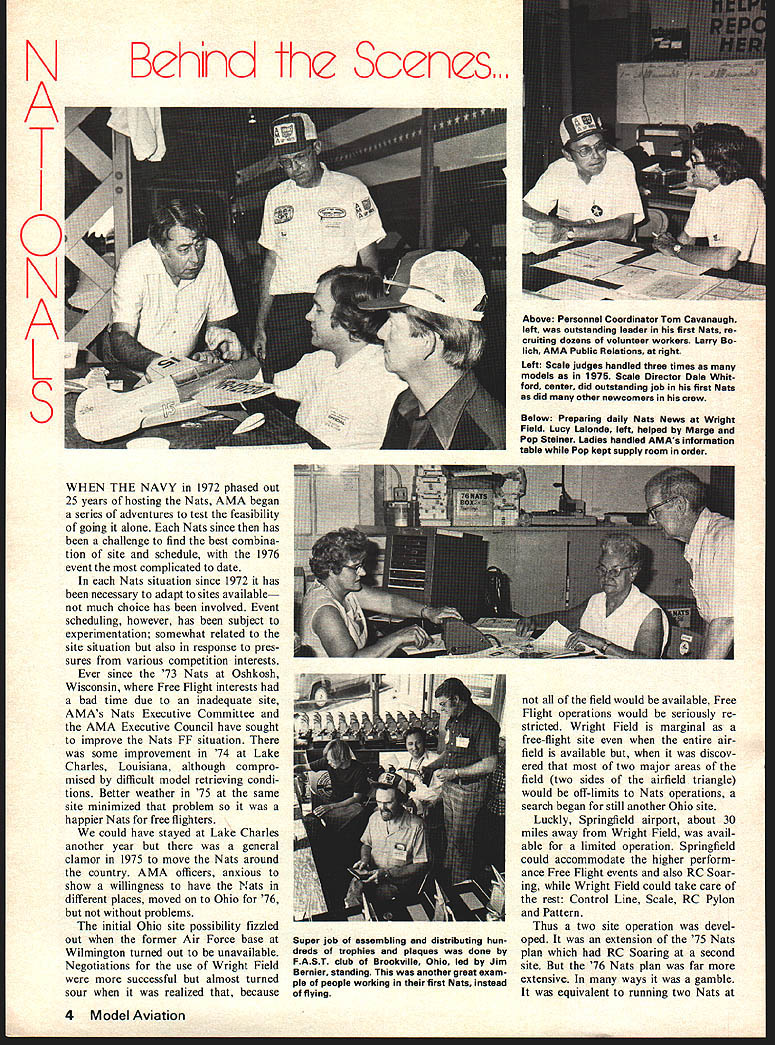
There were many individual heroes, too many to name them all. But some people who deserve credit for special behind the scenes efforts were Bill Collins, Clyde Stacy, Tom Cavanaugh, Bill Hager, Bob Levy, Jim Cline, Jim Benner. This was the first Nats for most of them and they worked hard hours so others could have fun. There were many others, too, who came to work rather than to fly—the behind the scenes people who make a Nats possible. Such people never get the recognition they should and this is unfortunate—they know that their efforts are appreciated even if unpublicized.
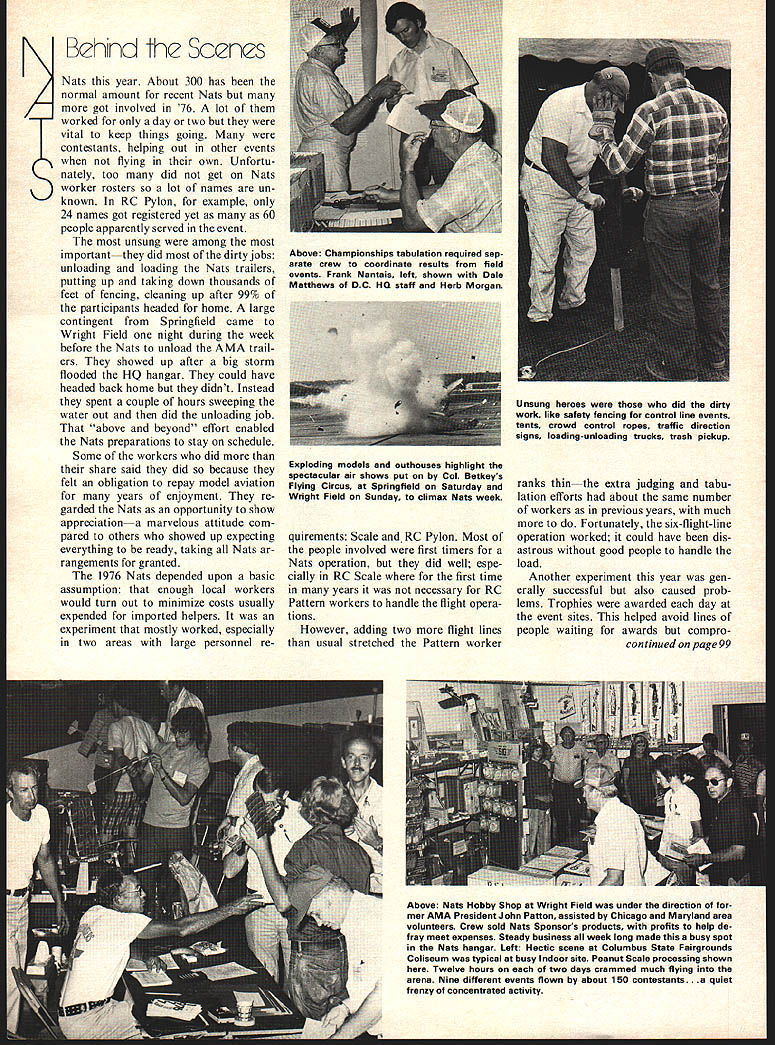
It may be hard to believe but over 500 people earned an Official badge at the Nats this year. About 300 has been the normal amount for recent Nats but many more got involved in '76. A lot of them worked for only a day or two but they were vital to keep things going. Many were contestants, helping out in other events when not flying in their own. Unfortunately, too many did not get on Nats worker rosters so a lot of names are unknown. In RC Pylon, for example, only 24 names got registered yet as many as 60 people apparently served in the event.
The most unsung were among the most important—they did most of the dirty jobs: unloading and loading the Nats trailers, putting up and taking down thousands of feet of fencing, cleaning up after 99% of the participants headed for home. A large contingent from Springfield came to Wright Field one night during the week before the Nats to unload the AMA trailers. They showed up after a big storm flooded the HQ hangar. They could have headed back home but they didn't. Instead they spent a couple of hours sweeping the water out and then did the unloading job. That "above and beyond" effort enabled the Nats preparations to stay on schedule.
Some of the workers who did more than their share said they did so because they felt an obligation to repay model aviation for many years of enjoyment. They regarded the Nats as an opportunity to show appreciation—a marvelous attitude compared to others who showed up expecting everything to be ready, taking all Nats arrangements for granted.
The 1976 Nats depended upon a basic assumption: that enough local workers would turn out to minimize costs usually expended for imported helpers. It was an experiment that mostly worked, especially in two areas with large personnel requirements: Scale and RC Pylon. Most of the people involved were first timers for a Nats operation, but they did well; especially in RC Scale where for the first time in many years it was not necessary for RC Pattern workers to handle the flight operations.
However, adding two more flight lines than usual stretched the Pattern worker ranks thin—the extra judging and tabulation efforts had about the same number of workers as in previous years, with much more to do. Fortunately, the six-flight-line operation worked; it could have been disastrous without good people to handle the load.
Another experiment this year was generally successful but also caused problems. Trophies were awarded each day at the event sites. This helped avoid lines of people waiting for awards but compro-
Nationals: Behind the Scenes
mised by difficult model-retrieving conditions. Better weather in 1975 at the same site minimized the problem, and happier Nats free-flyers could have stayed at Lake Charles another year; there was a general clamor. In 1975 the idea developed of moving the Nats around the country and AMA officers were anxious to show a willingness to have the Nats in different places, so the move to Ohio in 1976 was planned. Problems with the initial Ohio site possibility fizzled out when the former Air Force base at Wilmington turned out to be unavailable. Negotiations to use Wright Field were successful but almost turned sour when it was realized that the Air Force Museum property at Wright Field was sort of a no-man's land upon which no model activity could infringe. This caused operating problems since it prevented use of the side airfield.
AMA's use of the non-museum portion of Wright Field was based on an agreement: the Air Force would allow use of the real estate but would not provide manpower or other direct support. Actually, this turned out to be a mixed blessing because it was possible to borrow some equipment and material. Thus limited Air Force cooperation helped solve some problems involving crowd control, hangar cleanup and the manpower burden that otherwise would have fallen completely on the AMA—much as happened at the last Navy Nats at Glenview, Illinois in 1972 when we could use a field but had no military manpower.
The 1976 Nats were made more difficult by having two airfields, which spread official staffing very thin. Fortunately, the Ohio area included modelers drawn from nearby clubs who provided much-needed help.
The multiple-site arrangement also caused tabulation problems. Many events did not have time, with huge entry lists, to tabulate results past the trophy winners. So many contestants left without knowing how they had placed. This is a problem which will get more attention next year, but the only answer seems to be more workers to keep up with tabulation as the events proceed.
The tabulation problem was aggravated by the separate sites. It was difficult to find out at one site what had happened at the other. It became more complicated when some tabulation errors were discovered after trophies had been awarded—some exchanges had to be arranged by mail after the Nats was over.
We got away with the two-site operation but just barely. The universal opinion... The universal opinion of key officials was "never again." Adding to the burden was the largest registration of many years, perhaps the largest ever. There were over 2,500 fee-paying participants; almost 1,700 contestants and over 800 mechanics or helpers. The 1976 registration figures more than doubled those of 1975—the latter total was only about 1,200!
The large turnout helped pay the bills for the extra costs of the two-site operation: extra portability, extra transportation and communications, extra staffing, etc. The ultimate hope in all this was that the extra income from the large participation would cover the extra costs—it was hoped that the large participation would cover the extra costs—about $75,000 was budgeted for the '76 Nats, as compared with about $60,000 for 1975.
Had a single-site operation been possible with such a large entry, expense savings would have provided more and better services and/or less costly entry fees. It might, for example, have been possible to bring in more key officials such as judges. More experienced Nats officials might have been available if more in the way of travel-expense compensation had been possible.
Aside from such problems it was a great Nats. Most contestants seemed to be happy with how things went, especially for the many who said that the 1976 Nats was their first. Good weather on most days also was a big factor. Rain on Friday dampened enthusiasm somewhat as did windy weather before and after, but for almost five full days the weather was good and most of those who did their thing on those days had a good time.
Unfortunately, the RC Soaring people got the brunt of the bad weather. They had only three days to work with and those days bracketed the rainy and windy part of the Nats. The wind and rain, however, didn't stop flying altogether. It delayed some events a bit but all were completed.
Free Flight at Springfield had a couple of problem situations but most fliers seemed to enjoy themselves. One problem was trying to retrieve models from corn fields. Free fighters hate corn fields!
Besides the corn fields there were crops of alfalfa and beans. Running bikes and cars through the alfalfa and thrashing around in the beans cost AMA about $400 in compensation to the farmers.
Wind shifts made it difficult to move launch areas so as to avoid the corn but aside from this problem the Springfield site was generally regarded as better than the Nats FF sites of recent years. Lars Olofsson, the FAI Power World Champion, who was a special guest at the '76 Nats, classed the Springfield site as very good.
The most irksome thing to this year's FF competitors was the early cutoff time for daily flying. Due to special problems with the '76 Nats arrangements (which may not be a factor in the future) it was necessary to end model flying each day about 4 p.m., so as to be clear of the runways by 4:30. This situation was psychologically frustrating, to have to quit flying with good weather prevailing. Not only that, but there were some evening FF events at Wright Field from 5 to 9 p.m., which meant a half-hour drive from Springfield each night for those involved in this extra activity. The shuttling back and forth was time-consuming and irritating; too makeshift for much enjoyment. With more flying hours and a more mobile operation, FF at Springfield could have been a very happy operation. As it was, 1976 was better for FF than most other recent years. Many fliers indicated they would be happy to come back to Springfield if we could improve the time available and the retrieving situation.
Including the Society of Antique Modelers (SAM) championships in the 1976 Nats schedule was generally a happy situation. The SAM people had three good weather days but they lost many models when they couldn't operate far enough upwind at Wright Field. They also had much traveling to do — since most were based at Springfield — for the SAM FF events. But, in general, the SAM fliers were the happiest free flighters at the Nats (good weather always helps to minimize problems).
For RC fliers, Wright Field required a last-minute change of event layout, due to an unprecedented number of Pattern entries. When the number of advance entries for that event added up to almost 250, it became obvious that the usual four-flight-line operation would be inadequate. A first-time ever six-flight-line operation was decreed but this required revamping of the entire airfield use plan during the week before the Nats.
This meant that 6000 feet of the 7000-foot runway would be taken up by RC, leaving only 1000 feet for Control Line. But CL requires over 2000 linear feet of runway for the many circles used for Speed, Racing, Aerobatics, Carrier, and Scale events. By using 1000 feet of the main runway, plus 500 feet of a connecting taxiway, plus 500 feet more of the parking lot in front of the Nats hangar, Control Line events were accommodated.
Wright Field also accommodated, but just barely, the evening FF events (Payload, Cargo, Helicopter), three days of the SAM Champs (Society of Antique Modelers), plus three flight lines of RC Scale. It was a tight squeeze for everybody, especially FF Scale which was flown during the windy and rainy part of Nats week, without the freedom of a good upwind launch location.
Somehow it all worked out. It took a lot of work, a lot of money, and a lot of luck. It also took some patience and tolerance on the part of the Air Force. Unfortunately, Wright Field is very close to some off-base housing. Very quickly after the Nats started the Air Force began to receive complaints about noise. It came from an apartment project within about 500 feet and parallel to the main runway.
After some huddling between Air Force and AMA officials it was agreed that early and late engine running should be curtailed. Also, the museum side of Wright Field was to remain off-limits to any model activity which might infringe upon it. This caused operating problems since it prevented use of that side of the airfield. AMA's use of the non-museum portion of Wright Field was based on an agreement that the Air Force would not charge the Nats for the use of real estate, but the Air Force could not provide manpower. Actually, this turned out to be a blessing in disguise because it was possible to borrow some equipment and material. Thus some Air Force support anticipated helped solve some problems involving crowd control, hangar cleanup and manpower; a burden that otherwise would have fallen completely on AMA — much like the last Navy Nats at Glenview, Illinois, 1972, when we could use the field but had no military manpower.
The 1976 Nats were worse because two airfields provided officials spread very thin. Fortunately the Ohio area included modelers draw
Nats/Behind the Scenes (Cont.)
Some contestants were test flying at dawn and others were flying control line until midnight by the light of car headlights!
A special AMA security patrol was organized to prevent engine running before 7:30 a.m. and after 9 p.m. It worked fairly well and the Air Force was able to live with the noise complaints between those hours. The problem, however, suggests that future Nats may be limited to sites further away from neighborhoods, or else noise limits on all engine events may have to be imposed.
The problem accentuates the difficulty of getting Nats sites. The size of the Nats operation makes many sites unsuitable—it takes a very big airfield to handle all the events, especially Free Flight. Yet even if a site is big enough, if it's too close to a community, the noise problem may limit operations. And if the base is active there may be noise complaints from the base itself—we got complaints at Wright Field from some employees who were working there during the Nats week.
Both military and civilian airfields have problems which complicate the site selection problem. With the military hamstrung by tight budgets which prevent offering anything other than use of the property, there are now other problems which never used to be problems. These days every use of a military installation is subject to safety, security, and environmental restrictions that were not a problem before. These seem to be the most noticeable effect of this has been the time factor in getting approval for details of operation. It takes months in many cases.
Back in 1972 negotiations had been initiated for the use of Chanute Air Force Base as a '73 Nats site. Months later, well into 1973, approval had still not been obtained as a last minute switch to Oshkosh was made. Negotiations regarding the use of Wright Field also took a long time during '75 and '76 but details were worked out just in time. It's not that the Air Force isn't willing to have us—they are—but the paperwork processing requirements are frustrating. It's all part of a new atmosphere concerning the military: every detail of operation is subject to question and review because of anti-military interests who tend to criticize all aspects of operations. It's very discouraging to Air Force morale and makes our negotiations difficult and time-consuming.
Negotiating with civilian airport operators is much simpler but there's a different factor to contend with. This involves the loss of income to general aviation businesses when an airfield is shut down for a week. The obvious answer to this problem is to compensate the businesses for any loss. It cost AMA $2,000 to compensate the Fixed Base Operation at Springfield this year. The city donated the use of the airport without charge, but it couldn't ask the FBO to give up income from fuel sales, charter flights, student lessons, etc. So AMA had to foot that bill.
This was possible in the Springfield case because only one operator was involved. But in the case of negotiations for the use of Brown Field near San Diego as a possible '77 Nats site there was one operator too many. Of six FBO's all but one agreed to accept compensation for loss of income but that one refused so Brown Field has been dropped out of the potential Nats site picture.
This experience suggests that a very active civilian airport may be impossible to use for a Nats. So our search is inherently limited to relatively inactive or completely inactive sites. But it's more than a matter of finding a place that's not busy. There are many abandoned airports around the country. In addition to a suitable airfield it takes a lot in the way of accommodations to handle the 2 to 3000 people who are involved at a large Nats.
It takes a combination of motels, camping, and college dormitories. At the 1976 Nats about 600 participants stayed in college dorms, about the same amount camped, and about 1000 used motels. Several hundred others commuted from near-by homes. Thus the often heard "answer" to the Nats site problem of simply finding an abandoned airfield somewhere is not good enough.
A lot of feeding is involved, too. AMA President Clemens did a little estimating on the '76 Nats and the figures help to put the need in perspective; there were at least 3000 participants (over 2200 registered participants and at least 500 officials), to say nothing of several thousand AMA members, local spectators, each of whom averaged about $10 per day in food. That's about $50,000 per day for food alone. Throw in camping, dorm, and motel bills for a million dollars, probably much more.
The Dayton-Springfield area felt the Nats impact in 1976. Both areas want us back in 1977. Although the Air Force can't handle the whole show at Wright Field they'd like to have us back with about the same amount of activity we had there this year. We may go back to Dayton with some special event of national significance for 1977; perhaps the RC Masters event or some such major affair.
The Springfield people, however, have already offered to host the whole Nats in 1977. The airfield at Springfield is bigger than the one at Wright Field, so it's possible, although there are problems concerning how to avoid conflicts between Free Flight and other categories. One possibility is a return to the longer schedule of the 1974 Nats, but in different fashion: FF and RC Soaring to precede the rest of the Nats.
There was much unhappiness with the long Nats of 1974 but mostly due to a schedule that had RC Pattern and Scale all alone the last few days. Current thinking is that an easy starting schedule leading up to a big finish is a better way to go. The idea is being explored at present.
Meanwhile, the major problem of how to better staff the Nats is being looked at more closely, with a view toward getting the special-interest organizations more involved. The National Society for RC Aerobatics, for example, has offered to run the Pattern part of the '77 Nats. It would be helpful if other groups, such as those for Free Flight, RC Pylon, RC Sailplanes, etc., would take their events on in similar fashion; just as SAM did for the Old Timers.
But it won't be easy. Running a week-long event demands much more than a weekend contest. And it's vital for each group to operate compatibly with others, which means that compromises are inevitable. On the other hand, if those who have the most to say in criticizing an event would take more of a role in running it, the chances of improving the situation might be increased.
Last year the NSRCA bowed out of a previous offer to run the '76 Pattern event. But they seem willing and more determined to take up the challenge for '77. Similar offers to help are desired from other groups, provided they are serious about doing the job with equal willingness to sacrifice the pleasure of flying as those who have been running their events in recent years.
In other words, AMA is saying that those who complain the most about how to run the Nats are welcome to try to do it better. It's a challenge to all affiliated AMA organizations to do what the Precision Aerobatics Model Pilots Association (PAMPA) has done for Control Line at the Nats—acceptance of responsibility to do the whole job regarding their interest. The time to offer is now, before planning gets specific in January, so that any new ways of doing things can be blended into the overall Nats effort.
The 1976 Nats was a very big and largely happy affair that in itself is a major achievement so soon after the Navy had to bow out. AMA has shown its ability to handle differing site problems. So the Nats will go on—there are several site possibilities for '77.
At press time the Springfield bid seemed the strongest for the '77 Nats but other possibilities were also in the running: Oxnard, Calif.; Lake Charles, La.; Houston, Texas. A big deciding factor will be financial. Of AMA's four non-Navy Nats operations since 1972, the 1973 Nats lost $5,000, the 1974 Nats lost about $20,000, the 1975 Nats came within a few hundred dollars of breaking even. How the 1976 Nats made out (it will be about the end of September before all bills are in) will have considerable influence over where we go next year.
In any case the Nats site decision will involve compromises. As yet there is no ideal site situation. Furthermore, the overwhelming sentiment of participants is that the Nats should be retained as one big all-embracing extravaganza. AMA will therefore do the best it can with what's available at the time a decision is required. For that there need be no apologies, but there is a need for understanding—the Nats is the world's biggest model meet. As such there will always be problems behind the scenes, but so long as they can be coped with the Nats will continue in the old tradition. This was the 50th Nats—next year we'll start the next 50!
Transcribed from original scans by AI. Minor OCR errors may remain.

