
NATS '78
Overview
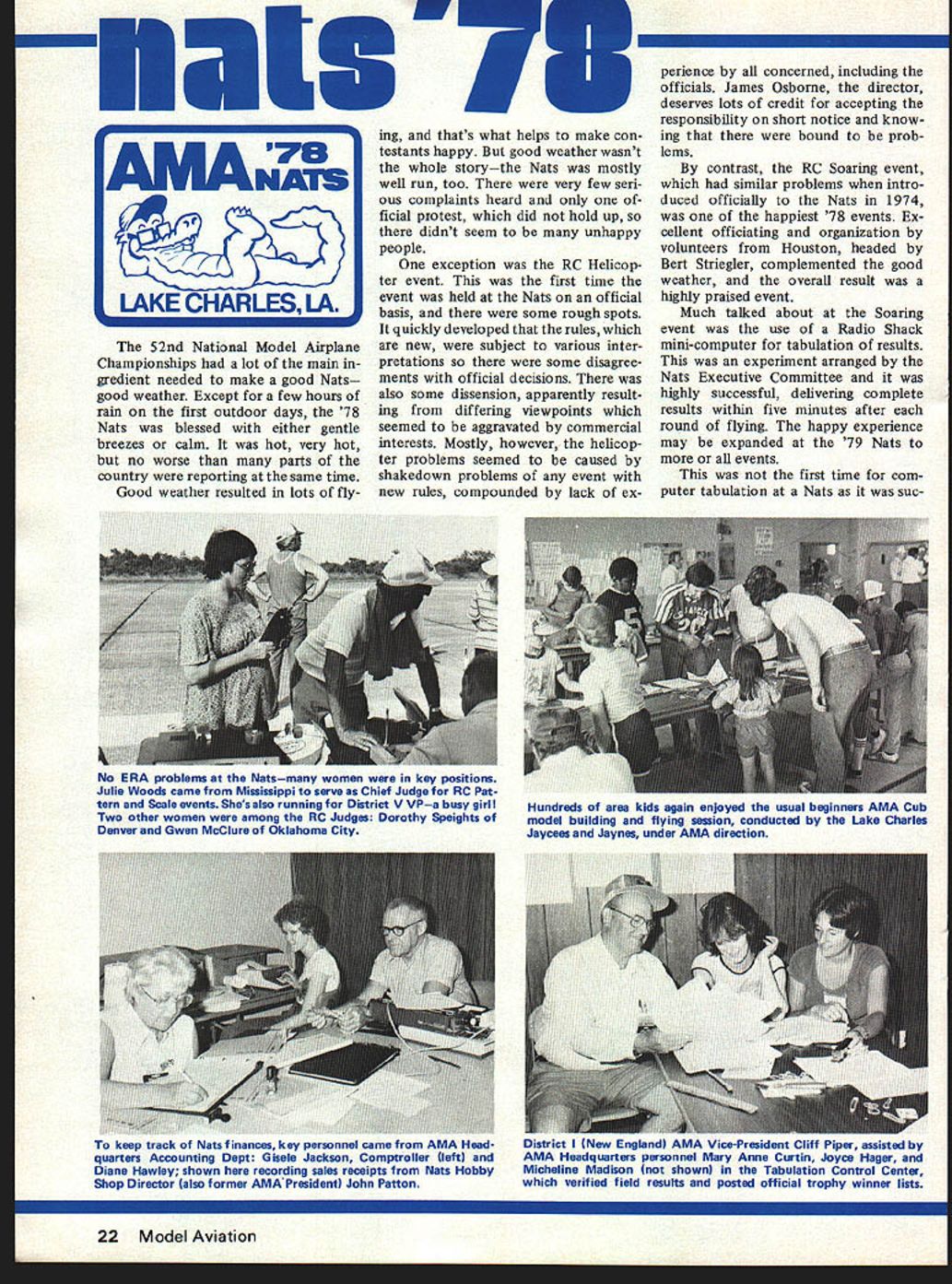
The 52nd National Model Airplane Championships had one of the main ingredients needed for a good Nats—good weather. Except for a few hours of rain on the first outdoor days, the '78 Nats was blessed with gentle breezes or calm. It was hot, very hot, but no worse than many parts of the country were reporting at the same time.
Good weather resulted in lots of flying, which helped make contestants happy. The Nats was also mostly well run: there were very few serious complaints and only one official protest, which did not hold up. For the most part, competitors left satisfied.
RC Helicopter
The RC Helicopter event was held at the Nats on an official basis for the first time and experienced some rough spots. New rules were subject to varying interpretations, leading to disagreements with officials. Dissension, apparently aggravated by differing viewpoints and commercial interests, also appeared. Mostly, however, the problems seemed to come from the usual shakedown of any event with new rules, compounded by lack of experience on all sides, including officials. James Osborne, the director, deserves credit for accepting responsibility on short notice and for handling the inevitable problems.
RC Soaring and computer tabulation
By contrast, RC Soaring—introduced officially to the Nats in 1974—was one of the happiest '78 events. Excellent officiating and organization by volunteers from Houston, headed by Bert Striegler, combined with good weather to produce a highly praised event.
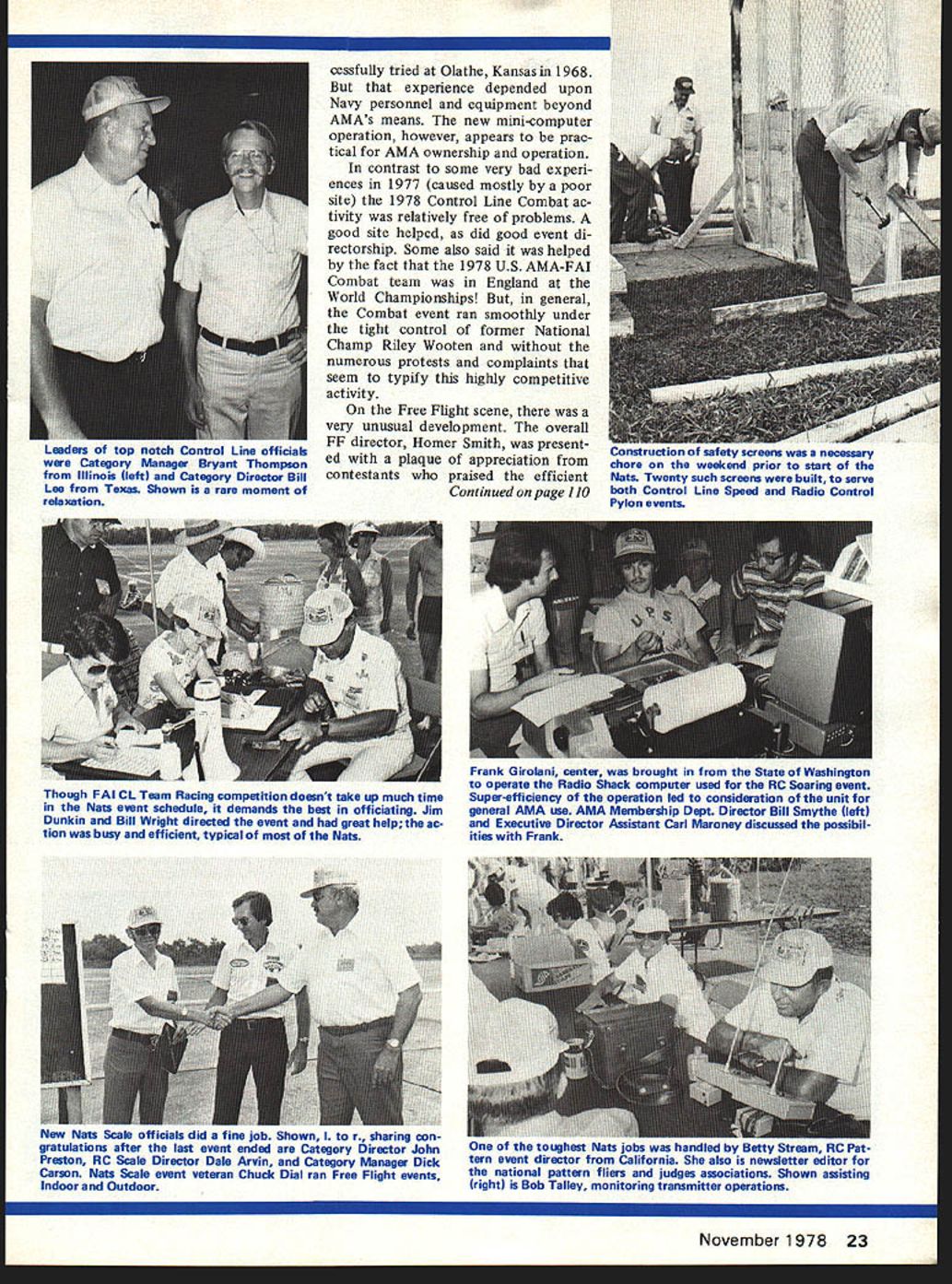
A much-talked-about innovation at Soaring was the use of a Radio Shack mini-computer for tabulation of results. This experiment, arranged by the Nats Executive Committee, was highly successful, delivering complete results within five minutes after each round of flying. The happy experience may be expanded to more or all events at the '79 Nats.
Computer tabulation had been tried before at Olathe, Kansas, in 1968, but that effort depended on Navy personnel and equipment beyond AMA's means. The new mini-computer operation appears practical for AMA ownership and operation.
Control Line Combat and other CL activity
Control Line Combat activity was relatively free of problems—a good site and strong event directorship helped. Some noted that the 1978 U.S. AMA-FAI Combat team had been to the World Championships in England; that experience may have been a factor. The general Combat event ran smoothly under tight control. Former national champ Riley Wooten observed that numerous protests and complaints often typify highly competitive activity.
Control Line activity in general was highly praised. The team of Bryant Thompson and Bill Lee as manager and director, plus excellent individual event directors and assistants, kept problems to a minimum. Notable combinations of people included:
- Linda Wheeler (Texas) in charge of Racing events, assisted by Vic Garner (California).
- Gerry Deneau (Denver) running Carrier events.
- John Shannon and Dubb Jett (Texas) directing Speed events.
- Arlie Preszler directing Precision Aerobatics, repeating his excellent job from the previous year.
Crises solved before and during the Nats
Several logistical crises were discovered and resolved in the week before the Nats:
- Carrier decks: The AMA Carrier decks could not be transported from Ohio (where they had been stored since 1976). The problem was solved when Bob Vojslavek arranged to have two Chicago decks trucked to Louisiana by his son Bill and Stan Stoy.
- Safety barriers: Speed event safety barriers and RC Pylon barriers were constructed on the weekend before the Nats after the originals had been left in California the year before due to lack of room on the Nats trailer.
- Pylons: RC competitors made new racing pylons on the same weekend to replace heavy plywood units discarded as too bulky; the new pylons were made from standard steel tubing sections for easier transport and storage.
- Telephone service: The biggest behind-the-scenes crisis involved telephone service. Special phone installations had been contracted for a month in advance, including a direct line between Chennault air base and the LARKS club field (about 20 miles away). Up until two days before the Nats only one of the half dozen requested phones was installed. The situation was resolved only after AMA officials sought help from the Louisiana State Public Service Commission.
Free Flight
Free Flight showed a very positive development. Overall FF director Homer Smith was presented with a plaque of appreciation by contestants who praised the efficient operation of events. Homer in turn praised his event directors for excellent organization and friendly administration. The general happiness in the Free Flight events was a welcome contrast to some previous Nats.
RC Pattern and Pylon
RC Pattern was a big and busy event, with almost 200 entries across four classes. Betty Strean again led the event and, with her daughter Suzi and many volunteers, efficiently handled about a thousand flights.
RC Pylon had a relatively light entry turnout, so Ed Rankin and a mostly Dallas/Fort Worth crew had an easier time than in some previous years. Nonetheless, the pylon competition was fierce and required top-quality officiating.
RC Scale
RC Scale drew the biggest crowd anyone could remember. The site was jammed with cars and people, largely because little else was scheduled at the same time. Sport Scale dominated, with roughly ten times as many entries as Precision Scale, and many unusual entries were seen. A largely new crew officiated and did an excellent job. The core team of Dick Carson, John Preston, Dale Arvin, and Chuck Dial worked well together and produced an overall Scale effort with few complaints.
Indoor
Indoor fliers enjoyed a brand-new site—the Burton Coliseum at Lake Charles. Many acclaimed it as one of the best ever at a Nats, even compared to some of the large dirigible hangars of the past. With a ceiling height over a hundred feet and a smooth beam structure (no girder network for models to get caught in), the Coliseum provided two days of happy flying. Event director Sandy Frank helped make it successful. As a result, ideas are being considered for future major indoor events at the site, possibly separate from the Nats.
Contestant viewpoint and operations
From the contestant viewpoint the Nats was a generally smooth operation. That result was due to many dedicated people working behind the scenes to cope with problems most participants take for granted. It could easily have been an unhappy Nats if the weather had been uncooperative or if so many volunteers had not shown up and done such a good job.
It took almost 400 volunteers to staff the Nats—about one for every three entries. Handling so many individuals involves registering, identifying, housing, and communicating with them. To coordinate and process the hundreds of officials and contestants, an AMA Headquarters group of 14 employees worked with volunteers. Besides essential paperwork, the HQ staff supervised and operated:
- a tabulation control center,
- the traditional Nats hobby shop,
- trophy distribution,
- a public information center,
- printing and distribution of the daily Nats News,
- a first aid station,
- souvenir sales.
Local support — the LARKS and the community
As in 1974 and 1975, the LARKS (Lake Area Radio Kontrol Society) provided the backbone of local support. Local volunteers help set up the Nats, keep it running, and clean up afterward. Local support tasks included painting circles for events, arranging rental or purchase of supplies and equipment, selling ads for the Nats program book, unloading the Nats trailer, building items before the Nats, transporting and setting up gear, putting up signs, keeping water coolers filled, and troubleshooting maintenance problems.
Key LARKS leaders who played super-critical roles included President Dennis "Bo" Hinch, Ned Barnes, and John Embry. Many LARKS wives and children also assisted; the LARKS have a women's auxiliary, the LaLarks, who worked at both Nats fields.
Community officials and organizations that provided tremendous assistance included:
- City of Lake Charles
- McNeese State University
- Sowela Technical Institute
- Burton Coliseum
- the Sheriff's Department
- Calcasieu Police Jury
- Lake Charles Civic Center
- Convention and Tourist Commission
- Chamber of Commerce
AMA officers expressed grateful thanks and appreciation for this local and community support.
Size and attendance
The week was busy but relatively calm. The Nats was not as large as some previous meets, but big enough to justify the title of the world's biggest model meet. The official entry list exceeded 1,100; with all officials, the total number of participants was over 1,500. Most attendees went home happy after enjoying the 52nd Nats, part of a series that began in the 1920s.
Where next?
Where the Nats will go next was uncertain at press time. Several sites were being explored: Ohio, Nebraska, Pennsylvania, and Texas. Lincoln, Nebraska became a new possibility after local modelers developed a detailed proposal; the AMA Executive Council planned a fall meeting there to help decide feasibility.
Other possibilities included a return to Willow Grove Naval Air Station near Philadelphia or to the Dayton, Springfield, and/or Columbus areas of Ohio. The option of using Ellington Air Force Base near Houston had gained strength, though that seemed more likely for 1980 than 1979. It was hoped an announcement about the 1979 site could be made before the end of the year.
Meanwhile, memories of a good '78 Nats linger on.
Transcribed from original scans by AI. Minor OCR errors may remain.

