
NATS '78: CL Carrier
Dick Perry
Overview
Carrier flying at Lake Charles has always been an unhurried event, and this year was no exception. The relaxed atmosphere existed because of the low turnout in all classes, but the flights offered plenty of excitement. Flight scores were good, two records were established, and some really close finishes kept people gathered around the scoring table, particularly during the Profile Carrier event.
Participation
Since the 1975 NATS, Navy Carrier activity has been increasing in Louisiana, but there are still only a few Carrier competitors within about 600 miles of Lake Charles. The distance and warm climate apparently discouraged many normally active Carrier fliers from making the trip. Junior and Senior fliers made up almost a third of the entries—an encouraging trend, even though overall participation was low.
Weather and engine issues
Flying started early on Thursday with the scale classes. Wind was very light throughout the day and caused no problems, although some fliers would have preferred a little wind to improve low-speed scores. The biggest weather factors seemed to be temperature and humidity. Many engines that had been adjusted for higher, drier, cooler conditions had to be readjusted for Lake Charles. Engine reliability became a major factor, precipitating a flurry of activity at the practice circles that evening.
Results
Junior Slow Rat
Bob and Tony Smedly won Junior Slow Rat with a Tune/Hill OS Max in a Bob Cat design. They used a Glasswerks 8 x 7-1/2 rat prop and burned 10% nitro fuel. The OS behaved perfectly, producing a four-flip race.
Open Class
Last-minute efforts to extract every available rpm took their toll on a number of Open class teams. Miller/Hoffman blew a connecting rod in their best K&B .8S, and the Harris family developed a swelled piston in their Max. Several others couldn't get their equipment to perform. By the time Open qualifying began, the field had been reduced to 18.
Paul Tune, Larry Hill, and Marshall Busby—the Nashville Rats—wasted no time establishing their superiority. They qualified 1–2–3, with six virtually identical 70-lap heats in the 2:40s. In the finals it was the same story: consistent 10-second pit stops and 120+ mph airspeed. Their slowest heat was sub 5:40 and they claim to be capable of getting into the 5:20s.
They were flying a foam-wing version of their Nashville Rat design, powered by Tune/Hill OS Max engines and swinging Glasswerks 9 x 7 slow-rat props. The prop is worked up to give 18,500–19,000 rpm on the ground. Their fuel system used a chicken-hopper arrangement with a mechanical fast-fill valve: the main tank is streamlined and faired into the leading edge of the inboard wing while the chicken hopper is a small rectangular tank located directly behind the venturi. Flexible fuel line connects the main tank to the chicken hopper, which houses the uniflow vent and fuel pickup line.
Plans for the Nashville Rat, engines, and spare parts are available from:
- Tune/Hill Racing Engines, Box 706, Franklin, TN 37064.
Anatomy of the winning flight
- Proto: 21.0 seconds
- Lap times: 14.8 / 15.0 / 15.0 seconds
- Pit times: 24.7 / 24.7 / 24.3 seconds
- Race time: 5:33.75
Class II Mouse
The Greater Houston Control Line Modelers Association sponsored Class II Mouse as an informal event at Lake Charles. Bill Lee organized and officiated the event with help from other Houston area modelers. Turnout was modest, but those who entered had a good time—Mouse racing offers maximum enjoyment for your racing dollar.
Les Pardue won with a Kustom Kraftersmanship left-hand TD .049 in a Lil Tiger. He used his own graphite-fiber prop, a Glow Bee plug, 50% nitro fuel, and a simple uniflow setup. His scale racer used a two-wheel gear and was larger than some planes designed strictly to the rules, which was not a serious disadvantage. Joe Klauss, Mr. 1/2A and current chairman of the racing advisory committee, finished second with a nicely finished rat-style racer.
Scale and Profile highlights
Other highlights from the meet included several notable scale and profile results and awards (as reported at the event):
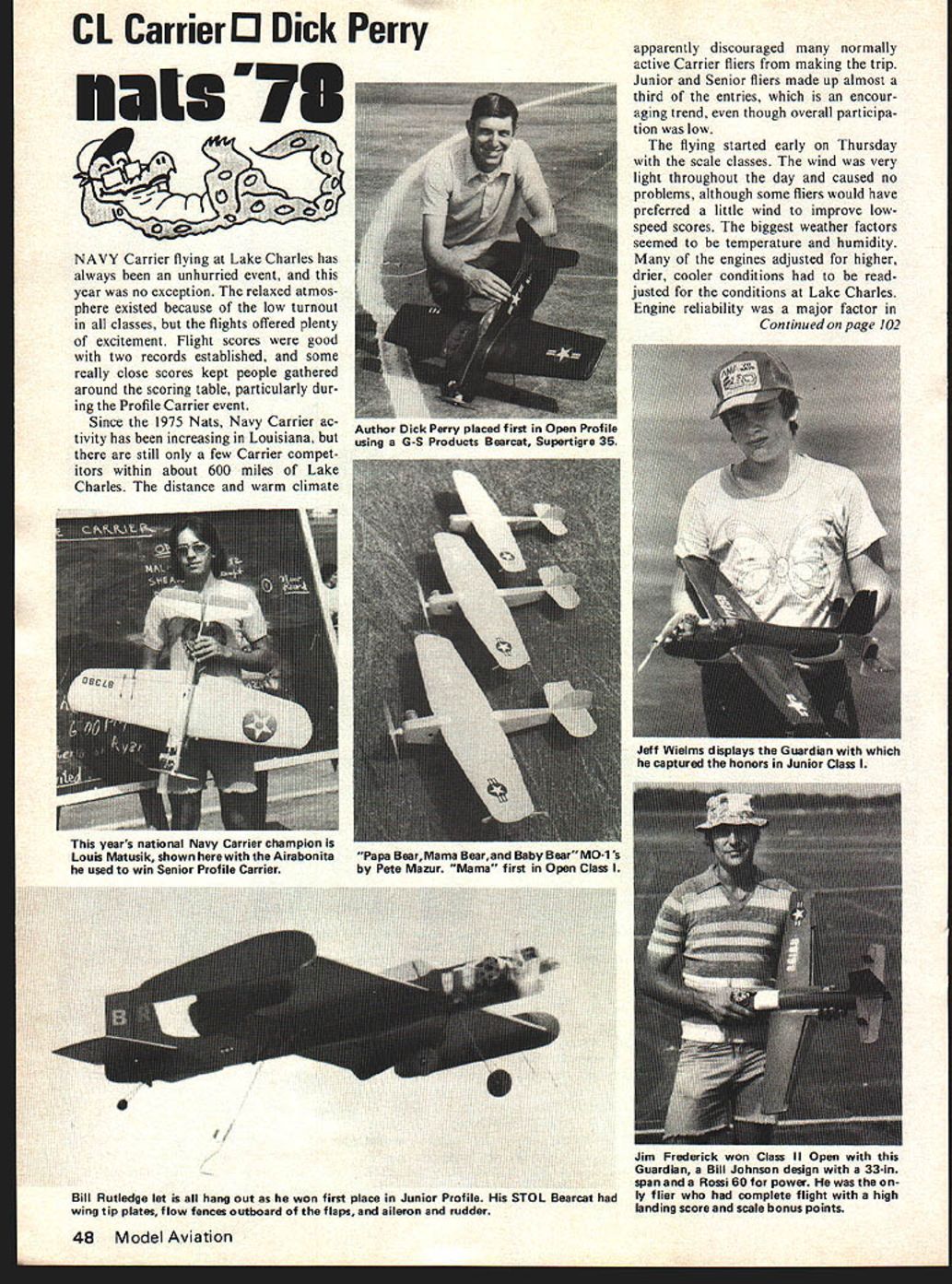
- Author Dick Perry placed first in Open Profile using a G-S Products Bearcat powered by a Supertigre .35.
- National Navy Carrier champion Louis Matusik won Senior Profile Carrier flying an Airabonita.
- Jeff Wielms captured honors in the Junior Profile class.
- Pete Mazur won first Open Class with "Mama."
- Jim Frederick won Class II Open.
- Guardian, a Bill Johnson design with a 33-inch span powered by a Rossi .60, flew a complete flight with a high landing score and scale bonus points.
- Stan Powell presented Roger Barrett the Highest Placing Rookie Award; Barrett finished tied for eighth place in his first NATS.
- At the conclusion banquet, Smilin' Bob Whitely presented the first-place Open trophy keys to the trophy case containing the Walker Trophy.
Equipment notes
Competitive engines in the top placings included several similar types: first and second place engines were of similar design, third place used HP .40 ORR engines, fourth used a K&B .40, and fifth used a K&B .65. The Max .405R finished fifth and shows potential—if you can extract enough power without going into self-destruct mode.
Closing
When compared to Dayton, Chicago, or Oshkosh NATS, the number of control-line scale contestants at a Lake Charles NATS is typically low. Notable absences this year included current members of the FAI CL Scale Team who were in England at the same time, as well as past standouts. Plan now to attend next year wherever the NATS are held—you won't regret it. It's an unbelievably enjoyable and entertaining experience—win or lose. Good people make for good times, and scale people are among the best.
Transcribed from original scans by AI. Minor OCR errors may remain.

