
NATS '78: CL Racing
Goodyear
Qualifying times ranged from a low of 2:47 by the Harris Family Team to a 2:59.9 cut-off time — much better than many experts predicted and close to a 15-second improvement over last year. Banning megaphones for 1978 did nothing to slow things down. Speeds were every bit as good as last year; the most noticeable difference was a dramatic improvement in reliability.
John Ballard won it all in one of the best finals I've ever seen. The heat matched the eventual first- and second-place teams. Gary Fentress pitted for Ballard, while Bud pitted and Doug flew for the Harris family. In the final analysis, heads-up piloting won out over flat-out speed. The Harris family had slightly better top-end speed and were able to pass once during each tank. Ballard used superior acceleration and a half-lap kill to gain ground at the start and on each pit. In the end he was less than a full lap ahead.
Ballard was flying a Rossi-powered Lil Quickie, swinging a Shadow Products 6.6 x 5.5 prop and using a 3-1/2-oz. Don's rat tank. He claims the larger tank has less variation of the fuel head between pits. It also gives more than 80-lap range, which leaves room for a quick pit to correct a bad setting.
So what does it take to be competitive in Goodyear? The hot runners were turning in the mid-15s and hitting 11–12 second pit stops — that translates into darn good teamwork. Equipment-wise:
- Rossi engines
- Glow Bee plugs
- Kelley "Willoughby" or Shadow "Ballard" props
- Trend toward internally connected lines and cleaner planes
The design to be flying this year was the Lil Quickie, popularized by Stewart Willoughby. The design took 1st and 5th and was used by five out of the top 10. (Plans are available for $2.00 a copy from: Stewart G. Willoughby, 607 W. Green St., Bensenville, IL 60106.)
Anatomy of the winning Goodyear flight
- "Go" to 8 laps: 17.5 seconds
- Average airspeed lap: 15.4–15.5 seconds
- 8 laps with a pit: 26.5 / 27.8 / 27.5 seconds
- Race time: 5:45.9
Senior Goodyear
Doug Harris completely out-muscled Bill Hughes and turned the best Goodyear time of this Nats. He used a Rossi-powered Buster set up with internally connected lines, a Kelley "Willoughby" prop, Glow Bee plug, and a Don's 2-1/2-oz. rat tank. Tom Fluker took Junior for the third time with a virtually identical setup.
FAI Team Race
With the U.S. team in England for the World Championships, this was supposed to be an off year for Team Race. Only seven teams actually flew, so participation was low, but the level of competition was excellent. The Willoughby/Oge team turned a 3:59 — the fastest heat time ever recorded at a U.S. Nats. They were flying a beautiful 437-gram Nelson-powered, all-balsa model, turning in high 17s. Bob Oge handled the pit work and did an outstanding job considering this was only his second day pitting a diesel.
Gary and Milo Wallace were close behind, flying a Nelson-powered Magnum design. The team used a one-way radio which enabled pilot Gary to give instructions to pit man Milo. They tore up their #1 plane in the second heat and never got their backup going in the finals.
Mogi/Jolly qualified third with a brand-new Rossi-powered original. In the 100-lap heats they used a .116" venturi which gave 37-lap range and a two-pit race. For the 200-lap final they switched to a .116" venturi for a four-stop race. Willoughby/Oge stuck to their 33–34 lap setup, so the final shaped up as a battle of speed vs. pits.
Unfortunately, Willoughby ran in at 164 laps, leaving Mogi/Jolly to finish alone.
Rat
Harold and Dick Lambert, father-and-son racing team, realized a dream when they took first and second in Open Rat. They had qualified first and second the past two years but couldn't put it together in the finals last year. 1978 was another story — two letter-perfect heats followed by two more perfect finals.
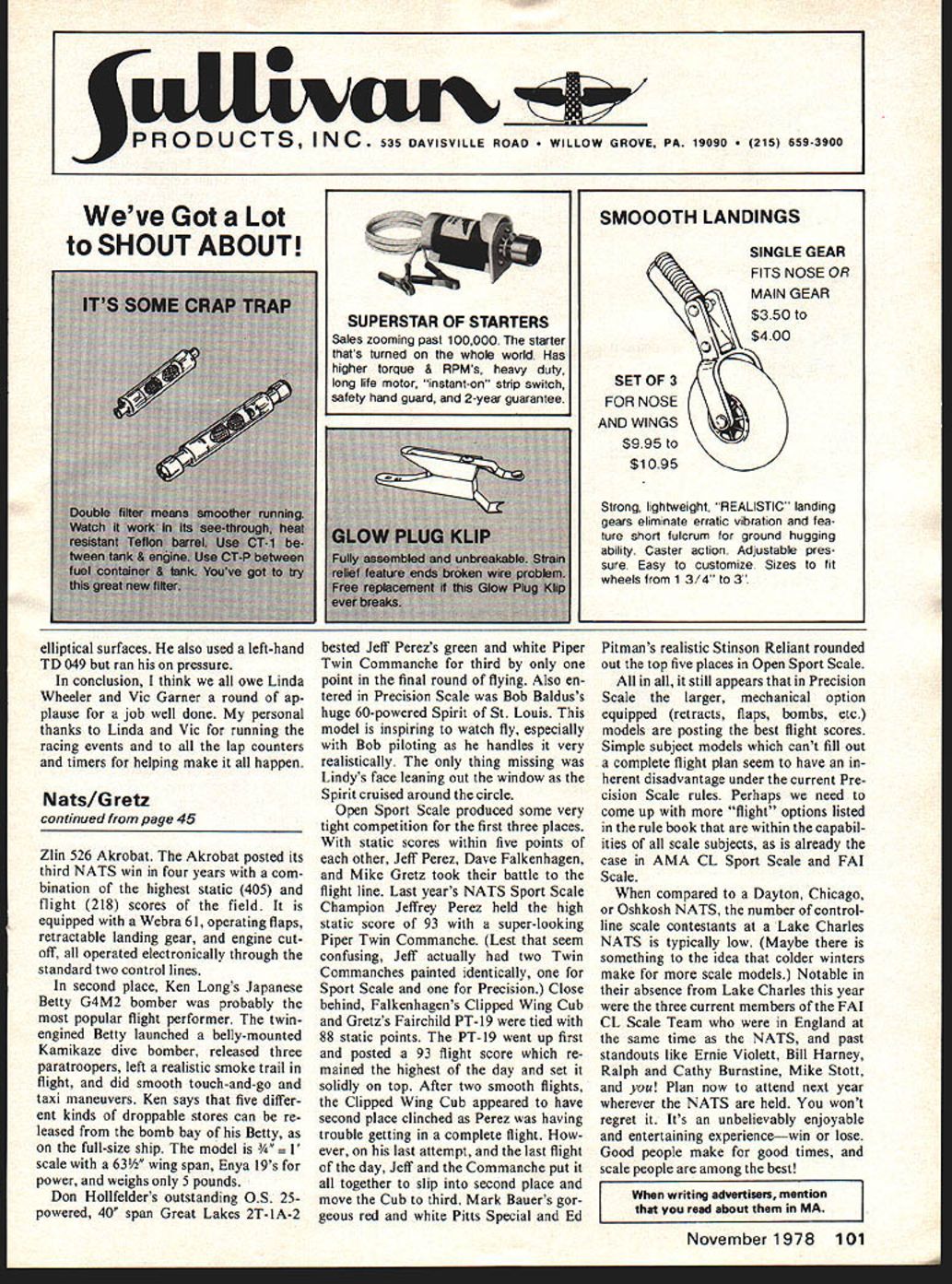
Dick is one of the few rat pilots in the country capable of handling a 150-mph rat. Harold handles the pitting, and although he appears deliberate, his overall pit times were equal to or better than anyone at the field. The Lamberts were flying their own design called the Snake and using HP40RR engines for power. (Editor: Article and plan for the Snake appeared in the June 1977 issue.) They use a 5-oz. tank and swing a Bartels prop. The humidity at Lake Charles didn't bother them a bit — "it's like home."
Equipment-wise, several engines are capable of being competitive in the right hands. Out of the top five:
- 1st & 2nd: HP40RR
- 3rd: K&B40S
- 4th: K&B65.5
- 5th: Max 40SR
The trick is to extract enough power to go fast without slipping into self-destruct mode.
Anatomy of the winning Rat flight
- Proto: 18.5 seconds
- Airspeed laps: 12.2–12.4 seconds
- Pit times: 25.0 / 25.2 / 25.5 seconds
- Race time: 4:51
Senior Rat
John Wolf and Chris Busby had a terrific final — both turned Open-class times. John teamed with Steve Reece and won with a K&B65.5-powered Swamp Rat. They've been flying together for about three years and displayed some of the smoothest teamwork at the Nats.
Junior Rat
The juniors were flying profile rats. Tom Fluker won with an ST G21-40-powered Quickie Rat. Toby Busby, taking time out from skateboarding, gave Tom a run for his money flying a Max 40SR-powered profile patterned after the Nashville fast rat.
Slow Rat
Senior Slow Rat was run the day before Open and promised to be a preview of better things to come. The Nashville Rats have completely dominated this event for the past three years and everybody in the country is out to beat them. One potential challenger this year was the Miller/Hoffman team. Larry Hoffman is a senior and put in a super race to record what looked to be an unbeatable time of 5:43.2. They then sat back to see what Chris Busby could do. Chris broke a prop at the first pit and withdrew, but later flew traffic for another competitor and showed the Texas boys that they still fly Slow Rat in Nashville. This precipitated a flurry of activity at the practice circles that evening.
In Junior Slow Rat, Bob and Tony Smedly won with a Tune/Hill OS Max in a Bob Cat design. They were using a Glasswerks 8 x 7½ rat prop and burning 10% nitro fuel. The OS behaved perfectly, giving a four-flip race.
That last-minute effort to extract every available rpm took its toll on a number of Open-class teams, including Miller/Hoffman who blew a connecting rod in their best K&B65.5, and the Harris family who developed a swelled piston in their Max. Several others just couldn't get their equipment to perform. By the time Open qualifying got underway, the field had been reduced to 18.
Paul Tune, Larry Hill, and Marshall Busby — better known as the Nashville Rats — wasted no time establishing their superiority. They qualified 1–2–3 with six virtually identical 70-lap heats in the 2:40s. In the finals it was the same story — consistent 10-second pit stops and 120+ mph airspeed. Their slowest heat was sub 5:40 and they claim to be capable of getting into the 5:20s. They were flying a foam-wing version of their Nashville Rat design, powered by Tune/Hill OS Max engines and swinging Glasswerks 9 x 7 Slow Rat props. The prop is worked up to give 18,500–19,000 rpm on the ground. They used a chicken-hopper tank setup and a mechanical fast-fill valve.
Tank arrangement:
- Main tank streamlined and faired into the leading edge of the inboard wing
- Chicken-hopper: small rectangular tank located directly behind the venturi
- Flexible fuel line connects the main tank to the chicken-hopper, which houses the uniflow vent and fuel pickup line
Plans for the Nashville Rat, engines, and spare parts are available from: Tune/Hill Racing Engines, Box 706, Franklin, TN 37064.
Anatomy of the winning Slow Rat flight
- Proto: 21.0 seconds
- Lap times: 14.8 / 15.0 / 15.0 seconds
- Pit times: 24.7 / 24.7 / 24.3 seconds
- Race time: 5:33.75
Class II Mouse
The Greater Houston Control Line Modelers Association sponsored Class II Mouse as an informal event at Lake Charles. Bill Lee organized and officiated with help from other Houston area modelers. Turnout was a little disappointing, but those who entered had a good time — Mouse Racing offers maximum enjoyment for your racing dollar.
Les Pardue won with a Kustom Kraftmanship left-hand TD .049 in a Lil Tiger. He used his own graphite-fiber prop, a Glow Bee plug, 50% nitro fuel, and a simple uniflow tank setup. His scale racer used a two-wheel gear and was larger than planes designed to the rules, but this was not a serious disadvantage.
Joe Klauss, Mr. 1/2A and current chairman of the racing advisory committee, was second with a nicely finished rat-style racer with a Bob Cat wing. He used a K&B .049 and a Bartels prop.
Transcribed from original scans by AI. Minor OCR errors may remain.

