
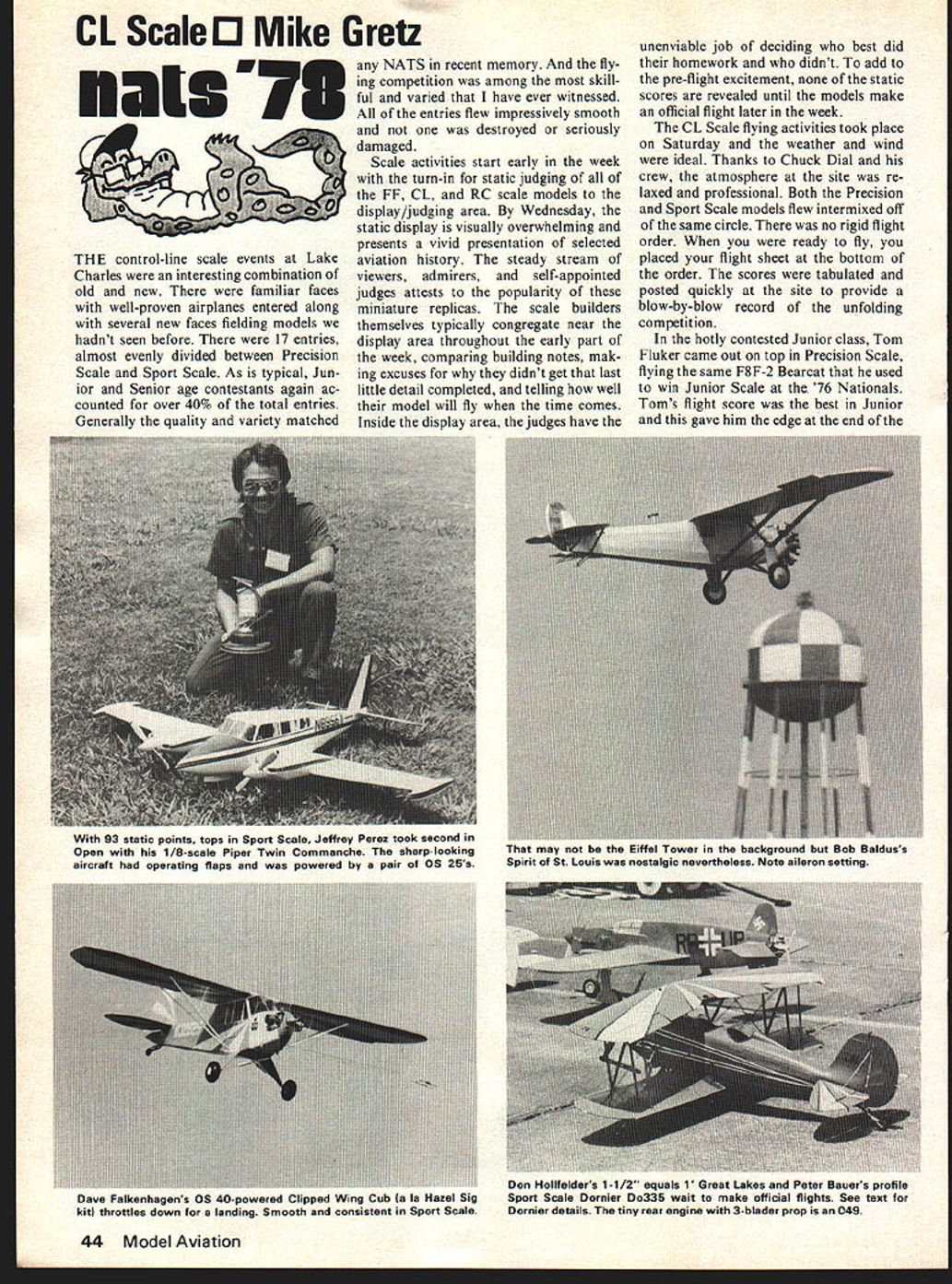
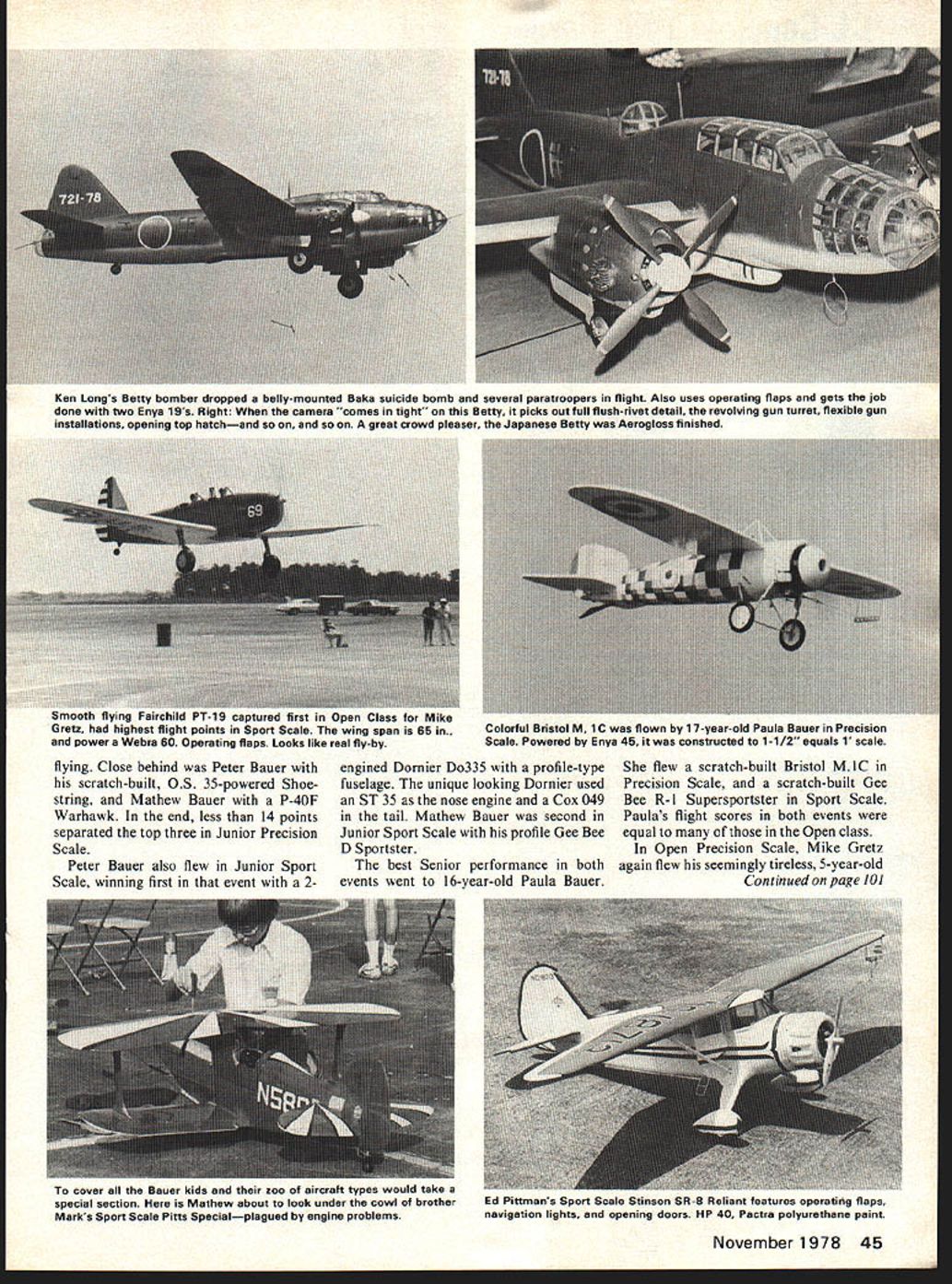
NATS '78: CL Scale
Mike Gretz
Overview
The control-line scale events at Lake Charles were an interesting combination of old and new. There were familiar faces with well-proven airplanes entered along with several new faces fielding models we hadn't seen before. There were 17 entries, almost evenly divided between Precision Scale and Sport Scale. As is typical, Junior and Senior age contestants again accounted for over 40% of the total entries. Generally the quality and variety matched any NATS in recent memory, and the flying competition was among the most skillful and varied that I have ever witnessed. All of the entries flew impressively smooth and not one was destroyed or seriously damaged.
Static Judging
Scale activities start early in the week with the turn-in for static judging of all of the FF, CL, and RC scale models to the display/judging area. By Wednesday, the static display is visually overwhelming and presents a vivid presentation of selected aviation history. The steady stream of viewers, admirers, and self-appointed judges attests to the popularity of these miniature replicas.
The scale builders themselves typically congregate near the display area throughout the early part of the week, comparing building notes, making excuses for why they didn't get that last little detail completed, and telling how well their model will fly when the time comes. Inside the display area, the judges have the unenviable job of deciding who best did their homework and who didn't. To add to the pre-flight excitement, none of the static scores are revealed until the models make an official flight later in the week.
Flying Competition
The CL Scale flying activities took place on Saturday and the weather and wind were ideal. Thanks to Chuck Dial and his crew, the atmosphere at the site was relaxed and professional. Both the Precision and Sport Scale models flew intermixed off the same circle. There was no rigid flight order. When you were ready to fly, you placed your flight sheet at the bottom of the order. The scores were tabulated and posted quickly at the site to provide a blow-by-blow record of the unfolding competition.
Junior Results
- Precision Scale
- 1st: Tom Fluker — F8F-2 Bearcat (same model he used to win Junior Scale at the '76 Nationals). Tom's flight score was the best in Junior and gave him the edge at the end of flying.
- 2nd: Peter Bauer — scratch-built Shoestring, O.S. 35-powered.
- 3rd: Mathew Bauer — P-40F Warhawk.
- Note: Less than 14 points separated the top three in Junior Precision Scale.
- Sport Scale
- 1st: Peter Bauer — 2-engined Dornier Do335 (profile-type fuselage). The Dornier used an ST 35 as the nose engine and a Cox .049 in the tail.
- 2nd: Mathew Bauer — profile Gee Bee D Sportster.
Senior Results
The best Senior performance in both events went to 16-year-old Paula Bauer.
- Precision Scale: Paula flew a scratch-built Bristol M.1C.
- Sport Scale: Paula flew a scratch-built Gee Bee R-1 Supersportster.
Paula's flight scores in both events were equal to many of those in the Open class.
Open Results
- Precision Scale
- Mike Gretz again flew his seemingly tireless, 5-year-old Fairchild PT-19.
- Also entered was Bob Baldus's huge, 60-powered Spirit of St. Louis. This model is inspiring to watch fly, especially with Bob piloting as he handles it very realistically. The only thing missing was Lindy's face leaning out the window as the Spirit cruised around the circle.
- Sport Scale
- The top three were tightly contested; static scores were within five points of each other.
- Jeffrey Perez held the high static score of 93 with a super-looking Piper Twin Comanche. (Jeff actually had two Twin Comanches painted identically, one for Sport Scale and one for Precision.)
- Dave Falkenhagen: Clipped Wing Cub (tied with Gretz at 88 static points).
- Mike Gretz: Fairchild PT-19 (tied with Falkenhagen at 88 static points).
- The PT-19 posted a 93 flight score early and remained the highest of the day.
- After two smooth flights, Falkenhagen's Clipped Wing Cub appeared to have second place clinched as Perez was having trouble completing a flight. On his last attempt—the last flight of the day—Jeff Perez and the Comanche put it all together to slip into second place and move the Cub to third.
- Other top finishes: Mark Bauer — red and white Pitts Special; Ed Pitman — realistic Stinson Reliant.
Observations and Closing
All in all, it still appears that in Precision Scale the larger, mechanical-option-equipped models (retracts, flaps, bombs, etc.) are posting the best flight scores. Simple subject models, which can't fill out a complete flight plan, seem to have an inherent disadvantage under the current Precision Scale rules. Perhaps we need to come up with more "flight" options listed in the rule book that are within the capabilities of all scale subjects, as is already the case in AMA CL Sport Scale and FAI Scale.
When compared to a Dayton, Chicago, or Oshkosh NATS, the number of control-line scale contestants at a Lake Charles NATS is typically low. (Maybe there is something to the idea that colder winters make for more scale models.) Notable in their absence from Lake Charles this year were the three current members of the FAI CL Scale Team who were in England at the same time as the NATS, and past standouts like Ernie Violett, Bill Harney, Ralph and Cathy Burnstine, Mike Stott, and you!
Plan now to attend next year wherever the NATS are held. You won't regret it. It's an unbelievably enjoyable and entertaining experience—win or lose. Good people make for good times, and scale people are among the best!
Transcribed from original scans by AI. Minor OCR errors may remain.

