
NATS '78: CL Speed
Gene Hempel & Tom Upton
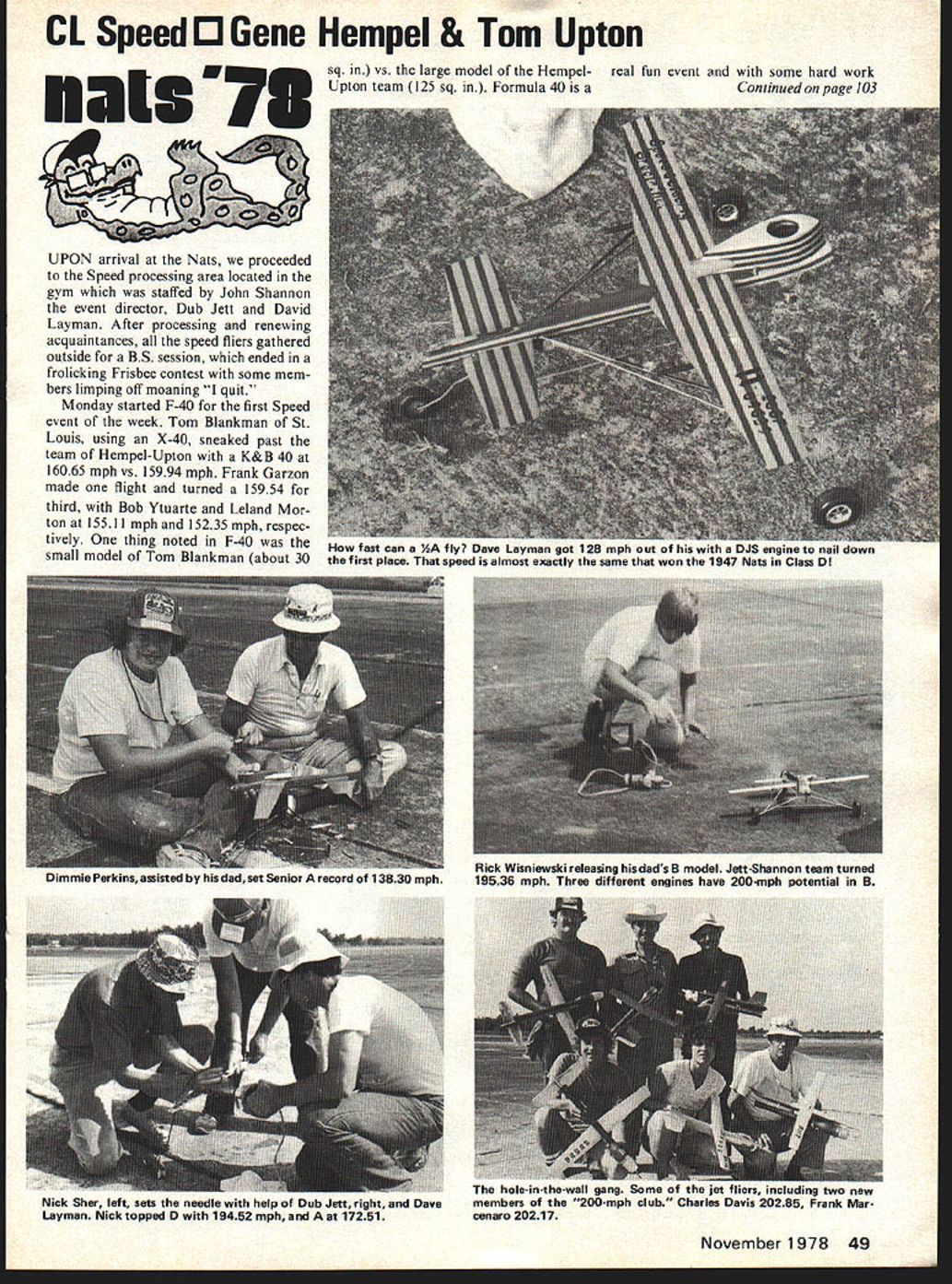
Upon arrival at the Nats, we proceeded to the speed processing area located in the gym, which was staffed by John Shannon, the event director, Dub Jett and David Layman. After processing and renewing acquaintances, all the speed fliers gathered outside for a B.S. session, which ended in a frolicking Frisbee contest with some members limping off moaning, "I quit."
Monday started F-40 for the first speed event of the week. Tom Blankman of St. Louis, using an X-40, sneaked past the team of Hempel–Upton with a K&B 40 at 160.65 mph vs. 159.94 mph. Frank Garzon made one flight and turned a 159.54 for third, with Bob Ytuarte and Leland Morton at 155.11 mph and 152.35 mph, respectively. One thing noted in F-40 was the small model of Tom Blankman (about 30 sq. in.) vs. the large model of the Hempel–Upton team (125 sq. in.). Formula 40 is a real fun event and with some hard work and perseverance one can be fairly successful.
Tuesday started B speed with the Jett–Shannon team turning a 195.36 mph using a DJS 29. David Layman, using an X-29, was at 194.32 mph, and the Hempel–Upton team at 191.21 mph using a K&B 29. We wish to point out the three different types of engines used for B speed all have potential to do 200 mph. All three B models were set up to run on a suction tank and were using a 7 x 10½ Rev-Up prop. Even the Juniors and Seniors were operating pretty much with the identical system. Senior Mark Seigler set the pace at 172.84 mph, then came William Hughes at 165.53 mph, and Patrick Hempel at 164.77 mph. After a bout with a rain squall, Ross Lewis and Quay Barber battled it out for Junior B with 135.39 mph and 121.90 mph, respectively. Nick Sher tried to demonstrate how to land a B ship in the dolly; after takeoff the dolly bounced back into the circle and upon landing, pow—there were instant splinters. B speed is a very popular event behind Formula 40. Hope this trend continues.
Wednesday brought out the big boys. Nick Sher finally did it, and turned 194.52 mph in D speed for first, with Glenn Lee at 191.82 mph, and the Wisniewski team third at 185.11 mph. There is quite a bit more interest in D speed since the mini-pipe rule because you don't have to worry about building a complete engine for each flight. In C speed, Patrick Hempel raised the record to 178.15 mph with Dennis Ytuarte at second.
Fast and furious, Jet speed was the best we've seen in some time. There are two new members of the "200 mph Club," Charles Davis at 202.85 mph and Frank Marcenaro at 202.17 mph. Both used a modified Raven engine on a sidewinder model. There still is controversy over which is faster, the sidewinder or an upright model. Frank Marcenaro had a new design jet engine mounted on an experimental model, test flown by Charles Davis. We will discuss this engine in a later column.
Thursday proved to be a very interesting and beneficial day for us. We kept wondering if anyone ever read our column besides the editor; bless his speedy heart who puts up with us. (Editor's Note: "Speedy heart" digs guys who toss Frisbees.) Nick set up an A engine per David Layman's article in our column several issues back. With the assistance of Dub Jett and David Layman, Nick set the pace with 172.51 mph for first, with David in second at a close 172.02 mph, and Frank Hunt at 155.78 mph. With a similar setup, Dimmie Perkins established a new Senior A record at 138.30 mph. Ross Lewis took first in Junior A with 119.25 mph. FAI was lacking in entries, with Glenn Lee taking first at 213.27 kph; Frank Hunt at 207.45 kph; and Senior Doug Hinckley turning 206.30 kph.
An interesting contest developed on Friday in 1/2A Speed. David Layman set a new 1/2A record of 128.00 mph using a DJS engine; Jett–Shannon turned 122 with their DJS engine; and Nick Sher, using his Cox TD, got 118 mph. 1/2A speeds are really honking on.
Saturday was 1/2A Profile Proto day with very few entries. Junior Quay Barber turned 84 mph, setting the pace for everyone including his dad, Quay Barber Sr., who turned 83 mph in Open. Senior Dimmie Perkins was at 77 mph.
The most outstanding event at the Nats was the CL Speed meeting on Thursday night. The subject of dropping some speed events was brought up by Ron McNally, CLCB chairman, but which events were to be dropped was the tickler. Because some speed fliers feel you will take away their favorite event, they have a selfish attitude about the whole subject, but, low and behold, this meeting proved different. All speed modelers agreed, even the Juniors and Seniors, that something had to be done, even if it meant dropping their favorite events.
The first event discussed was 1/2A Profile Proto, and the Juniors suggested it be dropped because they couldn't handle the quick takeoff. After some lengthy discussion, the vote to eliminate 1/2A Profile Proto was unanimous. "A" speed was proposed to be dropped for FAI since this is an international event.
B speed was proposed to remain per the existing rules, with B Proto and B Profile Proto to be dropped. The Juniors and Seniors agreed to eliminate C speed after much discussion.
D and Jet were discussed to remain only as Open events, with the option that a Senior can fly against Open members if he or she wishes. Formula .40 was discussed at length because the Juniors complained of problems with hanging onto a .40 model. It was suggested and agreed upon to establish a Formula .15 event for Juniors only.
This meeting represented almost 90% of all active speed fliers. There were six members of the Speed Advisory Committee plus Ron McNally, CLCB Chairman, present. We strongly endorse these proposals as voted upon at this meeting. The Hempels and Uptons have agreed to abide by these rules effective January 1, 1979, and we strongly urge everyone else to support this program for the betterment of Speed.
NEW PROPOSED EVENTS
- 1/2A Speed: Jr. X Sr. X Open X
- FAI: X X X
- B Speed: X X X
- D Speed: (X) Opt. X
- Jet Speed: (X) Opt. X
- F-40: .15 Cu. In. — X (for Junior)
Transcribed from original scans by AI. Minor OCR errors may remain.

