
NATS '78: FF Power
Jerry Barnette
As there are so many gas events it might be good to start with a brief overview. Several thoughts come to mind: power. All of the top fliers had engines that really honked. Most all of the fliers had an overabundance of power. Many models were on the small side for the size of engine. The sense of power in these events was impressive.
In general, the lift was tricky. The thermals were very small and difficult in which to center—and if the model did not center in the thermal, it probably would not max. What would appear to be good lift many times would inexplicably dissipate before three minutes. Thermal picking, done mostly by soap bubbles and piggybacking, was tricky, frustrating, and truly challenging.
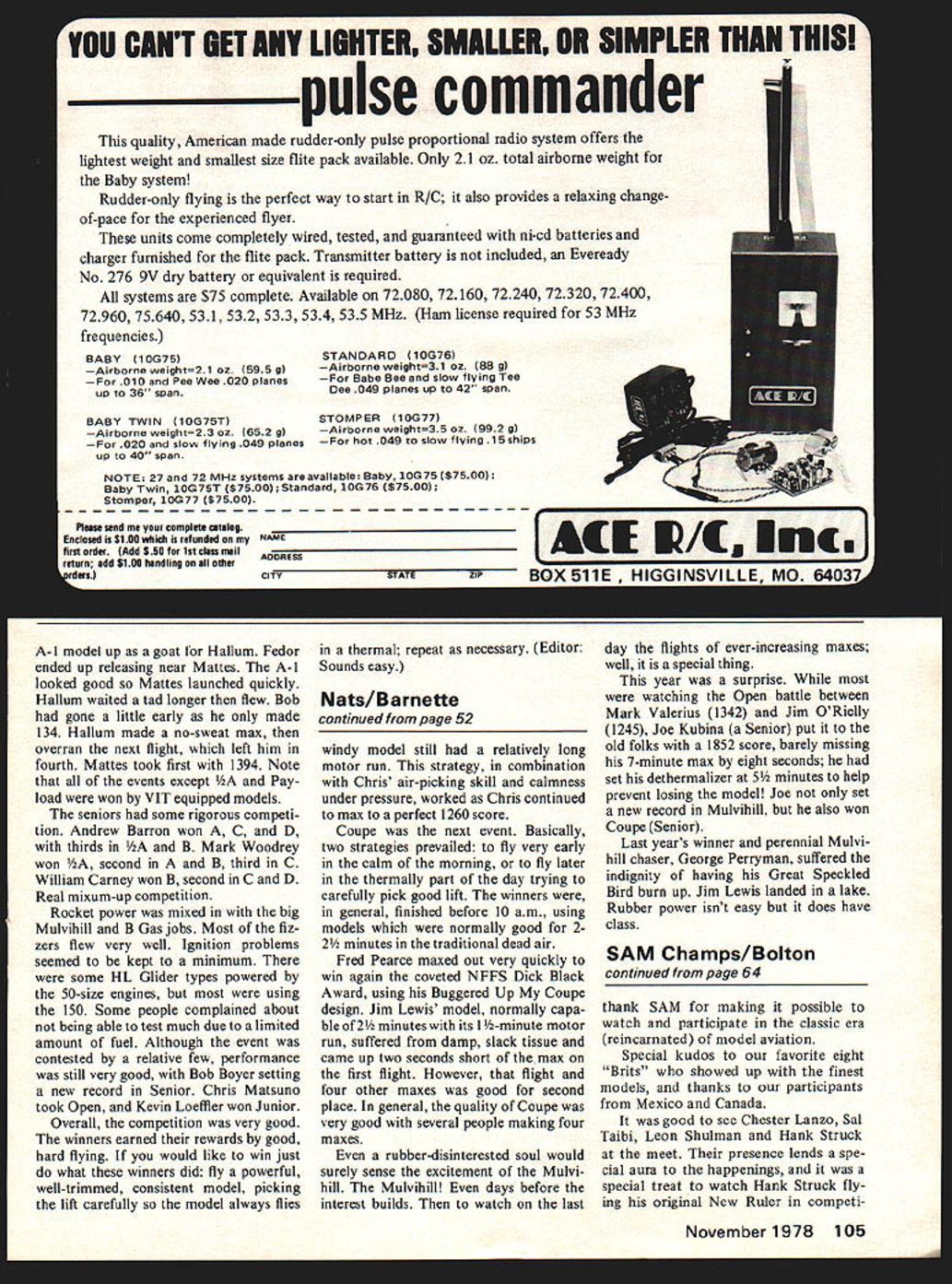
The top fliers had models that went like trains; the same patterns every flight. An off-pattern flight, in the small thermal conditions, usually drew a non-max score. There was a mixture of old and new designs. The new designs tend to incorporate VIT features, be high powered, have thinner wing sections, higher aspect ratios, and be more streamlined. The older designs (such as the 20-year-old Starduster or Satellite) showed they could still do very well, especially with the great gobs of power most used. However, the newer designs tended to finish higher.
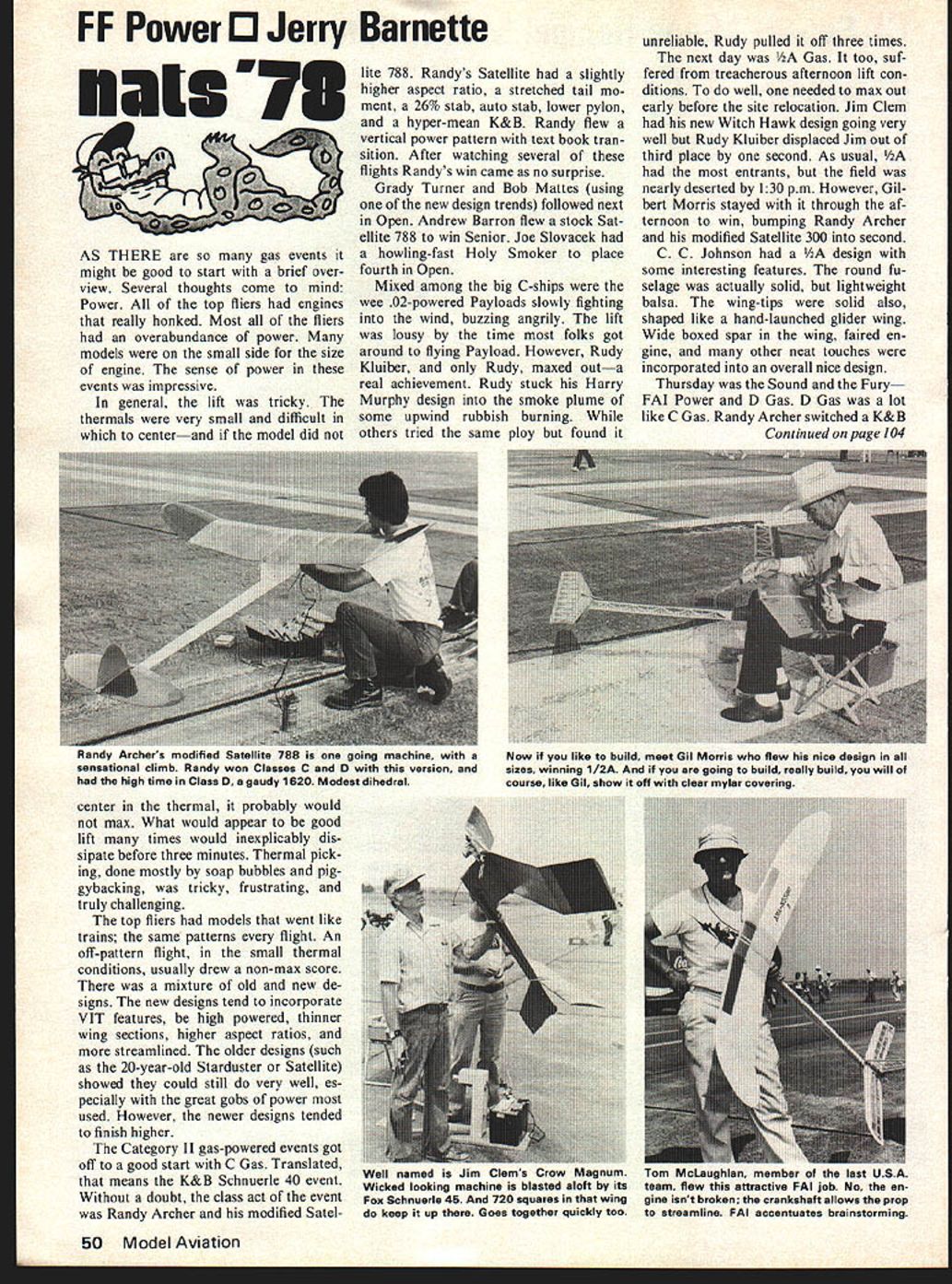
The Category II gas-powered events got off to a good start with C Gas. Translated, that means the K&B Schnuerle 40 event. Without a doubt, the class act of the event was Randy Archer and his modified Satellite 788. Randy’s Satellite had a slightly higher aspect ratio, a stretched tail moment, a 26% stab, auto stab, a lower pylon, and a hyper-mean K&B. Randy flew a vertical power pattern with textbook transition. After watching several of these flights Randy’s win came as no surprise.
Grady Turner and Bob Mattes (using one of the new design trends) followed next in Open. Andrew Barron flew a stock Satellite 788 to win Senior. Joe Slovacek had a howling-fast Holy Smoker to place fourth in Open.
Mixed among the big C-ships were the wee .02-powered Payloads slowly fighting into the wind, buzzing angrily. The lift was lousy by the time most folks got around to flying Payload. However, Rudy Kluiber, and only Rudy, maxed out—a real achievement. Rudy stuck his Harry Murphy design into the smoke plume of some upwind rubbish burning. While others tried the same ploy but found it unreliable, Rudy pulled it off three times.
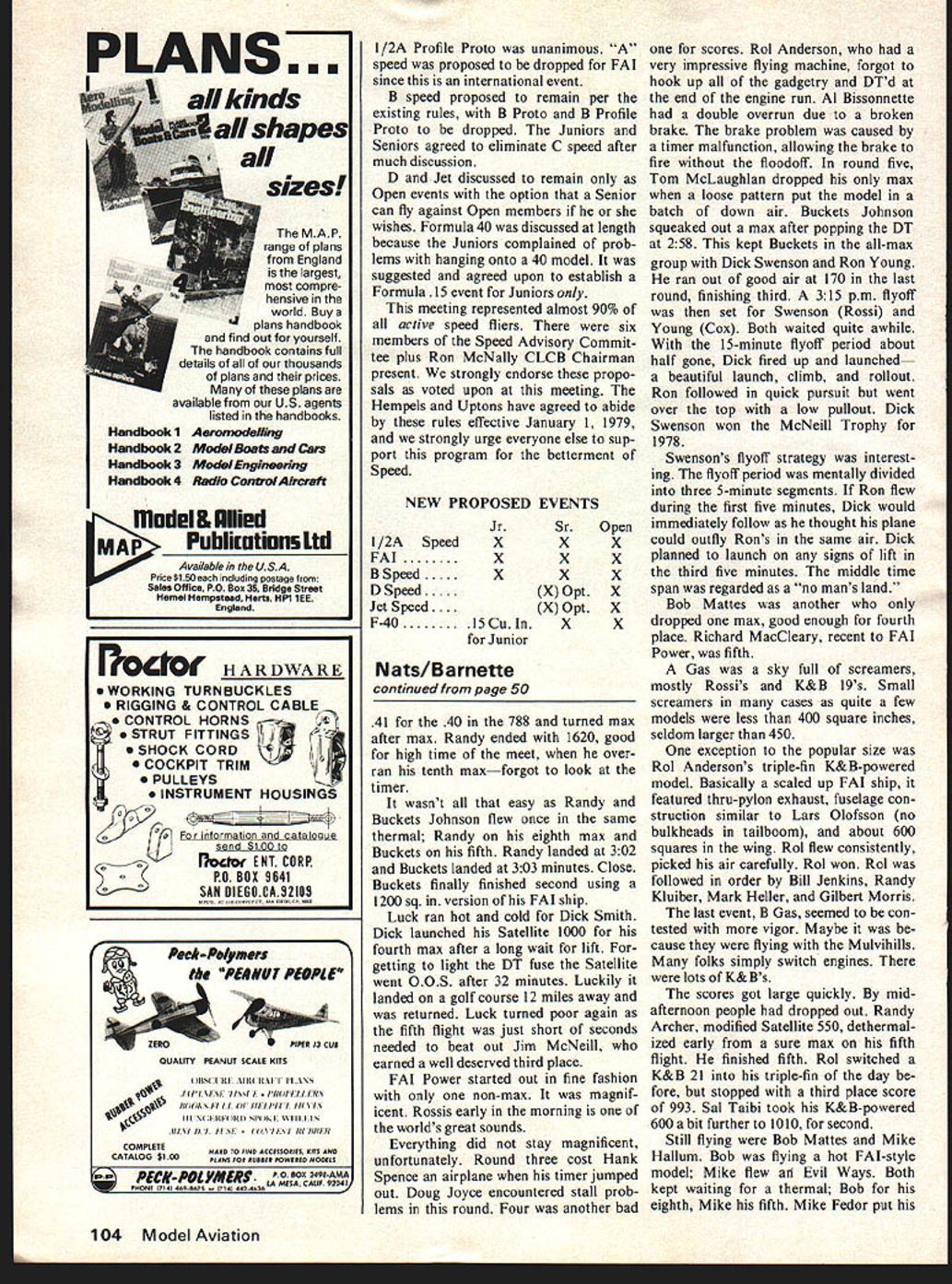
The next day was 1/2A Gas. It too suffered from treacherous afternoon lift conditions. To do well, one needed to max out early before the site relocation. Jim Clem had his new Witch Hawk design going very well but Rudy Kluiber displaced Jim out of third place by one second. As usual, 1/2A had the most entrants, but the field was nearly deserted by 1:30 p.m. However, Gilbert Morris stayed with it through the afternoon to win, bumping Randy Archer and his modified Satellite 300 into second.
C. C. Johnson had a 1/2A design with some interesting features. The round fuselage was actually solid but lightweight balsa. The wing-tips were solid also, shaped like a hand-launched glider wing. Wide boxed spar in the wing, faired engine, and many other neat touches were incorporated into an overall nice design.
Thursday was the Sound and the Fury—FAI Power and D Gas. D Gas was a lot like C Gas. Randy Archer switched a K&B .41 for the .40 in the 788 and turned max after max. Randy ended with 1620, good for high time of the meet, when he overran his tenth max—forgot to look at the timer.
Speed meeting and proposed rule changes
1/2A Profile Proto was unanimous. "A" speed was proposed to be dropped for FAI since this is an international event.
B speed was proposed to remain per the existing rules, with B Proto and B Profile Proto to be dropped. The Juniors and Seniors agreed to eliminate C speed after much discussion.
D and Jet were discussed to remain only as Open events with the option that a Senior can fly against Open members if he or she wishes. Formula .40 was discussed at length because the Juniors complained of problems with hanging onto a .40 model. It was suggested and agreed upon to establish a Formula .15 event for Juniors only.
This meeting represented almost 90% of all active speed fliers. There were six members of the Speed Advisory Committee plus Ron McNally, CL/CB Chairman, present. We strongly endorse these proposals as voted upon at this meeting. The Hempels and Uptons have agreed to abide by these rules effective January 1, 1979, and we strongly urge everyone else to support this program for the betterment of Speed.
NEW PROPOSED EVENTS
- 1/2A Speed — Jr., Sr., Open
- FAI — Jr., Sr., Open
- B Speed — Jr., Sr., Open
- D Speed — (X) Optional for Juniors, Open
- Jet Speed — (X) Optional for Juniors, Open
- F-40 — .15 cu. in. for Junior; .41 for the .40 in Open
It wasn't all that easy as Randy and Buckets Johnson flew once in the same thermal; Randy on his eighth max and Buckets on his fifth. Randy landed at 3:02 and Buckets landed at 3:03 minutes. Close. Buckets finally finished second using a 1200 sq. in. version of his FAI ship.
Luck ran hot and cold for Dick Smith. Dick launched his Satellite 1000 for his fourth max after a long wait for lift. Forgetting to light the DT, the Satellite went O.O.S. after 32 minutes. Luckily it landed on a golf course 12 miles away and was returned. Luck turned poor again as the fifth flight was just short of the seconds needed to beat out Jim McNeill, who earned a well-deserved third place.
FAI Power started out in fine fashion with only one non-max. It was magnificent. Rossi early in the morning is one of the world's great sounds.
Everything did not stay magnificent, unfortunately. Round three cost Hank Spence an airplane when his timer jumped out. Doug Joyce encountered stall problems in this round. Round four was another bad round. Ron McNeill dropped his only max when a loose pattern put the model in a batch of down air. Buckets Johnson squeaked out a max after popping the DT at 2:58. This kept Buckets in the all-max group with Dick Swenson and Ron Young. He ran out of good air at 170 in the last round, finishing third. A 3:15 p.m. flyoff was then set for Swenson (Rossi) and Young (Cox). Both waited quite awhile. With the 15-minute flyoff period about half gone, Dick fired up and launched a beautiful launch, climb, and rollout. Ron followed in quick pursuit but went over the top with a low pullout. Dick Swenson won the McNeill Trophy for 1978.
Swenson's flyoff strategy was interesting. The flyoff period was mentally divided into three five-minute segments. If Ron flew during the first five minutes, Dick would immediately follow as he thought his plane could outfly Ron's in the same air. Dick planned to launch on any signs of lift in the third five minutes. The middle time span was regarded as a "no man's land."
Bob Mattes was another who only dropped one max, good enough for fourth place. Richard MacCleary, recent to FAI Power, was fifth.
A Gas was a sky full of screamers, mostly Rossi's and K&B 19's. Small screamers in many cases as quite a few models were less than 400 square inches, seldom larger than 450.
One exception to the popular size was Rol Anderson's triple-fin K&B-powered model. Basically a scaled-up FAI ship, it featured thru-pylon exhaust, fuselage construction similar to Lars Olofsson (no bulkheads in the tailboom), and about 600 square inches in the wing. Rol flew consistently, picked his air carefully, and won. Rol was followed in order by Bill Jenkins, Randy Kluiber, Mark Heller, and Gilbert Morris.
The last event, B Gas, seemed to be contested with more vigor. Maybe it was because they were flying with the Mulvihills? Many folks simply switched engines. There were lots of K&B's.
The scores got large quickly. By mid-afternoon people had dropped out. Randy Archer, with a modified Satellite 550, was dethroned early from a sure max on his fifth flight. He finished fifth. Rol switched a K&B 21 into his triple-fin of the day before, but stopped with a third-place score of 993. Sal Taibi took his K&B-powered 600 a bit further to 1,010 for second.
Still flying were Bob Mattes and Mike Hallum. Bob was flying a hot FAI-style model; Mike flew an Evil Ways. Both kept waiting for a thermal; Bob for his eighth, Mike for his fifth. Mike Fedor put his A-1 model up as a goat for Hallum. Fedor ended up releasing near Mattes. The A-1 looked good so Mattes launched quickly. Hallum waited a tad longer then flew. Bob had gone a little early as he only made 134. Hallum made a no-sweat max, then overran the next flight, which left him in fourth. Mattes took first with 1,394. Note that all of the events except 1/2A and Payload were won by VIT-equipped models.
The seniors had some rigorous competition. Andrew Barron won A, C, and D, with thirds in 1/2A and B. Mark Woodrey won 1/2A, second in A and B, third in C. William Carney won B, second in C and D. Real mix-up competition.
Rocket power was mixed in with the big Mulvihill and B Gas jobs. Most of the fliers flew very well. Ignition problems seemed to be kept to a minimum. There were some HL glider types powered by the .50-size engines, but most were using the .15. Some people complained about not being able to test much due to a limited amount of fuel. Although the event was contested by a relative few, performance was still very good, with Bob Boyer setting a new record in Senior. Chris Mason took Open, and Kevin Loeffler won Junior.
Overall, the competition was very good. The winners earned their rewards by good, hard flying. If you would like to win just do what these winners did: fly a powerful, well-trimmed, consistent model, picking the lift carefully so the model always flies in a thermal; repeat as necessary. (Editor: Sounds easy.)
Nats/Barnette (continued)
A windy model still had a relatively long motor run. This strategy, in combination with Chris' air-picking skill and calmness under pressure, worked as Chris continued to max to a perfect 1,260 score.
Coupe was the next event. Basically, two strategies prevailed: to fly very early in the calm of the morning, or to fly later in the thermally part of the day trying to carefully pick good lift. The winners were, in general, finished before 10 a.m., using models which were normally good for 2–2½ minutes in the traditional dead air.
Fred Pearce maxed out very quickly to win again the coveted NFFS Dick Black Award, using his Buggered Up My Coupe design. Jim Lewis' model, normally capable of 2½ minutes with its 1½-minute motor run, suffered from damp, slack tissue and came up two seconds short of the max on the first flight. However, that flight and four other maxes was good for second place. In general, the quality of Coupe was very good with several people making four maxes.
Even a rubber-disinterested soul would surely sense the excitement of the Mulvihill. The Mulvihill! Even days before the interest builds. Then to watch on the last day the flights of ever-increasing maxes; well, it is a special thing.
This year was a surprise. While most were watching the Open battle between Mark Valerius (1,342) and Jim O'Reilly (1,245), Joe Kubina (a Senior) put it to the old folks with an 1,852 score, barely missing his seven-minute max by eight seconds; he had set his dethermalizer at 5½ minutes to help prevent losing the model! Joe not only set a new record in Mulvihill, but he also won Coupe (Senior).
Last year's winner and perennial Mulvihill chaser, George Perryman, suffered the indignity of having his Great Speckled Bird burn up. Jim Lewis landed in a lake. Rubber power isn't easy but it does have class.
Transcribed from original scans by AI. Minor OCR errors may remain.

