
NATS '78: FF Scale (Outdoor)
Jerry Barnette
The 1978 National Model Airplane Championships was a good contest. The folks who seemed to have the most fun were the free flight scale group. You should've been there.
Rubber Scale
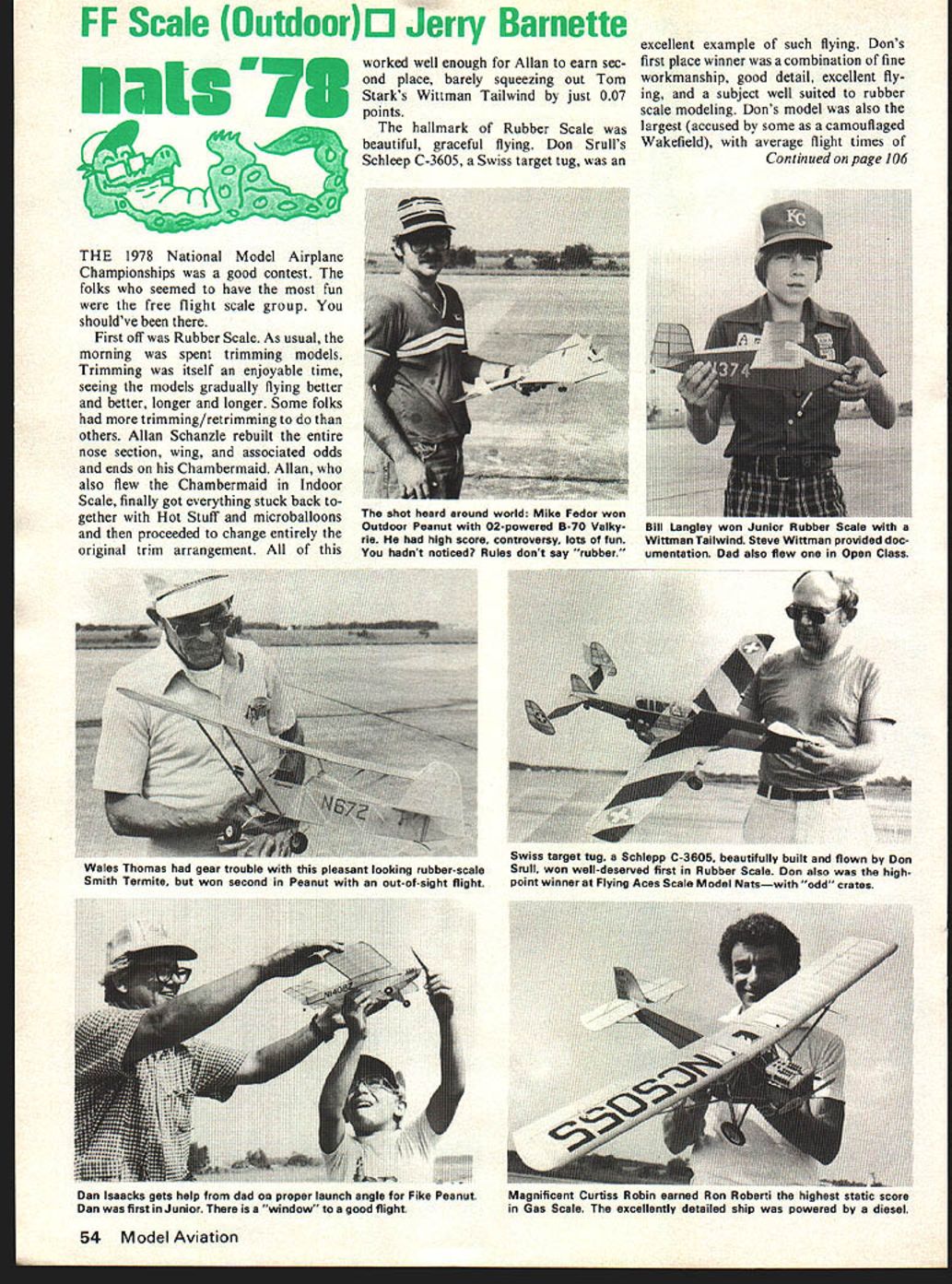
First off was Rubber Scale. As usual, the morning was spent trimming models. Trimming was itself an enjoyable time, seeing the models gradually flying better and better, longer and longer. Some folks had more trimming/retrimming to do than others. Allan Schanzle rebuilt the entire nose section, wing, and associated odds and ends on his Chambermaid. Allan, who also flew the Chambermaid in Indoor Scale, finally got everything stuck back together with Hot Stuff and microballoons and then proceeded to change entirely the original trim arrangement. All of this worked well enough for Allan to earn second place, barely squeezing out Tom Stark's Wittman Tailwind by just 0.07 points.
The hallmark of Rubber Scale was beautiful, graceful flying. Don Srull's Schlepp C-3605, a Swiss target tug, was an excellent example of such flying. Don's first-place winner was a combination of fine workmanship, good detail, excellent flying, and a subject well suited to rubber scale modeling. Don's model was also the largest (accused by some as a camouflaged Wakefield), with average flight times of over a minute.
Free flight participation totaled a respectable 90 individuals. Apparently the rule change deleting glow engines didn't exert quite the negative impact anticipated. Surprisingly, there were very few ignition conversions in evidence, yet these engines are legal for competition and certainly provide good, stable performance, and they are available.
See you all at Salt Lake City in '79.
A-2 (Towline) and Weather
The weather presented a challenge. Very small ("Pitifully small," to quote one frustrated flier) thermals were the nemesis in the early part of the day. Later the lift improved, the breeze died, and the air became super hot and humid.
The first round saw a respectable number of maxes plus some very close ones. Dale Segle, second to Bob Issacson in last year's fly-off, missed his max by 0.1 second. Bob Klipp noticed that his DT timer was set for less than three minutes. Rather than take the time to reset it, Bob gambled that he would be high enough when he DT'd to still max. Almost. Bob did in fact DT early and touched down at 177 seconds. Bob went on to score six straight maxes for second place, but missed forcing a flyoff with Jim Lewis by those same three seconds.
It was a good day for Don Chancey designs: Klipp flew a Poacher and Jim Lewis a modified Hyperion V. Jim's Hyperion was only his second A-2; the first one was a Poacher. Jim worked hard for his well-deserved win, circle-towing upwind to pick his own air each round. Jim had been running a couple of miles each evening to keep in shape for the event, but the Louisiana heat and humidity was almost too much. He spent half an hour in air conditioning prior to the last round to regain his composure. Lucky that he did, as he towed into a monster downer in the last round, eventually ending up a long way downwind before releasing for a max to complete his perfect score.
After Lewis and Klipp came Herb Mieras (the first of three Seniors in the top seven), followed by Jon Watson in sixth and Andrew Barron in seventh. The Seniors are tough competition.
Rolfe Gregory's nicely detailed Heinkel He-100D took fifth place, helping the D.C. Maxecutters dominate the event (first, second, fifth). Rolfe also placed fifth in Indoor with the same Flyline kit. Tailwinds were popular: in addition to Tom Stark's, the Bill Langleys flew identical red ones. The elder Bill was seventh in Open and the younger Bill was first in Junior. Senior was closely contested by Nick Decarlis (Fike) and Guy Larsen (Miles Sparrowhawk); Nick Decarlis eventually won all three outdoor scale events.
Gas Scale
Gas Scale — something of a misnomer with the widespread use of electric (first Open), CO2 (first and second Senior; fourth and fifth Open), and diesels (second Open) — followed the next day. Again, early morning trimming was the first order of business as many of the models were brand new. However, new models were not the only cantankerous ones. Ron Roberti's beautiful blue-and-silver Curtiss Robin, which earned the highest static score, has been around awhile (second in '76, seventh in '77) but had starting problems as the engine had not been run since the '77 Nats. The starting problem impacted the Robin's flight score, allowing Tom Stark's very realistic Fokker T-2 to earn top total score. (Editor: Tom's article and plan on the subject appeared in the August 1977 issue; it also won this Nationals event in 1976.)
Tom decided to use an electric motor for this event. The relatively low power available limited the choice of model subject. Tom figured that a transport or long-distance aircraft would be suitable, but didn't want a rubber-powered-looking model. He chose the T-2 because he thought the Fokker looked neat and complete documentation was available at the Smithsonian (the actual aircraft hangs in the National Air and Space Museum).
Quite a few kits were entered and did well: Flyline's Curtiss Robin, Kinner Sportster, Stearman C3B, and Jetco's Cessna 170 all flew nicely. It should be noted that in this event good flights really paid off, as quite a few higher static-scoring models were beaten in the end by better flying models.
Outdoor Peanut and a Rules Controversy
While Outdoor Peanut ended the free flight scale contest, it started a new rules controversy. The furor centered around Mike Fedor's winning model, a Cox .02-powered B-70 Valkyrie. Note, however, the B-70 did score the highest static score (even after being docked points for the pusher prop), was properly trimmed for flight, and did not break any rule. The controversy was over the lack of a rule for Mike to break, as the Peanut rules do not discuss, limit, infer, or define propulsion.
The day began, as usual, with trimming and testing. Wales Thomas, flying a Fike, put his model into a nice thermal and out of sight at 269 seconds. With a static score of 62, this gave Wales a healthy total of 331. Wales, incidentally, is just returning to contests after 38 years.
Fedor's first flight was good for 80 seconds, using the standard PeeWee fuel tank. For the second flight Mike stuffed a small extra amount of fuel into the Valkyrie's engine inlets, hooked it up, and launched for a flight which went O.O.S. at 236 seconds (out of sight but one could still hear the engine running). While the flight was 33 seconds less than the Fike, the B-70 had a bonus factor due to the model being judged as a mid-wing design. Final scoring for the Valkyrie was 337.
Overall, the Free Flight Scale events could be described as not having very many competitors, but the quality of the models and of the flying was excellent. And the scale folks had fun.
Transcribed from original scans by AI. Minor OCR errors may remain.

