
NATS '78: Indoor
Bud Tenny
Venue and conditions
The first two things on everyone's mind as they entered the huge Burton Coliseum in Lake Charles, Louisiana, were "How high is it?" and "How good is it?" Advance publicity gave a vague "105 feet" as the building height, and predicted that the site would have good conditions. Very quickly, Richard Doig filled a balloon and sent it up to the top. Contest Director Sandy Frank joined Richard and their joint efforts measured the ceiling at 107'7" — thereby establishing that any flights must exceed the current AMA Cat. III times to achieve record status.
Those who participated in the 1974 and 1975 Nats in Lake Charles remembered the beautiful Civic Auditorium, which had a huge speaker in the top of the arena similar to the one now visible. Besides having the speaker as an obstacle, the Civic Auditorium's flying conditions had deteriorated badly during the daily showers that marked both days of flying. The 1974 contest was plagued by many models landing in the speaker structure. This experience led to installation of a plastic shroud over the speakers during the 1975 contest. That lesson was remembered for 1978, so these speakers were shrouded again.
The remaining concern was whether the air would be calm and stable whether it rained or not. It rained both days, and the Burton Coliseum's double-wall construction saved the day. Very minor air disturbance in a few areas seemed to be the only product of the rains.
Event schedule
Ever since the Indoor Nats was changed from a one-day contest to two days (the first two-day Indoor Nats was in 1969), it has been customary to divide the events according to weight and flying speed to minimize collisions between lightweight models and the heavier hand-launched gliders and scale models. The schedule for 1978 followed this practice:
- Day 1: Indoor Stick, Paper Stick, Indoor Cabin (and FAI Indoor Stick in recent years)
- Day 2: Hand-Launched Glider, Pennyplane, Easy B, AMA Indoor Scale, Peanut Scale
Early flying and drift
As is usual with almost any indoor contest, most competitors began flying Paper Stick models first. These slightly heavier models effectively scout out the drift without being affected as much as the microfilm models to follow. A small amount of drift turned up, so curtains and doors around the arena perimeter were closed; this stopped virtually all drift caused by the doors.
Once the models had identified the drift, competitors began to play the range game — trying to get their models closer and closer to the ceiling. An expert flier must test-fly enough to get the amount of rubber, number of turns and just-right trim so the model reaches the ceiling safely. Occasional drift still showed up very close to the ceiling.
Steering and FAI Stick
In recent years international-class FAI Stick competitors have allowed steering when balloon effects or drift could offset the flight. Steering requires extreme skill and good eyesight. Effective steering consists of using a helium-filled balloon to intercept the model's flight, pushing the new flight path out of the drift. On initial contact usually a string is used to move the model; move too hard and the model may be damaged. Also, the balloon string can get into the propeller path and the flight may become entangled and terminated. Disengage the balloon string from the propeller. Finally, a poor steering job may leave the model in worse position than before, so it strikes the wall or lands in the bleachers and loses minutes of flight potential.
In recent years, the concept of model steering has been added to AMA contests, but the hazards involved and a lack of expertise by many fliers have made steering rare at the Nats. This year, Dan Domina's FAI model found drift next to the ceiling which put his model in the bleachers on one flight. On the next flight the same thing almost happened until Dan grabbed his balloon. At least four times during the half-hour flight Dan had to steer his model across the arena to the opposite side. Those who had never seen or tried steering may not have been impressed since it looked so easy; everyone else realized they had seen a master at work.
Since 1978 was the first year of a two-year program to select the U.S. Indoor Team for the 1980 Indoor World Championships, the FAI Stick models were flown in "rounds" — that is, FAI contenders could make only one flight during each of six time periods, and missed flights could not be taken over later. Fliers entering both FAI and AMA events had to watch their time very carefully.
Humidity, weights and results
One point of high interest at any new site with over 90 feet of ceiling height is whether any flights over 30 minutes will be made. Certainly the Burton Coliseum should have allowed more than one such flight, but almost everyone encountered difficulty getting their models all the way to the ceiling. Due to the rain and generally high humidity at Lake Charles, the air was very heavy. The humidity and heat combined to make the models heavier and harder to fly, so only one flight exceeded the 30-minute mark.
This was Dan Domina's second flight, and the steering activity stopped the prop for about one and a half minutes. The stopped-prop time must be deducted from the flight total, so the final flight time was only 29:26. The next longest flight was 26:16.4, logged by Clarence Mather.
Since the Indoor Stick models, FAI Stick models and most Indoor Cabin models are covered with microfilm (an extremely thin plastic), these models suffered less weight gain from humidity than did the Paper Stick models. Paper Stick models, as the name implies, are covered with paper. The type of paper used is very thin and light, but it absorbs a lot of moisture from the air. Consequently, these models may weigh 30% more than they would in better conditions. The heavier model requires more power — a greater weight of rubber band — and so the model becomes even heavier. With dense air and the extra weight, the Paper Stick winning time was only 17:47.2. One might reasonably expect well over 20 minutes with Paper Stick models under good conditions in this type of site, so the toll on these models was heavy.
Hand-launched gliders
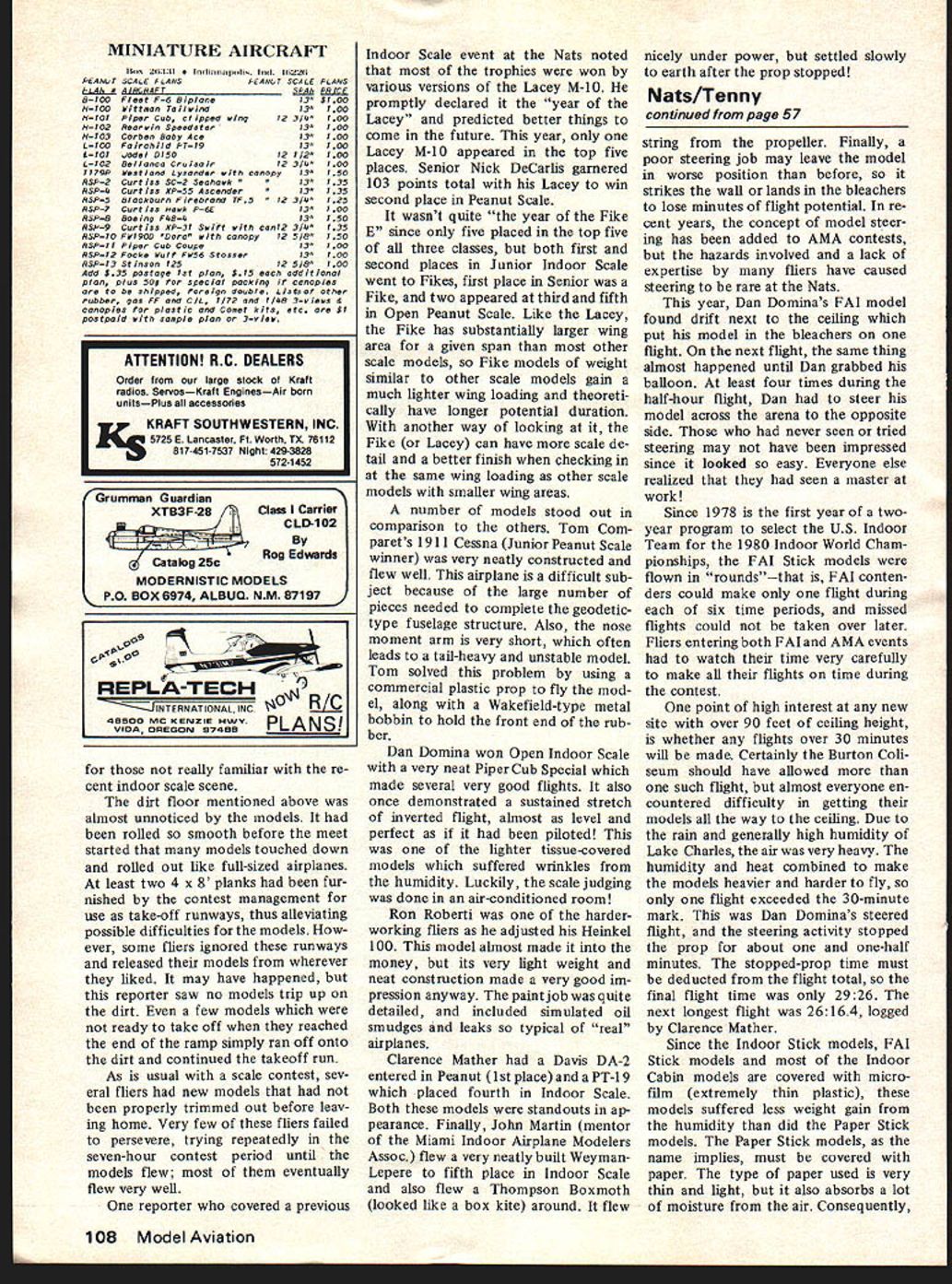
On the second day, hand-launched gliders filled the air from opening time until 2 p.m. There was the usual sprinkling of Sweepettes and modified Sweepettes, along with numerous original gliders. As usual, a certain amount of "tune-up" was necessary before the flight times reached satisfactory levels. The hand-launched glider event is an extraordinary combination of building, adjusting and athletic skill.
The models must be heavy and strong enough to withstand being thrown to an altitude of about 100 feet; lighter models will not go that high even if skillfully thrown. Since flight time is proportional to launch altitude, gliders will fly longer if they reach a higher altitude. The objective is to get the model to the ceiling without touching. If the model just brushes the ceiling it may not level out into normal flight; a dive all the way down may cause the model to shatter on the floor. It is real skill to throw the model to the ceiling without its going too high or too low.
The tune-up period consists of the flier beginning with easy tosses to get the model gliding well. This has the dual advantage of ensuring the model is properly trimmed for safe and efficient flight and serving as a physical warm-up for the flier. Some fliers do normal athletic warm-ups, working up to very hard throws. Failure to warm up properly not only risks elbow injury but can cause a missed precise launch aim and a smashed glider.
Paul Shailor set an early lead with his Sweepette and waited out the day for someone to beat him. Since gliders are scored on the best two of nine flights, Paul's 1:04.8 and 1:07.2 remained tops after he logged them. Then Dale Segle scored 1:08.4 with his original design for the best single time; he was unable to get a backup flight long enough to win. Paul decided to try for a high single time also. The third of his remaining four tries turned the trick by landing after 1:09.0. Paul's last toss just grazed the plastic shroud around the speakers and landed after only 59.9 seconds.
Pennyplanes, Easy B and Indoor Scale
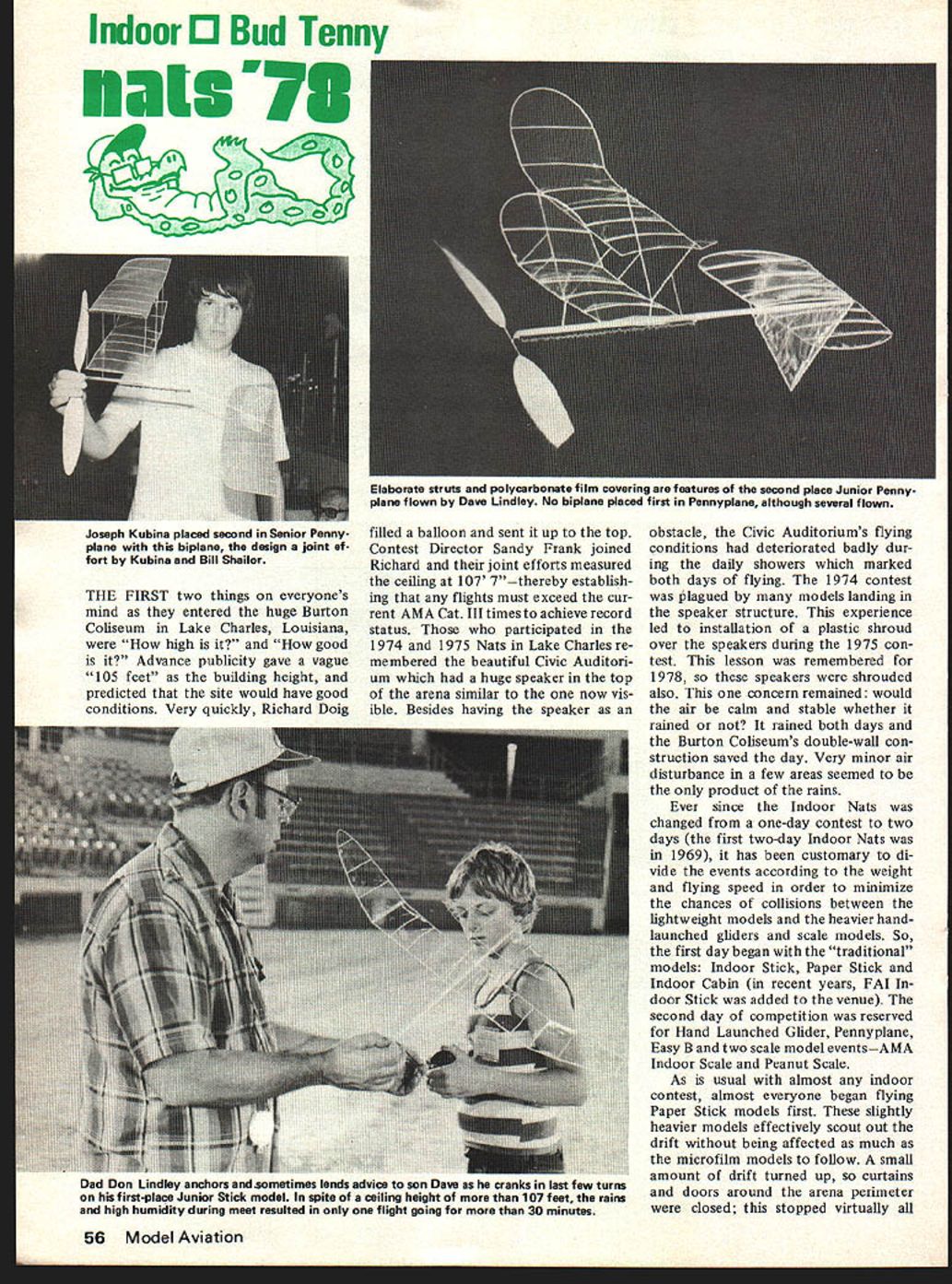
After 2 p.m., Pennyplanes and Easy B models shared the air with the Indoor Scale event. The Burton Coliseum is long enough that the scale models flew at one end while the Pennyplanes and Easy B's shared the other end. Humidity scarcely affected the Pennyplanes, except for a bit of extra weight. The "penny" weight (about three grams) seemed to give these models a reserve of strength, and they took the extra rubber weight in stride. Some Pennyplanes were paper covered and suffered more, but many were covered with polycarbonate film. This material is essentially waterproof and virtually tear resistant, while being about half the weight of the condenser paper required on Paper Stick models and Easy B's.
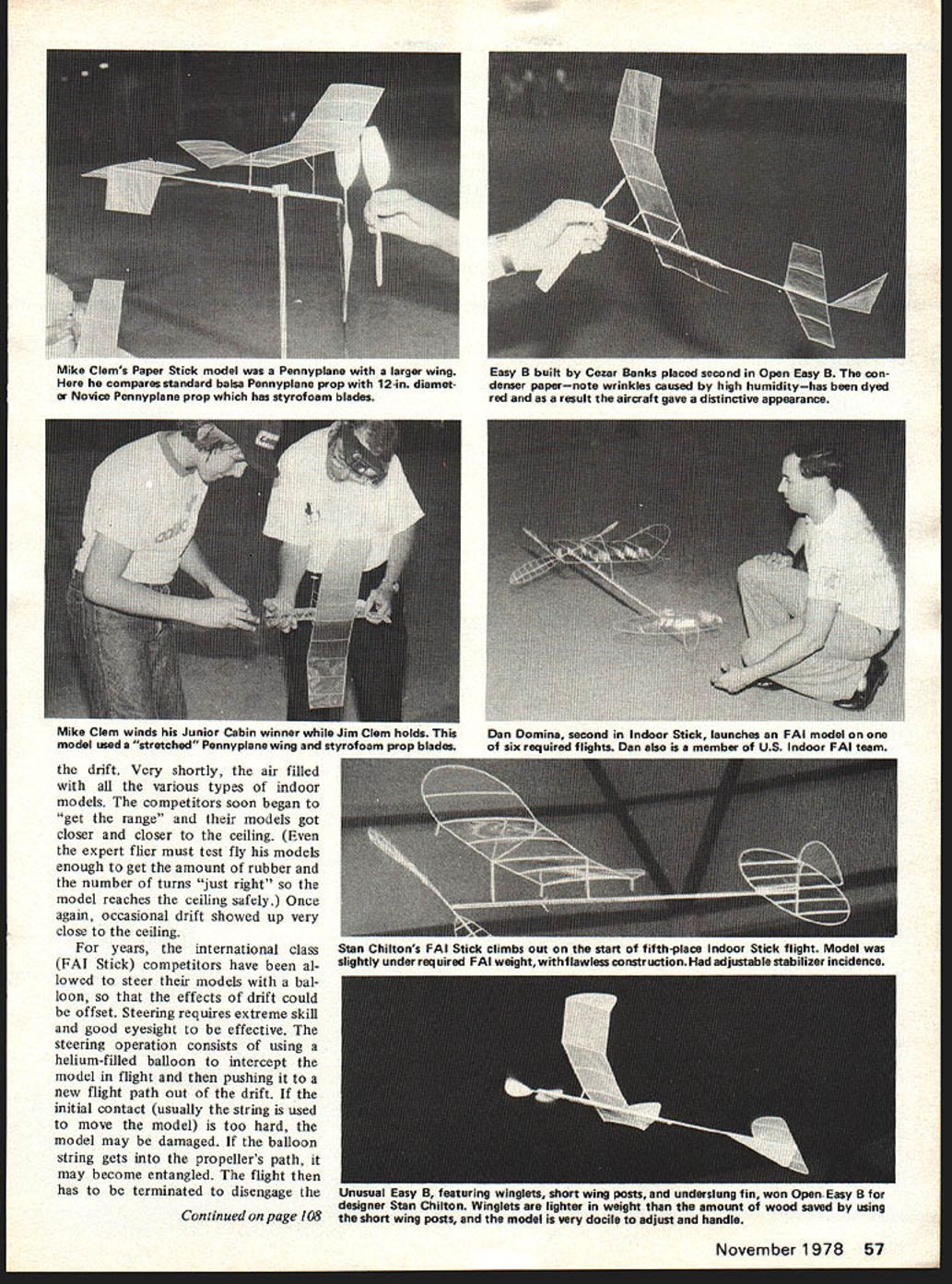
Since Easy B models have no weight requirement, many are as delicately built as any microfilm model. This light structure and the paper covering severely hampered a few of the lighter models — certainly the times were not a match for good conditions. Top Pennyplane times were 10:10.2 in Open, 8:10.2 in Senior and 7:03.6 in Junior, with a monoplane winning in each case. Several biplanes were flown, but as is usually the case, the biplanes were less consistent for some reason. Easy B times were 8:22.0 in Junior, 9:54.4 in Senior and 14:31.4 in Open. Actually, 14+ minutes isn't bad for Open Easy B, but times in sites such as blimp hangars (about 60' higher) have been nearly 21 minutes under really good conditions.
So ended another Nats — a good time was had by almost all!
Transcribed from original scans by AI. Minor OCR errors may remain.

