
NATS '78: Indoor Scale
Byline: Bud Tenny
Indoor Scale models seemed a little scarce at the Nats this year (16 models were judged and flown), as did the Peanut Scale models (16 judged for static points and 13 models were flown). However, most of the models were quite well built, with excellent scale detail, and most of them flew very well. Only one model was noted in the "superlight" category — the rules have steadily evolved to limit the effectiveness of a clear plastic covering (not microfilm), which gives poor scale points and a phenomenal flight score. Gradually the event is approaching a better balance between flying and scale points.
This Nats seemed blessed by more spectators than usual, without many of the typical disadvantages of large crowds. Even the youngsters who watched were well behaved, and no unusual air conditions seemed to arise from the relatively large group of people. Furthermore, the crowd included many "appreciators" who repeatedly applauded flights they liked. A number of contestants and long-time participants appreciated the applause; it added a new dimension seldom noted at indoor model airplane contests held in the U.S.
Venue conditions
Burton Coliseum had two drawbacks for the contestants: the quite high humidity (seems to be normal for Lake Charles, judging from three years of activity there) and a dirt floor. Perhaps the dirt floor was less of a handicap for the scale fliers than it would have been for the "traditional" indoor events, since it was certainly not as hard as wood or concrete if an untrimmed model pranged. Many of the lighter models covered with Japanese tissue and using little or no dope suffered a bad case of wrinkles caused by the very damp air. Only those fliers who had previously trimmed their models and knew what the performance should be noticed; the "prunes" seemed to have very little to do with the models' actual performance.
For those not familiar with the recent indoor scale scene, the dirt floor was almost unnoticed by the models. It had been rolled so smooth before the meet started that many models touched down and rolled out like full-sized airplanes. At least two 4 x 8' planks were furnished by contest management for use as take-off runways, thus alleviating possible difficulties for the models. However, some fliers ignored these runways and released their models from wherever they liked. This reporter saw no models trip on the dirt; even a few that were not ready to take off when they reached the end of the ramp simply ran off onto the dirt and continued the takeoff.
As is usual with a scale contest, several fliers had new models that had not been properly trimmed before leaving home. Very few of these fliers failed to persevere; most tried repeatedly during the seven-hour contest period until the models flew, and most eventually flew very well.
Workmanship and judging
The most impressive thing about many of the scale models flown this year was the high degree of workmanship and considerable scale detail. When one of these models was picked up, it almost seemed to float out of your hand. It was no mystery how such models flew so well — which was another pleasant surprise. Luckily, the scale judging was done in an air-conditioned room, protecting the fine finishes and allowing the judges to evaluate details despite the humid flying area.
Trends and results
One reporter who covered a previous Indoor Scale event at the Nats noted that most trophies were won by various versions of the Lacey M-10, dubbing it the "year of the Lacey." This year, only one Lacey M-10 appeared in the top five places. Senior Nick DeCaris garnered 103 points total with his Lacey to win second place in Peanut Scale.
It wasn't quite "the year of the Fike E," but Fike models were prominent: both first and second places in Junior Indoor Scale went to Fikes, first place in Senior was a Fike, and two appeared at third and fifth in Open Peanut Scale. Like the Lacey, the Fike has substantially larger wing area for a given span than many other scale models; for a similar weight, Fike models gain a much lighter wing loading and therefore have longer potential duration. Another way to look at it is that a Fike (or Lacey) can carry more scale detail and achieve a better finish at the same wing loading as other scale subjects with smaller wing areas.
Notable models and fliers
- Tom Comparet — 1911 Cessna (Junior Peanut Scale winner). Very neatly constructed and flew well. The airplane is a difficult subject because of the geodetic-type fuselage structure and a short nose moment arm that often produces tail-heavy, unstable models. Tom solved this by using a commercial plastic prop and a Wakefield-type metal bobbin to hold the front end of the rubber.
- Dan Domina — Won Open Indoor Scale with a very neat Piper Cub Special that made several excellent flights. It even demonstrated a sustained stretch of inverted flight, almost as level and perfect as if it had been piloted. It was one of the lighter tissue-covered models that suffered wrinkles from the humidity.
- Ron Roberti — Worked hard adjusting his Heinkel 100. The model nearly placed, but its very light weight and neat construction made a strong impression. The paint job included detailed simulated oil smudges and leaks typical of real airplanes.
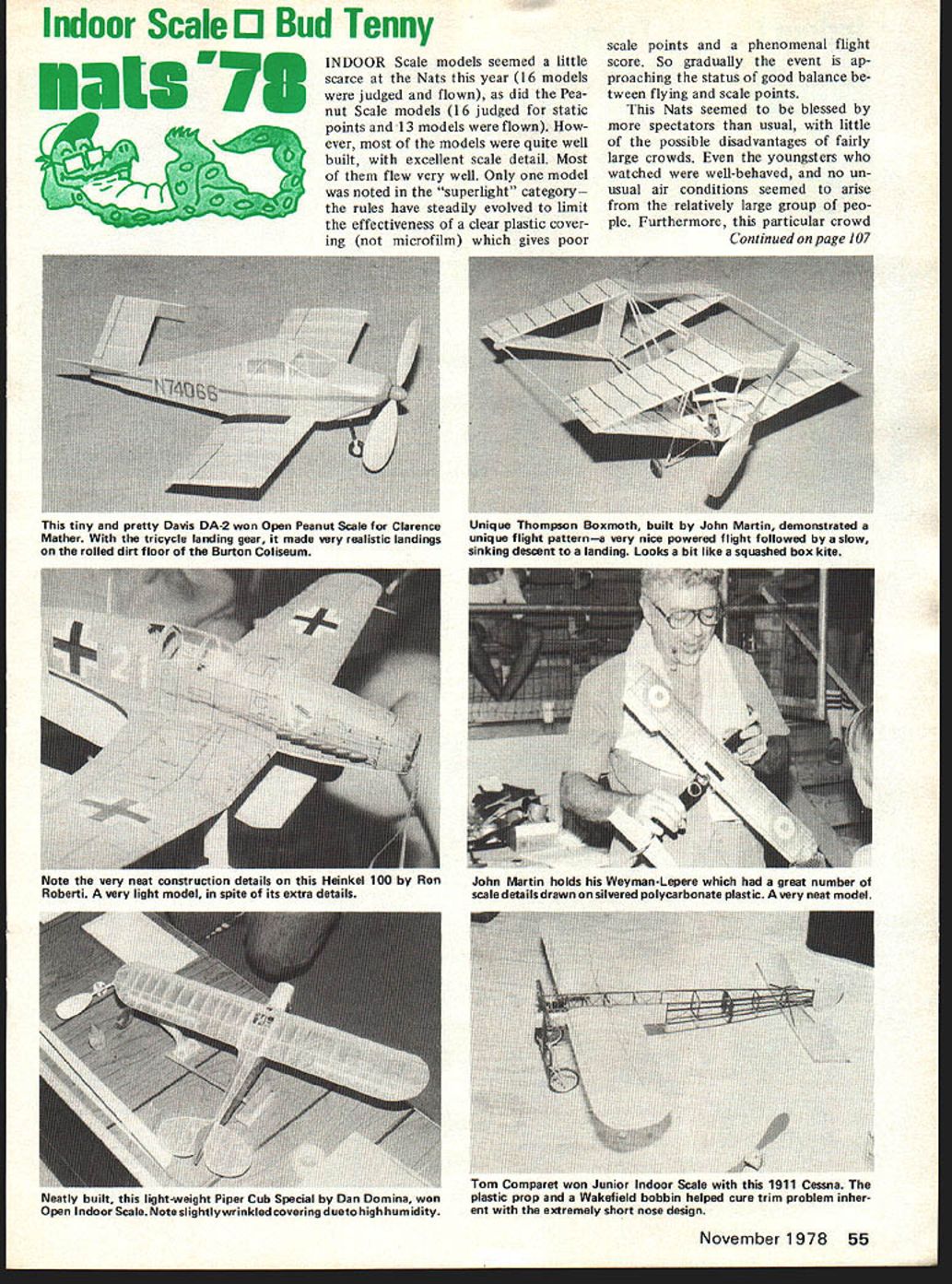
- Clarence Mather — Entered a Davis DA-2 in Peanut (1st place) and a PT-19 which placed fourth in Indoor Scale. Both models were standouts in appearance.
- John Martin (mentor of the Miami Indoor Airplane Modelers Assoc.) — Flew a very neatly built Weymann-Lepere to fifth place in Indoor Scale and also flew a Thompson Boxmoth (which looked like a box kite). The Boxmoth flew nicely under power but settled slowly to earth after the prop stopped.
Overall, the event showcased excellent construction, careful trimming, and enthusiastic spectators — a successful Indoor Scale contest despite humidity and a dirt floor.
Transcribed from original scans by AI. Minor OCR errors may remain.

