
NATS '78: RC Helicopters
Dave Chesney
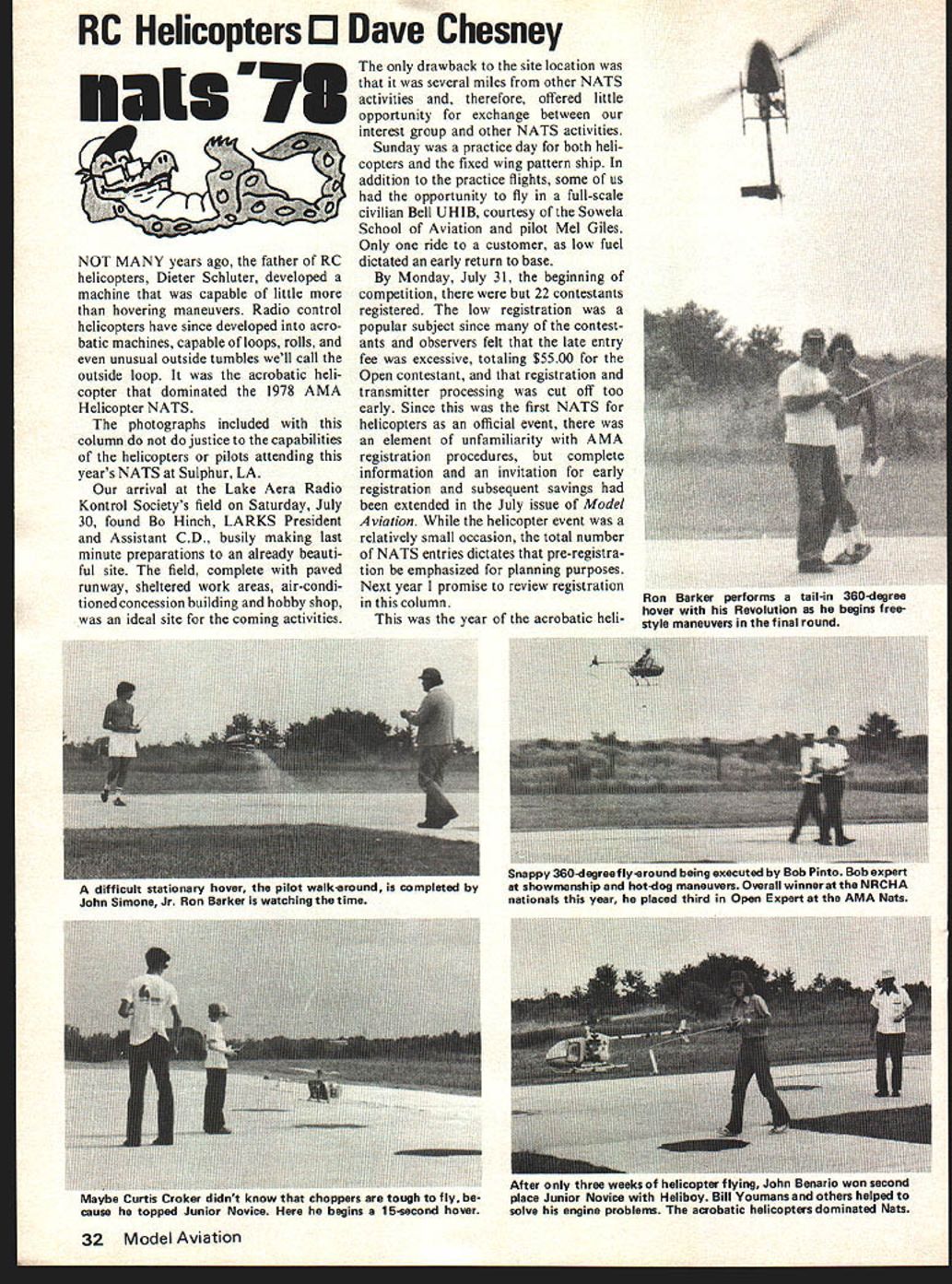
Not many years ago, the father of RC helicopters, Dieter Schluter, developed a machine that was capable of little more than hovering maneuvers. Radio-control helicopters have since developed into acrobatic machines capable of loops, rolls, and even unusual outside tumbles we'll call the outside loop. It was the acrobatic helicopter that dominated the 1978 AMA Helicopter NATS.
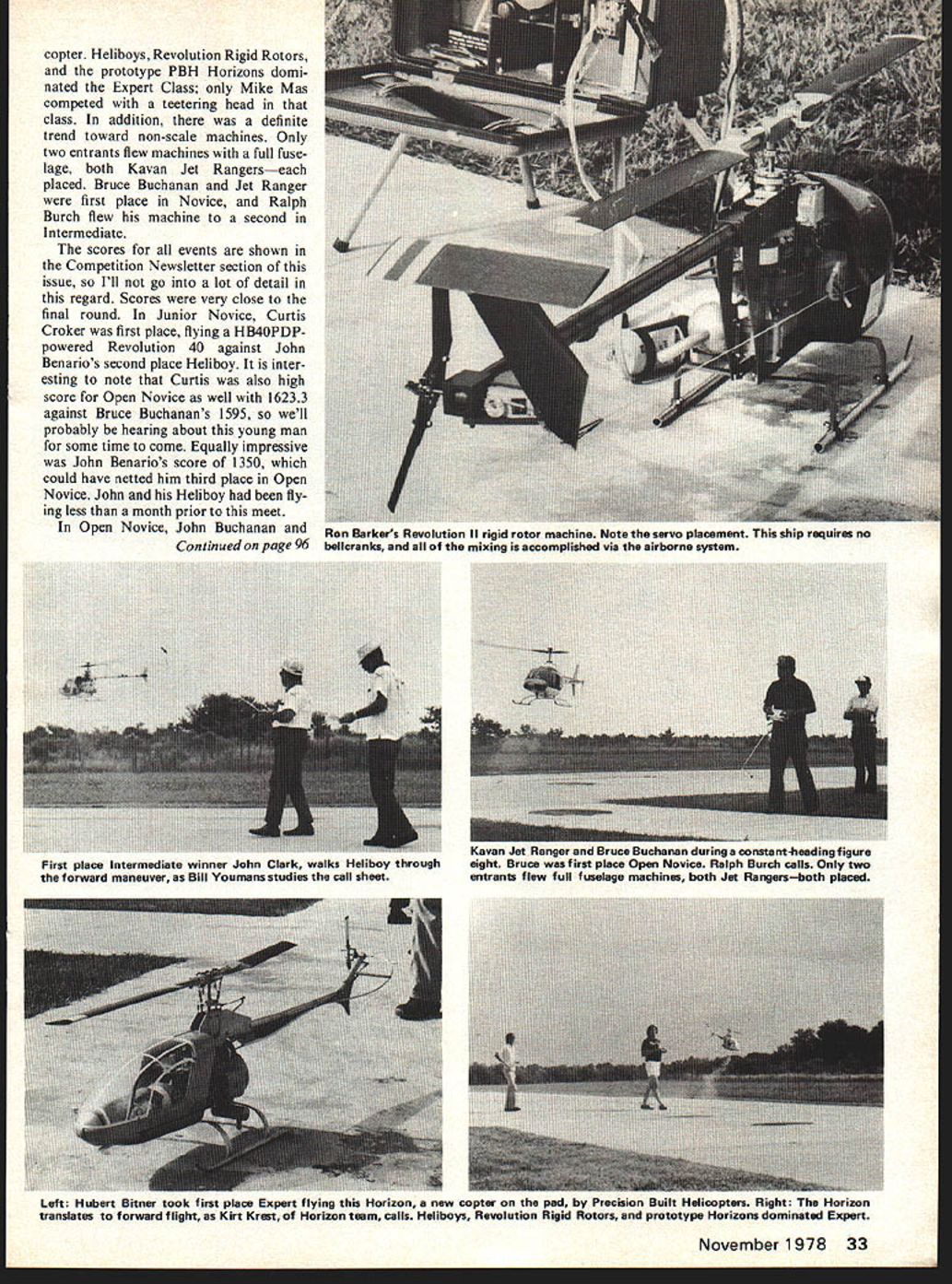
The photographs included with this column do not do justice to the capabilities of the helicopters or pilots attending this year's NATS at Sulphur, LA.
Event site and arrival
Our arrival at the Lake Area Radio Kontrol Society's field on Saturday, July 30, found Bo Hinch, LARKS President and Assistant C.D., busily making last-minute preparations to an already beautiful site. The field, complete with paved runway, sheltered work areas, air-conditioned concession building and hobby shop, was an ideal site for the coming activities.
The only drawback to the site location was that it was several miles from other NATS activities and therefore offered little opportunity for exchange between our interest group and other NATS events.
Sunday was a practice day for both helicopters and the fixed-wing pattern ship. In addition to the practice flights, some of us had the opportunity to fly in a full-scale civilian Bell UH-1B, courtesy of the Sowela School of Aviation and pilot Mel Giles. Only one ride was given to a customer, as low fuel dictated an early return to base.
Registration and entries
By Monday, July 31, the beginning of competition, only 22 contestants were registered. The low registration was a popular topic since many contestants and observers felt that the late entry fee was excessive, totaling $55.00 for the Open contestant, and that registration and transmitter processing were cut off too early. Because this was the first NATS for helicopters as an official event, there was an element of unfamiliarity with AMA registration procedures, but complete information and an invitation for early registration and subsequent savings had been extended in the July issue of Model Aviation.
While the helicopter event was a relatively small occasion, the total number of NATS entries dictates that pre-registration be emphasized for planning purposes. Next year I promise to review registration in this column.
Heliboys, Revolution rigid rotors, and the prototype PBH Horizons dominated the Expert Class; only Mike Mas competed with a teetering head in that class. In addition, there was a definite trend toward non-scale machines. Only two entrants flew machines with a full fuselage, both Kavan Jet Rangers—each placed. Bruce Buchanan's Jet Ranger was first place in Novice, and Ralph Burch flew his machine to a second in Intermediate.
The scores for all events are shown in the Competition Newsletter section of this issue, so I won't go into a lot of detail here. Scores were very close going into the final round.
Competition highlights
Junior Novice: Curtis Croker took first place, flying an HB40PDP-powered Revolution 40 against John Benario's second-place Heliboy. It is interesting to note that Curtis was also high scorer for Open Novice as well, with 1623.3 against Bruce Buchanan's 1595, so we'll probably be hearing about this young man for some time to come. Equally impressive was John Benario's score of 1350, which could have netted him third place in Open Novice. John and his Heliboy had been flying less than a month prior to this meet.
Open Novice: John Buchanan and his Jet Ranger teamed up for some very smooth hovering maneuvers and a first place. Steve Mintz and Peter Philipp were second and third respectively; each flew a Heliboy.
Intermediate: The Heliboy took first place with John Clark. Second place was Ralph Burch flying a Webra Speed–powered Kavan Jet Ranger. Fifty points behind was George Crocker, flying a standard Revolution 40 with HB40PDP engine. George proved the fixed-pitch helicopter still has a life in competition against the collective machines.
Expert: Things livened up as acrobatics became the rule rather than the exception. A still camera cannot do justice to the maneuvers of which the rigid-rotor machines are capable. Mike Mas flew his Revolution 40 with collective pitch and a teetering head, finishing second against a field of rigid-rotor machines. The Revolution proved to be an excellent machine in Mike's hands, but the K-factors awarded for loops and rolls (K35) presented a handicap to both his skills and the capabilities of the machine. This was a close second, with only a few points separating Mike from third-place Bob Pinto.
"O.C." Bob Pinto was anything but "out of control" with that third-place win. Bob and his Heliboy did some fantastic flying during and after the contest. No doubt you have heard, or will hear more, about this gentleman. Bob was recently overall winner at NRCHA Nationals. Probably the most unusual ability that Bob demonstrates is the capacity to fly almost any stick mode you put in his hands—single or two-stick, nose or tail—he can fly it.
A first place for the Horizon?
By the middle of next year the Horizon helicopter should be available from Precision Built Helicopters, Houston, Texas. Prototypes were flown by Joe Pasztos, Kirt Krest, Helmut Holder, and first-place Expert winner Hubert Bitner. The Horizon is a rugged machine. Joe was not having the best of luck; an engine failure put his machine down from about a hundred feet. I had the opportunity to help repair his bird and can vouch for the rugged construction and excellent serviceability. Attractive design and simplicity will make the Horizon a desirable addition to your helipad.
NRCHA revival
More on the NRCHA: At this year's AMA NATS, Dale Willoughby arrived to poll those present at the helicopter event regarding our interest in resurrecting the NRCHA. Dale also offered his assistance in initiating the resurrection. Most of us wanted the NRCHA to continue, but no active effort was made after the contest. Good news arrived recently: Don Chapman of Radio Control Modeler reported in the September issue that Walter Knaus of Ontario, Canada, is taking positive action to bring the NRCHA to life again. If you haven't seen Don's column, try to get it; or contact Walter Knaus, 82 Eldorado Ave., London, Ontario, Canada, N5W 1S5. If there is interest in NRCHA, prove it—write Walter today.
Acknowledgments
There wasn't room to write all of the names involved with the success of the AMA Helicopter NATS, but I would like to thank the following:
- Jim Osbourne, C.D.
- Bo Hinch, Assistant C.D.
- The judges for helping me collect all the info I asked for
- John Gorham and Walt Schoonard for letting me fly my first loops and rolls with their Heliboys
- John Simone, Mike Mas, Lowell Draper, and Ron Barker for the hangar talk regarding my Revolution rigid rotor
Next month we'll discuss the Revolution II RR and my first attempts at rigid-rotor flying. Meanwhile, please drop me a line regarding your experiences with RC helicopters.
Transcribed from original scans by AI. Minor OCR errors may remain.

