
RC Pattern — Ron Van Putte
The 1978 Nats returned to Lake Charles, Louisiana. The experience rivaled the past two Lake Charles Nats sites and can hardly be equaled. The RC site was the same location as the past two times. The combination of afternoon flying and near-perfect weather made the 1978 RC aerobatic championships the best yet.
Sites and Operations
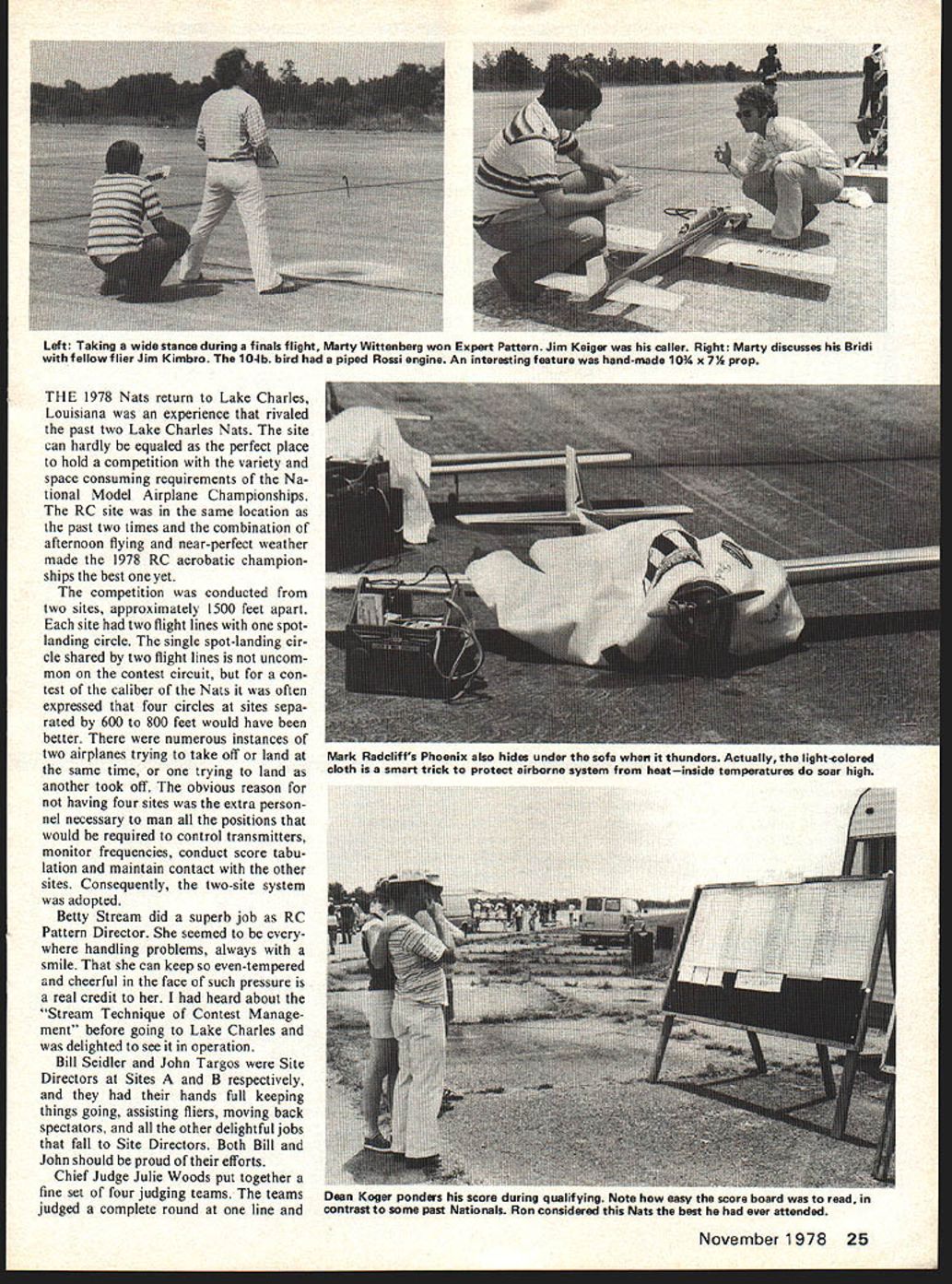
Competition was conducted at two sites approximately 1,500 feet apart. Site Two had two flight lines and a common landing circle; a single spot-landing circle was shared by two flight lines — an uncommon contest circuit. At Nats-caliber events, many felt four circles with sites separated 600–800 feet would have been better. There were numerous instances of two airplanes trying to take off or land at the same time, or one trying to land while another took off. Obviously, having four sites would require extra personnel and man-positions to control transmitters, monitor frequencies, conduct score tabulation, and maintain contact with the other sites. Consequently, the two-site system was adopted.
Betty Stream did a superb job as RC Pattern Director. She seemed to handle problems, always with a smile, and kept an even-tempered, cheerful face under pressure — real credit. I had heard about Stream's technique in contest management before going to Lake Charles and was delighted to see the operation. Bill Seidler and John Targos, Site Directors at Sites A and B respectively, had their hands full keeping things going, assisting fliers moving back, handling spectators, and other duties. Both Bill and John should be proud of their efforts.
Judges and Scoring
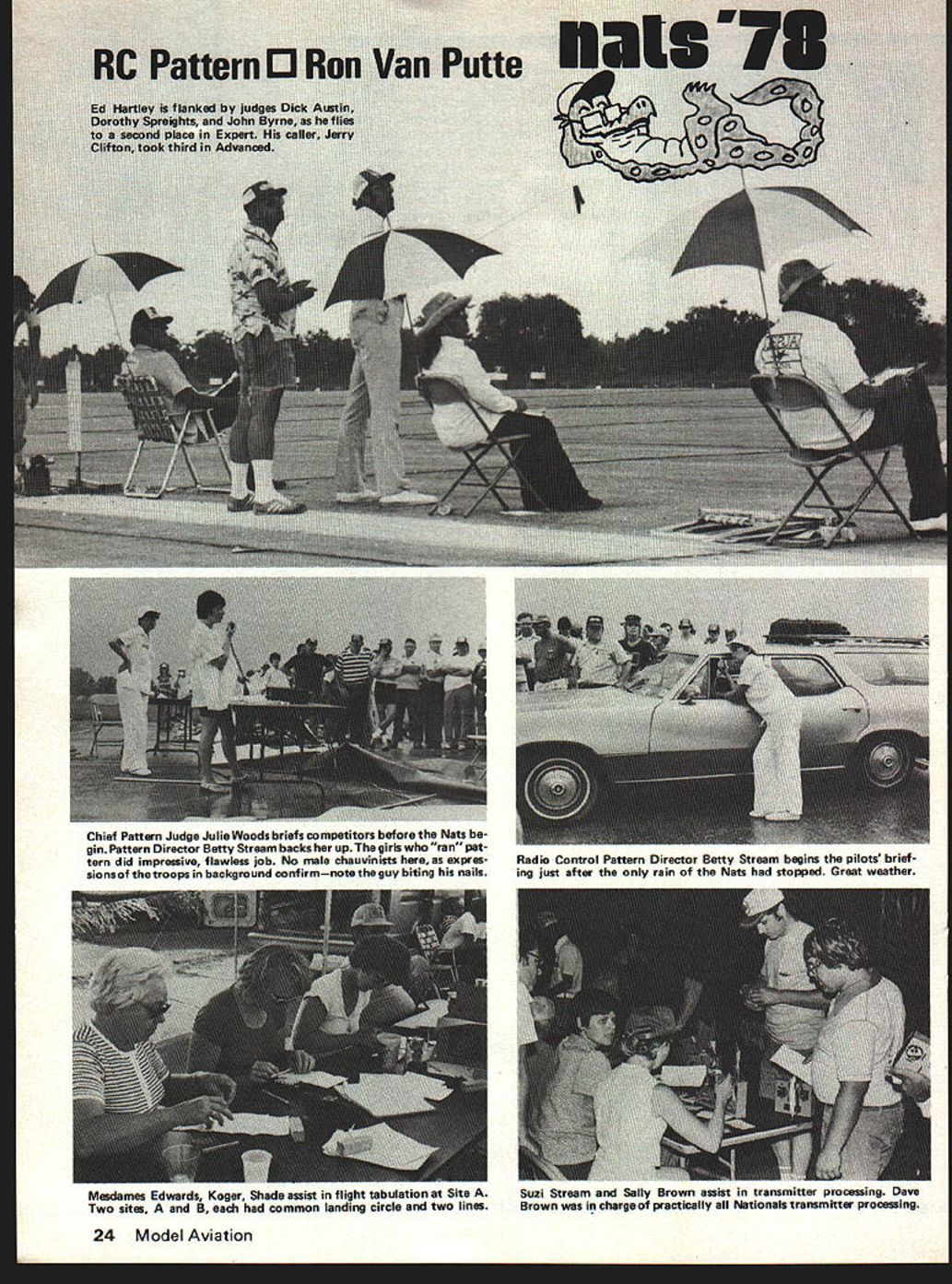
Chief Judge Julie Woods put together a fine set of four judging teams. The teams judged the complete round line. Judges rotated to the next line for the next round. When four rounds of qualifying competition were completed, all fliers had equal exposure in front of all the judges. For the fifth round of qualifying, Julie reordered the judging teams to balance the "high" and "low" judges. Since the finals also had four rounds, the same judge rotation was used to obtain equal exposure. Julie had been very concerned about the judging, but most fliers agreed that the 1978 Nats had the best judging in a long time.
Tabulation of flight scores had been a problem at past Nats. This year the scores were calculated at each of the sites and rechecked at the tabulation center; the finals scores were calculated and checked so that results were available quickly. The tabulation headquarters was housed in "Doc" Edwards' motor home. The scores for flights at a particular site were posted at that site and an official set of all scores was posted on another board at Site A. Most competitors checked their site scoreboard periodically to see how they were doing relative to others on their line, and then checked the official scoreboard at the end of the day to see their overall standing. All of the scoreboards were large and easy to read, a welcome change from past Nats.
Weather and Engines
Weather wasn't really a factor at this Nats. Despite the arrival of Hurricane Amelia at the Texas coast the day before the Nats were to begin, the expected severe rainfall never materialized. The only significant rain started just as the pilots' briefing was to be held on the first day, and it lasted only about 45 minutes. Winds were light and variable all week, getting calmer as the week progressed. The only weather factor of consequence was the heat: both temperature and humidity hovered around 90, making everyone wish for a stronger breeze.
Some pilots had problems with needle valve settings on engines tuned for cooler, drier climates, but most straightened out their engines soon after arriving.
Competition Format
Pattern qualifying competition was scheduled from 2 p.m. to 8 p.m. each day, but due to the unusually low number of 1/4‑Midget and Formula 1 pylon competitors, the pylon racing events ended earlier than expected and the pattern competition was able to start earlier. Five rounds of competition were held during the four days of qualifying and the best three flights were used to pick the ten finalists in each category.
There were nominally 40 fliers on each of the four lines. The starting place was rotated five fliers each round, with flier #1 starting the first round, and fliers #5, #11, #16, and #21 starting the subsequent rounds. It kept you on your toes; some competitors lost a qualifying flight when they didn't realize they would have to fly twice on a particular day and left for their motel or the dormitories. I once returned to my flight line late in the afternoon and discovered that I was next to fly because the three fliers in front of me weren't there!
The competitors who actually flew were as follows:
- Novice — 59
- Advanced — 40
- Expert — 17
- Master — 38
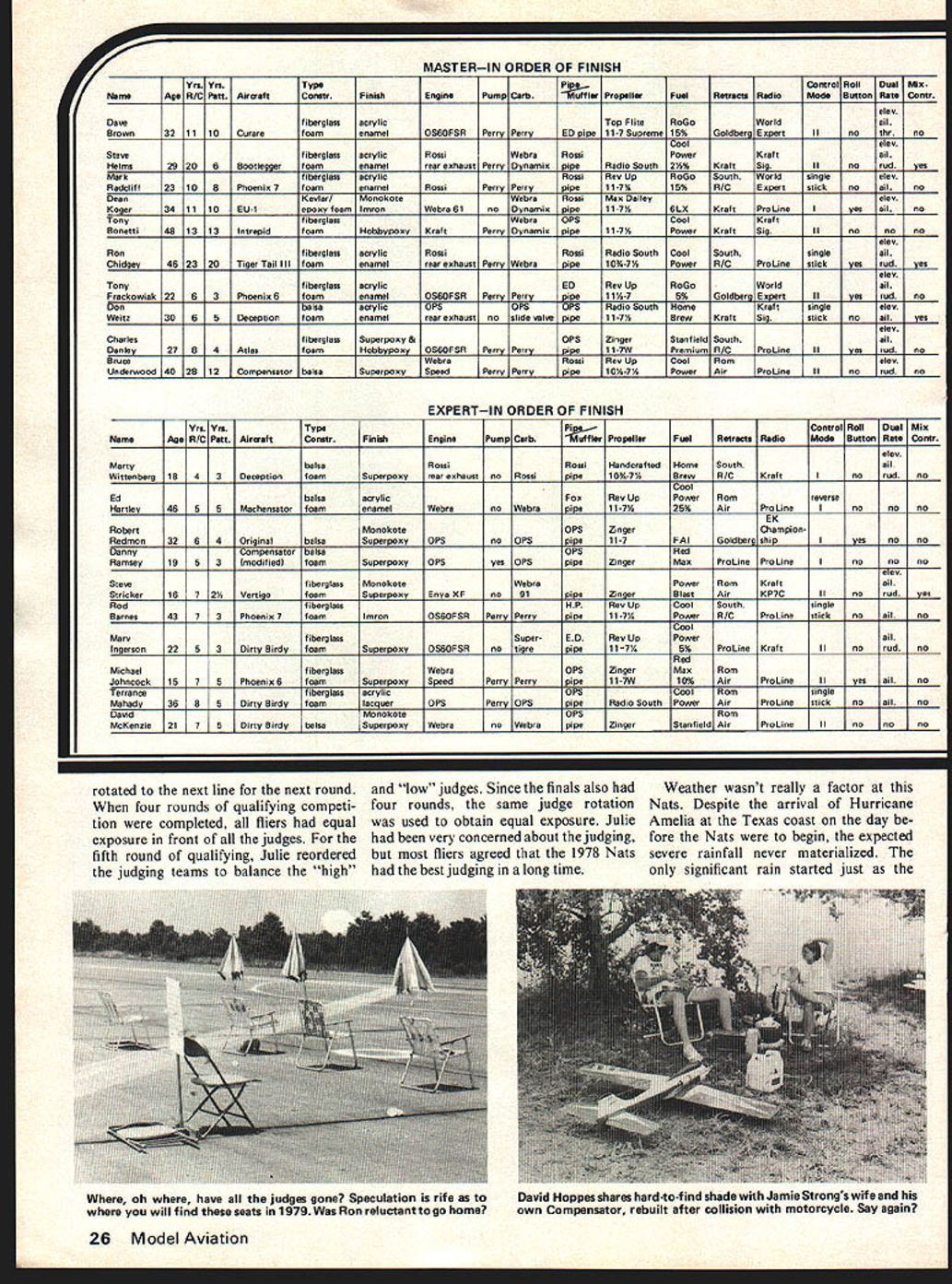
MASTER — In Order of Finish
(Scores and full placings are posted elsewhere in this issue.)
EXPERT — In Order of Finish
Results and Notable Performances
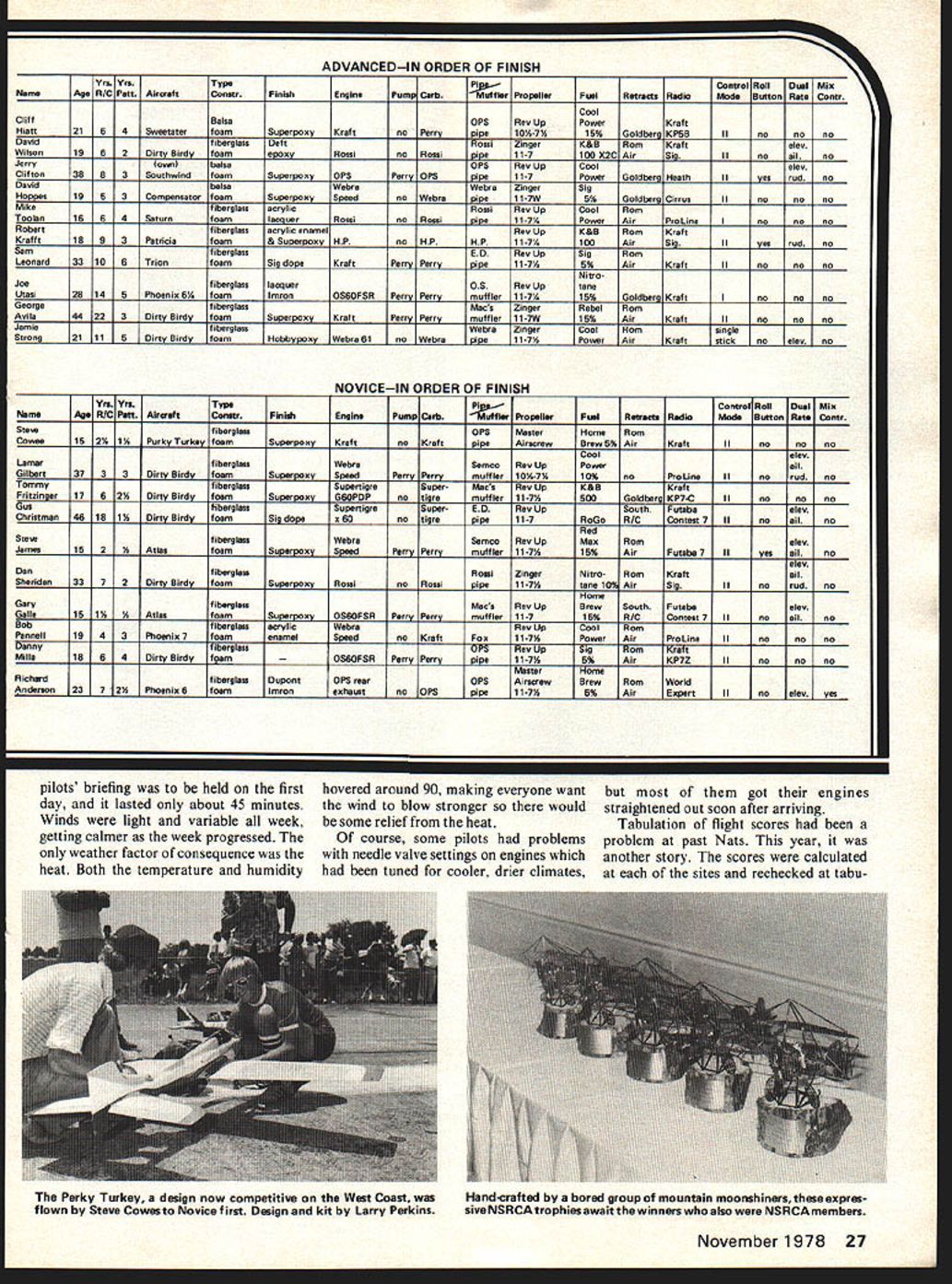
Surprisingly, only one of the top qualifiers went on to win his event. Steve Cowee won Novice handily after qualifying third, while top qualifier Tommy Fritzinger slid to third place. Lamar Gilbert qualified in tenth position but leaped to second place in the finals.
Advanced pattern featured a very tight competition with the outcome in doubt until Jerry Clifton missed the spot landing on his last flight, dropping him to third place.
Cliff Hiatt finished first in Advanced, one place higher than he had qualified. Dave Wilson was second, while top qualifier David Hoppes had to settle for fourth. Hoppes was flying an airplane which had never lost a contest and had been rebuilt eight weeks before the Nats after a dead-stick collision with a motorcycle.
Marty Wittenberg moved up from number-two qualifier to take first in the Expert class. The top qualifier was Steve Stricker, who finished fifth in the finals. Ed Hartley came one good flight shy of catching Wittenberg and ended up second.
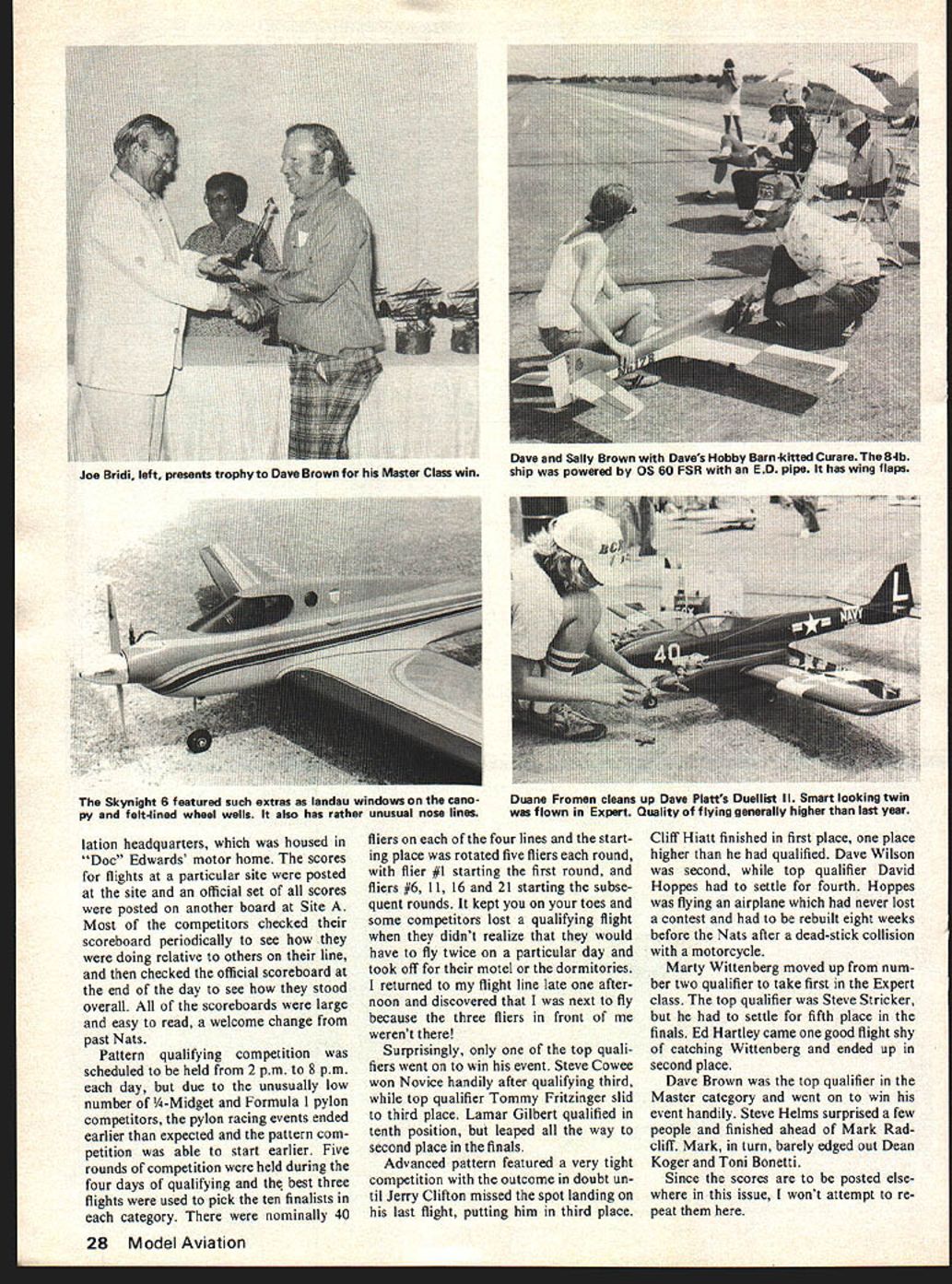
Dave Brown was the top qualifier in Master and went on to win his event handily. Steve Helms surprised a few people and finished ahead of Mark Radcliff. Mark, in turn, barely edged out Dean Koger and Toni Bonetti.
Flying quality was consistently higher at the 1978 Nats; in fact, flying quality has been improving noticeably during the past few years. It would have been interesting to see demonstration flights of the Novice pattern by Novice winner Steve Cowee and by Master winner Dave Brown — I'd bet the performances would have been very nearly the same.
Aircraft and Designs
Anyone who has been to a pattern contest would have recognized most of the aircraft designs flown. Common airplanes included:
- Phoenix 6 and 7
- Dirty Birdy
- Compensator
- Atlas
- Curare
- Saturn
- Vertigo
- Trion
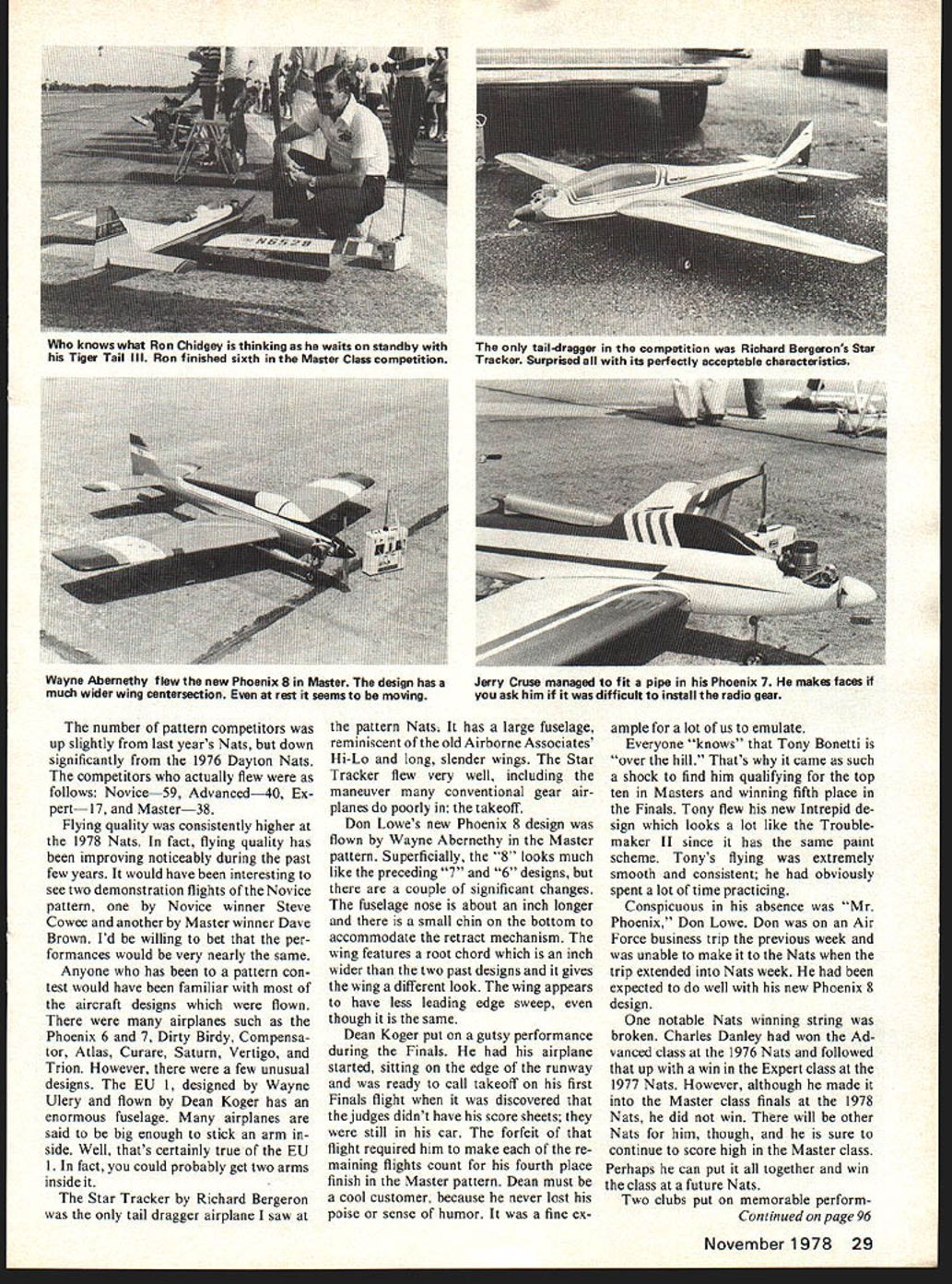
There were a few unusual designs. The EU I, designed by Wayne Ulery and flown by Dean Koger, has an enormous fuselage — you could probably fit two arms inside it. The Star Tracker, by Richard Bergeron, was the only taildragger airplane seen at the pattern Nats; it has a large fuselage reminiscent of the old Airborne Associates Hi-Lo and long, slender wings. The Star Tracker flew very well, including takeoffs, a maneuver many conventional-gear airplanes do poorly in.
Don Lowe's new Phoenix 8 design was flown by Wayne Abernethy in the Master pattern. Superficially the "8" looks much like the "7" and "6" designs, but there are a couple of significant changes: the fuselage nose is about an inch longer with a small chin on the bottom to accommodate the retract mechanism, and the wing features a root chord an inch wider than the previous designs, giving the wing a different look.
Anecdotes and People
Dean Koger put on a gutsy performance during the finals. He had his airplane started on the edge of the runway and was ready to call takeoff on his first finals flight when it was discovered the judges didn't have his score sheets — they were still in his car. The forfeit of that flight required him to make each remaining flight count for his fourth-place finish in Master. Dean never lost his poise or sense of humor; it was a fine example to emulate.
Tony Bonetti surprised many by qualifying for the top ten in Masters and finishing fifth in the finals. Tony flew his new Intrepid design, which resembles the Troublemaker II in paint scheme. His flying was extremely smooth and consistent, showing a lot of practice.
Conspicuous in his absence was "Mr. Phoenix," Don Lowe. He was on an Air Force business trip the previous week and was unable to make it to the Nats when the trip extended into Nats week. He had been expected to do well with his new Phoenix 8 design.
One notable winning streak was broken. Charles Danley had won Advanced in 1976 and Expert in 1977; although he made the Master finals in 1978, he did not win. There will be other Nats for him, and he is sure to continue scoring high in Master.
Two clubs put on memorable performances. Volunteers continue to be the backbone of the Nats. LARKS members were everywhere; I saw them doing every job imaginable around Chennault Field. Whole families volunteered, too. For example, I met Bill Snavely at Flight Line 4 of RC Site B: he worked the flight line while his son was a scorer runner, his wife sold patches in the hobby shop, and his daughter helped in the Nats News print shop and delivered the News to the dormitory area. They took a week of vacation to help others enjoy the Nats. Thanks to all the volunteers.
Have you ever had "Cajun pork"? I went into Chuck Shade's and Dean Koger's suite at the dormitory to go out to dinner and met Russ and Mrs. Nitch, who ran the name-tag and pin concession at the Nats hobby shop. Mrs. Nitch offered me some "Cajun pork" that turned out to be alligator, prepared from a local recipe — it was so good I had three more pieces.
The trophy presentations were held at the Sheraton Chateau Charles in Lake Charles and most winners were there to receive their trophies. In addition, National Society of R/C Aerobatics (NSRCA) trophies were presented for each class. Surprisingly, many NSRCA trophies were not won by the class winners because those winners were not NSRCA members, which was notable since the pattern Nats was again run by the NSRCA.
Looking Ahead
There was talk that 1978 might be the last year of the "big" Nats. Let's hope not. I'm hoping the 1979 Nats is held in one of two sites. After seeing the Springfield site at the 1977 Team Finals/World Championships, I'm convinced it could handle all Nats activities. The 1976 Dayton Nats demonstrated the enormous popularity of a Nats in that area. Of course, my third choice is a return to good old Lake Charles.
Transcribed from original scans by AI. Minor OCR errors may remain.

